
Last Updated on: October 2, 2026
Reviewed by Darren Andrew Rafel
Yes — autism can qualify for an emotional support animal when a licensed mental health professional evaluates the person and finds that it substantially limits daily life (work, self-care, sensory overload, living independently) and that the animal eases it. HUD’s own regulation names autism as an impairment. PetESALetter evaluates adults 18 and over with a clinician licensed in their state; if the need is there, the letter usually follows within 24–48 hours, for $99 flat.
Key takeaways
It can, and on paper autism has a stronger footing than most conditions people ask about. The Fair Housing Act protects a person with a “handicap” — a physical or mental impairment that substantially limits one or more major life activities (42 U.S.C. § 3602(h)). HUD’s regulation then lists what counts as an impairment, and autism is named in it, alongside cerebral palsy, epilepsy and hearing impairments (24 C.F.R. § 100.201). Most conditions on this site’s other guides reach the definition through the general wording “any mental or psychological disorder”; autism is written into the text.
Being named does not settle the question, because the regulation tests two things and the diagnosis is only the first. The second is limitation: HUD defines the major life activities as “caring for one’s self, performing manual tasks, walking, seeing, hearing, speaking, breathing, learning and working”. Autism reaches that list in ways that differ from person to person — the sensory load of a workday that ends in a shutdown at home, the executive-function gaps that make meals and bills hard to keep up with, the communication strain that makes a job or a degree take more out of a person than it does for others. A licensed clinician has to find that the limitation is real for this person now, and that the animal does something about it.
That is why the same diagnosis qualifies one person and not another. An adult diagnosed at 29, whose evenings after work are lost to overload and whose cat is how the evening recovers, has a clear case. An adult diagnosed in childhood who is working, living independently and not limited in any way the animal eases does not — and a clinician who signs a letter anyway is the clinician landlords have learned to distrust. The CDC’s numbers explain why the question comes up so often: about 1 in 31 eight-year-olds has been identified with autism, boys 3.4 times as often as girls (MMWR, 2025), and the agency estimates that 2.21% of adults — about 5.4 million — are autistic, a figure that counts the undiagnosed. Our ESA qualification checklist covers the general test; this page is about how it plays out for autism, and the ESA for anxiety and ESA for ADHD guides cover two conditions that are often diagnosed alongside it.
Many of the people searching for an emotional support animal for autism are parents, and the honest answer has two halves: the law covers the child, and PetESALetter is not the service that writes that letter.
The law covers the household, not only the leaseholder. The Fair Housing Act makes it unlawful to discriminate because of the disability of the buyer or renter or of “a person residing in or intending to reside in that dwelling” (42 U.S.C. § 3604(f)(1)(B) and (f)(2)(B)). So a parent who rents can ask a housing provider for a reasonable accommodation — an exception to a no-pets rule, for instance — because of a child’s disability. The request comes from the adult on the lease; the documentation is about the child.
The letter has to come from someone who knows the child. A clinician can only document a disability and a disability-related need they have actually evaluated. For a child that is normally the psychologist, psychiatrist, therapist or physician who already treats them, and families usually find that the team they have — the one that made the diagnosis or runs the therapy — is the right place to ask. PetESALetter’s clinicians evaluate adults only: its terms require clients to be at least 18 (or the age of majority where they live). The who can write an ESA letter guide goes through the license types, including the state rules on who may sign.
Think about the animal before the paperwork. The research on families is encouraging but specific. A survey of 70 parents found that children with autism who owned dogs scored higher on average on a social-skills scale, and parents described the children as attached to their dogs (Carlisle, Journal of Autism and Developmental Disorders, 2015). A prospective study of 62 families found that carers who acquired a dog saw their parenting stress fall significantly compared with carers who did not (Wright et al., 2015). Neither study is about ESA letters, and neither promises a result for a particular child; they describe what a pet can do in a household that is ready for one. Autistic teenagers heading to a first dorm room are a separate case — at 18 they can be evaluated in their own right, and the ESA letter for college dorms guide covers the university side.
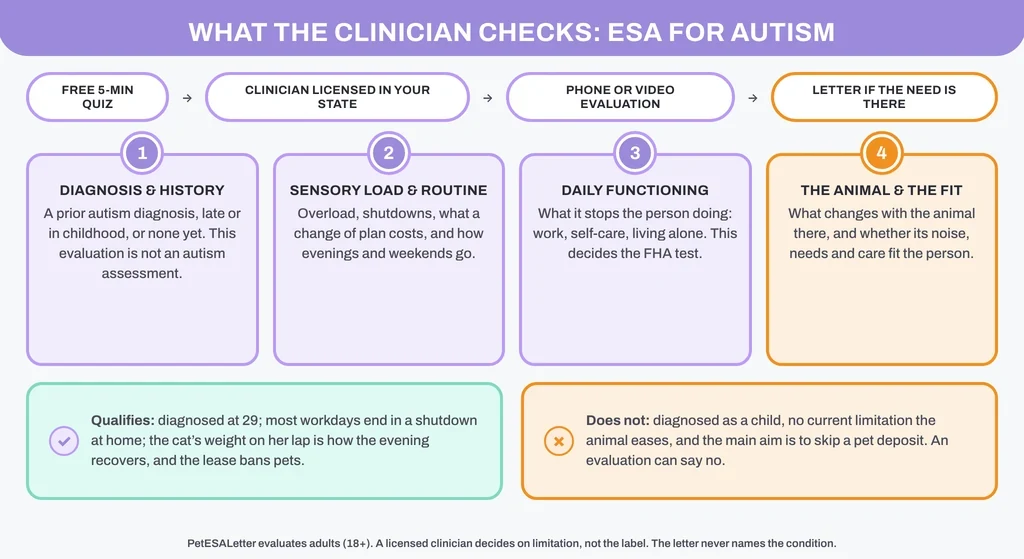
The evaluation is a clinical conversation with a therapist licensed in the applicant’s own state, by phone or video in most states (the online ESA evaluation page describes the format, and the state table below lists the exceptions). For an autistic adult it covers four things:
The diagnosis and the history behind it. When autism was identified, by whom, and what support is in place. Many autistic adults were diagnosed late, and some are still waiting for an assessment or identify as autistic without one. An ESA evaluation is not an autism assessment and cannot replace one: the clinician evaluates what is in front of them — often the anxiety, depression or overload that comes with being autistic in a non-autistic world — and documents what the conversation supports. A prior diagnosis is welcome and shortens the conversation; it is not required.
Sensory load and routine. The DSM-5 criteria for autism include “insistence on sameness, inflexible adherence to routines” and “hyper- or hyporeactivity to sensory input”, and those two are where most housing-relevant limitations live: the commute that leaves no capacity for anything else, the shutdown after a change of plan, the noise of a shared building. The clinician asks how evenings and weekends actually go.
Daily functioning. What autism stops the person doing: keeping a job, cooking and eating, paying bills on time, living alone, answering the door or the phone. This is the part that decides whether the condition counts as a disability under the Fair Housing Act, and it is where most evaluations are decided.
The animal, and whether it fits. What changes when the animal is there — and the question other conditions do not get as often: does the animal itself fit the person’s sensory profile and capacity? A dog that barks at every footstep in the hallway, or a care routine that collapses on the worst weeks, can add load instead of easing it. The clinician will ask, because a letter for an animal that makes things harder helps nobody.
Many autistic adults find a phone or video assessment harder than the questions in it. Writing notes in advance and reading from them is fine, and so is saying that eye contact or quick back-and-forth is difficult; specifics about the present — the three evenings a week lost to shutdowns, the job that ended after the open-plan office move, what is different on the days the cat is there — do the work. There is no script, and there should not be: a clinician can only document what the conversation supports, and an overstated letter is the one a landlord challenges. When the conclusion is that the criteria are not met, the fee comes back under the refund policy.
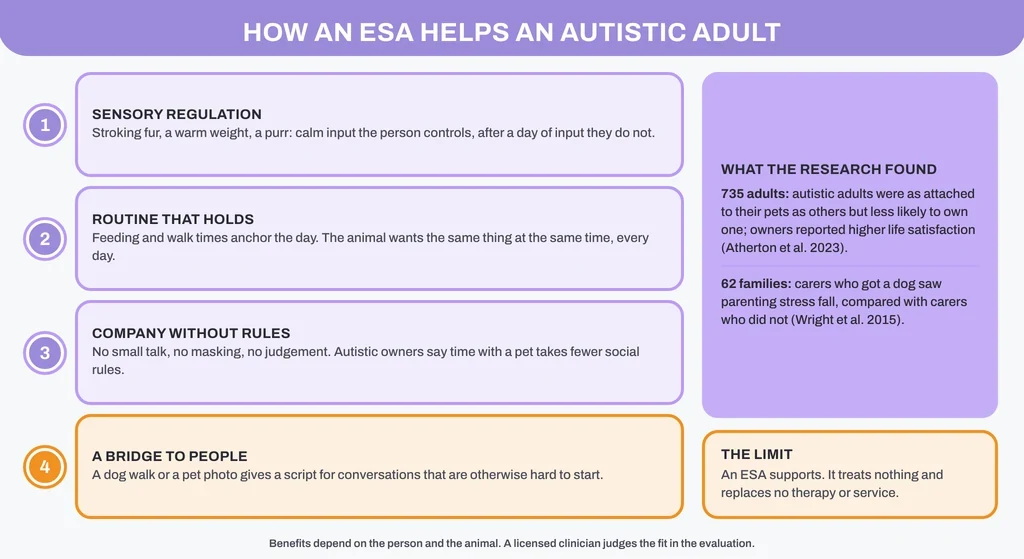
An ESA has no training requirement and performs no tasks; it helps by being there. For autistic adults the clearest research describes four ways that happens.
Sensory regulation the person controls. In the largest study of autistic adults and pets — 735 people in the quantitative part, 16 autistic pet owners interviewed in depth — participants described the “sensory benefits of stroking fur” and being able to vent to an animal without expecting a response as calming in times of stress (Atherton et al., Journal of Autism and Developmental Disorders, 2023). A day full of input the person cannot control can end with input they can.
A routine that holds. Feeding times and walks do not move, and for people who rely on sameness that is a feature. Participants in the same study described the responsibility for an animal as the motivation to go outside and be more active.
Company without the rules. The study’s title is a participant’s own description of pets: “They ask no questions and pass no criticism.” Autistic participants said interactions with animals required fewer social rules than interactions with non-autistic people, and that they did not feel judged — no masking required.
A bridge to other people. A dog walk, a neighbor’s question about the cat, an online group about the breed: participants described pets as a social interest that gave them a way into conversations and a place in a wider community.
The quantitative findings are the ones that matter for a letter. Autistic adults were just as attached to their pets as non-autistic adults, but less likely to own one, and those who did own a pet reported higher life satisfaction. Asked why they did not, participants named the barriers — and one of them was housing. “We live in rented flats, so we wouldn’t be allowed to have any pets even if I wanted some,” one said. That is precisely the situation a reasonable-accommodation request exists for. The honest reading is that an ESA is a support, not a treatment: it does not change autism, and a clinician will ask what else is in place. The choice of animal matters as much as the letter — a dog brings the walk and the schedule, a cat brings quiet company with fewer demands, and the emotional support cat guide covers the cat side.
This is the section the rest of the results page skips, and it is the one a good clinician cares about most. Three situations come up again and again.
The animal adds sensory load. A dog that barks, a parrot that screams at dawn, a cat that knocks things over at 3 a.m.: for a person with sound or touch sensitivity, the wrong animal is another source of the overload the letter is supposed to ease. Animal choice is personal, and the research shows autistic adults were more likely than others to own pets other than dogs. An evaluation that does not ask whether this particular animal calms or adds load has skipped the question that decides whether it is a support at all.
The care routine depends on the hardest days. Autistic burnout and shutdowns do not pause for a feeding schedule, and executive-function gaps make the hardest weeks the hardest for an animal too. Participants in the 2023 study worried that aspects of their own autistic traits might get in the way of caring for a pet responsibly, and the ones who managed it described the sacrifices they had made. A plan for the bad weeks — an automatic feeder, a litter routine that survives a shutdown, a friend or family member with a key — belongs in the evaluation.
The animal is expected to do a service dog’s job. An untrained pet will not interrupt self-harm, prevent wandering or keep a child safe near a road, and nobody honest will say it can. If what the person needs is a trained task, the answer is a service dog, which is the next section. When the conclusion of an evaluation is that an ESA is the wrong fit right now, the fee is refunded under the published policy, and the honest outcome is worth more than the document.
Half the results for this search are about service dogs, and the two are different jobs. An emotional support animal is usually the animal a person already has; it needs no training and its role is presence. An autism service dog is a dog individually trained to do work or tasks for the disability, and the Justice Department’s definition names the kind of task that fits autism: “helping persons with psychiatric and neurological disabilities by preventing or interrupting impulsive or destructive behaviors” (28 C.F.R. § 36.104). The same definition says that “the provision of emotional support, well-being, comfort, or companionship” does not count as a task — which is exactly why an ESA has housing rights only and a trained service dog also has public-access rights under the Americans with Disabilities Act.
The research on autism service dogs is more careful than the marketing. In a 2024 study of 75 families of children with autism, the 39 placed with a service dog reported significantly better child sleep — falling asleep, sleep duration, less sleep anxiety — than the 36 on the waiting list, but the dog was not significantly linked to child withdrawal, irritability or emotional self-control, or to caregiver strain (Rodriguez et al., Frontiers in Psychiatry, 2024). The broader distinctions, including therapy dogs, which are a third thing, are in service dog vs therapy dog vs ESA; the what disabilities qualify for a service dog guide covers the ADA side.
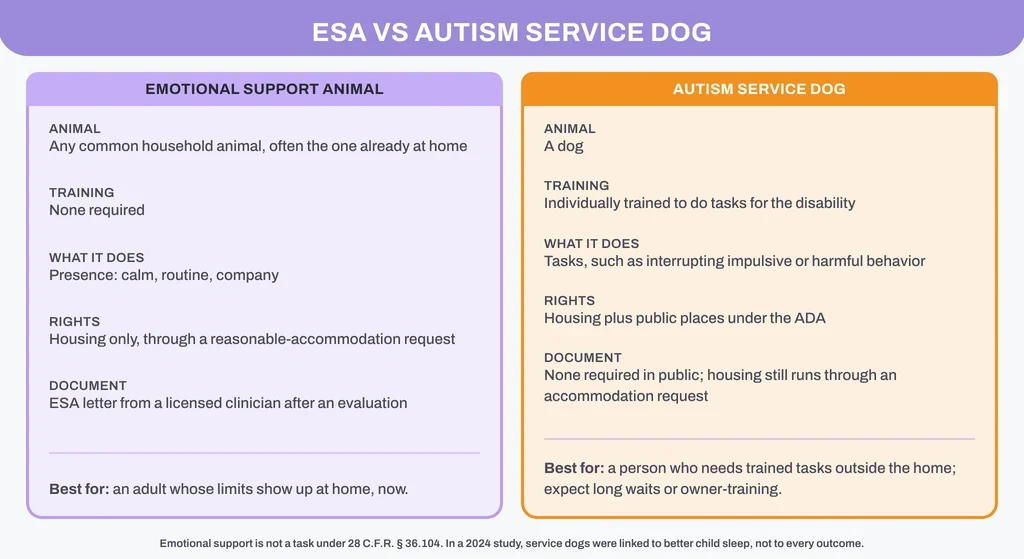
| For autism | Emotional support animal | Autism service dog | Pet with no documentation |
|---|---|---|---|
| Animal | Any common household animal, often the one already at home | A dog | Any |
| Training | None required | Individually trained to do work or tasks for the disability | None |
| What it does | Presence: sensory calm, routine, company | Tasks, such as interrupting impulsive or destructive behavior | Company |
| Housing (FHA) | Reasonable accommodation request with an ESA letter | Reasonable accommodation; the training is the strongest case after the 2026 HUD memo | Subject to the lease: pet rent, deposits, breed and weight limits |
| Public places (ADA) | No access rights | Shops, restaurants, transit and other public places | No access rights |
| Air travel | Standard pet rules since the 2021 DOT rule | Accepted with the DOT service-animal form | Standard pet rules |
| Document | ESA letter from a licensed mental health professional after an evaluation | None required in public; housing still runs through an accommodation request | None |
| Time to get | Days, if the evaluation supports it (30-day states excepted) | Program waiting lists or months of owner-training | — |
For most autistic adults who rent, the practical sequence is the obvious one: the animal already at home can become an ESA now, and a trained dog is a separate decision for later, if the tasks would change something presence cannot. The ADA allows owner-training, and the self-training a service dog guide covers that route. The paperwork side — including the PSD letter a trained psychiatric service dog’s handler uses for housing — is in ESA letter vs PSD letter.
For an adult, the process takes four steps.
Answer the free five-minute quiz. A handful of questions — is there a condition that affects daily life, is there an animal that helps, which state — so that nobody books an evaluation that cannot go anywhere. The quiz is the only free step.
Get matched with a clinician licensed in the applicant’s state. Not a clinician somewhere in the country: one licensed where the applicant lives, because several states have their own rules about who may sign and what has to come first. The fee is $99 flat, paid at checkout before the evaluation — no membership, no auto-renewal, no add-ons (details on the ESA letter pricing page). If the clinician finds the applicant doesn’t qualify, they get a full refund.
Do the evaluation. It runs through the four checks above. Useful to have to hand: the date and source of any autism diagnosis, the name of a current therapist or prescriber if there is one, notes on what the animal changes, and the plan for its care on the hardest weeks; none of them is required.
Receive the letter if the clinician finds a qualifying need. In most states it usually arrives within 24–48 hours of the evaluation. In California, Louisiana, Arkansas, Montana and Iowa the letter follows a 30-day clinical relationship instead, so it comes after the 30 days, not in two. It states that the person has a disability under the Fair Housing Act and that the animal is connected to it, carries the clinician’s license number, state and signature, and does not contain the word autism. If the housing provider calls to verify, the support team answers. Letters are written for twelve months; autism is lifelong, so the renewal a year later is a short re-evaluation, not a fresh application — the ESA letter renewal guide covers what a landlord can and cannot ask at that point.
If the clinician decides the applicant doesn’t qualify, the refund is requested within 7 days. If a landlord rejects the letter in writing after our support team has been involved, the refund window is 30 days. Both terms are on the refund policy page. The full walkthrough, including what a finished letter looks like, is in how to get an ESA letter.
The letter is a housing document, and the housing picture in 2026 has three separate parts. Any site that gives one sentence for all three is wrong about at least two.
The law itself has not moved. 42 U.S.C. § 3604(f)(3)(B) makes it discrimination to refuse a reasonable accommodation in rules, policies, practices or services when a person with a disability needs it to use and enjoy a dwelling, and 24 C.F.R. § 100.204 is HUD’s own regulation restating that duty. Neither contains a training requirement, and both can be enforced by a private lawsuit and by state fair-housing agencies.
HUD’s how-to notices are gone. FHEO Notices 2013-01 and 2020-01 were withdrawn effective September 17, 2025 (91 FR 17291, April 6, 2026), and nothing has replaced them. That includes the passage saying pet deposits and pet rent could not be charged for an assistance animal: whether a fee can be charged is now a case-by-case question, and the ESA pet rent and deposits guide lists the states whose own statutes still bar them.
HUD’s own enforcement has narrowed. A May 22, 2026 FHEO memorandum says HUD will find reasonable cause and recommend charges only in cases involving animals individually trained to perform disability-related work or tasks. HUD frames this as prioritizing its own resources, not as a change in the statute: open ESA cases go to case-by-case review, Section 504 and the ADA are outside the memo, and the right to sue privately is untouched. In practice the quality of an ESA letter carries more of the weight than it did, and a trained service dog has the stronger housing case of the two.
For autistic adults the request itself is often the hard part — a phone call to a leasing office is exactly the kind of unscripted exchange many would rather avoid. It can be made in writing. The letter confirms a disability and the animal’s connection to it without naming autism; Florida’s statute (§ 760.27(3)(a)) and Montana’s (§ 70-24-114(4)(a)) go further and bar a housing provider from asking for the diagnosis, its severity or medical records. What a housing provider may still do is ask for reliable documentation from a licensed professional, verify the letter with the clinician, and set reasonable rules about the animal’s conduct. How to make the request, and what happens if it is refused, is in ESA letter to landlord.
Several states add their own rules about who may write the letter and what has to happen first, and a letter that ignores them is easy to challenge — which is why PetESALetter matches each applicant with a clinician licensed in their own state.
| State | What has to be in place before the letter is signed | Who may sign | Statute |
|---|---|---|---|
| California | A client-provider relationship of at least 30 days and a clinical evaluation; license details stated in the letter | A practitioner licensed in California | Cal. Health & Safety Code § 122318 (AB 468, 2021) |
| Louisiana | A therapeutic relationship of at least 30 days, at least two sessions, a disability assessment and a clinical evaluation | A Louisiana-licensed provider | La. R.S. 46:1974 (Act 558 of 2024) |
| Arkansas | A 30-day client-provider relationship and a clinical evaluation, reviewed at least once a year | A provider licensed in the jurisdiction | Ark. Code Ann. § 20-14-1003 (Act 268 of 2023) |
| Montana | A client-provider relationship of at least 30 days and a clinical evaluation; a registry card is not sufficient on its own | A Montana-licensed mental health professional, license details in the letter | Mont. Code Ann. § 70-24-114 (HB 703, 2023; amended 2025) |
| Iowa | A written finding that states whether the provider-patient relationship has lasted at least 30 days; the state’s own form has the signer certify that it has | A licensed physician, PA, nurse, psychologist, social worker or behavioral-science professional, in Iowa or in good standing in another state | Iowa Code § 216.8C (SF 2268, 2024) |
| Florida | Personal knowledge of the disability; no waiting period. An out-of-state practitioner must have provided in-person care at least once | A practitioner acting within the scope of the license | Fla. Stat. § 760.27 (SB 1084, 2020) |
| Colorado | An in-person meeting and a written finding on disability and need; no waiting period | A mental health licensee with sufficient familiarity with the patient | C.R.S. § 12-245-229; HB26-1045 (eff. Aug 12, 2026) |
Everywhere else the federal framework applies on its own. Our California ESA letter and Louisiana ESA letter pages go through the two strictest states in detail, the Iowa ESA letter page explains the state form, and the state pages linked in the navigation cover the rest.
The red flags are the same for every condition. A letter in minutes — “instant approval” means nobody evaluated anyone, and the how to verify an ESA letter is real guide lists what a genuine one contains. A registration number, certificate, vest or ID card — U.S. law has no ESA registry, and our ESA registration myths page takes the claims apart one by one. A “service dog certification” for an untrained pet — the training is the qualification, and misrepresenting an assistance animal carries a penalty in Florida, Colorado and a growing list of states. And a promise that the landlord “must” accept the letter — the statute obliges a housing provider to consider a reasonable accommodation, not to grant every request, and after the 2026 HUD memo the quality of the letter carries more of the weight, not less.
The bottom line. Autism can qualify for an emotional support animal when a licensed clinician finds that it substantially limits daily life and that the animal eases it — and HUD’s regulation names autism outright. The best case for an ESA is sensory calm, routine and company without rules; the honest limits are that the animal has to fit the person’s senses and capacity, and that it is not a trained service dog. Parents can request an accommodation for a child, with documentation from the child’s own clinician. PetESALetter evaluates adults, with a clinician licensed in their state, for $99 flat and a full refund if the clinician finds no qualifying need; the letter never names the diagnosis, and the 2026 changes narrowed HUD’s enforcement, not the statute.
Not sure whether autism qualifies — or whether an ESA is the right fit right now? A licensed clinician in your state evaluates whether an emotional support animal fits the situation — and the first step is a free five-minute screen.
Yes, when a licensed mental health professional evaluates the person and finds that autism substantially limits a major life activity — working, learning, caring for oneself, or coping with the sensory load of daily life — and that the animal eases it. HUD’s Fair Housing Act regulation names autism among the impairments it covers (24 C.F.R. § 100.201), but a diagnosis by itself does not qualify anyone, and an evaluation can conclude that the criteria are not met.
A parent who rents can ask a housing provider for a reasonable accommodation because of a child’s disability: the Fair Housing Act covers “a person residing in or intending to reside in that dwelling”, not only the leaseholder. The documentation has to come from a clinician who has evaluated the child, usually the psychologist, psychiatrist, therapist or physician who already treats them. PetESALetter’s clinicians evaluate adults 18 and over only.
An ESA evaluation is not an autism assessment and cannot replace one. A licensed clinician evaluates what the conversation shows — often anxiety, depression or sensory overload that limits daily life — and documents a disability and the animal’s role if the evidence supports it. A prior diagnosis helps but is not required; a formal autism assessment is a separate process.
There is no single best animal; the right one fits the person’s sensory profile and capacity for care. Dogs bring structure and walks but can bark; cats are quieter and need less daily routine; some people do best with a calm small animal. In the 2023 study of 735 adults, autistic participants were more likely than others to own pets other than dogs. Any common household animal can be an ESA for housing, but no ESA has airline or public-access rights.
An autism service dog is individually trained to do tasks for the disability — for example interrupting impulsive or destructive behavior — and has public-access rights under the ADA. An emotional support animal needs no training, can be any common household animal, and has housing rights only: the ADA definition says emotional support and companionship are not tasks. A 2024 study found service dogs linked to better sleep in children with autism, but not to every outcome measured.
No. A legitimate letter states that the person has a disability under the Fair Housing Act and that the animal is connected to it, with the clinician’s license details and signature; the diagnosis is not named. In Florida and Montana the statute also bars a housing provider from asking for the diagnosis, its severity or medical records.

Licensed Psychotherapist
Darren is a leading expert in mental health advocacy and assistance animal documentation. He specializes in streamlining the process for obtaining ESA Letters, PSD Letters, and State-specific ESA compliance.

ESA Letters Issued

Successful Consultations

Licensed Therapist Network

Client Satisfaction Rate




Petesaletter.com helps you get your emotional support animal letter online with guidance and support.

Got Questions? Call us 24/7
Copyright © 2020-2026 Petesaletter All rights reserved. Terms | Privacy | Refund
Owned and Operated by Verimedix LLC