
Last Updated on: August 14, 2026
Reviewed by Darren Andrew Rafel
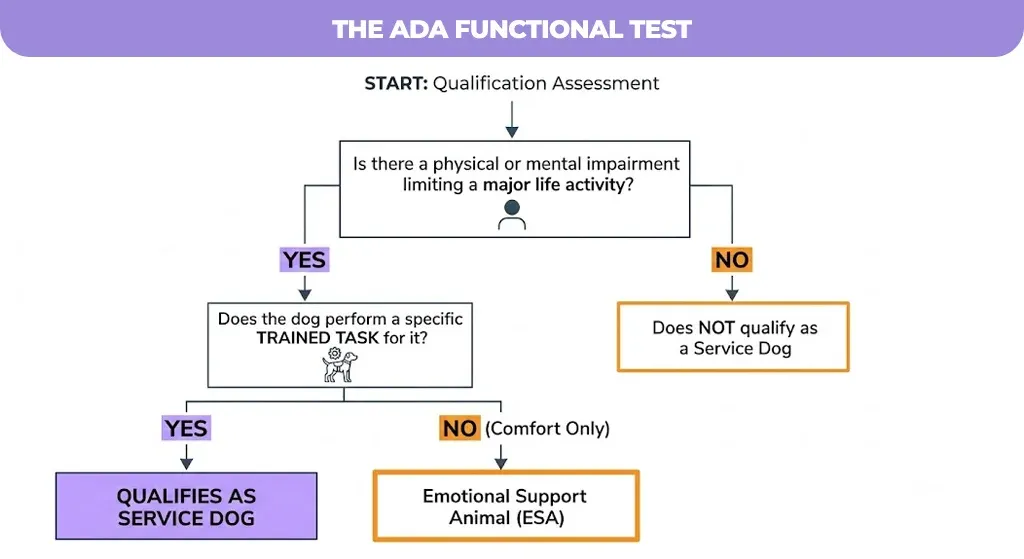
You don’t need a specific diagnosis to qualify for a service dog. You need a disability that limits a major life activity, and a dog trained to do a specific task connected to that limitation. That’s the whole legal test, and almost every article ranking on Google buries it under three paragraphs of history before saying so.
Here’s where the confusion actually starts. People search this question expecting a checklist of approved conditions, like a disability rating chart. That list does not exist under federal law, and any site that hands you one is simplifying past the point of accuracy. What exists instead is a functional test — and once you understand how it works, applying it to your own situation takes about five minutes.
Any physical, sensory, psychiatric, or other mental impairment can qualify for a service dog if it substantially limits a major life activity and the dog is individually trained to perform a task that helps with that specific limitation. There is no fixed diagnosis list under the Americans with Disabilities Act, and no medical documentation is required for public access.
The Americans with Disabilities Act defines a disability as a physical or mental impairment that substantially limits one or more major life activities — including walking, seeing, hearing, and breathing, as well as major bodily functions like the neurological, endocrine, and immune systems. The 2008 ADA Amendments Act went further and explicitly covered episodic conditions, meaning conditions like epilepsy, migraine, and panic disorder still qualify even during periods when symptoms are not active.
The second half of the test matters just as much as the first. A dog that provides comfort simply by being present does not meet the ADA definition of a service dog, no matter how real the underlying disability is. The dog must be trained to do something specific — retrieve medication, interrupt a panic attack, alert to dropping blood sugar, brace against a fall. Comfort alone describes an emotional support animal, and the two categories carry very different rights.
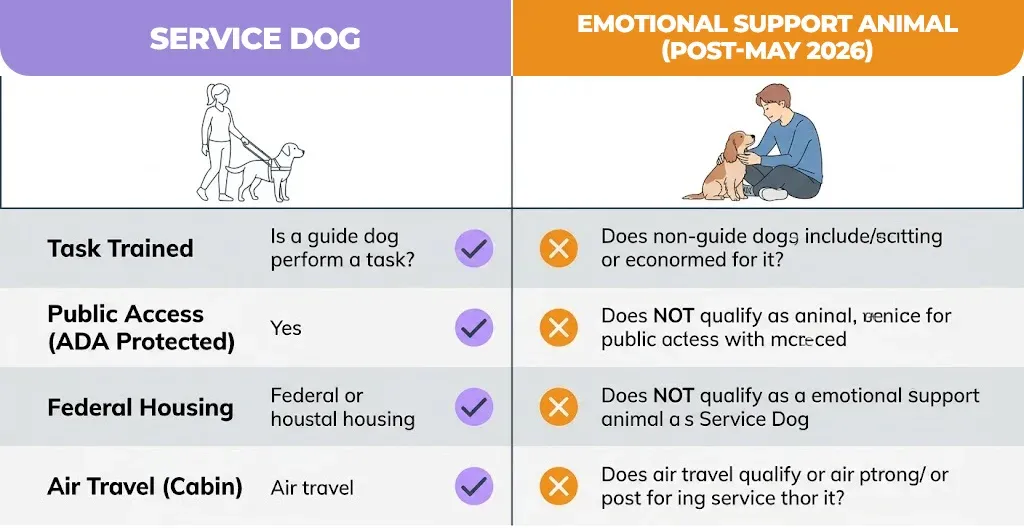
A service dog is individually trained to perform a task and has full public access rights under the ADA. An emotional support animal provides comfort through its presence and requires no task training — and after HUD’s 2025–2026 withdrawal of its assistance-animal guidance, the federal housing landscape for ESAs is less predictable than it used to be. The Fair Housing Act statute still protects assistance animals, but the detailed federal rulebook landlords and tenants leaned on is gone.
This distinction used to matter mostly for restaurants, planes, and stores. It now matters for housing too, and that shift is recent enough that most existing articles on this topic haven’t caught up.
A side-by-side of the two categories — training, public access, housing and the common myths — is in Difference Between Service Dogs and Emotional Support Animals.
Several states have their own fair housing laws that are more protective than the federal floor, and those aren’t affected by HUD’s policy change. If you’re relying on an ESA for housing, the practical takeaway is that the strength of your clinician’s letter and your state’s specific law now matter more than they did before 2026.
| Feature | Service Dog | Emotional Support Animal (Post-May 2026) |
|---|---|---|
| Task-trained | Yes, required | No |
| Public access (stores, restaurants, hotels) | Yes, under the ADA | No |
| Federal housing protection | Yes, under ADA and FHA | Still statutory under the FHA, but enforcement is more case-by-case after HUD’s 2026 policy shift |
| Air travel (cabin) | Yes, under DOT rules | No, since the 2021 ACAA amendment |
| Documentation required | None for public access | A letter from a licensed provider, for housing requests |
| Species | Dogs (and in limited cases, miniature horses) | Any species, typically |
Conditions such as PTSD, severe anxiety, panic disorder, major depression, OCD, and schizophrenia can all qualify a person for a psychiatric service dog, as long as the dog is trained to perform a specific task — such as interrupting a panic attack, applying deep pressure therapy, or checking a room before the handler enters.
Psychiatric service dogs, or PSDs, are held to the exact same legal standard as physical-disability service dogs. That surprises a lot of people, because psychiatric disabilities are often invisible and get treated with more suspicion in public. The ADA does not allow that suspicion to change the rule. If the task training requirement is met, a PSD has the same public access rights as a guide dog.
Common PSD tasks include:
Interrupting a panic attack by applying pressure or a nudging behavior to break the escalation
Deep-pressure therapy during dissociative or anxiety episodes
Room checks — walking into a space first for someone with PTSD-related hypervigilance
Retrieving medication or reminding a handler to take it on schedule
Grounding behaviors, like tactile stimulation, during a dissociative episode
Blocking or creating space — standing between the handler and crowds to reduce anxiety triggers
Waking a handler from night terrors or sleep paralysis episodes
A dog that simply calms someone down by being nearby, without a trained response to a specific symptom, is still functioning as an ESA under the legal definition, not a PSD, even if the handler’s need is completely genuine.
When a service dog’s function isn’t obvious, staff at a business may ask only two things: whether the dog is required because of a disability, and what work or task it has been trained to perform. They cannot ask about your diagnosis, demand documentation, or require the dog to demonstrate the task.
This rule comes directly from federal regulation, 28 CFR § 36.302(c)(6), issued by the Department of Justice. It exists for two reasons: to protect handler privacy, since asking about a diagnosis is invasive, and to prevent businesses from using paperwork demands as a backdoor way to exclude legitimate handlers, since no federal certification exists to demand in the first place. If a staff member asks anything beyond these two questions, they’re going beyond what federal law allows, whether or not they realize it.
A useful script for a handler facing pushback: state clearly that the dog is required because of a disability, then name the specific trained task. That’s the complete legal answer, and no further explanation is owed to anyone. You can review the DOJ’s official service animal requirements directly at ADA.gov Service Animals.
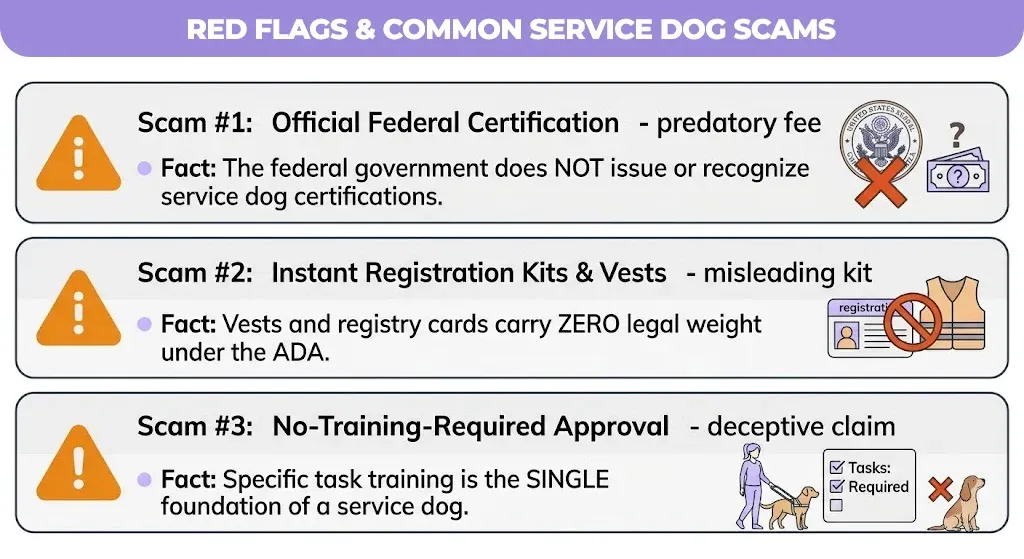
No. Federal law requires zero documentation, certification, ID card, or registration for a service dog to access public places. Voluntary registries and ID cards exist, and some handlers find them useful for reducing friction with untrained staff, but none of them create legal rights the dog didn’t already have.
This is also where most service dog scams live. Common patterns to watch for:
Fake federal certification. No such thing exists. Any company claiming to issue “official ADA certification” is selling a marketing product, not a legal credential.
Vest-only access kits. A vest signals nothing legally. Selling one as a shortcut to public access misleads buyers about how the law actually works.
Instant-approval registries. A legitimate voluntary registry states plainly that it’s voluntary and doesn’t imply government affiliation. One that promises instant, no-questions “certification” is a red flag.
Untrained dogs marketed as service-ready. Training is the entire legal foundation of service dog status. A dog without genuine, task-specific training does not qualify, no matter what paperwork accompanies it.
Where documentation genuinely does apply: a landlord can request a letter for a housing accommodation request, an airline can require the DOT Service Animal Air Transportation Form, and an employer engaging in the ADA’s interactive process for a workplace accommodation can request limited medical confirmation. Public accommodations like stores and restaurants cannot.
The ADA’s core definition applies nationwide, but states differ on misrepresentation penalties, housing statutes, and, in Ontario’s case, an entirely separate legal framework outside the ADA altogether.
| Location | Public Access Standard | Misrepresentation Penalty |
|---|---|---|
| Florida | Follows ADA; Fla. Stat. § 413.08 adds state-level public access detail | 2nd-degree misdemeanor: up to $500 fine, up to 60 days jail |
| Texas | Follows ADA; Human Resources Code Ch. 121 sets state rights, Property Code § 92.255 covers housing | Misdemeanor under § 121.006: up to $300 fine, 30 hours community service |
| California | Follows ADA; also covered by the Unruh Civil Rights Act | Misdemeanor under Penal Code § 365.7: up to $1,000 fine, up to 6 months jail |
| Georgia | Follows ADA directly; limited state-specific statute for misrepresentation as of this writing | No dedicated criminal misrepresentation law confirmed at this time; check current Georgia Code Title 30 |
| Michigan | Follows ADA; Persons with Disabilities Civil Rights Act adds state protections | Misdemeanor: up to $500 fine, up to 30 days community service, up to 90 days jail |
| Ohio | Follows ADA | Civil penalty rather than a dedicated criminal misdemeanor |
| Ontario, Canada | Not governed by the ADA at all. Falls under the Accessibility for Ontarians with Disabilities Act and the Ontario Human Rights Code, which can require documentation from a regulated health professional in some contexts | Provincial rules differ from every U.S. state listed above |
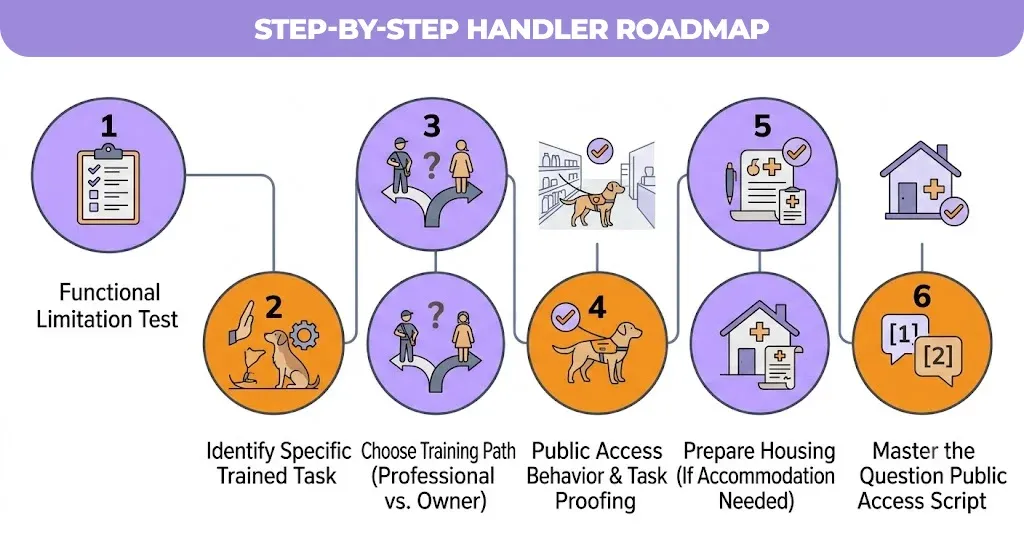
Confirm the disability meets the ADA’s functional test. Does it substantially limit a major life activity? Write down specifically how.
Identify the exact task the dog needs to perform. Not “comfort” — a specific, describable action tied to your limitation.
Decide between a professional training program and owner-training. Both are legal. Professional programs cost more but reduce training risk; owner-training costs less but demands consistent, verifiable skill-building.
Train and proof the task in public settings. A service dog also needs baseline public behavior: no aggression, no uncontrolled barking, reliable house-training, and calm focus around distractions.
Decide if voluntary ID or registration is worth it to you. It changes nothing legally, but some handlers find it reduces friction at unfamiliar venues.
If housing accommodation is part of your need, get a letter from a licensed provider. This is the one place documentation genuinely helps your case, especially under the post-2026 HUD landscape.
Know the two-question script before you need it. Practicing the exact wording removes hesitation in a real confrontation.
The disability doesn’t need a name on an approved list. It needs to genuinely limit a major life activity, and the dog needs a real, trained task connected to it. That’s the entire legal bar, and understanding it protects you from both overpaying for unnecessary paperwork and under-claiming rights you already have.
If your situation is more about emotional and psychological support than a task-trained dog, and housing is your main concern, PetESALetter can connect you with a licensed mental health professional to see whether a properly documented ESA letter fits your circumstances — especially given how much more the letter’s quality and your state’s specific law now matter after the 2026 HUD guidance shift.
Not sure which document you actually need? A licensed clinician can tell you whether an ESA letter or a PSD letter fits your situation — before you pay for the wrong one.
A service dog is trained to perform specific tasks for a person with a disability. Valid reasons include helping with mobility, guiding someone who is blind, alerting to seizures or low blood sugar, assisting with hearing loss, or performing tasks related to certain psychiatric disabilities.
A doctor or other licensed healthcare professional may provide documentation that you have a disability if needed in certain situations. However, under U.S. law, there is no official certification or letter required for a service dog. The key requirement is that the dog is individually trained to perform tasks related to the person’s disability.
To qualify for a service dog, you must have a disability, and the dog must be trained to perform tasks that help with that disability. The process can take time because service dogs require specialized training, and some organizations may have waiting lists.
ADHD alone does not automatically qualify someone for a service dog. However, if ADHD is part of a disability that substantially limits daily activities, and a trained service dog performs specific tasks to assist with that disability, a person may qualify. A healthcare professional can help determine whether a service dog is appropriate for your situation.

Licensed Psychotherapist
Darren is a leading expert in mental health advocacy and assistance animal documentation. He specializes in streamlining the process for obtaining ESA Letters, PSD Letters, and State-specific ESA compliance.

ESA Letters Issued

Successful Consultations

Licensed Therapist Network

Client Satisfaction Rate




Petesaletter.com helps you get your emotional support animal letter online with guidance and support.

Got Questions? Call us 24/7
Copyright © 2020-2026 Petesaletter All rights reserved. Terms | Privacy | Refund
Owned and Operated by Verimedix LLC