
Last Updated on: August 14, 2026
Reviewed by Darren Andrew Rafel
Yes, you can self-train a service dog. Federal law says so, and landmark court cases back it up.
Under the Americans with Disabilities Act (ADA), you do not need professional training, a training program, or any type of certificate to have a legitimate service dog. What you do need is a dog that is individually trained to perform a specific task that helps with your disability, and that behaves reliably in public — that’s it.
This guide will walk you through exactly how self-training works, what the law actually requires, how long it takes, and what it costs. It also tells you how to avoid the scams that trip up new handlers. We’ll also cover psychiatric and PTSD service dogs, flying with a self-trained dog, housing rights, and the questions businesses are legally allowed to ask you. Let’s get into it.
Yes. The ADA does not require professional training, certification, or registration. A service dog can be trained by its owner, a friend, or a professional — and the law will treat all three the same, as long as the dog reliably performs a task that is tied to a disability.
This is not a gray area. It’s settled law.
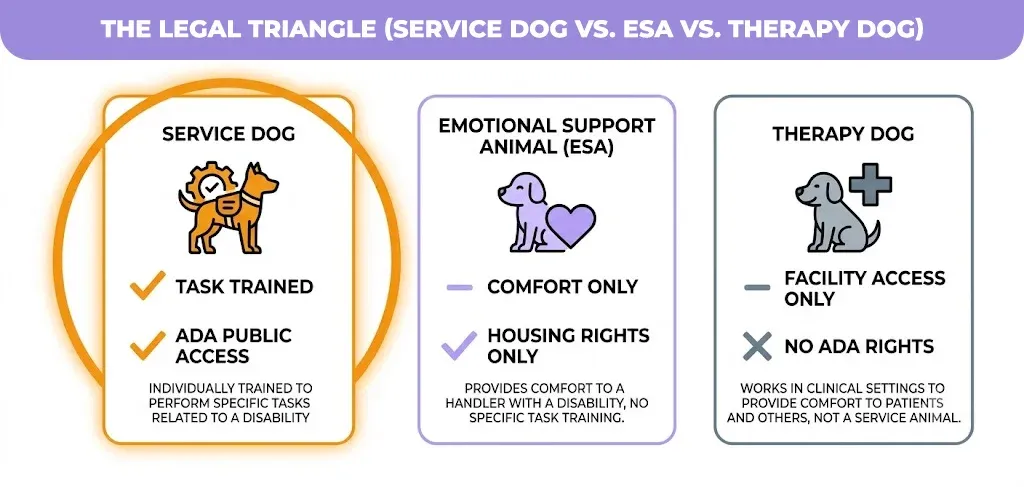
Under the ADA, a service dog is a dog that is individually trained to perform a specific task directly related to a person’s disability. Comfort alone doesn’t count. The dog has to do something — retrieve items, alert to a medical change, interrupt a panic attack, guide around obstacles — on cue or in response to a trigger.
This is the line that trips people up. A calm, loving dog that makes you feel better just by sitting next to you is not a service dog under federal law. That’s an emotional support animal (ESA), and ESAs have a completely different, much narrower set of legal rights. They don’t get ADA public access.
A service dog has two requirements:
Task training. The dog performs a specific, trained action connected to your disability — not a natural behavior it does on its own.
Public behavior. The dog is housebroken, under control, and not a danger or disruption in public spaces.
Both parts matter. A dog that knows one solid task but barks at strangers and pulls on the leash isn’t ready for public access yet, even if the task training is done.
Self-training a service dog happens in four stages: foundation obedience, task training specific to your disability, public access conditioning, and a final readiness check. Most owner-trainers move through these stages over 12 to 24 months.
Here’s what each stage actually looks like.
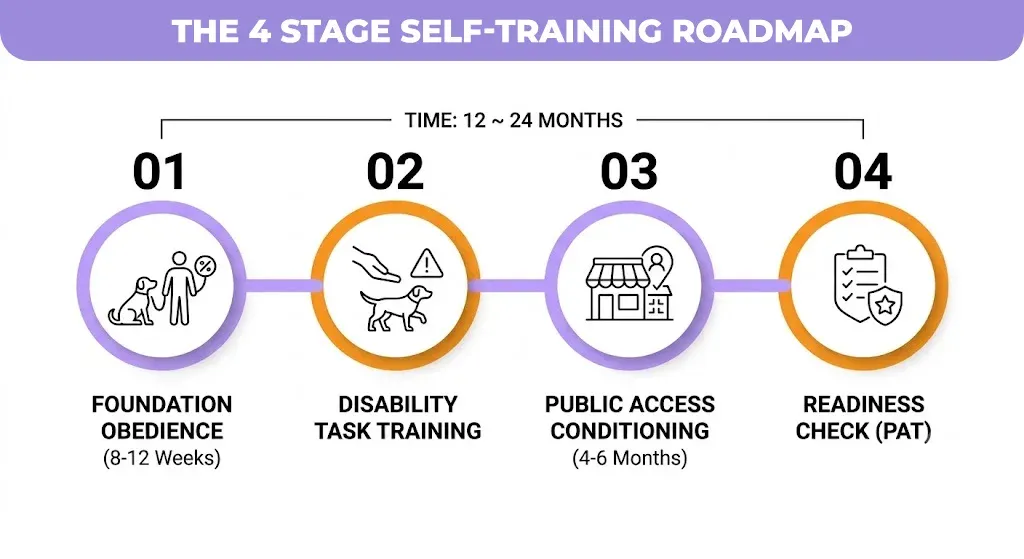
Before any task training starts, your dog needs rock-solid basics: sit, stay, down, loose-leash walking, recall, and a reliable “leave it.” This is also where you build focus and teach your dog to check in with you instead of the environment.
Most owner-trainers spend 8 to 12 weeks here before moving on. Rushing this stage is the single biggest reason self-training stalls later.
This is the part that legally makes your dog a service dog. Pick one or two tasks tied directly to your diagnosed condition and train them until they’re reliable — not “usually works,” but “works every time, even when distracted.”
Examples of common tasks:
Mobility support: bracing, retrieving dropped items, opening doors
Medical alert: alerting to blood sugar changes, seizure onset, blood pressure shifts
Psychiatric interruption: nudging or pawing to interrupt anxiety spirals, flashbacks, or repetitive behaviors
Deep pressure therapy: applying body weight during panic attacks
Guide work: navigating around obstacles for visually impaired handlers
Work with your treating doctor or therapist to identify which tasks would actually help your specific symptoms. A trained task should solve a real, functional problem — not just look impressive.
Now you take the trained behavior out into the real world: grocery stores, restaurants, transit, elevators, crowded sidewalks. Your dog needs to hold its training under distraction — other dogs, dropped food, loud noises, strangers reaching to pet it.
This stage takes the longest, usually 4 to 6 months of consistent outings, because real-world distractions can’t be simulated at home.
Many owner-trainers finish with a Public Access Test (PAT) — a checklist covering loose-leash walking, food refusal, calm behavior around other animals, and recovery from surprises like a dropped tray. This is not legally required, but it is the closest thing to an objective “is my dog ready” benchmark, and it’s useful if you ever need to demonstrate reliability to a skeptical landlord or airline.
You can self-administer it, but a second set of eyes (a trainer, a trusted friend) catches problems you’re too close to notice.
Most owner-trainers reach public access readiness in 12 to 24 months. Dogs learning a single, simple task who already have a naturally calm temperament can be ready faster; multiple-task psychiatric or medical alert dogs — and dogs that need behavior correction first — often take longer.
Dogs that already have a stable, food-motivated, low-reactivity temperament tend to move through these stages faster. Puppies started from scratch usually land at the longer end.
Self-training generally costs $500–$8,000 total, compared to $15,000–$50,000 for a professionally program-trained dog. The exact number depends on how much professional guidance you bring in for the harder parts of training.
If you already own a dog with the right temperament, your out-of-pocket cost can be close to zero — just your time, treats, and maybe one or two obedience classes.
Yes, you can self-train a psychiatric service dog for PTSD, anxiety, depression, or related conditions. Common trained tasks include deep pressure therapy, nightmare interruption, crowd blocking, and medication reminders — each one trained as a specific response to a specific trigger.
Psychiatric service dogs are fully covered under the ADA, but they get more pushback in public because the disability is not visible. That makes solid task training even more important — it is your greatest evidence that the dog is doing real work, not just keeping you company.
Common PTSD and psychiatric tasks:
Deep pressure therapy (DPT): the dog leans or lies across your lap or chest during a panic spike, which can reduce physical anxiety symptoms
Nightmare interruption: the dog wakes you during a nightmare or night terror
Room search / “clear”: the dog checks a room and confirms it’s safe before you enter
Block / cover: the dog positions itself behind or beside you in crowds to create space
Medication reminders: the dog nudges you at a set cue time or retrieves your medication
Grounding: physical contact that interrupts dissociation or a flashback
Start with one or two tasks tied to your most disruptive symptoms. Get those rock-solid before adding more. A dog with one flawless task beats a dog with five shaky ones.
Under the Fair Housing Act (FHA), landlords must make reasonable accommodations for service dogs — even in buildings with strict no-pets policies. They cannot charge pet rent or pet deposits for a legitimate service dog.
The FHA covers self-trained service dogs the same way it covers program-trained ones. What matters is the same thing that matters everywhere else: task training tied to a disability.
A landlord can ask for reliable documentation of your disability-related need in some cases, but they cannot demand a specific certification that does not even exist, and they cannot charge you extra fees the way they might for a regular pet. If a landlord denies a reasonable accommodation request without any solid reason, that is a fair housing violation you can report to HUD.
Yes. Airlines can require the DOT Service Animal Air Transportation Form, which applies equally to self-trained and program-trained dogs. It asks about your dog’s health, training, and behavior — not who trained it.
Since the Air Carrier Access Act (ACAA) rule took effect in 2021, U.S. airlines are allowed to require this one federal form before you fly with a service dog. Here’s what to know:
Submit it up to 48 hours before departure if your airline requires advance notice
Booked within 48 hours of your flight? You can bring the completed form to the gate instead
Flights 8 hours or longer may also require a second form — the Relief Attestation — confirming your dog can either hold it or relieve itself sanitarily
The form doesn’t ask who trained your dog. It only covers vaccination status, behavior, and training outcomes — which means a self-trained dog qualifies exactly the same as a program-trained one, as long as the training is real
You submit the form directly to the airline, never to the Department of Transportation itself.
Federal ADA rights apply the same in every state, but some states go further — especially around dogs still in training. California, for example, gives public access rights to dogs still in training if a trainer is present, which federal law does not require.
This distinction matters a lot for owner-trainers, because your dog spends months in an in-between phase where the task training isn’t finished yet. Federal law doesn’t protect a dog that’s still in training; only a fully trained service dog gets ADA public access.
A few things that vary by state:
Whether “service dogs in training” get any public access at all
Criminal penalties for faking a service dog (many states now treat this as a misdemeanor)
Optional low-cost ID tags through local animal control (not the same as legal certification)
Always check your specific state’s statute before assuming in-training access rules from another state apply to you.
Most self-training failures come down to a short list of avoidable mistakes.
Skipping foundation obedience. Jumping straight to task training on a dog that hasn’t mastered basics leads to unreliable performance later.
Training in low-distraction environments only. A task that works perfectly at home often falls apart in a busy store. Public access work has to happen in public.
Choosing the wrong dog. Not every dog has the temperament for service work — high reactivity, poor food motivation, or extreme shyness can make training much harder or unrealistic.
Adding too many tasks too fast. One reliable task beats five shaky ones. Build depth before adding breadth.
Assuming certification exists. Time spent chasing a “certificate” is time not spent training. No federal certification exists to earn.
Not consulting your medical provider. Task selection works best when it’s tied to your actual diagnosed symptoms, not a generic task list.
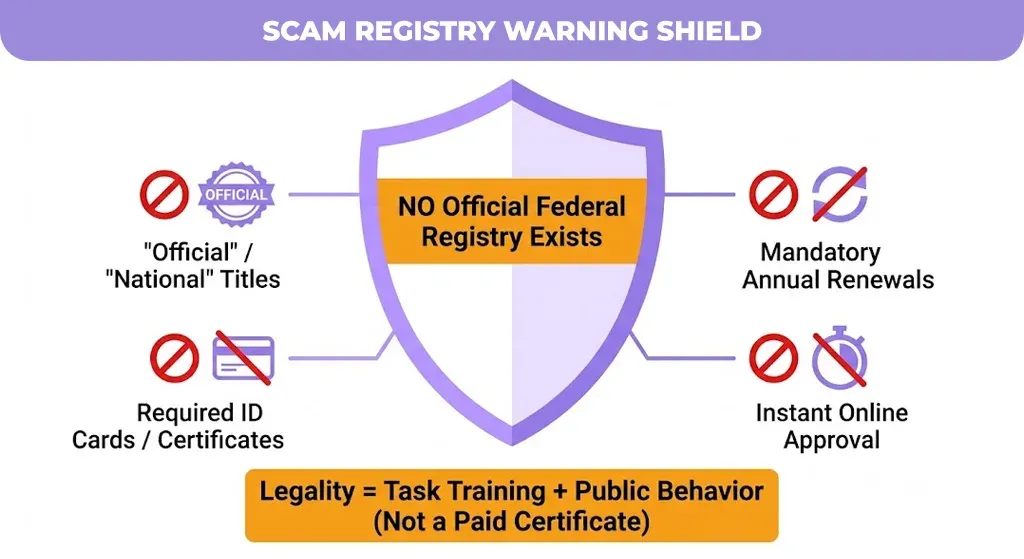
No federal service dog registry exists, so any site claiming to offer “official” registration, certification, or a required ID card is not telling the truth. These sites often use fear-based language like “required by law” to pressure a sale.
Watch for these red flags:
The word “official” or “national” in the company name (no private company can be official — there’s no government registry to be official with)
Claims that you’ll be denied access without their card or certificate
Pressure to renew your “registration” annually
Fake Department of Justice or ADA seals printed on ID cards
A sales process that skips any real questions about your dog’s task training
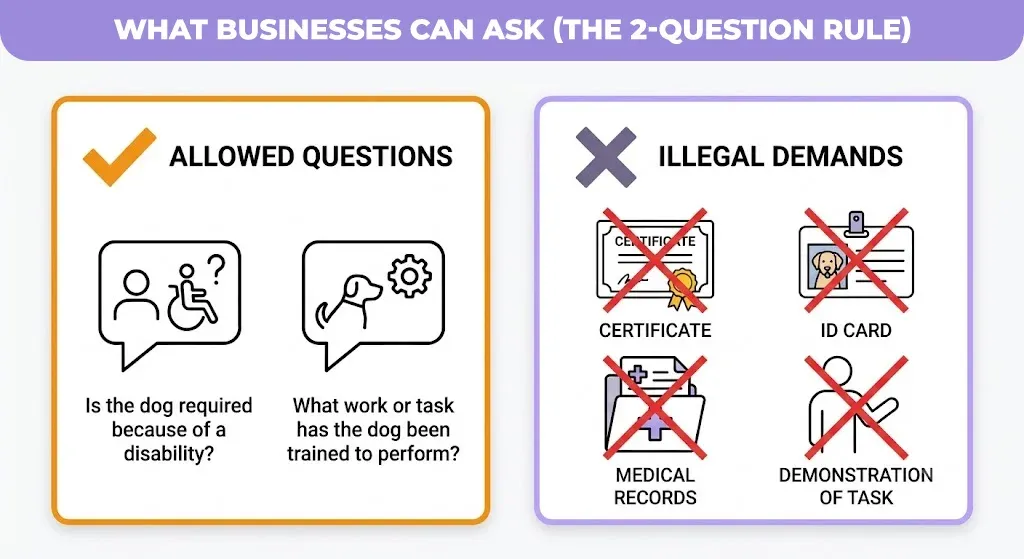
None of this means every paid ID card or vest is a scam — some handlers find a visible ID genuinely useful for reducing friction in public. The problem is only when a company claims that product is legally required. It isn’t, and no business can lawfully demand you show one.
Not sure which document you actually need? A licensed clinician can tell you whether an ESA letter or a PSD letter fits your situation — before you pay for the wrong one.
Yes — under U.S. federal law you can generally train your own dog to be a service animal. The dog must be trained to perform specific tasks that are directly related to your disability and must be under control in public.
Yes, owner training is allowed under the Americans with Disabilities Act. You do not have to use a professional trainer or any service dog certification. However, your dog must meet the requirements for service animals.
Training time varies based on the dog’s age, temperament, skills, and the tasks it needs to learn. It can take several months to two years — or even more — to develop reliable task performance and appropriate public behavior.
It depends entirely on your situation. Training your own dog is less expensive and lets you tailor the tasks specifically to your needs. However, it requires significant time, consistency, and training knowledge. Professional guidance can help if you have difficulty with training or public access behavior.

Licensed Psychotherapist
Darren is a leading expert in mental health advocacy and assistance animal documentation. He specializes in streamlining the process for obtaining ESA Letters, PSD Letters, and State-specific ESA compliance.

ESA Letters Issued

Successful Consultations

Licensed Therapist Network

Client Satisfaction Rate




Petesaletter.com helps you get your emotional support animal letter online with guidance and support.

Got Questions? Call us 24/7
Copyright © 2020-2026 Petesaletter All rights reserved. Terms | Privacy | Refund
Owned and Operated by Verimedix LLC