Service Dog vs Therapy Dog vs ESA: 2026 Legal Guide
Last Updated on: August 14, 2026
Reviewed by Darren Andrew Rafel
Licensed Agent
@ Petesaletter
A landlord can legally turn away your emotional support animal in a way they never could a real service dog. That single fact trips up more people than almost anything else in disability law, and getting it wrong can cost you an apartment, a flight, or a legal fight you don’t need to have.
These three terms get used as if they mean the same thing, but they don’t. Each one comes with its own training standard, its own legal protections, and its own rules for where the animal can go. Get the category wrong and you could show up somewhere expecting rights you don’t actually have.
What’s the Quick Explanation?
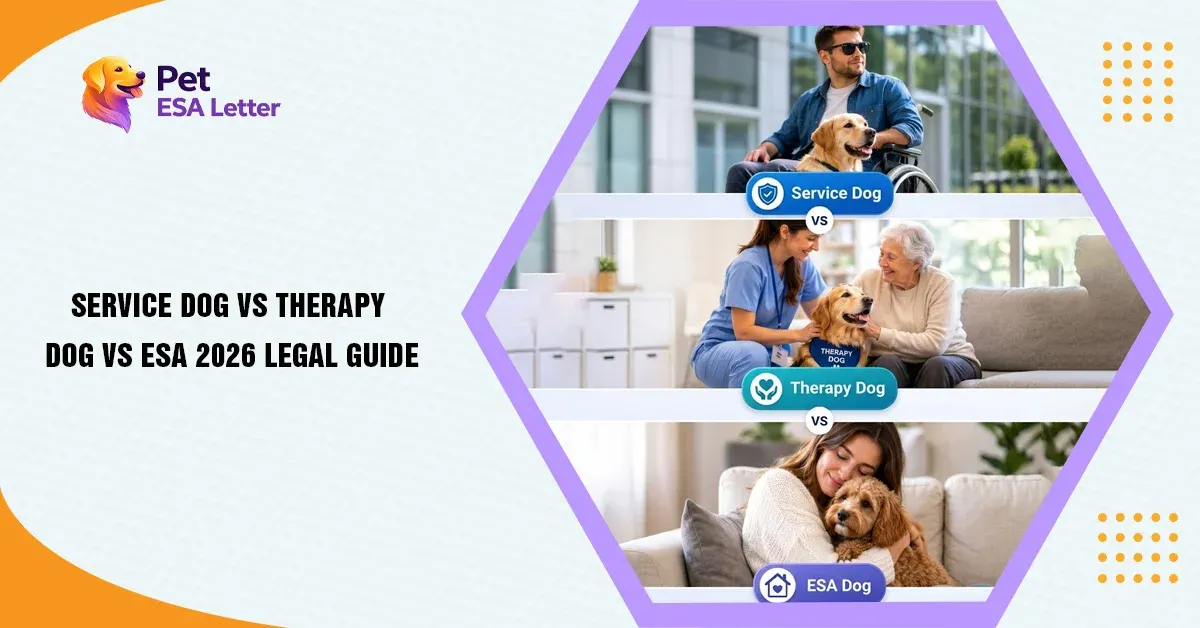
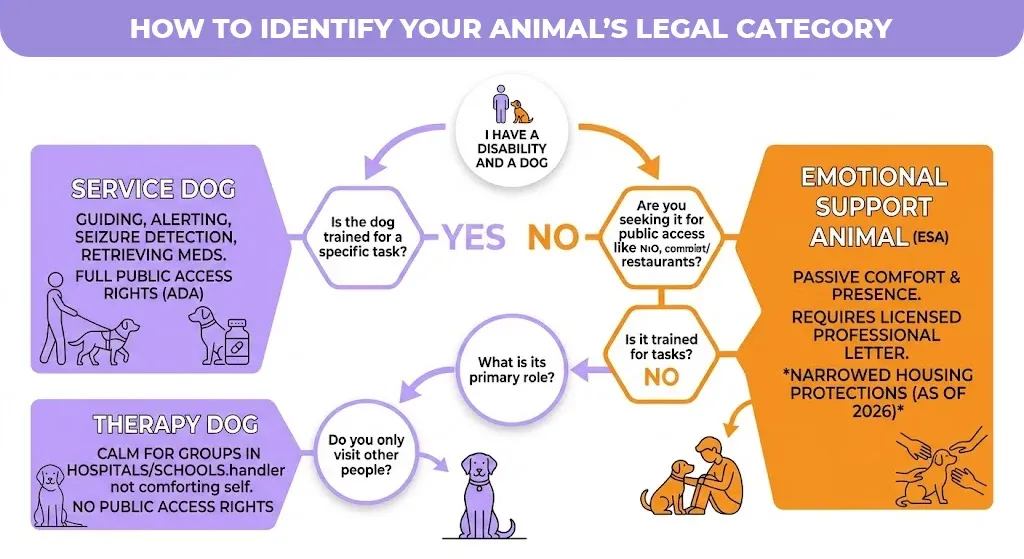
A service dog is individually trained to perform a specific task for a person with a disability, and it has public access rights under federal law. A therapy dog is trained to comfort groups of people in places like hospitals and schools, with no public access rights. An emotional support animal offers comfort just by being present, with no required training and far fewer legal protections in 2026 than in past years.
The table below breaks down the three side by side.
Feature
Service Dog
Therapy Dog
Emotional Support Animal
Legal definition source
ADA (federal)
No federal legal status
Fair Housing Act (limited, as of May 2026)
Training required
Yes, individually trained for a specific task
Yes, trained for calm behavior around groups
No formal training required
Public access (stores, restaurants)
Yes, under the ADA
No
No
Housing protections
Yes, always
No
Case-by-case, narrowed in 2026
Air travel cabin access
Yes, with DOT form
No
No, treated as a pet
Who it helps
One handler with a disability
Multiple people, not the handler
One owner
Certification required by law
No
No official federal requirement
No
← swipe to compare →
What Is a Service Dog, Exactly?
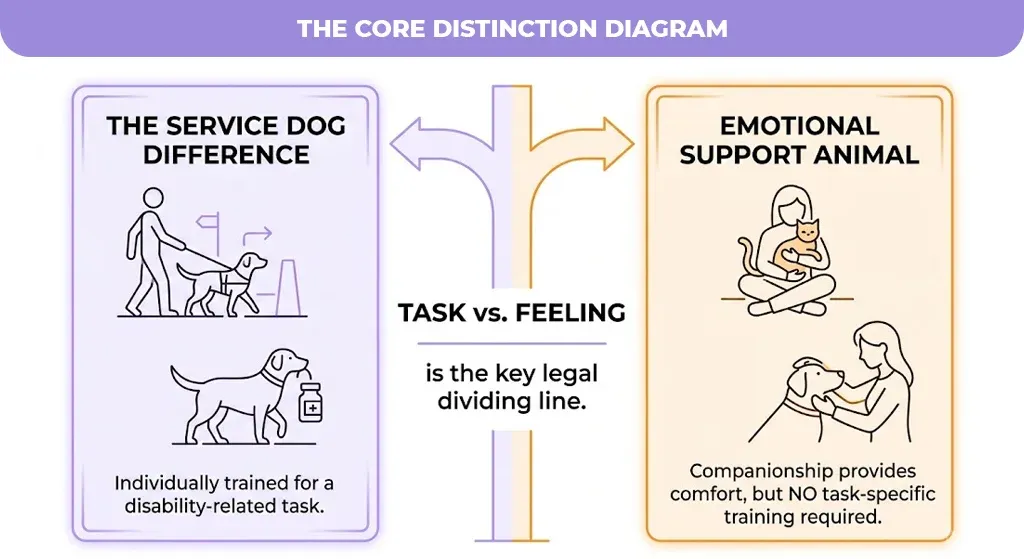
A service dog is a dog that is individually trained to perform specific tasks directly connected to a person’s disability — for example, guiding someone who is blind or interrupting a panic attack. This is the only category of the three with full public access rights under the Americans with Disabilities Act, enforced by the Department of Justice.
What Tasks Do Service Dogs Perform?
The task has to be specific, not general comfort. Examples include guiding a person who is blind, alerting a person who is deaf, detecting a seizure before it happens, retrieving medication, or performing deep pressure therapy during a panic attack for someone with PTSD.
A dog that simply makes its owner feel calmer does not meet the standard on its own. The DOJ has made clear that emotional support by itself is not a trained task.
What Rights Do Service Dogs Have Under the ADA?
A service dog can go anywhere the public can go, including restaurants, hotels, hospitals, and stores. Businesses cannot charge a pet fee, and they cannot deny entry because a staff member feels uneasy or because another customer complains about allergies.
Can Businesses Legally Ask for Proof?
When it is not obvious that the dog is a service animal, a business can ask only two questions: “Is the dog required because of a disability?” and “What task has the dog been trained to perform?” They cannot ask about your diagnosis, and they cannot demand ID cards, certification papers, or a vest, or require documentation as a condition of entry — doing so is a violation of federal law.
What Is a Therapy Dog?
A therapy dog is trained to provide comfort to multiple people in settings like hospitals, schools, and nursing homes, usually alongside a handler who is not the person receiving the comfort. Therapy dogs have no legal public access rights, and they cannot go into a restaurant or store just because they are working.
Where Are Therapy Dogs Allowed?
Therapy dogs go wherever the facility invites them, such as a hospital visit program or a school reading event, and nowhere else by legal right. Access depends entirely on permission from the organization, not on federal disability law.
Therapy Dog vs Service Dog: Who Do They Actually Help?
A service dog is bonded to one handler and is trained around that person’s specific disability. A therapy dog is trained to be calm and friendly around strangers, and its handler is often a volunteer or a professional — not a person the dog is comforting that day.
What Is an Emotional Support Animal (ESA)?
An emotional support animal is any animal that provides comfort to a person with a diagnosed mental health condition, without needing task-specific training. Emotional support animals are not service animals under the ADA, and as of a major 2026 policy shift, they have significantly narrower housing protections than they did just a year earlier.
Do ESAs Need Training?
No. An ESA’s benefit comes from companionship and presence, not from performing a trained task. This is the exact reason ESAs don’t qualify for ADA public access rights — the law requires a task, not a feeling.
What Changed With ESA Housing Rules in 2026?
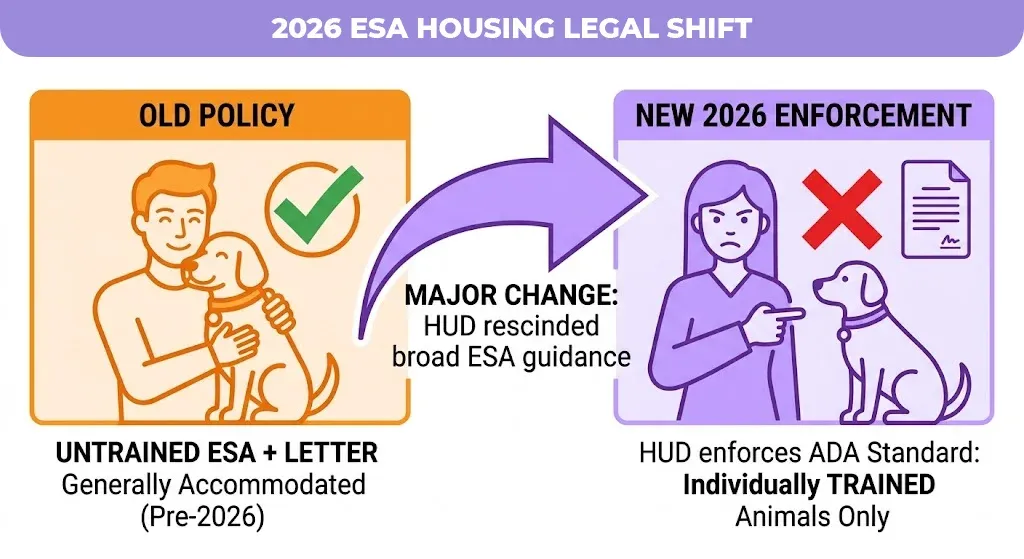
On May 22, 2026, HUD’s Office of Fair Housing and Equal Opportunity permanently rescinded its 2020 guidance on emotional support animals in housing. Going forward, HUD will only find reasonable cause in cases involving animals individually trained to provide disability-related assistance, aligning its enforcement standard with the ADA’s service animal definition rather than the broader ESA standard used for years.
This is a significant change, and it’s worth understanding clearly. Under the old 2020 guidance, an untrained ESA with a valid letter generally had to be accommodated under the Fair Housing Act, and housing providers couldn’t charge pet fees for it. Under the new 2026 enforcement posture, HUD will no longer pursue complaints on behalf of ESA owners whose animals aren’t individually trained, even with a legitimate letter from a licensed provider.
This does not mean the Fair Housing Act itself was rewritten — the statute is unchanged. What changed is how HUD enforces it, which affects whether HUD will investigate and pursue a complaint on your behalf. State and local fair housing laws may still offer separate protections, and this is exactly the kind of detail that’s worth confirming with a local fair housing agency or attorney before you sign a lease, since enforcement standards can keep shifting.
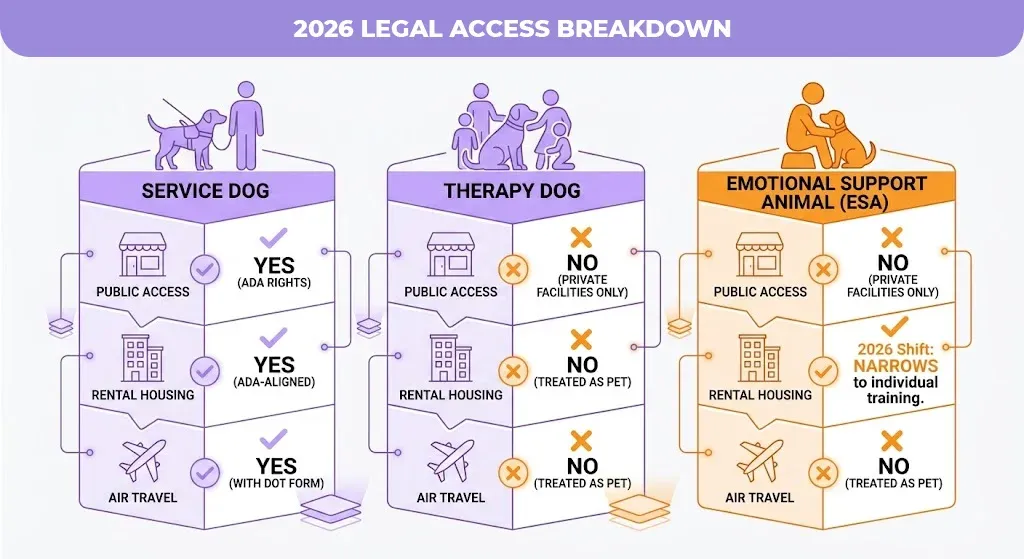
Where Can Each Animal Legally Go? Public Access Breakdown
Location
Service Dog
Therapy Dog
Emotional Support Animal
Restaurants, retail stores
Yes (ADA)
No
No
Hotels
Yes (ADA)
No
No
Rental housing
Yes
No
Case-by-case, narrowed in 2026
Commercial flights
Yes, with DOT form
No
No, treated as a pet
Hospitals, schools (invited visits)
Yes, plus general access
Yes, by invitation only
No
Workplace
Reasonable accommodation analysis, not ADA public access rules
No
No
← swipe to compare →
How to Get an ESA Letter the Right Way
A legitimate ESA letter comes from a licensed mental health professional — such as a therapist, psychologist, or psychiatrist — who has evaluated you and can confirm that you have a diagnosed condition the animal helps you manage. It generally costs between $100 and $200 and takes anywhere from the same day to a few days, depending on the provider.
The Bottom Line
The difference between a service dog, a therapy dog, and an ESA isn’t just semantics — it decides whether you can bring your animal into a restaurant, onto a plane, or into a no-pet apartment. With HUD’s 2026 enforcement change, ESA housing protections in particular are shifting, so it’s worth confirming your current rights before you rely on outdated information from an older article.
If you’re trying to figure out which category fits your situation and what documentation you’d actually need, petesaletter.com can walk you through the right next step — no pressure, just clarity on where you stand.
Not sure which document you actually need? A licensed clinician can tell you whether an ESA letter or a PSD letter fits your situation — before you pay for the wrong one.
🐾 100% Risk-Free Guarantee (full refund if you don’t qualify, or if your landlord rejects the letter)
🐾 Clinician-led assessment of which documentation fits your needs
🐾 No task-training claims we can’t support — just an honest evaluation
It depends on what you need from the animal. A service dog is trained to perform specific tasks related to the person’s disability, while an emotional support animal provides comfort through its presence. They have different legal protections.
There is no single best breed for ADHD or autism. A good candidate is calm, trainable, social, and comfortable in different environments. The dog’s temperament and ability to perform the needed tasks are generally more important than its breed.
No. Simply calling a pet an emotional support animal does not give it ESA status or any legal protection. For housing purposes, you generally need documentation from a qualified healthcare or mental health professional showing that the animal provides disability-related emotional support.
A service dog should be trained to perform tasks directly related to the person’s disability and should generally remain under control in public. There is no federally required service dog vest, certification, or registration in the United States, and businesses generally cannot demand proof of certification.
No. A vest does not make a dog a service animal. A dog must meet the applicable legal definition and be trained to perform a disability-related task. Misrepresenting a pet as a service dog can also violate state and local laws.
A service dog should generally be trained to perform disability-related tasks, remain under its handler’s control, and be suitable for public access — behaving appropriately around people and other animals. Breed or certification is not what defines service dog status under the ADA.
THE AUTHOR
Darren Andrew Rafel
LMFT, LCSW, LMHP
Licensed Psychotherapist
Darren is a leading expert in mental health advocacy and assistance animal documentation. He specializes in streamlining the process for obtaining ESA Letters, PSD Letters, and State-specific ESA compliance.