


ESA Letter California: A $99 Emotional Support Animal Letter Under AB 468
Your $99 letter follows two evaluations over 30 days with a California-licensed clinician, matching the state's 30-day relationship rule. Clinically reviewed by Darren Rafel, LCSW.






ESA LETTER CALIFORNIA
What Is a California ESA Letter?
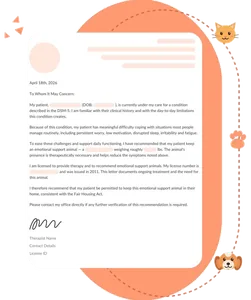
An ESA letter is a licensed clinician's written opinion that you have a disability and that your animal helps with it. California has no official registry, ID card or certificate to buy.
California controls who may sign a letter for an emotional support dog. Health & Safety Code § 122318, from AB 468, requires a client-provider relationship ofat least 30 daysplus a clinical evaluation, unless the person is verified homeless.
The letter supports a housing request under the federal Fair Housing Act and California's Fair Employment and Housing Act (FEHA). Each emotional support animal letter California renters get from us costs $99 flat.

How to Get an ESA in California: The 30-Day Path
Expect two evaluations with a California-licensed clinician, spread across at least 30 days.

Take the Free Quiz
Answer a private, 5-minute questionnaire about your symptoms, daily life and animal. It is free.

First Evaluation Opens the Clock
Pay $99 at checkout. Your first evaluation with a California-licensed clinician starts the 30-day relationship.

Second Evaluation After Day 30
Once at least 30 days have passed, a second evaluation lets your clinician decide whether you qualify. Not everyone does.

Letter After Evaluation Two
If you qualify, the letter is issued after evaluation two. Otherwise, request a full refund within 7 days.
Who Qualifies for a California ESA?
You may qualify for an emotional support animal in California if a mental or emotional condition limits a major life activity. FEHA's test is broader than federal law: the condition need only make that activity difficult (Gov. Code § 12926(j)).
California ESA Laws: What AB 468 and FEHA Do
California ESA laws work in two layers. AB 468 sets rules for the clinician who writes a dog letter. FEHA and its regulations give renters the right to ask for an accommodation.
AB 468's 30-Day Rule
Section 122318(a)(3)(A) requires a client-provider relationship of at least 30 days before a clinician documents your need for an emotional support dog. It sets no minimum number of sessions.
What the Letter Must Show
The clinician must hold an active license where you are located. A dog letter must list that license's effective date, number, jurisdiction and type (§ 122318(a)(1)–(2)).
Why HUD's 2026 Memo Matters Less
HUD's May 22, 2026, memo limits HUD's own cause findings to trained animals. The Civil Rights Department's guidance, Legal Alert 2026-01, says the memo has 'no impact' on the ESA complaints it accepts. FEHA still covers untrained support animals.
No Public Access Rights
An ESA is not a service animal. California's public-access laws protect dogs individually trained for a disability, so stores and restaurants can refuse an ESA (Civ. Code § 54.1).
Seller Notices Under AB 468
Anyone selling an ESA certificate, ID, tag or vest must state in 12-point bold type that it gives no service-dog rights (§ 122317).
Can a California Landlord Refuse an Emotional Support Animal?
Only on narrow grounds. The duty to accommodate comes fromGov. Code § 12927(c)(1), and 2 CCR § 12185 applies it to untrained support animals. Small landlords are covered too: FEHA's only exemption is one roomer in an owner-occupied single-family home.
No-Pet Rules Can Bend
Landlords generally have to grant a reasonable accommodation to a no-pets rule for a qualifying renter unless a lawful defense applies.
No Pet Fees or Pet Rent
California's rule, 2 CCR § 12185(d)(2), bars pet fees, pet rent, extra deposits and insurance demands for any assistance animal. Actual damage remains your cost.
No Breed or Size Limits
Landlords cannot apply breed, size or weight limits to an assistance animal (§ 12185(d)(5)). Each animal is judged on its own conduct.
No Diagnosis Questions
A landlord may not ask for your diagnosis, its severity or your medical records (2 CCR § 12178(e)(1)).
Direct Threat or Damage
Denial is allowed if this specific animal poses a direct threat or would cause substantial physical damage, shown by objective evidence of its conduct.
Undue Burden or Alteration
Refusal is also allowed for an undue financial and administrative burden, or a fundamental alteration (2 CCR § 12176(c)).
Ask First, Then Decide
Shaky paperwork is not a ground by itself. First the landlord must request more information and let you supply it (§ 12177(b)).
AIR TRAVEL
California Service Dog Laws and ESAs
California service dog laws cover dogs trained to do tasks, not ESAs. Since the DOT's 2020 Air Carrier Access Act rule took effect on January 11, 2021, airlines may treat an ESA as a pet.
Your letter gives no cabin right. If your dog is trained to perform tasks for a psychiatric disability, ask about our PSD letter.
Is There Emotional Support Animal Registration in California?
California has no emotional support animal registration. Clinician rules sit in Health and Safety Code§ 122318and breaches bring licensing-board discipline (§ 122318(c)). The fines below are civil; AB 468 created no crime.
Key facts:
OUR CALIFORNIA PROCESS
Why Do California Renters Choose PetESALetter?
Letters Built for AB 468
Every letter lists the clinician's license type, number, jurisdiction and effective date, on letterhead with their name and the date.
California-Licensed Clinicians Only
Every evaluation is done by a clinician holding an active California license.
Letter After Your Second Evaluation
We never rush the 30 days. Your letter is issued only after the second evaluation, if you qualify.
Two Evaluations, 30 Days
Two one-on-one evaluations, by video, phone or secure online visit, give your clinician time to know you.
$99 Covers Both Evaluations
One $99 checkout payment covers both evaluations over 30 days and any letter issued. No upsells.
Fair Refund Terms
If the clinician finds you don't qualify, request a full refund within 7 days. If a landlord rejects your letter, email the written denial within 30 days for a refund.
Landlord Verification Help
Our support team answers landlord questions about verifying your letter and your clinician's license.
Your Health Data Stays Private
HIPAA-conscious handling, and we never sell your data.
TRUSTPILOT REVIEWS
What Clients Say on Trustpilot
This company provides great service easy to follow up and very convenient. We did not have any issues on the process or in accepting the letter.
FAQ
ESA Letter California: Your Questions
Take PetESALetter's free 5-minute quiz, then pay $99 and meet a California-licensed clinician. After at least 30 days comes a second evaluation, and the letter follows it if you qualify.
It is AB 468, in force since January 1, 2022. It added Health & Safety Code §§ 122317–122319.5 on emotional support dogs: seller notices, clinician rules and civil fines. Housing rights did not change (§ 122319(b)).
Yes, on limited grounds: a direct threat, substantial physical damage, undue financial and administrative burden, or fundamental alteration. Over paperwork, the landlord must first ask for more information.
For an emotional support dog, any California licensee under Division 2 of the Business and Professions Code, acting within scope, may write it (§ 122318(b)). That covers psychologists, LCSWs, LMFTs, LPCCs and physicians.
Yes. California allows several assistance animals; each is reviewed on its own, and combined impact can count (2 CCR § 12185(d)(4)).
PetESALetter charges $99 flat at checkout. That covers two evaluations spread across 30 days with a California-licensed clinician and the letter if you qualify. If the clinician finds you don't, you get a full refund.
No real one. A free template has no clinician, so it cannot meet § 122318 for a dog. California also presumes online certificates without an individualized assessment unreliable (2 CCR § 12185(c)(2)).
At least 30 days. Outside the homelessness exception, § 122318 bars a dog letter before the relationship reaches 30 days. We use that timeline for every animal.
They can. A California dog letter must list the clinician's license number, type, jurisdiction and effective date, so a landlord can check the license. Our team answers landlord verification questions.
No, not for an accommodated ESA. California's Civil Rights Department guidance says landlords may not charge pet deposits, pet rent or other fees for an ESA, matching 2 CCR § 12185(d)(2). Real damage is still yours.
File with the Civil Rights Department (CRD) within one year, online or at 800-884-1684 (Gov. Code § 12980(b)); its mediation is free. You may also sue in state court within two years (§ 12989.1).