
Last Updated on: August 14, 2026
Reviewed by Darren Andrew Rafel

Quick answer: Getting an ESA letter in California requires a licensed California mental health professional who has had at least a 30-day therapeutic relationship with you — that’s the law under AB 468, effective January 2022. Your California ESA letter covers you under both the California Fair Employment and Housing Act and the federal Fair Housing Act. Landlords cannot charge pet fees or enforce breed bans for ESAs in California.
California has some of the strongest tenant protections in the country — and some of the most specific rules around ESA documentation. If you’re looking for an ESA letter California renters can actually rely on, you need to understand what changed in 2022. The state passed AB 468 specifically to crack down on fraudulent letters and raise the bar for legitimate ones. That’s good news for people who genuinely need support animals. It’s bad news if you were thinking about buying the $50 ESA letter some California-targeting websites try to sell you, with no real clinical relationship behind it.
This guide covers everything: what AB 468 actually requires, how the 30-day process works, what California landlords can and can’t do, the penalties for fake letters, and city-specific notes for Los Angeles, San Francisco, and San Diego. California ESA law is more detailed than most states’ — understanding the current requirements before you start can save you weeks of frustration and a rejected accommodation request.
Whether you’ve been denied by a landlord, are starting from scratch, or just want to make sure your existing California ESA letter meets current standards — you’re in the right place.
California AB 468 was signed by Governor Newsom in October 2021 and took effect January 1, 2022. It added Section 122318 to the California Health and Safety Code, targeting the wave of fake California ESA letter mills that issued letters after a five-question quiz and a credit card number. California ESA law had no real teeth before this — AB 468 changed that.
Here’s what AB 468 actually requires. A licensed mental health professional (LMHP) in California must have an established client relationship with you for at least 30 days before they can issue an ESA letter. That’s not 30 days from when you find a website — it’s 30 days of active therapeutic engagement. A real clinician needs to assess whether your condition genuinely warrants an ESA recommendation before putting their license on the line.
The LMHP must hold a valid California license. This is one of the most important parts of California ESA law that people miss when shopping for an ESA letter online. An out-of-state therapist — even a fully licensed one in their home state — cannot legally write a California ESA letter under AB 468. The license must be active and issued by California’s Board of Behavioral Sciences or a comparable California licensing authority.
AB 468 also created criminal consequences that didn’t exist before. Misrepresenting an animal as an emotional support animal — or fraudulently claiming disability status — is now a misdemeanor, with fines up to $1,000. That applies both to renters who lie about needing an ESA and to providers who issue a letter without meeting the legal requirements.
The California Fair Employment and Housing Act (FEHA) runs alongside the federal Fair Housing Act (FHA) to cover virtually all rental housing in the state. When it comes to California emotional support animals, FEHA often provides broader protections than the federal baseline — so even in situations where a federal exemption might otherwise apply, California renters frequently have additional rights. A California ESA letter that meets AB 468 standards triggers both layers of protection.
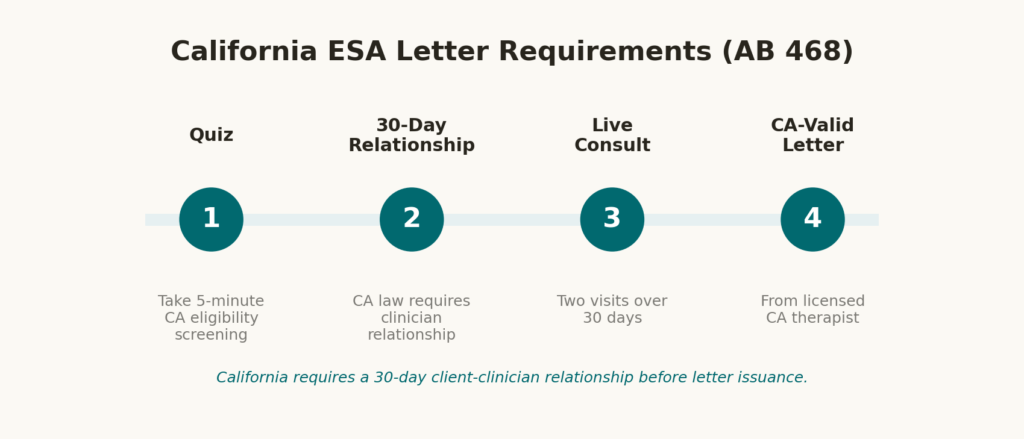
The 30-day requirement sounds intimidating. It isn’t as bad as it sounds — but you do need to plan ahead. Here’s how the process actually works under current California requirements.
You start by connecting with a licensed California LMHP and beginning a therapeutic relationship. That first session is step one. Over the following 30 days, you have at least one follow-up session — ideally two. The clinician evaluates whether your condition (depression, anxiety, PTSD, OCD, phobias, or another DSM-5-recognized diagnosis) qualifies you for an ESA recommendation. After the 30-day window closes, the provider can legally issue your California ESA letter.
A few things to know before you start: the letter should be on the provider’s official letterhead, include their California license number and license type, describe the nature of your disability without revealing specific diagnoses to your landlord, confirm the animal provides therapeutic benefit related to that disability, and be signed and dated. That’s the format California landlords and property managers recognize as valid.
You don’t need to register your ESA anywhere. There’s no California state ESA registry, and no city or county requires one. Anyone charging you for an “official California ESA registration” is selling something with zero legal standing. What matters is the letter — and its legitimacy depends entirely on the licensed provider behind it.
Services like PetESALetter connect you with California-licensed therapists who meet all AB 468 requirements. The process starts with a free eligibility check and moves through proper clinical sessions. If you need an ESA letter California landlords will actually respect — one that holds up when scrutinized — this is the right path. Don’t shortcut the 30 days.
Step 1: Connect with a licensed California LMHP — not an out-of-state provider
Step 2: Complete your initial clinical assessment session
Step 3: Maintain the therapeutic relationship for at least 30 days with follow-up contact
Step 4: Clinician determines your DSM-5-recognized condition warrants an ESA recommendation
Step 5: Your ESA letter is issued on official letterhead with a California license number
Step 6: Submit the letter to your landlord as a formal reasonable accommodation request
This is where things get practical — and where a lot of California renters get taken advantage of, because they don’t know what landlords are actually allowed to ask for when you present an ESA letter.
Under both the FEHA and the federal FHA, your ESA is not a pet. It’s an assistance animal. California emotional support animals are legally distinct from pets, and that distinction matters enormously. California landlords cannot charge you a pet deposit, monthly pet rent, or any pet-related fee for your ESA. They can hold you liable for actual damage your animal causes — that’s standard lease liability — but they cannot preemptively charge you just for having the animal.
Breed restrictions don’t apply to California emotional support animals. California landlords cannot use a building’s ban on pit bulls, Rottweilers, German shepherds, or any other breed to deny your accommodation request. The evaluation must be individual — based on your specific animal’s actual behavior, not the breed’s reputation. When can a landlord legally reject an ESA in California? The legal grounds are narrow: your specific animal poses a direct, documented threat; it has already caused substantial property damage; or the housing falls under a very limited statutory exemption. A blanket breed policy is not sufficient.
Here’s what landlords CAN do: request to see your ESA letter; verify the provider holds an active California license; conduct an individualized assessment of whether your specific animal poses a safety risk based on documented behavior — not assumptions. They can also require that your animal remain under control and not disturb other tenants.
What they cannot do: demand medical records, require you to reveal your specific diagnosis, ask for a “registration certificate” (no such thing exists), require the animal to wear a vest or complete formal training, or drag their feet indefinitely on your request. Taking an unreasonable amount of time to respond is itself treated as a de facto denial under HUD guidance.
Here’s the part no one tells you about: a landlord who receives a valid California ESA letter and still refuses without legal grounds isn’t just being difficult — they’re potentially violating both the state FEHA and the federal Fair Housing Act simultaneously. That’s a significant legal exposure for them. Knowing this changes how you respond to pushback.
CAN: Request a valid ESA letter from a licensed California LMHP
CAN: Verify the provider holds an active California license
CAN: Conduct an individualized assessment of the specific animal’s documented behavior
CANNOT: Charge pet deposits, pet fees, or monthly pet rent for ESAs
CANNOT: Apply breed, size, or weight restrictions to an ESA
CANNOT: Demand a diagnosis, medical records, or a “registration” certificate
CANNOT: Deny based on other tenants’ preferences, personal discomfort, or blanket policies
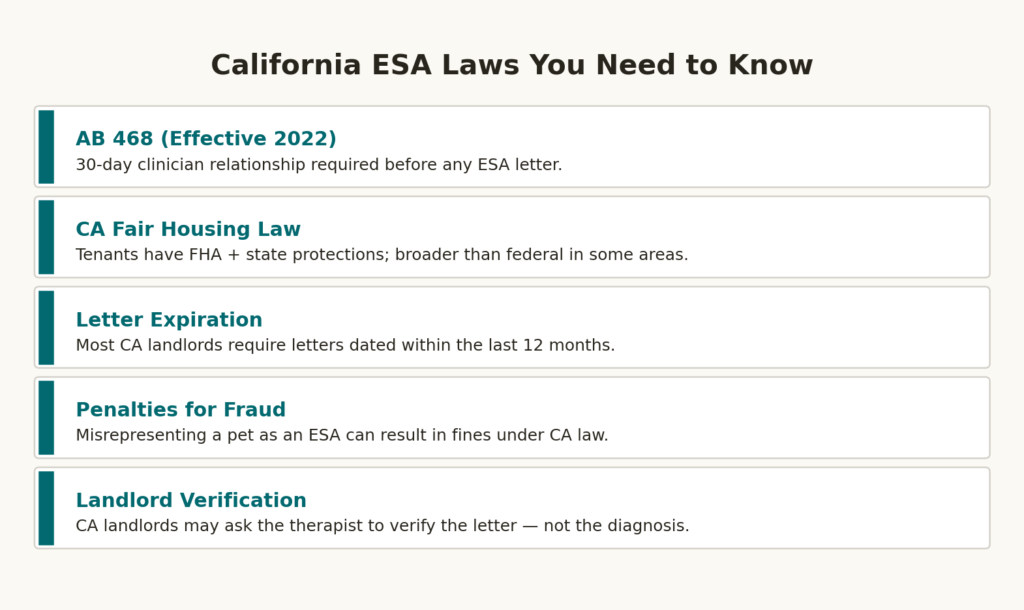
Before AB 468, faking an ESA situation was mostly a moral problem. Now it’s a legal one. California made fraudulent ESA misrepresentation a criminal misdemeanor — one of the few states to do so — and the consequences are real. If you’re wondering why you should care about getting a proper California ESA letter rather than the cheap online version, this section is why.
The fine under AB 468 is up to $1,000 per violation. That applies to individuals who falsely claim disability status to obtain ESA housing rights, providers who issue a letter without meeting the 30-day relationship and licensure requirements, and websites that sell letters after a cursory online quiz. The law was written broadly enough to reach letter mills operating from other states but targeting California renters.
Why does this matter even if you’re acting in good faith? Because California landlords — especially in major cities — have become significantly more skeptical of ESA documentation since AB 468 passed. A letter from a provider that doesn’t list a California license number, or that was issued after a single day of contact, will likely be challenged. A rejection based on a defective letter isn’t a Fair Housing violation — it’s a landlord doing exactly what the law intended.
The 30-day rule exists precisely to distinguish legitimate therapeutic relationships from transactional letter mills. If your ESA letter was issued the same week you signed up for a service, it probably doesn’t meet AB 468 standards — and a California landlord is right to question it. A letter that does meet those standards carries real legal weight. The wait is worth it.
California ESA law applies statewide under AB 468, but these three cities each have rental market characteristics that ESA renters should understand before submitting their letter.
Los Angeles. If you’re looking for an ESA letter Los Angeles renters can use, AB 468 applies — there’s no separate LA city law adding requirements. But the LA rental market is massive and competitive, and landlords in high-demand neighborhoods scrutinize ESA documentation carefully. Large apartment complexes managed by professional property companies will typically have a formal accommodation request process and know exactly what a valid California ESA letter looks like. Smaller independent landlords may push back incorrectly. Know when a landlord can legally reject an ESA in California before you walk in. Getting your letter from a California-licensed provider ensures your documentation holds up under any challenge.
San Francisco. Here’s a scenario worth telling in detail. A renter in the Mission District was searching for months before finding the right apartment. They connected with an online ESA service that promised quick turnaround, and received their letter within 24 hours of signing up. The landlord — a professional property manager fully familiar with AB 468 — flagged it immediately. The letter was issued before the 30-day period had elapsed, and the provider wasn’t licensed in California. The accommodation request was denied, legally, because the letter simply didn’t meet state requirements. The renter lost the apartment and had to start over. That’s not hypothetical — it’s exactly the situation AB 468 was written to prevent, and it happens to renters every week. San Francisco landlords are sophisticated. Your ESA letter needs to be, too.
San Diego. San Diego has a large military-adjacent renter population, and PTSD-related ESA needs are especially common there. California emotional support animal rules apply equally in San Diego — AB 468’s 30-day requirement, the California license requirement, the misdemeanor penalties. San Diego County also has its own Office of Fair Housing that handles landlord complaints in addition to HUD’s federal process. If a San Diego landlord illegally rejects your valid ESA letter, you have both routes available.
Across all three cities, the fundamentals are the same. California’s ESA requirements don’t vary by city — but how landlords respond certainly does. A properly issued California ESA letter is your strongest protection regardless of which city you’re renting in.
First, don’t panic. A rejection isn’t necessarily the end. Sometimes it’s based on a misunderstanding, sometimes the landlord is bluffing, and sometimes — if your letter has problems — the fix is simply getting a proper letter that meets AB 468 requirements.
Step one: find out why they rejected it, in writing. A California landlord is required to give you a reason. If they say your letter doesn’t meet AB 468 requirements, review the letter carefully: valid California license number, 30-day relationship, proper letterhead, explicit therapeutic benefit statement. If they can’t give a legal reason or cite a personal preference, that’s a red flag that the denial itself is the violation.
Step two: if your letter is solid and the denial is unfounded, respond in writing stating that you believe the denial violates the California Fair Employment and Housing Act and the federal Fair Housing Act (FHA). Reference HUD’s guidance on assistance animals. Keep copies of everything.
Step three: file a complaint. You have two routes. Federally, you can file with HUD’s Office of Fair Housing and Equal Opportunity (FHEO) at HUD.gov — it’s free, and the window is one year from the date of denial. At the state level, file with the California Civil Rights Department (formerly DFEH). California’s process sometimes moves faster than the federal one.
Many fair housing attorneys in California take ESA discrimination cases on contingency — meaning you pay nothing unless they win. A consultation can tell you exactly where you stand. And if you’re starting fresh, you can get a California ESA letter that meets every AB 468 requirement through PetESALetter — avoiding this situation entirely.
Get the denial in writing and document the stated reason
Review your letter against AB 468 requirements (CA license, 30-day relationship, letterhead)
Respond in writing citing FEHA and FHA protections and HUD guidance
File with HUD’s FHEO (federal) and/or the California Civil Rights Department (state)
Consult a California fair housing attorney — many take ESA cases on contingency
Your state’s rules decide whether your letter holds up. Get matched with a clinician licensed where you live, who knows the requirements that apply to you.
The state doesn’t set an official expiration date, but most ESA letters California landlords accept are considered current for one year from the date of issue. After that, your landlord can reasonably request an updated letter. Importantly, under AB 468, getting a new letter requires re-establishing the 30-day therapeutic relationship with a California-licensed LMHP. Maintain an ongoing relationship with your provider and renewals are straightforward.
Yes, but only on narrow legal grounds: if your specific animal poses a direct, documented threat; if it has already caused substantial property damage; or if the housing falls under a limited statutory exemption. A landlord cannot reject your ESA based on breed, size, other tenants’ preferences, or personal discomfort. A blanket policy is not a legal basis for denial in California.
At minimum, 30 days from your first clinical session with a California-licensed LMHP. That’s the mandatory waiting period under AB 468 before a letter can legally be issued. The actual timeline depends on session scheduling and your provider’s process. Services like PetESALetter that work with California-licensed therapists guide you through efficiently — but no legitimate California provider can hand you an ESA letter on day one. That 30-day wait is the law.
No. Under AB 468, the LMHP who issues your California ESA letter must hold a valid California license. A therapist licensed only in another state — even if fully reputable there — cannot legally issue one. Letters from out-of-state providers will not hold up under scrutiny, and a California landlord is within their rights to reject a letter that doesn’t include a valid California license number.
Under AB 468, misrepresenting an animal as an emotional support animal — or falsely claiming disability status to obtain ESA housing rights — is a criminal misdemeanor with fines up to $1,000. This applies to both renters presenting fraudulent documentation and providers who issue letters without the required 30-day relationship and California licensure. California is one of the few states with actual criminal consequences for fake ESA letters.
Yes. Both California ESA law and the federal Fair Housing Act require landlords to evaluate ESA accommodation requests individually — never based on breed. A blanket ban on pit bulls or any other breed cannot be legally applied to an ESA in California. The landlord can only deny based on your specific animal’s documented behavior, not its breed. Submit a valid California ESA letter and the breed-ban policy simply doesn’t apply to your animal.
No. There is no official California ESA registry. No state or local agency requires ESA registration, and “registration certificates” or ESA ID cards have no legal value. The only documentation that matters under California ESA law is a valid letter from a California-licensed LMHP who has maintained at least a 30-day therapeutic relationship with you. Don’t pay for registration — invest in getting the right letter from the right provider.
Don’t risk a fake letter Get your FHA-compliant ESA letter today from a licensed mental health professional. 100% money-back guarantee. |

Licensed Psychotherapist
Darren is a leading expert in mental health advocacy and assistance animal documentation. He specializes in streamlining the process for obtaining ESA Letters, PSD Letters, and State-specific ESA compliance.
Lorem ipsum dolor sit amet, consectetur adipiscing elit. Ut elit tellus, luctus nec ullamcorper mattis, pulvinar dapibus leo.

ESA Letters Issued

Successful Consultations

Licensed Therapist Network

Client Satisfaction Rate




Petesaletter.com helps you get your emotional support animal letter online with guidance and support.

Got Questions? Call us 24/7
Copyright © 2020-2026 Petesaletter All rights reserved. Terms | Privacy | Refund
Owned and Operated by Verimedix LLC