Difference Between Service Dogs and Emotional Support Animals (ESAs)
Last Updated on: August 14, 2026
Reviewed by Darren Andrew Rafel
Licensed Agent
@ Petesaletter
Understanding the difference between service dogs and ESAs (emotional support animals) is essential if you rely on an animal for mental or physical support. While both provide comfort and assistance, they are legally, functionally, and practically very different.
Many people confuse these two categories, which can lead to issues with housing, travel, and public access. In this complete guide, we’ll break down everything you need to know — from legal rights and training requirements to benefits and how to qualify.
What Is a Service Dog?
A service dog is a specially trained dog that performs specific tasks to assist individuals with disabilities. These disabilities can be physical, sensory, psychiatric, intellectual, or mental.
Examples of Service Dog Tasks:
Guiding individuals who are visually impaired
Alerting deaf individuals to sounds
Detecting seizures before they occur
Providing support during anxiety or panic attacks
Retrieving items for individuals with mobility issues
Service dogs are protected under laws like the Americans with Disabilities Act (ADA), which grants them access to public places such as restaurants and stores; on airplanes, they are covered by the Air Carrier Access Act (ACAA).
What Is an Emotional Support Animal (ESA)?
An emotional support animal (ESA) provides comfort and emotional stability to individuals dealing with mental health conditions such as anxiety, depression, PTSD, or stress disorders.
Unlike service dogs, ESAs:
Do not require specialized training
Provide support through companionship
Require an ESA letter from a licensed mental health professional
ESAs are primarily protected under housing laws, allowing individuals to live with their animals even in no-pet housing.
Difference Between Service Dogs and ESAs
Here’s a clear comparison of the difference between service dogs and emotional support animals:
Feature
Service Dog
Emotional Support Animal (ESA)
Training
Extensive task-based training
No formal training required
Purpose
Performs specific tasks
Provides emotional comfort
Legal Protection
ADA + full public access
Limited (mainly housing rights)
Species
Dogs (and, in some cases, miniature horses)
Any animal (dog, cat, etc.)
Airline Access
Allowed in cabin for free
Treated as pet (fees apply)
This distinction is crucial when traveling, renting housing, or accessing public spaces.
What Is the Difference Between a Service Dog and an Emotional Support Dog?
A service dog is trained to actively assist with a disability, while an emotional support dog provides passive emotional comfort.
For example:
A service dog may stop a panic attack by applying pressure or guiding the owner
An ESA provides comfort simply by being present
Because service dogs perform specific tasks, they are granted broader legal rights.
Can Any Dog Be a Service Dog?
No, not every dog can become a service dog.
Requirements for Service Dogs:
Must undergo extensive professional training
Must be able to perform specific tasks related to a disability
Must have a calm and obedient temperament
Must behave appropriately in public settings
While any breed can potentially be trained, not all dogs have the temperament or ability required for service work.
Can My Dog Be a Service Dog for Anxiety?
Yes, but only under certain conditions.
If your dog is trained to perform tasks that directly help with anxiety, such as:
Interrupting panic attacks
Providing grounding techniques
Alerting to rising anxiety levels
Then your dog may qualify as a psychiatric service dog (PSD).
However, if your dog simply provides comfort without task-based training, it is considered an emotional support animal, not a service dog.
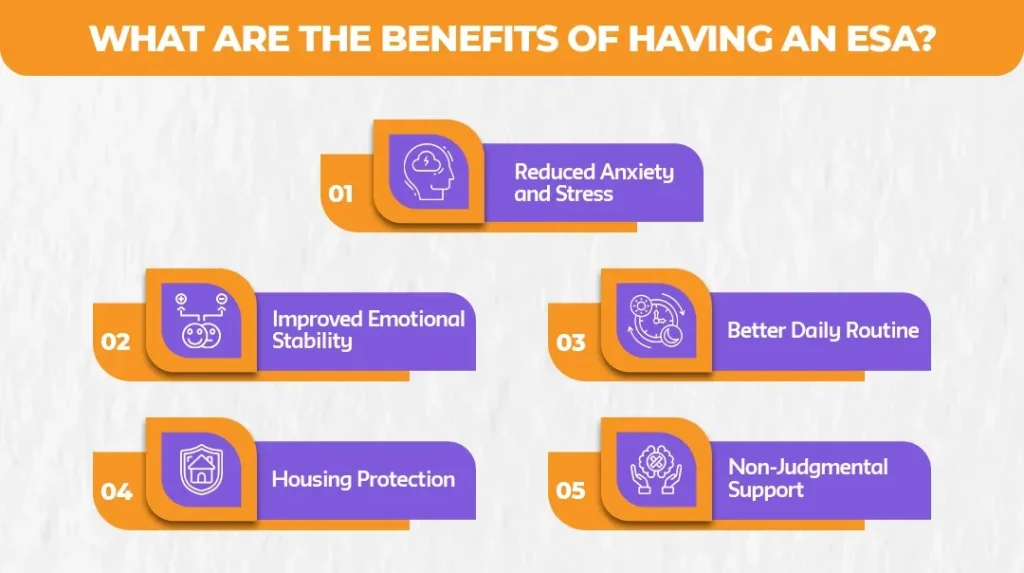
What Are the Benefits of Having an ESA?
Emotional support animals offer a wide range of mental health benefits:
1. Reduced Anxiety and Stress
The presence of an ESA can lower cortisol levels and promote relaxation.
2. Improved Emotional Stability
ESAs provide companionship, reducing feelings of loneliness and depression.
3. Better Daily Routine
Caring for an animal helps establish structure and purpose.
4. Housing Protection
With a valid ESA letter, landlords must accommodate your ESA even in no-pet housing.
5. Non-Judgmental Support
ESAs provide unconditional companionship without judgment.
How to Tell If a Dog Is an Emotional Support Dog
Unlike service dogs, ESAs do not have official certification or visible identification.
Ways to Identify an ESA:
The owner has a valid ESA letter from a licensed professional
The dog provides emotional comfort rather than performing tasks
There is no legal requirement for vests or ID cards
Be cautious — many online “registries” are not legally recognized. The only legitimate documentation is an ESA letter.
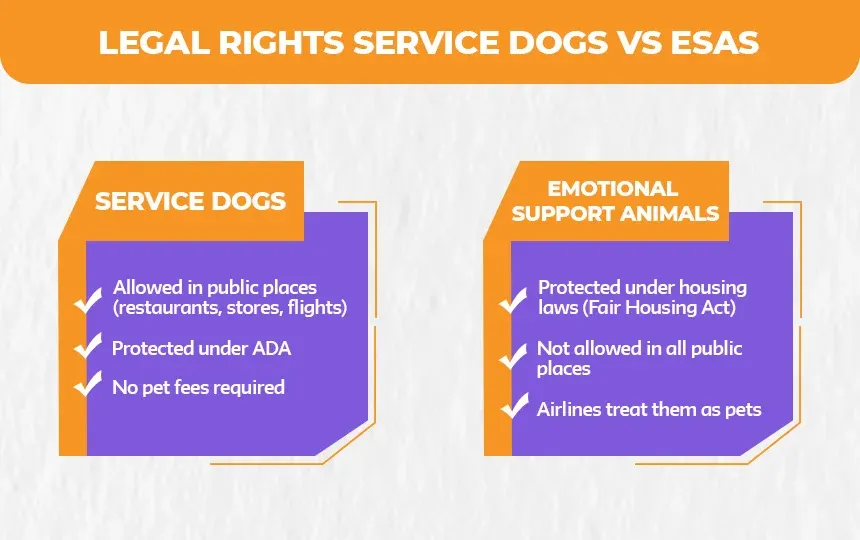
Legal Rights: Service Dogs vs. ESAs
Understanding legal rights is essential:
Service Dogs
Allowed in public places (restaurants, stores, flights)
Protected under ADA
No pet fees required
Emotional Support Animals
Protected under housing laws (Fair Housing Act)
Not allowed in all public places
Airlines treat them as pets
Training Requirements
Service Dogs
Require extensive training (often 1–2 years)
Must perform specific disability-related tasks
ESAs
No training required
Focus on emotional companionship
Choosing Between a Service Dog and an ESA
The right choice depends on your needs:
Choose a Service Dog If:
You need assistance with daily tasks
You require full public access
You can commit to training
Choose an ESA If:
You need emotional support and companionship
You want housing protection
You don’t require task-based assistance
Common Misconceptions
Myth 1: ESAs Have the Same Rights as Service Dogs
False. ESAs have limited legal protections.
Myth 2: Any Pet Is Automatically an ESA
False. You need a valid ESA letter.
Myth 3: Service Dogs Don’t Need Training
False. Training is essential for service dogs.
Get Your ESA Letter Today
If you’re looking for emotional support and want to qualify your pet as an ESA, the first step is getting a legitimate ESA letter.
At PetESALetter, we connect you with licensed professionals who evaluate your needs and provide legally compliant ESA letters quickly and securely.
Visit PetESALetter today and take the first step toward better mental health and emotional support.
Enjoy the comfort, companionship, and legal protection you deserve with your emotional support animal.
Not sure which document you actually need? A licensed clinician can tell you whether an ESA letter or a PSD letter fits your situation — before you pay for the wrong one.
🐾 100% Risk-Free Guarantee (full refund if you don’t qualify, or if your landlord rejects the letter)
🐾 Clinician-led assessment of which documentation fits your needs
🐾 No task-training claims we can’t support — just an honest evaluation
Yes, if it is trained to perform specific tasks related to anxiety. Otherwise, it is considered an ESA.
THE AUTHOR
Darren Andrew Rafel
LMFT, LCSW, LMHP
Licensed Psychotherapist
Darren is a leading expert in mental health advocacy and assistance animal documentation. He specializes in streamlining the process for obtaining ESA Letters, PSD Letters, and State-specific ESA compliance.