
Last Updated on: August 14, 2026
Reviewed by Darren Andrew Rafel

Quick answer: A legitimate ESA letter comes from a licensed mental health professional (LMHP) who has actually evaluated you. It’s on official letterhead, includes the provider’s license number and state of issue, and is dated within the past 12 months. Anything that skips the consultation, costs $29, or arrives as an instant PDF is almost certainly a scam.
There are a lot of ESA letters floating around — and a scary number of them aren’t worth the paper they’re printed on. If you’ve ever typed “ESA letter” into a search engine, you’ve probably seen sites promising a legitimate ESA letter in minutes, no appointment needed, for the price of a pizza. That’s not how a legitimate ESA letter works.
A legitimate emotional support animal letter is a clinical document. It has to come from a real, licensed mental health professional who actually knows you — not an algorithm, not a customer service rep overseas, not a PDF template anyone can download for $29. Landlords are getting smarter about spotting fakes, and a bad letter won’t just fail to help you — it can actively damage your credibility.
This guide is your decoder ring. We’ll walk through every element a real ESA letter must have, the six red flags that give scam sites away, and exactly how landlords do ESA verification when they receive your paperwork. By the end, you’ll know whether you have a legitimate ESA letter or a fraudulent one — in about 60 seconds.
A legitimate ESA letter is a clinical document — not a form, not a certificate, and definitely not a registration. It’s issued by a licensed mental health professional (LMHP) who has conducted a real assessment and determined that you have a qualifying mental or emotional disability and that an emotional support animal provides meaningful therapeutic benefit.
The legal basis is the Fair Housing Act (FHA), enforced by the U.S. Department of Housing and Urban Development (HUD). Under HUD’s guidance on assistance animals, landlords are required to honor a legitimate ESA letter as documentation for a reasonable accommodation request. The word “legitimate” is doing a lot of work in that sentence — because HUD’s guidance also makes clear that landlords can question letters that don’t appear to come from a genuine therapeutic relationship.
Here’s what that means in practice: a letter generated by a website five minutes after you answer a ten-question quiz isn’t a legitimate ESA letter. It’s a piece of paper dressed up to look like one. Courts and landlords have seen enough of these to know the difference — and a fake letter can get your accommodation request denied outright.
An authentic ESA letter demonstrates that a real clinician — a licensed therapist, psychologist, clinical social worker, or psychiatrist — knows who you are, has reviewed your mental health needs, and has determined that an ESA is appropriate for your situation. That relationship is what gives the letter its legal weight. Without it, you’ve got a printout. Valid ESA letters are clinical records; everything else is a prop.
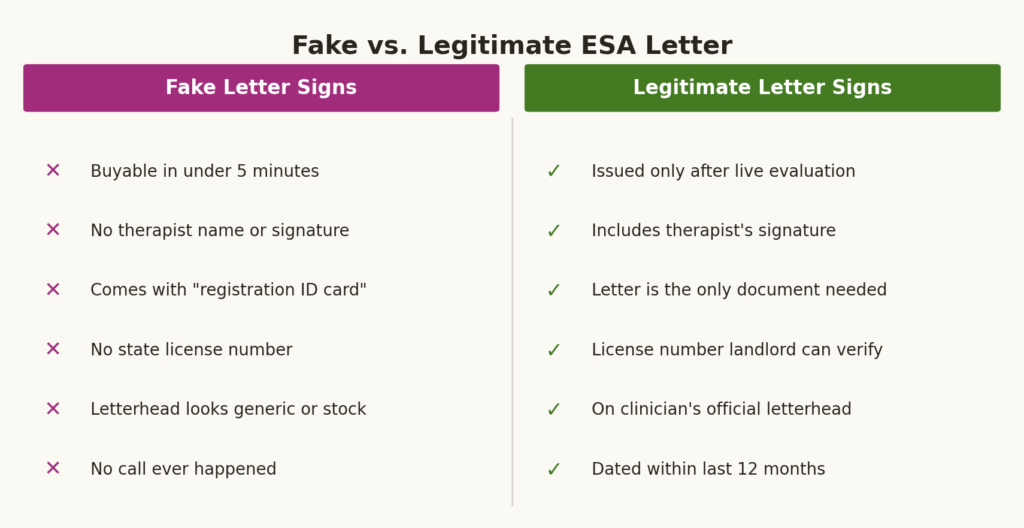
Think of a legitimate ESA letter like a legal contract: every element serves a purpose, and a missing piece can make the whole thing unenforceable. When you receive any ESA letter — from any source — hold it up against this list before you hand it to a landlord.
Here’s what every valid ESA letter absolutely must contain. If yours is missing any of these six elements, don’t submit it. Fix it first. Getting these details right is how to verify an ESA letter’s legitimacy before your landlord does it for you.
LMHP signature: The letter must be personally signed — wet signature or secure digital signature — by the licensed mental health professional who evaluated you. A typed name at the bottom doesn’t cut it. The signature confirms the clinician reviewed your case and stands behind the recommendation.
License number: The LMHP’s professional license number must appear on the letter. This is how a landlord — or anyone else — can verify that the person who signed is actually licensed and in good standing in their state. No license number means the letter can’t be verified. Full stop.
State of issue: The letter should clearly identify the state in which the LMHP holds their license. Licensure is state-specific, so a therapist licensed in Florida can’t legitimately issue ESA letters for a client in Oregon unless they hold licenses in both states. This detail matters for ESA verification.
Date: An authentic ESA letter is dated, and that date has to be within the last 12 months. ESA letters don’t have indefinite shelf lives — HUD and most landlords consider letters older than a year to be expired. Undated letters are a red flag on their own.
Letterhead: A legitimate ESA letter appears on the LMHP’s official professional letterhead, showing their practice name, address, phone number, and contact information. A letter typed in a generic Word document with no identifying information isn’t professional documentation — it’s a rough draft.
Specific accommodation language: The letter should state that you have a disability as defined under the FHA and that you require the emotional support animal as a reasonable accommodation for that disability. It doesn’t need to name your diagnosis — but it has to clearly connect your disability to the need for the animal.
Picture this: a renter paid $29 online for what he was promised was a real ESA letter. The site had a convincing logo and five-star reviews. He answered twelve questions, uploaded a photo of his dog, and had a PDF in his inbox twenty minutes later. When he submitted it to his apartment complex, the property manager looked at it for thirty seconds and rejected it. No license number. No letterhead. No clinical language. He was out $29 and back to square one — now with a skeptical landlord who flagged his file.
His story isn’t unusual. Scam ESA sites have been around since the letters became mainstream, and they’ve gotten good at looking legitimate to the untrained eye. Here are the six warning signs that should stop you cold.
No license number on the letter: A legitimate mental health professional is proud of their credentials. If the letter doesn’t include a license number you can look up with your state’s licensing board, it wasn’t written by a verified clinician — or if it was, something went wrong. Either way, don’t use it.
No professional letterhead: Real clinicians issue documents on letterhead with their name, practice, address, and contact information. A generic white document with a logo slapped at the top isn’t letterhead. A legit ESA letter looks like it came from a professional office — because it did.
Instant PDF with no consultation: An ESA assessment takes time. A licensed professional needs to review your mental health history, ask questions, and make a clinical determination. If you clicked “buy” and got a letter in under an hour with no video call, no phone call, and no real exchange with a clinician, that letter didn’t come from a genuine assessment.
“Registration” upsells: There is no federal ESA registry. There is no state ESA registry. ESA registration doesn’t exist as a legal concept — it has zero standing under the FHA. Any site upselling “ESA registration,” ID cards, vests, or certificates alongside your letter is selling you something that’s worthless, and probably selling you a worthless letter too.
Suspiciously low prices: A real consultation with a licensed mental health professional costs money. It’s not free, and it’s not $29. Typical legitimate ESA letter services range from $100 to $200 or more — because they involve actual clinician time. A $29 price tag is advertising that no real clinician was involved.
Foreign call centers or no contact info: If the “support team” you reach by phone has no idea what state they’re in, or if the site lists no physical address or verifiable contact, that’s a major warning sign. Legitimate services employ US-licensed clinicians and have real, reachable contact information. If you can’t figure out who actually wrote your letter, neither can your landlord.
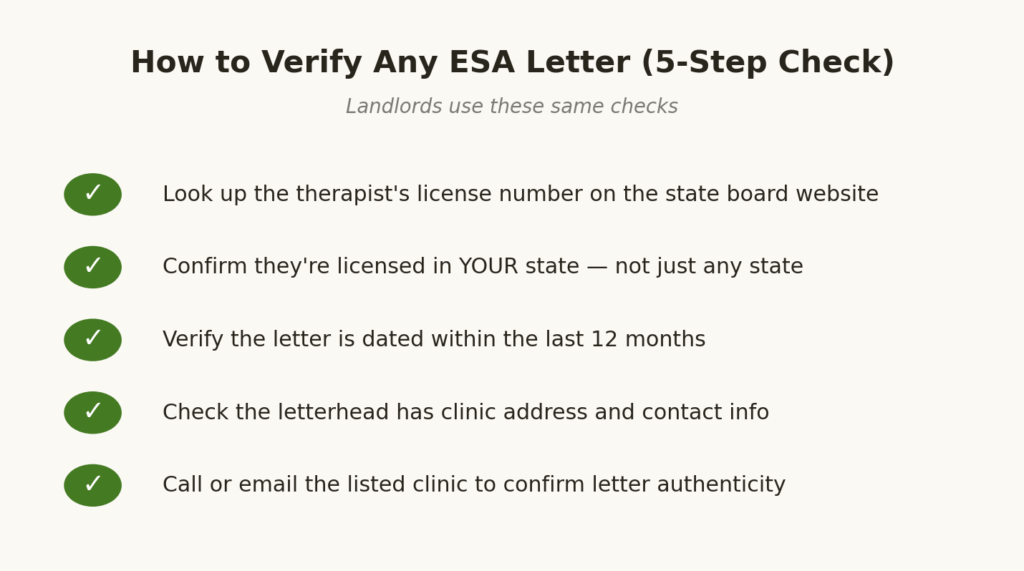
Landlords don’t just read ESA letters — the careful ones verify them. Understanding how landlords verify ESA letter authenticity is critical for you too, because knowing what your landlord will check helps you avoid submitting anything that won’t hold up. If you’ve ever wondered whether your legitimate ESA letter would survive scrutiny, this section answers that.
The first thing a landlord typically does is look for the LMHP’s license number and cross-reference it with the licensing board database for the state listed on the letter. Every US state has a publicly searchable database of licensed mental health professionals. If the license number doesn’t match the name on the letter, or if there’s no license number at all, the letter fails immediately.
Next, they’ll check the date. A letter dated more than 12 months ago is considered expired by most property managers — and many large apartment companies have this as an explicit policy. Fresh documentation signals an ongoing therapeutic relationship, which is what HUD actually wants to see.
Here’s the part no one tells you about: some larger property management companies now use third-party ESA verification services — companies that specialize in reviewing ESA documentation for housing providers. These services flag missing elements, check license databases automatically, and rate the letter’s credibility. A letter from a scam site often fails this review in seconds.
What a landlord cannot do is call your therapist to discuss your diagnosis, demand your medical records, or require that your letter come from a specific provider. But they can — and often do — look up whether the provider exists and is licensed. That’s completely within their rights under HUD guidance, and it’s exactly why every element on a legitimate ESA letter needs to be real and verifiable.
First: don’t panic, and don’t submit the letter. Using a letter you know to be fraudulent can complicate your housing situation far more than simply not having a letter at all. Some states have laws against misrepresenting an emotional support animal, and knowingly submitting a fake clinical document to a landlord creates real legal exposure. A legit ESA letter takes a bit longer to obtain — but that’s always the right trade-off.
What you should do is get a real one — fast. The process for a legitimate emotional support animal letter through a reputable online service is faster than most people expect. You’ll typically schedule a short consultation with a licensed therapist, complete an intake questionnaire, have a real assessment, and receive your letter within 24 to 48 hours. That’s not instant, but it’s quick. And because you’re working with an actual clinician, the letter will hold up to scrutiny.
If you paid for a fake letter, dispute the charge with your credit card company if possible — many of these sites don’t deliver what they promise, which is grounds for a chargeback. You can also report the site to the Federal Trade Commission (FTC) and your state attorney general. These scam operations target vulnerable people, and reports do lead to enforcement actions.
Requirements differ by state too. Check your state’s specific rules on our ESA letters by state hub — some states have additional standards that your letter needs to meet beyond the federal baseline.
The bottom line: a fake letter wastes your money and your time. A real consultation takes maybe 30 minutes and produces a legit ESA letter that actually works. The detour through a scam site costs more — in every sense — than going to a legitimate service in the first place.
The safest path to a legitimate ESA letter is through a licensed mental health professional in your state — either your own existing therapist or a reputable online ESA letter service that employs state-licensed LMHPs. The key word is “employs”: you want a service where a real clinician is doing a real evaluation, not a website that auto-generates PDFs.
When you’re vetting a service, ask these questions before you pay. Is the consultation with a licensed professional, and can I verify their license? What state are they licensed in? Will I receive a letter on official letterhead with the provider’s license number and signature? Is there a money-back guarantee if the letter isn’t accepted?
A legitimate service will answer all of those questions confidently. A scam site will dodge them, give vague answers, or just keep pushing you to click “buy now.”
At PetESALetter, every assessment is conducted by a licensed mental health professional, every letter includes all six required elements, and letters are issued within 24 hours of a completed consultation. The process is straightforward: you complete a quick eligibility quiz, connect with a licensed therapist in your state, complete your assessment, and receive your authentic ESA letter on official letterhead. State-specific requirements are covered too — whether you need a California ESA letter, a Texas ESA letter, or documentation for any other state, the clinician assigned to you holds the appropriate state license.
Don’t shortcut this. A legitimate ESA letter is a legal document that has to hold up to a landlord’s scrutiny, and possibly HUD’s. Get it right the first time — because the cost of fixing a bad letter is always higher than getting a real one upfront.
Want a letter that survives verification? Skip the registry scams and get documentation backed by an actual licensed clinician who can be looked up and confirmed.
Check for six things: your provider’s name and professional license number, the state of licensure, official letterhead with contact info, a wet or digital signature, a current date (within the last 12 months), and specific FHA accommodation language. If your letter came from a site that issued it instantly with no real consultation, it’s almost certainly not a legitimate ESA letter. Look up the license number on your state’s licensing board website to confirm.
Yes — and many do. Landlords can look up the LMHP’s license number on the state licensing board’s public database, check that the date is current, and confirm the letter contains all required elements. Some larger property management companies now use third-party ESA verification services that flag incomplete or suspicious letters automatically. What landlords cannot do is contact your therapist to discuss your diagnosis or demand your medical records.
A fake ESA letter is one that wasn’t issued by a licensed mental health professional who actually evaluated you. The most common signs: no license number, no professional letterhead, no real consultation before the letter was issued, and a price that’s suspiciously low (think $29 to $49). Any letter generated automatically after a short online quiz — with no real clinician involvement — is not a valid ESA letter under HUD standards.
An online ESA letter can be a completely legitimate ESA letter — if it comes from a real licensed mental health professional practicing in your state who has conducted an actual assessment. The delivery method (online vs. in-person) doesn’t determine legitimacy. What matters is the clinician behind the letter. Online services that connect you with a licensed therapist for a real consultation produce authentic, valid ESA letters. Sites that sell instant PDFs do not.
Yes. A real ESA letter involves a clinical assessment by a licensed professional, and that takes time and expertise. Expect to pay $100 to $200 or more for a legitimate service. If a site offers a letter for under $50 with no real consultation, that price reflects what you’re getting: no real clinician involvement. The cost of a legitimate letter is far less than the cost of a rejected accommodation request or a housing dispute.
A legitimate ESA letter is a clinical document from a licensed mental health professional — it’s the only documentation that has legal standing under the Fair Housing Act. “ESA certification,” “ESA registration,” and “ESA ID cards” don’t exist as legal categories. There is no federal or state ESA registry. Any site selling registration, certification badges, or ID cards is selling something that landlords don’t have to recognize and courts won’t uphold.
Most landlords and property managers treat an ESA letter as current for 12 months from the date it was issued. HUD doesn’t set a specific expiration date in its guidance, but ongoing documentation is expected to reflect an ongoing therapeutic relationship — which means an annual renewal is standard practice. If your letter is older than a year, renew it before submitting a new accommodation request or moving to a new property.
Don’t risk a fake letter Get your FHA-compliant ESA letter today from a licensed mental health professional. 100% money-back guarantee. |

Licensed Psychotherapist
Darren is a leading expert in mental health advocacy and assistance animal documentation. He specializes in streamlining the process for obtaining ESA Letters, PSD Letters, and State-specific ESA compliance.

ESA Letters Issued

Successful Consultations

Licensed Therapist Network

Client Satisfaction Rate




Petesaletter.com helps you get your emotional support animal letter online with guidance and support.

Got Questions? Call us 24/7
Copyright © 2020-2026 Petesaletter All rights reserved. Terms | Privacy | Refund
Owned and Operated by Verimedix LLC