
Last Updated on: August 14, 2026
Reviewed by Darren Andrew Rafel

Managing a physical disability often comes with visible tools: a cane, a wheelchair, a guide dog in a vest. Managing a mental health disability rarely comes with anything visible at all — yet for millions of people living with PTSD, panic disorder, or major depression, a psychological service dog can be just as essential as a wheelchair is to mobility. These dogs are not pets that happen to be comforting. They are working animals, trained to perform specific, measurable tasks that interrupt and mitigate psychiatric symptoms in real time.
A psychological service dog (also called a psychiatric service dog or PSD) is a service animal individually trained to perform specific tasks that directly mitigate a handler’s mental health disability. Under the Americans with Disabilities Act (ADA), this task-trained work, not simple companionship, is what legally separates a PSD from a pet or an emotional support animal.
The legal journey toward a legitimate Psychiatric Service Dog begins with a medical determination. Under the ADA, your condition must meet the threshold of a disability, and a licensed mental health professional must confirm that a service animal is an appropriate clinical intervention for you.
The ADA defines a service animal narrowly: it must be a dog (or, in limited circumstances, a miniature horse) individually trained to do work or perform tasks directly related to a person’s disability. A psychological disability service dog must meet this same bar: the handler’s condition has to substantially limit one or more major life activities, and the dog’s trained tasks must directly address that limitation.
This is the core legal distinction behind every claim involving a service dog for psychological disabilities: comfort alone does not qualify. The dog must do something trained and observable.
A wide range of clinically diagnosed conditions can meet the ADA threshold when they substantially limit daily functioning. Common qualifying conditions include:
Post-Traumatic Stress Disorder (PTSD): including combat-related, assault-related, and complex trauma presentations.
Severe Panic Disorder: marked by recurring, debilitating panic attacks.
Major Depressive Disorder: when symptoms substantially limit daily activity.
Bipolar Disorder: particularly where manic or depressive episodes create safety risks.
Obsessive-Compulsive Disorder (OCD): where compulsions or intrusive thoughts are functionally disabling.
The phrase “emotional support animal vs. psychological service dog” gets confused constantly — and the confusion has real legal consequences. The table below breaks down the differences side by side.
| Factor | Psychological Service Dog (PSD) | Emotional Support Animal (ESA) | Legal Basis | Key Takeaway |
|---|---|---|---|---|
| Training Required | Must perform specific, learned tasks tied to a disability | No task training required; presence alone provides comfort | ADA Title III | Task training is the legal dividing line |
| Public Access (ADA) | Yes — restaurants, stores, hospitals, transit | No public access rights outside housing | ADA Title II/III | Only PSDs may accompany handlers everywhere |
| Housing Protections (FHA) | Covered as a service animal | Covered with proper documentation | Fair Housing Act | Both qualify for reasonable housing accommodation |
| Air Travel Rights (DOT) | Cabin access under DOT rules with required forms | No guaranteed cabin rights; airline discretion applies | DOT Air Carrier Access Act | Always confirm current airline policy before booking |
| Species Limitations | Dogs (and in limited cases, miniature horses) | No species restriction under FHA guidance | ADA / FHA | ESAs allow more species flexibility |
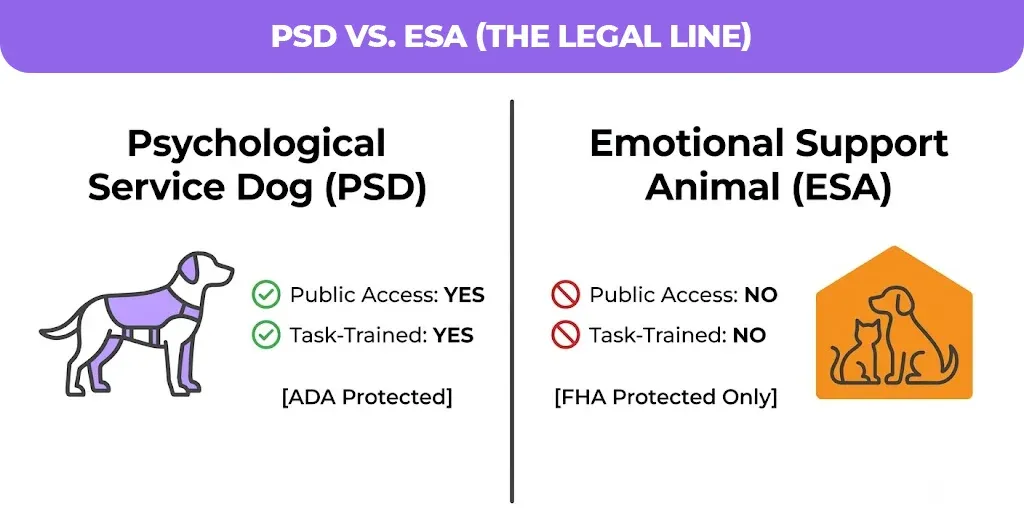
An ESA provides benefits simply through its presence — there is no task requirement under the Fair Housing Act. A psychological service dog, by contrast, must execute an active, trained behavior on cue or in response to a specific physiological or environmental trigger. That distinction is what gives PSDs ADA public access rights that ESAs do not have.
Psychiatric service dog benefits include legal access to restaurants, retail stores, hospitals, and public transit — places ESAs generally cannot accompany their handlers. ESA protections are narrower, focused primarily on housing accommodations under the Fair Housing Act rather than public spaces.
Online “service dog registries,” ID cards, and certificates are not recognized under the ADA and carry zero legal authority. No national registry exists, and purchasing one will not make an untrained pet a legitimate service dog. The only thing that confers legal status is genuine task training tied to a diagnosed disability.
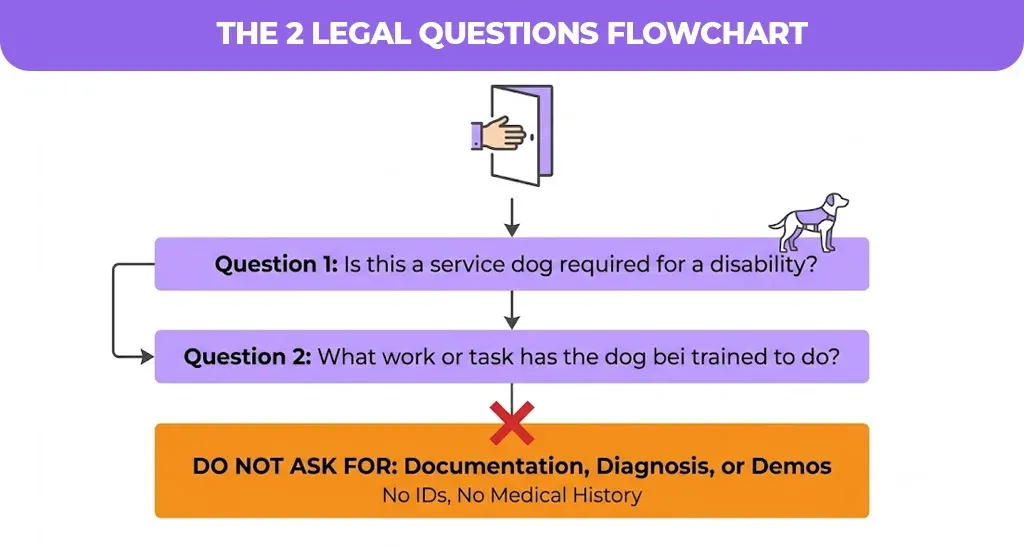
Under the ADA, a business owner is legally permitted to ask only two questions of a handler: (1) is the dog a service animal required because of a disability, and (2) what work or task has the dog been trained to perform. Staff cannot demand documentation, ask about the handler’s diagnosis, or require a demonstration of the task.
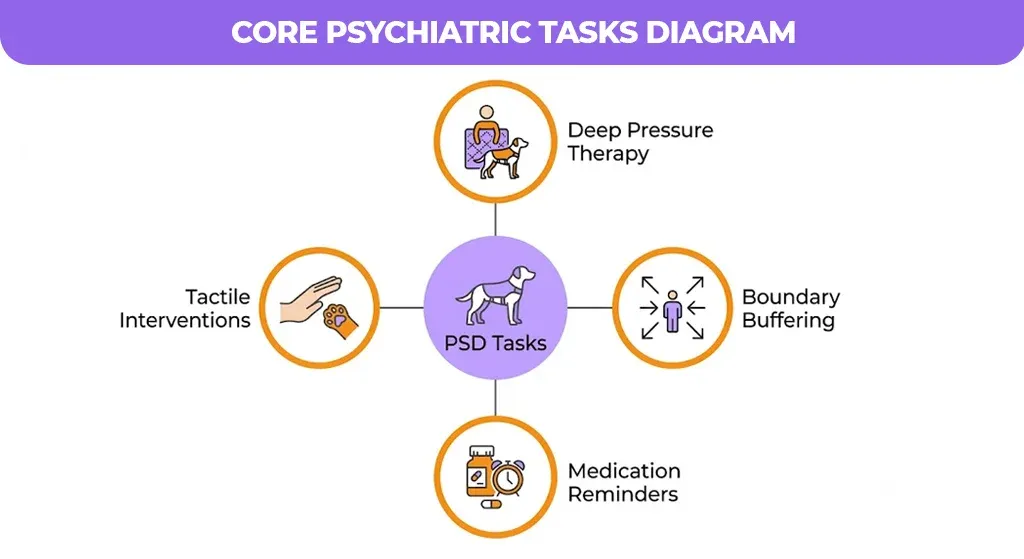
True psychological service dog tasks go well beyond emotional comfort; they are concrete, trainable behaviors with a physiological effect on the handler.
Deep Pressure Therapy (DPT): the dog applies its body weight across the handler’s lap or chest during a panic episode, which can help lower heart rate and cortisol output by activating the parasympathetic nervous system.
Tactile Interventions: nudging, licking, or pawing to interrupt self-harm behaviors, dissociative episodes, or manic hyper-fixation before they escalate.
Room Reconnaissance & Boundary Buffering: the dog positions itself to create physical space in crowds, reducing trigger exposure for handlers with social anxiety or PTSD.
Medication & Reality Reminders: retrieving medication on an alarm cue, or waking a handler from severe night terrors or dissociative states.
For anxiety, psychological service dog tasks typically center on grounding techniques deployed during high-cortisol spikes — physical contact, paw taps, or guided pressure that redirects the handler’s attention away from a spiraling panic response.
Organizations accredited by Assistance Dogs International (ADI) provide dogs that arrive fully task-trained. The psychiatric service dog benefits here are significant — proven temperament, professional task conditioning — but waiting lists frequently run multiple years.
Many handlers pursue psychological service dog training directly, working alongside a certified professional behaviorist to shape both public access manners and condition-specific tasks. This path is faster but demands significant time investment.
Not every pet has the temperament for public access work. A candidate dog must show zero aggression, remain calm under unpredictable stimuli, and have the focus to ignore floor-level distractions consistently.
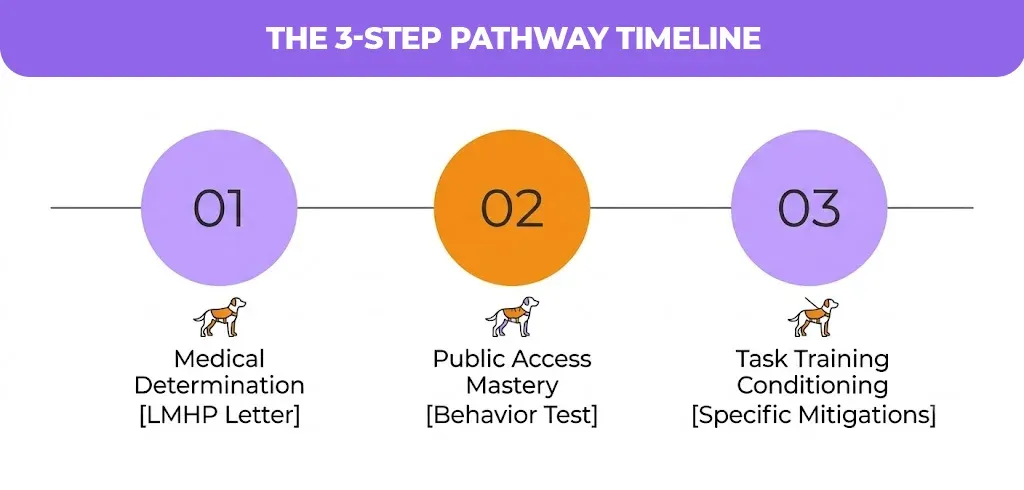
Secure a Medical Determination: Consult a licensed mental health professional (LMHP) to confirm that your condition meets the ADA definition of a disability and that a service dog is an appropriate clinical intervention.
Master Public Access Training: Train the dog to be housebroken, non-aggressive, indifferent to food and floor distractions, and reliably under voice or leash control in any public setting.
Train Condition-Specific Tasks: Condition the dog to perform at least one — ideally several — distinct, trained tasks that directly mitigate your specific psychiatric symptoms when triggered.
Costs vary dramatically depending on the pathway chosen:
Accredited Program Placement: typically $15,000–$30,000+, covering selection, professional task training, and handler instruction — though many ADI-member nonprofits offer the dog at no cost to qualifying applicants through grants and fundraising.
Owner-Training With a Behaviorist: generally $3,000–$10,000, depending on session frequency and the dog’s starting temperament.
Self-Directed Owner Training: the lowest-cost path, requiring primarily time, consistency, and access to public-access training resources.
Several ADI-accredited nonprofits provide fully trained psychiatric service dogs at no cost to qualifying veterans and civilians through grant funding. Waiting lists are long, so early application matters.
A legitimate psychological service dog is defined by rigorous task training and behavioral discipline, not a certificate purchased online. For handlers managing PTSD, panic disorder, depression, or other qualifying conditions, a properly trained PSD can restore a measure of independence that medication and therapy alone sometimes cannot reach.
Are you considering training a psychological service dog? Let us know which tasks would help you most, or ask a question in the comments section below. Petesaletter.com is here to guide you through every step.
Not sure which document you actually need? A licensed clinician can tell you whether an ESA letter or a PSD letter fits your situation — before you pay for the wrong one.
Start with a medical determination from a licensed mental health professional, then move into public access training (housebreaking, distraction-proofing, leash discipline) before layering in condition-specific tasks tied to your diagnosis. There is no registration step — training and reliable task performance are what matter legally.
A psychiatric service dog is a dog individually trained to perform specific tasks that mitigate a handler’s diagnosed mental health disability, such as interrupting panic attacks, providing deep pressure therapy, or retrieving medication. It carries the same ADA public access rights as physical-disability service dogs.
Program-trained dogs from accredited organizations generally cost $15,000 to $30,000 or more, though many nonprofits offer them free to qualifying applicants. Owner-training with professional guidance typically runs $3,000 to $10,000, while fully self-directed training costs primarily time rather than money.
Seizure response and seizure alert dogs are typically classified as medical or neurological service dogs rather than psychological service dogs, though the ADA’s training-and-task standard still applies. Qualification generally requires a documented seizure disorder from a treating physician and training in specific alert or response behaviors, distinct from the psychiatric task categories covered above.
Conditions that substantially limit major life activities can qualify, most commonly PTSD, severe panic disorder, major depressive disorder, bipolar disorder, and OCD. Qualification depends on the severity of functional limitation and a licensed mental health professional’s clinical determination, not the diagnosis label alone.
Ready to legally build your psychiatric service dog pathway? Whether you choose program training or owner training, your clinical eligibility is the foundation. Let Pet ESA Letter help you establish a legitimate professional relationship safely.

Licensed Psychotherapist
Darren is a leading expert in mental health advocacy and assistance animal documentation. He specializes in streamlining the process for obtaining ESA Letters, PSD Letters, and State-specific ESA compliance.

ESA Letters Issued

Successful Consultations

Licensed Therapist Network

Client Satisfaction Rate




Petesaletter.com helps you get your emotional support animal letter online with guidance and support.

Got Questions? Call us 24/7
Copyright © 2020-2026 Petesaletter All rights reserved. Terms | Privacy | Refund
Owned and Operated by Verimedix LLC