
Last Updated on: August 14, 2026
Reviewed by Darren Andrew Rafel
Millions of people manage anxiety, depression, PTSD, and other mental health conditions with the help of a devoted animal companion. Yet the internet is flooded with confusing — and often predatory — information about how to make that relationship official. Between registration scams, questionable certificates, and a major 2026 shift in federal housing policy, understanding your actual rights around an emotional support animal has never mattered more.
An emotional support animal (ESA) is an animal, of any species, that provides therapeutic comfort to a person managing a diagnosed mental or emotional disability. Unlike a service animal, an emotional support animal is not required to perform a specific trained task. Its presence, companionship, and calming effect are themselves what qualify it as a recognized form of disability accommodation.
This guide walks through the real legal framework behind emotional support animals, what the law actually requires, how the process works, and what changed when the federal government updated its enforcement posture in May 2026.
The Americans with Disabilities Act (ADA) sets a narrow, specific standard. Under the ADA, a service animal is limited to a dog — or, in limited circumstances, a miniature horse — that has been individually trained to perform a specific task directly related to a person’s disability.
Guiding a person who is blind, alerting a person who is deaf, interrupting a panic attack, or retrieving items for someone with limited mobility are all examples of trained tasks. Comfort and companionship alone do not meet this bar under ADA emotional support animal rules.
No. This is one of the most searched questions on the topic, and the answer is consistent across every relevant statute: emotional support animals are not service animals. Are emotional support animals service animals under the ADA? No — and are emotional support animals considered service animals under most state public-access laws? Also no.
The dividing line is training, not need. A service animal’s value comes from a specific trained behavior; an ESA’s value comes from the therapeutic relationship itself. Both are legitimate forms of support; they are simply governed by different laws with different levels of public access.
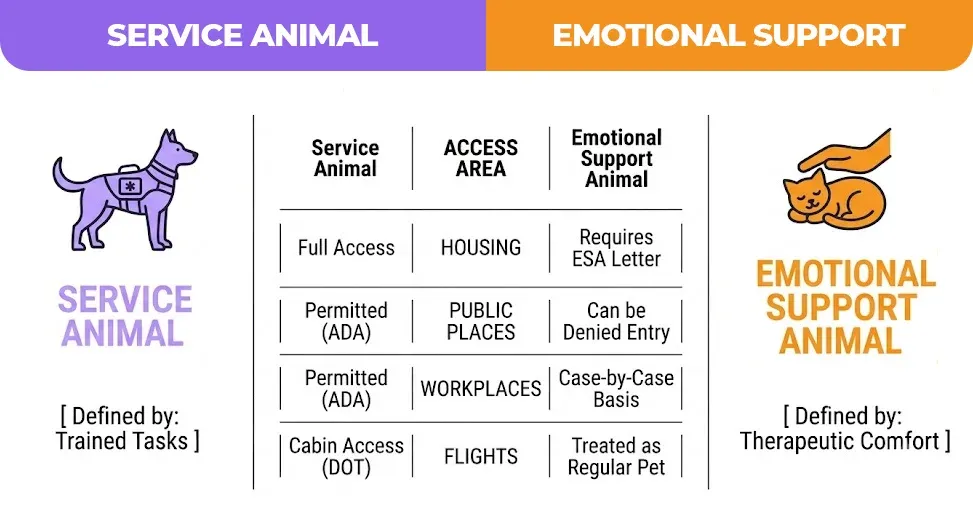
| Access Area | Service Animal | Emotional Support Animal |
|---|---|---|
| Housing | Full access; landlords must waive no-pet rules, size/breed limits, and pet fees. | Reasonable accommodation still applies under the FHA, but since May 22, 2026, HUD federal enforcement prioritizes only individually trained animals. A strong ESA letter is now essential. |
| Flights | No longer guaranteed cabin access under DOT rules; airlines may treat it as a pet or require carrier compliance. | Generally treated as a pet by airlines; no federal in-cabin guarantee under current DOT air travel rules. |
| Restaurants & Public Places | Legally permitted to accompany the handler under the ADA. | Not covered by the ADA; businesses may lawfully decline entry. |
| Workplaces | Employers generally must permit the animal as a reasonable accommodation. | Handled case-by-case under employer policy or the ADA’s broader reasonable-accommodation framework, not guaranteed. |
Service Animal: A dog (or miniature horse) individually trained to perform a specific task for a person with a disability. Governed by the ADA.
Emotional Support Animal: Any animal that provides therapeutic comfort for a diagnosed mental or emotional disability, with no task-training requirement. Governed primarily by the Fair Housing Act.
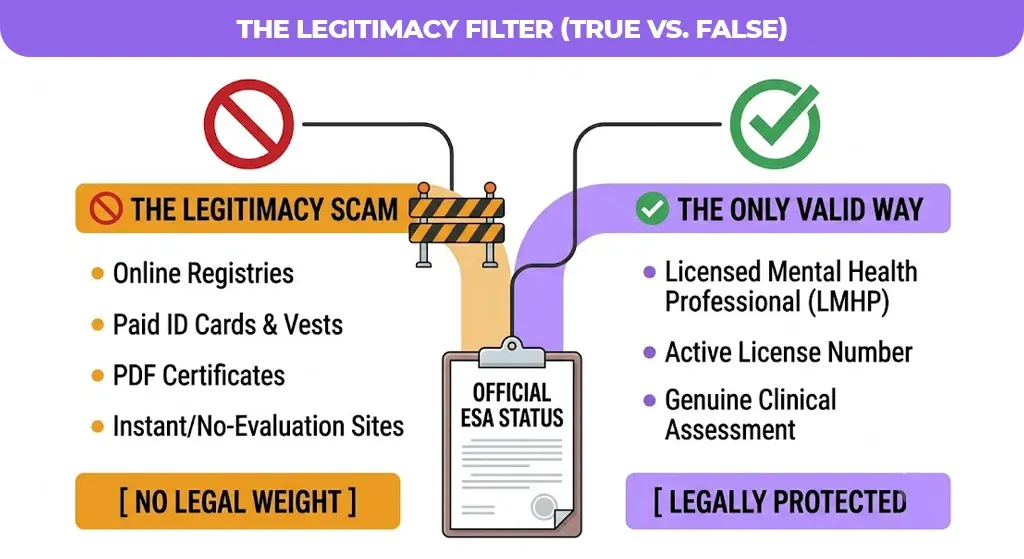
Search terms like “register emotional support animal,” “how to register an emotional support animal,” or “how to register my dog as an emotional support animal” are common — but they describe something that does not legally exist. There is no federal emotional support animal registration database, and no government agency issues an emotional support animal certification.
Websites selling ESA vests, ID cards, or PDF certificates for a one-time fee are selling a product with zero legal standing. Owning one of these items does not entitle an animal to housing protection, does not satisfy any landlord’s legal documentation standard, and will not hold up if challenged.
No federal or state government maintains an official ESA registry.
A vest, badge, or certificate purchased online carries no legal weight on its own.
The only document that matters is a letter written by a licensed mental health professional after a genuine clinical evaluation.
Legitimate emotional support animal paperwork takes exactly one form: an official emotional support animal letter, written on the letterhead of a currently licensed mental health professional (LMHP) who is authorized to practice in your state.
A valid letter identifies the type of license the provider holds, includes their license number and jurisdiction, states the issue date, and confirms — based on a real clinical relationship — that the animal alleviates one or more symptoms of a diagnosed condition. Anything short of this standard is not a recognized emotional support animal letter.
Schedule an LMHP Consultation — Book an appointment with a licensed therapist, psychologist, psychiatrist, or primary care provider. You can search for “emotional support animal near me” locally, or use a telehealth provider licensed specifically in your state.
Undergo a Mental Health Assessment — Discuss your symptoms openly. To satisfy emotional support animal requirements, the provider must evaluate whether your condition meets the Fair Housing Act’s definition of a mental or emotional disability — for example, an emotional support animal for anxiety, depression, or PTSD.
Review and Obtain Your Official Document — If approved, the provider issues an ESA letter that includes their licensing board type, license number, issue and expiration dates, and a statement confirming the animal alleviates symptoms of your diagnosed condition.
Submit a Reasonable Accommodation Request — Deliver the written paperwork to your housing provider proactively, before moving the animal in. Requesting accommodation only after a lease violation has already occurred puts you in a far weaker position.
Tip: Bring documentation of your symptoms and history to your first appointment. A genuine, ongoing relationship with your provider produces a far stronger letter than a single, rushed intake call — and it matters more than ever under the 2026 enforcement standard.
The Fair Housing Act has prohibited housing discrimination against people with disabilities since 1988, and that statute has not been amended. Under its reasonable-accommodation provision, housing providers are generally required to waive no-pet rules, size caps, and breed restrictions for a legitimate emotional support animal, and they cannot charge pet deposits or monthly pet rent for one.
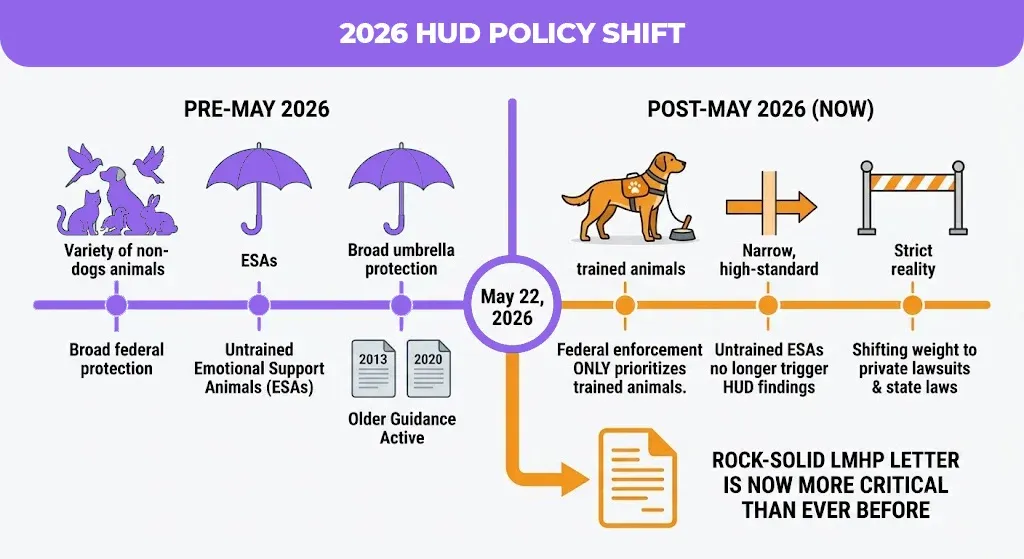
For years, official guidance from the U.S. Department of Housing and Urban Development (HUD) reinforced this broad protection for untrained ESAs. That enforcement guidance — not the underlying law itself — is what changed dramatically in the spring of 2026.
On May 22, 2026, HUD’s Office of Fair Housing and Equal Opportunity (FHEO) issued a memorandum, signed by Assistant Secretary Craig Trainor, that permanently rescinded the agency’s 2013 and 2020 ESA guidance documents. Those older notices had told housing providers to treat untrained emotional support animals essentially the same as trained assistance animals.
Going forward, FHEO will pursue federal enforcement action only in cases involving an animal individually trained to perform a task directly related to the person’s disability — the same training-based standard the ADA already applies to service animals. Comfort, companionship, and emotional support alone no longer trigger a federal enforcement finding.
This is a shift in enforcement priorities, not a change to the statute. Congress has not amended the Fair Housing Act, and no court has ruled that ESAs fall outside its protection. Private individuals can still sue a housing provider directly in federal or state court, and state or local fair housing laws — some of which are broader than the federal standard — remain fully intact and unaffected by the memo.
HUD will generally no longer pursue federal complaints on behalf of tenants with untrained ESAs, shifting more weight onto private lawsuits and state-level protections.
Housing providers are no longer categorically expected to waive pet fees or no-pet policies for untrained ESAs — though case-by-case review continues.
A rock-solid, individualized ESA letter from a real LMHP — not a generic template — is now more important than ever to support any accommodation request.
Securing a legitimate emotional support animal is a clinical process grounded in a real relationship with a licensed provider — not a financial transaction on a registration website. That has always been true, and it matters even more now that HUD’s federal enforcement priorities have narrowed. A well-documented, individualized ESA letter is the strongest protection available to you.
If you believe an emotional support animal could genuinely help you manage a diagnosed condition, the right next step is a real conversation with a licensed mental health professional — not a shortcut.
Think you might qualify? A short assessment with a licensed clinician is the only way to know — and the only route to documentation that actually carries weight.
You qualify for an emotional support animal when a licensed mental health professional determines that you have a mental or emotional disability — one that substantially limits a major life activity, such as an anxiety disorder, depression, or PTSD — and that the animal’s presence alleviates a symptom of that condition. Self-diagnosis or an online quiz does not meet this standard; a genuine clinical evaluation does.
Free or low-cost trained service dogs are typically available through nonprofit service-dog organizations, many of which specialize in a specific disability type, such as mobility impairment, PTSD, or diabetic alert needs. Expect an application process and a waitlist that can run from several months to a few years, since professional task-training is expensive and time-intensive. This is a very different and far more involved path than obtaining an ESA letter, which does not require any formal training program.
Approval largely depends on whether you have a genuine, documented relationship with a licensed mental health provider and a condition that meets the Fair Housing Act’s definition of a disability. The process is not designed to be difficult for someone with a real, diagnosable need, but it is designed to filter out people looking for a shortcut through an online form with no clinical evaluation behind it.
Yes, ADHD can qualify a person for an emotional support animal when it substantially limits major life activities such as focus, emotional regulation, or organization, and a licensed provider determines that an animal companion helps manage those symptoms. Attention-Deficit/Hyperactivity Disorder affects executive function — the brain’s ability to plan, initiate, and regulate behavior — and many patients find that a routine built around an animal’s needs provides a stabilizing external structure.
The 30% rule is a clinical heuristic developed by psychologist Dr. Russell Barkley, describing research suggesting that ADHD is associated with roughly a 30% delay in the development of executive function and emotional self-regulation skills relative to same-age peers. In practice, this means a 20-year-old with ADHD may functionally self-regulate closer to the level of a 14-year-old in certain executive tasks. This delay is part of why external structure — including the routine and grounding an emotional support animal can provide — is often clinically relevant for ADHD patients.
There is no single best pet for ADHD; the right choice depends on lifestyle and symptom profile. Dogs tend to help patients who benefit from routine-building, since walks and feeding schedules impose consistent structure. Cats or small caged animals often suit patients who need a lower-maintenance, sensory-soothing presence without a demanding daily schedule. A licensed provider can help you think through which type of animal best supports your specific symptoms.
Ready to establish a legally sound therapeutic partnership with your animal? Skip the risky shortcuts and navigate the current 2026 legal standards with absolute ease. Pet ESA Letter provides a structured, fully compliant way to protect your peace of mind.

Licensed Psychotherapist
Darren is a leading expert in mental health advocacy and assistance animal documentation. He specializes in streamlining the process for obtaining ESA Letters, PSD Letters, and State-specific ESA compliance.

ESA Letters Issued

Successful Consultations

Licensed Therapist Network

Client Satisfaction Rate




Petesaletter.com helps you get your emotional support animal letter online with guidance and support.

Got Questions? Call us 24/7
Copyright © 2020-2026 Petesaletter All rights reserved. Terms | Privacy | Refund
Owned and Operated by Verimedix LLC