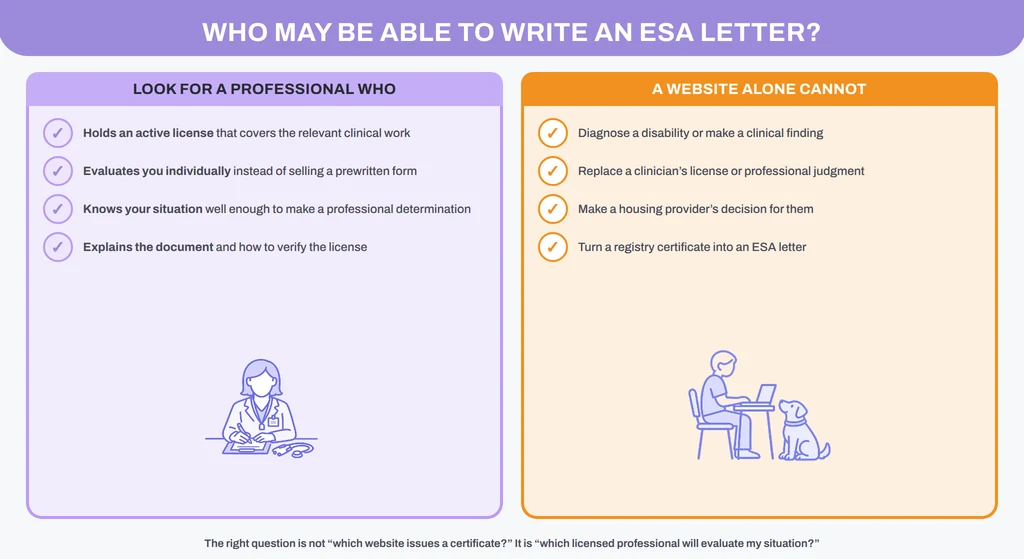
Who can write an ESA letter? Usually, it must be a licensed clinician whose scope and jurisdiction permit the relevant evaluation—not a registry, certificate seller, or website alone. A licensed mental-health professional or another qualified licensed health professional may provide documentation when, after an individualized evaluation, they can support it.
Quick answer: The right writer depends on the professional’s license, scope, jurisdiction, relationship with you, and evaluation. Ask who will evaluate you, what credential they hold, how to verify it, and what the documentation will address. A website, registry listing, or certificate cannot make that clinical determination.
Who may be able to write an ESA letter?
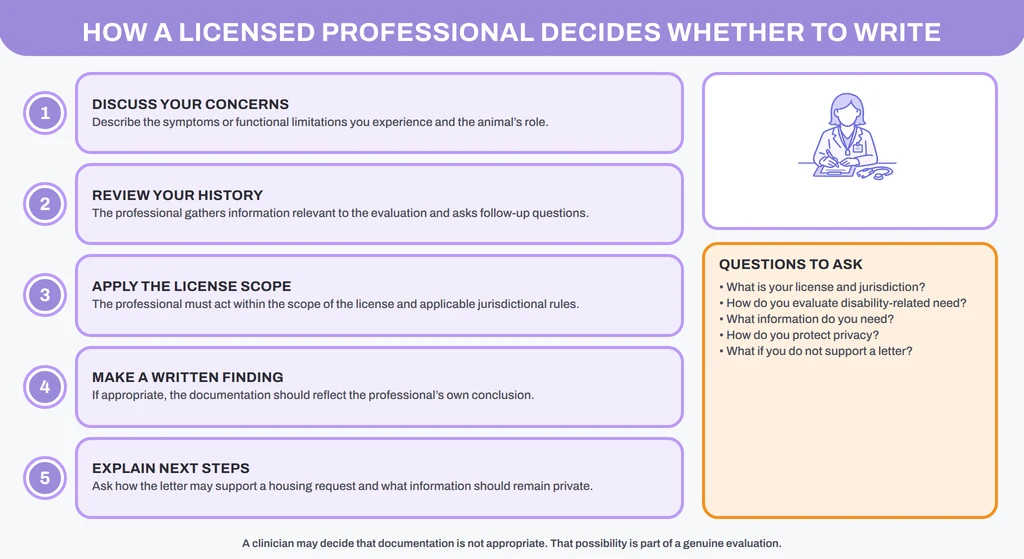
A licensed mental-health professional—or another licensed health professional whose scope and jurisdiction permit the relevant evaluation—may be able to provide documentation. “May” matters: state rules, professional scope, clinical knowledge, and the facts of your situation can differ. A provider should make an independent decision after evaluating you, rather than selling a predetermined result.
Name the professional’s license and the jurisdiction where it is active.
Explain how the evaluation is conducted and what information is considered.
Maintain a professional relationship sufficient to support the opinion offered.
Describe only the disability-related need and animal role that the clinician can responsibly support.
What should a licensed professional evaluate?
The professional should gather enough information to understand the relevant symptoms or impairment, functional impact, and the role an animal may play in helping you function. The process is not a script-reading exercise. Be honest, ask how your information will be used, and understand that a clinician may conclude that documentation is not appropriate.
What can a website or registry not do?
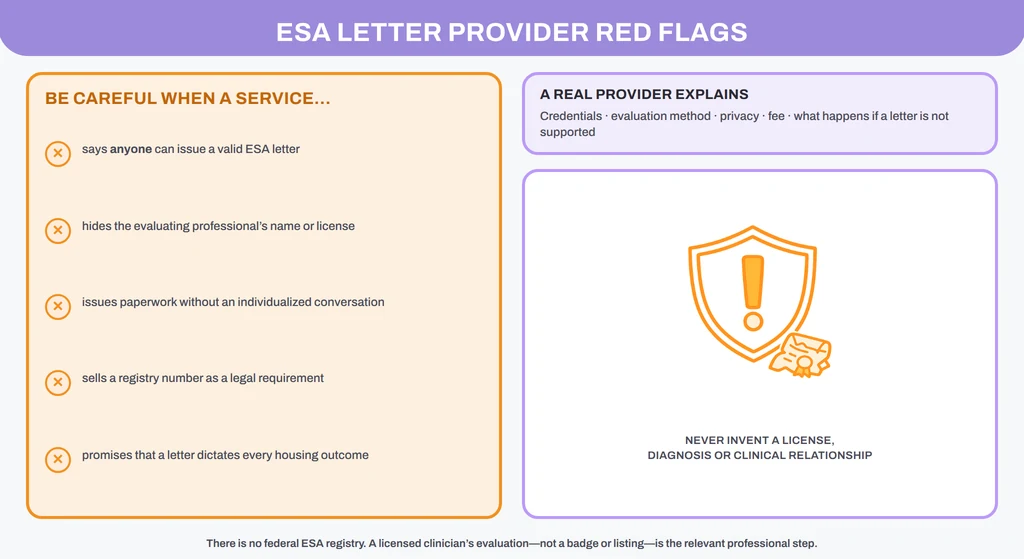
A website can provide education, connect you with professionals, or explain a service process. It cannot diagnose you, create a clinician-patient relationship by itself, sign a letter as a professional, or turn a registry entry into legal proof. There is no official federal ESA registry. Be skeptical of products that emphasize a certificate, ID card, vest, or registration number instead of a real evaluation.
What does federal housing law actually say?
The surviving federal baseline is 42 U.S.C. § 3604(f)(3)(B), which addresses reasonable accommodations in rules, policies, practices, or services when necessary to afford an equal opportunity to use and enjoy a dwelling. The implementing regulation is 24 C.F.R. § 100.204. These authorities do not designate one universal job title as the writer of every ESA document and do not establish an ESA registry.
HUD materials must be separated from the statute and regulation. FHEO-2013-01 and FHEO-2020-01 were withdrawn effective September 17, 2025, with the action formalized in 91 FR 17291. The May 22, 2026 HUD enforcement memo describes current FHEO enforcement posture, including a stated focus on animals trained to provide disability-related assistance. It is an internal enforcement document, not a replacement for the FHA statute or regulation; withdrawn guidance is not a fallback standard.
How do you verify a provider before paying?
Ask for the clinician’s name, professional license, active jurisdiction, evaluation format, fee, privacy practices, and follow-up process. Verify the credential through the relevant licensing authority when possible. Also ask whether the clinician can explain the basis of the documentation and what happens if the evaluation does not support an ESA letter. Clear answers are more useful than a marketing badge.
Provider type
What it may offer
What to verify
Licensed clinician
Evaluates you within license and scope
Can explain professional basis and limits
Certificate seller
May sell a document or ID product
Does not create clinical judgment by itself
Registry listing
Adds a commercial listing or number
No official federal registry establishes eligibility
← swipe to compare →
What red flags should you avoid?
Avoid services that hide the evaluating professional, offer a letter before learning anything about you, ask you to supply a signature, or focus on registration as the product. Be wary of pressure to omit facts or copy a diagnosis. A responsible process explains its limits, protects your information, and leaves the clinical decision to the licensed professional.
What should you prepare for an evaluation?
Prepare an honest summary of the practical problem, the housing context, any deadline, and how an animal may help you function. Bring questions about the clinician’s credential, evaluation, privacy, fee, and follow-up. Do not try to force a particular conclusion. For context, see our step-by-step ESA guide, licensed professional guide, and housing guide.
It depends on the doctor’s license, scope, jurisdiction, personal knowledge of your situation, and whether the doctor can responsibly perform the relevant evaluation. Ask the doctor directly rather than relying on a universal rule.
A therapist may be able to do so when appropriately licensed and qualified, within scope and jurisdiction, and able to support the documentation after an individualized evaluation. The title “therapist” alone does not answer every licensing question.
A website cannot replace a licensed clinician’s evaluation or professional judgment. It may explain a process or connect you with a provider, but a certificate or form alone is not clinical documentation.
No federal registry establishes eligibility for an emotional support animal. Commercial registries, certificates, and ID cards do not replace an evaluation by a qualified licensed professional.
A housing provider may ask for reliable information relevant to a reasonable-accommodation request, while personal medical records and unnecessary diagnosis details are not the same as that documentation. The appropriate information depends on the facts and applicable law.
That can be the outcome of a genuine evaluation. Ask the clinician to explain the decision and any other resources or next steps that may fit your situation; do not seek a different document by misrepresenting your facts.
Need help with the next step? Start by learning how a licensed clinician evaluates an ESA letter request, then review the housing and cost details before choosing a service.
• Individualized evaluation by a qualified clinician
• Clear explanation of documentation and next steps
• Privacy-conscious process with transparent service details
Darren is a leading expert in mental health advocacy and assistance animal documentation. He specializes in streamlining the process for obtaining ESA Letters, PSD Letters, and State-specific ESA compliance.