
Last Updated on: August 14, 2026
Reviewed by Darren Andrew Rafel
Quick Answer: An ESA letter for housing is a signed document from a licensed mental health professional stating that you have a disability-related need for your emotional support animal. Under the Fair Housing Act, it requires most landlords — including those with no-pet policies — to grant a reasonable accommodation so your ESA can live with you, at no extra charge.
For a practical companion, see our ESA Support Groups: What They Can—and Cannot Do.
An ESA letter for housing is a formal written recommendation from a licensed mental health professional (LMHP) — a therapist, psychologist, psychiatrist, or licensed counselor — stating that you have a diagnosed or diagnosable mental health condition and that your emotional support animal provides therapeutic benefit related to that condition.
Under the Fair Housing Act (FHA), this single document gives you the right to request a reasonable accommodation in housing that would otherwise prohibit pets. That means no-pet buildings, breed restrictions, and weight limits cannot be used to deny your ESA — and your landlord cannot charge you a pet deposit or pet fee for the animal. The ESA letter is the mechanism that activates all of those protections. Without it, you’re just a tenant with a pet.
2026 update: HUD withdrew its 2013 and 2020 assistance-animal guidance notices effective September 17, 2025, and a May 22, 2026 FHEO enforcement memorandum narrowed HUD’s charging standard to animals trained to perform disability-related tasks. Your landlord’s underlying duty under the Fair Housing Act to consider a reasonable accommodation still exists, and state ESA laws still apply — but a federal HUD complaint over an untrained emotional support animal is much weaker than it was. This page was reviewed against the primary sources on August 26, 2026.
The Fair Housing Act prohibits discrimination in housing on the basis of disability, and requires a housing provider to make reasonable accommodations that may be necessary to give a person with a disability an equal opportunity to use and enjoy a dwelling (42 U.S.C. §3604(f)(3)(B); 24 C.F.R. §100.204). That statutory duty has not changed. What has changed is HUD’s own interpretation of it: the familiar framing that an emotional support animal “is not a pet” but an “assistance animal” came from HUD guidance notices that were withdrawn effective September 17, 2025. The accommodation duty in the statute survives that withdrawal — but HUD’s reading of how it applies to untrained animals has narrowed sharply, and this page reflects that.
In January 2020, HUD published FHEO Notice 2020-01, guidance on how housing providers should evaluate accommodation requests for assistance animals. That notice is no longer in force. It and the earlier 2013 notice (FHEO-2013-01) were withdrawn effective September 17, 2025, published at 91 FR 17291 (April 6, 2026), Docket FR-6571-N-01. A subsequent FHEO memorandum dated May 22, 2026 and signed by Assistant Secretary Craig W. Trainor permanently rescinded the 2020 notice and reconfirmed both withdrawals. The practices described in the next few sections are what that withdrawn guidance told landlords to do. Many housing providers still follow them, and state or local fair housing law may still require them — but HUD no longer enforces them as written, so treat them as context rather than as a guarantee. What still counts as a legitimate ESA letter is driven by the FHA’s necessity standard and by state law.
Key takeaways from that guidance:
The withdrawn 2020 guidance told landlords to engage in an “interactive process” when they receive an accommodation request. The FHA’s reasonable-accommodation duty still requires a housing provider to actually consider a request rather than reject it out of hand, but the “interactive process” label itself came from guidance that is no longer in force.
Under that same withdrawn guidance, landlords were told not to demand your full medical records or require you to use a specific third-party verification service. A housing provider may still request information reasonably necessary to verify that you have a disability and a disability-related need for the animal, and a number of states now set their own documentation rules on top of federal law.
A letter from a treating or evaluating LMHP is generally sufficient documentation.
The withdrawn guidance also stated that breed, size, and weight restrictions should not be applied to assistance animals. Note that nothing in the text of the FHA creates a blanket breed, size, or weight exemption — and a request can still be denied where the specific animal would pose a direct threat to the health or safety of others, or cause substantial physical damage to property.
For a deeper breakdown of how the FHA applies to your situation, see our Fair Housing Act and emotional support animals guide.
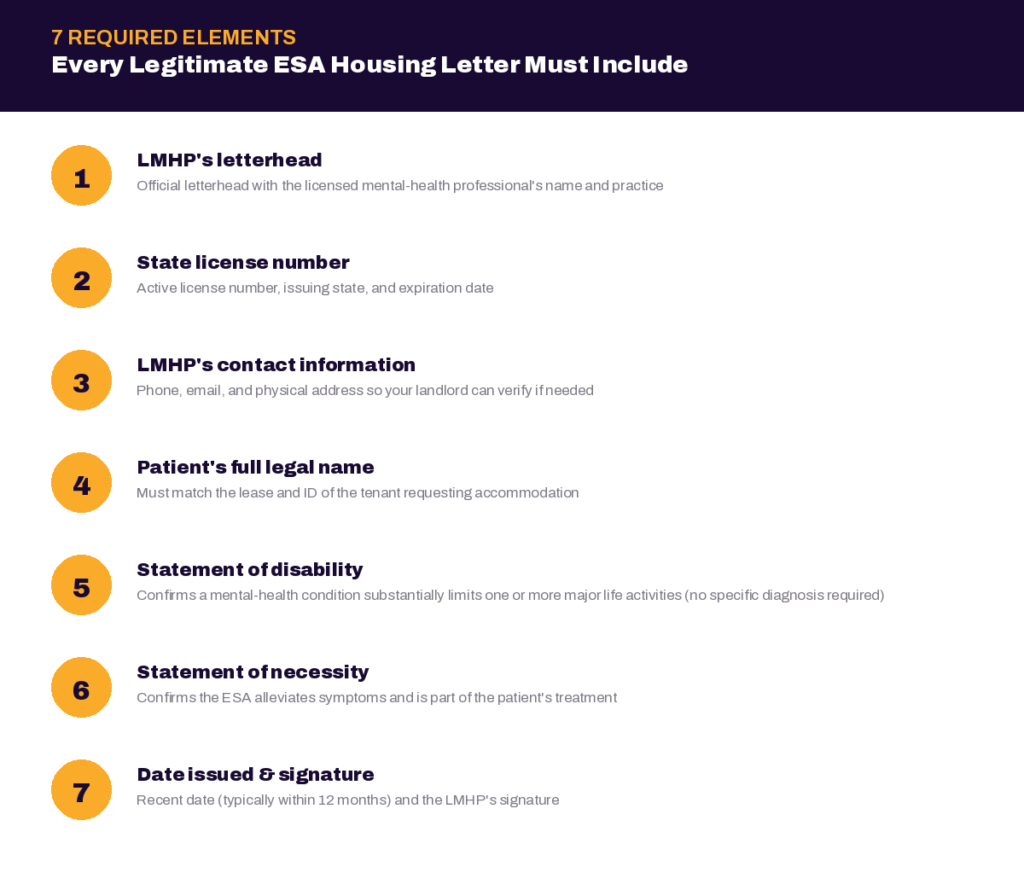
Not every ESA letter is created equal. HUD’s guidance sets a clear bar for what makes a housing ESA letter legitimate. A letter that’s missing any of these elements can be legally rejected by your landlord — and could expose you to accusations of misrepresentation.
7 required elements every legitimate ESA housing letter must include.
A valid ESA letter for housing must include:
The LMHP’s full name, license type, and license number — no anonymous providers
The state in which the LMHP is licensed — they must be licensed in your state
The LMHP’s contact information — phone and/or email so the landlord can verify
A statement that you have a disability (not a diagnosis — just that a disability exists under the FHA definition)
A statement that your ESA provides disability-related therapeutic benefit — this connects the animal to the condition
The date the letter was issued — landlords may ask for a letter less than one year old
The LMHP’s signature — wet or electronic, on official letterhead
Notice what’s not required: your specific diagnosis, your full medical history, or a registry number for your animal. ESA registries are not legally recognized under the FHA — a letter from a licensed professional is the only document that matters.
Below is a sample of what a properly formatted ESA housing letter looks like. This is for illustration only — do not copy and submit this. Your actual letter must be issued by a licensed mental health professional who has evaluated you.
SAMPLE LETTER — FOR ILLUSTRATION ONLY. DO NOT COPY OR SUBMIT.
Dr. Sarah M. Holloway, LPC Licensed Professional Counselor | License No. LPC-TX-88421 | State of Texas Phone: (512) 555-0193 | Email: s.holloway@counselingpractice-example.com
June 1, 2026
To Whom It May Concern:
I am a Licensed Professional Counselor licensed in the State of Texas (License No. LPC-TX-88421) and currently providing treatment to my client, James R. [Last Name Withheld].
My client has a mental or emotional disability as defined under the Fair Housing Act. Through individualized assessment, I have determined that an emotional support animal alleviates one or more symptoms or effects of my client’s disability.
Specifically, my client’s Golden Retriever, “Buddy,” serves as an emotional support animal whose presence is directly related to my client’s disability and provides therapeutic benefit that supports daily functioning within their home environment.
I am requesting a reasonable accommodation under the Fair Housing Act (42 U.S.C. § 3604(f)(3)(B)) to allow my client to keep this animal in their residence, including any housing with a no-pets policy.
Please contact me directly if you have questions.
Sincerely, Dr. Sarah M. Holloway, LPC | June 1, 2026
SAMPLE LETTER — FOR ILLUSTRATION ONLY. This document is not valid for submission. Obtain your letter from a licensed mental health professional who has evaluated you.
The LMHP’s license number and state are prominently listed, the letter ties the animal to the disability, and it cites the FHA statute directly. That specificity is what makes a landlord take it seriously.
Need a letter like this, issued by a real LMHP licensed in your state? PetESALetter can connect you with one in 24 hours for $99.
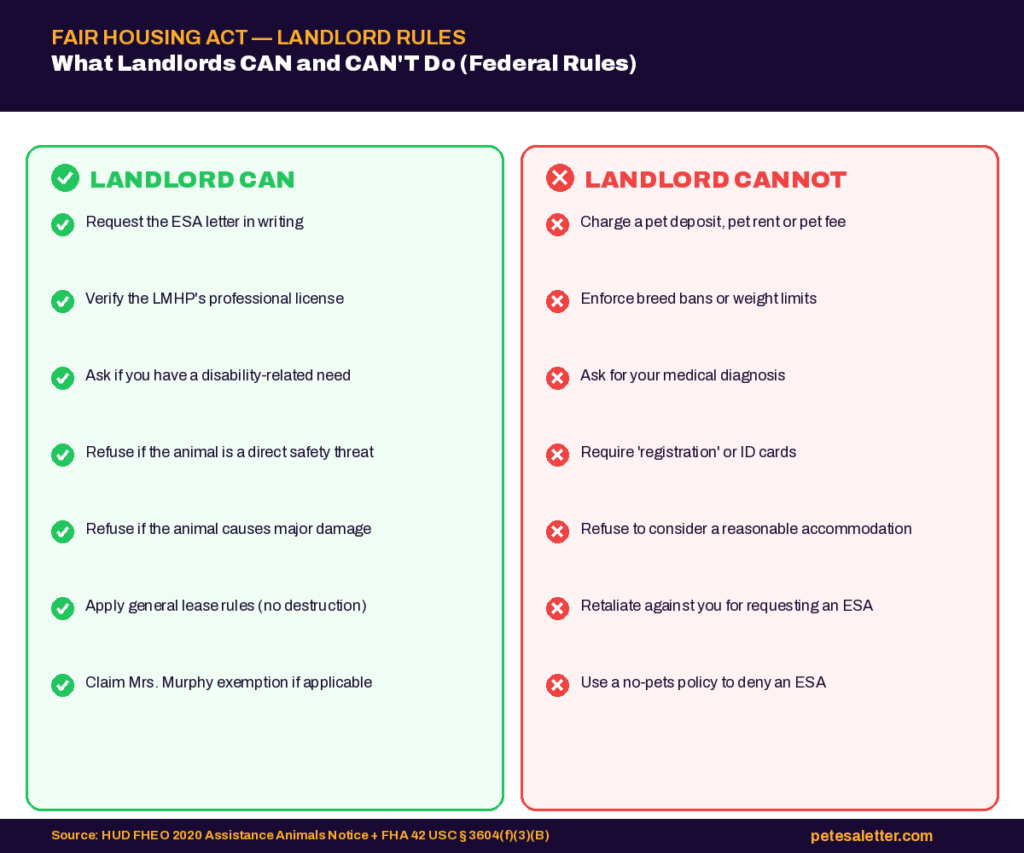
This is where most disputes happen. Landlords — sometimes out of genuine confusion, sometimes not — push back in ways that aren’t legally permitted. Here’s the clear breakdown:
| Landlords CAN | Landlords CANNOT |
|---|---|
| Request an ESA letter from a licensed professional | Require your medical records or diagnosis |
| Ask whether the animal is needed due to a disability | Ask what your specific disability or condition is |
| Request verification that the LMHP is licensed | Require you to use a specific verification service |
| Deny an animal that poses a direct physical threat | Deny based on breed, size, or weight alone |
| Deny an animal that has caused significant documented damage | Charge a pet deposit or pet fee for your ESA |
| Ask for a new letter if the current one is over a year old | Require a separate “pet interview” or approval process |
| Apply standard lease terms (cleanliness, noise) | Apply a different lease standard specifically because of your ESA |
The pattern here: landlords can verify your request is legitimate. They cannot interrogate your disability or create extra barriers that don’t exist for non-disabled tenants.
For detailed guidance on having this conversation with your landlord — including scripts — see our guide on how to talk to your landlord about an ESA.
Getting a legitimate ESA letter is step one. Submitting it correctly is step two — and this is where people make avoidable mistakes that weaken their position.
Step 1: Put your request in writing. Submit a formal written reasonable accommodation request with your ESA letter attached. State: (a) you have a disability, (b) you have an emotional support animal, and (c) you are requesting a reasonable accommodation under the Fair Housing Act. Keep it factual and brief.
Step 2: Send via certified mail or email with read receipt. Documented delivery matters. Certified USPS mail creates a legal paper trail. Email with read receipt works too — save the confirmation. Never rely on verbal submission.
Step 3: Follow up if you don’t hear back within 10 business days. HUD expects landlords to respond within a reasonable timeframe. A written follow-up referencing your original request date creates an additional record if you later need to file a complaint.
Step 4: Keep copies of everything. Your letter, request, and all correspondence. You may need them.
For template language and a full walkthrough, see our landlord communication guide.
A landlord who refuses a valid ESA letter and denies your reasonable accommodation request is likely violating the Fair Housing Act. You have real options.
Option 1: Request a written explanation. Ask your landlord to explain in writing why your request was denied. This forces them to articulate a legal basis — and often they can’t, which opens the door to resolution without formal action.
Option 2: File a HUD complaint — but understand the 2026 change first. HUD’s Office of Fair Housing and Equal Opportunity (FHEO) receives FHA complaints, at no cost, and they must typically be filed within one year of the discriminatory act. The important update: the May 22, 2026 FHEO memorandum states that HUD will find reasonable cause and recommend charges only in cases involving animals trained to provide disability-related assistance, and routes still-open emotional support animal cases to a senior enforcement official for case-by-case review on the merits. In practice, a HUD complaint about an untrained emotional support animal is now much less likely to result in a charge than it would have been before this memorandum. This is HUD’s internal enforcement priority, not a change to the statute — so your private right of action in federal court (generally two years from the discriminatory act) and any state or local fair housing agency both remain fully available, and are now the stronger route.
Option 3: Contact a fair housing organization. Local fair housing nonprofits offer free consultations and can mediate disputes. The HUD Fair Housing assistance page lists resources by region.
Option 4: Consult a tenant’s rights attorney. If you’ve suffered financial harm — paid prohibited fees, lost housing, or faced eviction — a private attorney can pursue damages under the FHA. Many work on contingency.
Before filing, confirm your letter came from a licensed mental health professional. A letter from a non-licensed source or an online registry may have given the landlord legitimate grounds to deny.
The FHA is broad, but not unlimited. There are specific circumstances where a landlord can legally deny an ESA accommodation request — and knowing them protects you from wasted time and misplaced expectations.
Owner-occupied buildings with four or fewer units (“Mrs. Murphy” exemption). If your landlord lives in one of the units in a building of four or fewer units, they’re partially exempt from the FHA. This exemption does not apply if a real estate broker was involved in the transaction.
Single-family homes rented without a broker. If the owner rented directly to you without an agent and without publicly discriminatory advertising, the FHA’s reasonable accommodation requirements may not apply.
The animal poses a direct threat. A landlord can deny an ESA if the specific animal poses a direct threat to health or safety, or would cause substantial damage that can’t be mitigated. This must be based on the individual animal’s actual behavior — not its breed.
Undue burden. If granting the accommodation would impose an extreme financial or administrative burden on the housing provider, it can be denied — but this bar is rarely met in standard residential rentals.
Need documentation your landlord will actually accept? Establish a compliant clinical connection before you submit your accommodation request, not after it gets denied.
In most cases, yes. If your housing is covered by the Fair Housing Act and your letter is from a licensed mental health professional, your landlord must engage in good faith. They can verify authenticity but cannot refuse without a valid legal basis. Learn more about how to get an ESA letter landlords will respect.
A landlord can ask whether you have a disability-related need for your ESA — but not what your disability or diagnosis is. They can confirm a nexus exists; they cannot audit your medical records.
Potentially, yes — the FHA sets no cap. Each animal must be covered by your ESA letter and must provide a disability-related benefit. A landlord can challenge a request that seems unreasonable, but cannot impose a blanket one-animal rule.
Yes. HOAs are housing providers under the FHA and must provide reasonable accommodations for assistance animals. HOA breed restrictions, pet fees, and no-pet rules cannot override your FHA rights with a valid ESA letter.
No federal expiration date exists, but HUD guidance allows landlords to request updated documentation if the letter is more than a year old and the need isn’t readily apparent. Plan to renew annually.
No. Requiring pet insurance creates a barrier not imposed on non-disabled tenants — precisely the differential treatment the FHA prohibits. Document the request; it’s a potential fair housing violation.
A legitimate ESA letter from a licensed mental health professional is the only document that legally protects your right to keep your emotional support animal in housing. PetESALetter connects you with LMHPs licensed in all 50 states. One flat price: $99. No upsells, no add-ons. Your letter is delivered in 24 hours, and there’s a 100% money-back guarantee if you don’t qualify.

Licensed Psychotherapist
Darren is a leading expert in mental health advocacy and assistance animal documentation. He specializes in streamlining the process for obtaining ESA Letters, PSD Letters, and State-specific ESA compliance.

ESA Letters Issued

Successful Consultations

Licensed Therapist Network

Client Satisfaction Rate




Petesaletter.com helps you get your emotional support animal letter online with guidance and support.

Got Questions? Call us 24/7
Copyright © 2020-2026 Petesaletter All rights reserved. Terms | Privacy | Refund
Owned and Operated by Verimedix LLC




For a practical rental-reference checklist, see our landlord recommendation letter guide.
