
Last Updated on: August 14, 2026
Reviewed by Darren Andrew Rafel
Animals have always occupied a unique space in human life — but for millions of people managing anxiety, depression, PTSD, and other mental health conditions, that bond goes far beyond companionship. Research consistently shows that animals reduce cortisol levels, lower blood pressure, and provide a reliable source of comfort that many therapeutic interventions struggle to replicate alone.
If you are exploring the idea of an emotional support pet, you have probably already encountered a swamp of confusing websites promising instant certificates, laminated ID cards, and official-looking registrations. Before we go any further, let’s cut through all of that.
An emotional support pet (also called an emotional support animal, or ESA) is a companion animal prescribed by a licensed mental health professional to provide therapeutic comfort to a person with a diagnosed mental or emotional disability. Unlike service animals, emotional support pets are not required to perform specific trained tasks. Their legal recognition comes primarily from the Fair Housing Act (FHA), which requires landlords and housing providers to make reasonable accommodations — including waiving standard no-pet policies — for tenants with a valid ESA letter.
The term “emotional support pet” is deceptively simple. In practice, it refers to any animal that a licensed mental health professional has determined provides therapeutic benefit to a person with a qualifying mental health condition. No training certification is required, and the species of animal is broader than most people expect.
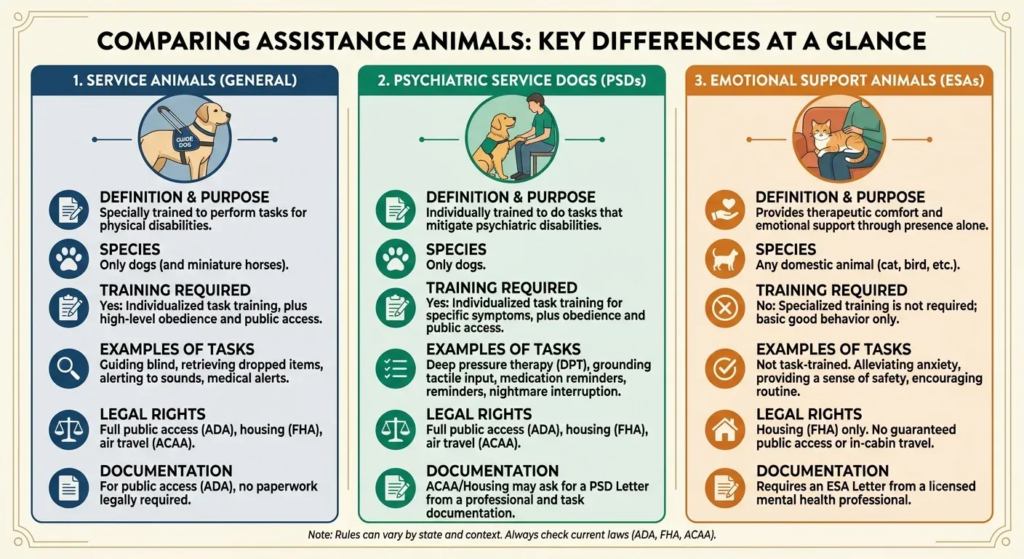
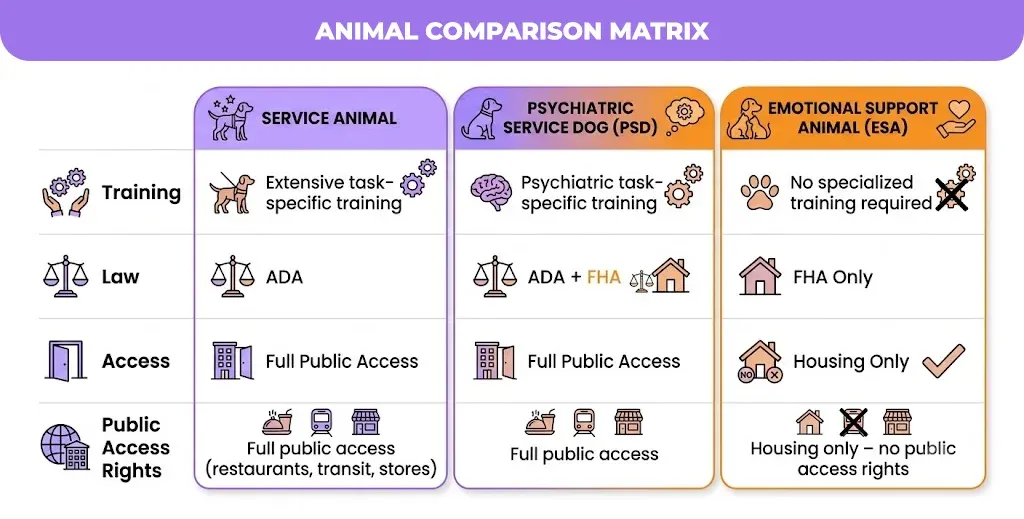
This is where most people hit a wall of confusion, and it matters enormously — because the legal protections attached to each category are completely different.
Service animals under the Americans with Disabilities Act (ADA) are trained to perform specific tasks directly related to a person’s disability. A guide dog for a blind individual is the classic example. Psychiatric Service Dogs (PSDs) occupy a fascinating middle ground — they are trained to perform disability-related psychiatric tasks (such as interrupting self-harm behaviors or performing room searches for PTSD sufferers) and qualify for both ADA and FHA protections.
Emotional support pets sit in their own lane. They require no task-specific training, carry no ADA public access rights, and are specifically recognized under the Fair Housing Act for housing accommodations only. The table below maps out these critical distinctions:
| Metric | Service Animal | Psychiatric Service Dog (PSD) | Emotional Support Animal (ESA) |
|---|---|---|---|
| Training Required | Extensive task-specific training | Specialized psychiatric task training | No specialized training required |
| Legal Framework | Americans with Disabilities Act (ADA) | ADA + Fair Housing Act (FHA) | Fair Housing Act (FHA) only |
| Public Access Rights | Full public access (restaurants, transit, stores) | Full public access | Housing only — no public access rights |
| Species Restrictions | Primarily dogs; miniature horses allowed | Dogs only | Dogs, cats, and many other domestic species |
| Documentation Needed | Training certification (voluntary) | PSD letter; may be asked to describe the trained task | Valid ESA letter from licensed LMHP |
| Pet Fees Waived? | Yes | Yes | Yes — under FHA housing accommodations |
Dogs and cats make up the overwhelming majority of emotional support pets, but the Fair Housing Act does not explicitly restrict ESA status to any particular species. Birds, rabbits, guinea pigs, hamsters, and even miniature pigs have been documented as legitimate ESAs when a licensed professional has determined they provide genuine therapeutic benefit.
That said, HUD guidelines do allow landlords to evaluate whether an unusual species creates legitimate safety or sanitation concerns — so while a dog or cat is straightforward, requesting ESA status for a large reptile or exotic animal may require more thorough documentation from your mental health provider.
Technically, you can pay a website to add your pet’s name to a private database and mail you a laminated card. But that act carries absolutely no legal weight whatsoever.
The U.S. Department of Housing and Urban Development (HUD) has been unambiguous on this point: it does not recognize any registry, database, ID card, badge, vest, or commercial emotional support pet certification as proof of ESA status. These are private businesses, not government entities, and their “certificates” have no standing under the Fair Housing Act.
Reference: HUD.gov — Official Guidance on Assistance Animals
The danger with fake certifications goes beyond wasted money. When a landlord receives an ESA accommodation request, they are legally permitted to verify the authenticity of the supporting letter — including confirming the licensing number of the mental health professional who wrote it and verifying their state jurisdiction.
If you present a letter generated by an online registry rather than a document from a genuinely licensed therapist, a knowledgeable landlord can — and often will — rightfully deny your accommodation request. Worse, it can damage your credibility if you later attempt to obtain a legitimate letter and submit a new request.
The only document that actually matters is an official emotional support pet letter written on professional letterhead by a licensed mental health professional (LMHP) who holds an active license in your state.
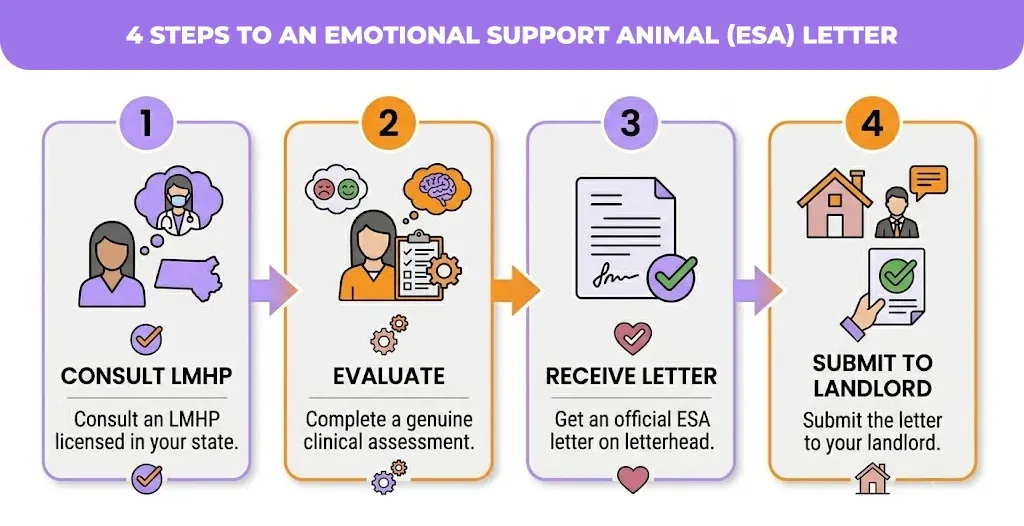
The process of securing a legitimate ESA letter is straightforward when you know exactly what it involves. There are no federal forms to fill out, no government agencies to contact, and no registries to join. It is a clinical process, not a bureaucratic one.
Step 1 — Schedule an Appointment with a Licensed Mental Health Professional (LMHP): Your first step is identifying a licensed therapist, psychiatrist, psychologist, or clinical social worker who is actively licensed in your state. This is non-negotiable: the letter must come from someone whose license is valid in the state where your rental property is located. Many LMHPs now offer telehealth sessions, which makes this step significantly more accessible.
Step 2 — Undergo a Genuine Mental Health Evaluation: During your session, be open and thorough about your mental health history. The LMHP needs to determine — based on genuine clinical assessment — that you have a diagnosable mental or emotional disability (as defined by the DSM-5) and that an emotional support pet would actively help mitigate your symptoms. Common qualifying conditions include anxiety disorders, depression, PTSD, OCD, and phobias. This must be an authentic evaluation, not a rubber-stamp process.
Step 3 — Receive Your Official ESA Letter: If you qualify, the mental health professional will provide you with an official emotional support pet letter. This document must be written on their professional letterhead and include: their full name and professional title, their license type and license number, the state in which they are licensed, confirmation that you are their patient under their care, a statement that you have a disability and that an ESA is clinically indicated, and their signature and the date of the letter.
Step 4 — Submit the Letter to Your Landlord: Once you have a valid letter, you submit it to your landlord or property manager as part of a formal reasonable accommodation request. You do not need to submit this during the application process; you may request accommodation at any point during your tenancy. The landlord then has a reasonable period to respond.
Pro tip — Telehealth ESA letters: A number of legitimate telehealth mental health platforms can connect you with licensed therapists who can assess you for ESA qualification. Always verify that the professional is licensed in your specific state before booking. Avoid any platform that guarantees an ESA letter before a clinical assessment has taken place — that is a red flag.


Once you have a valid ESA letter, the Fair Housing Act provides you with meaningful, legally enforceable protections in housing. Understanding these rights — and their limits — is essential for every emotional support pet owner.
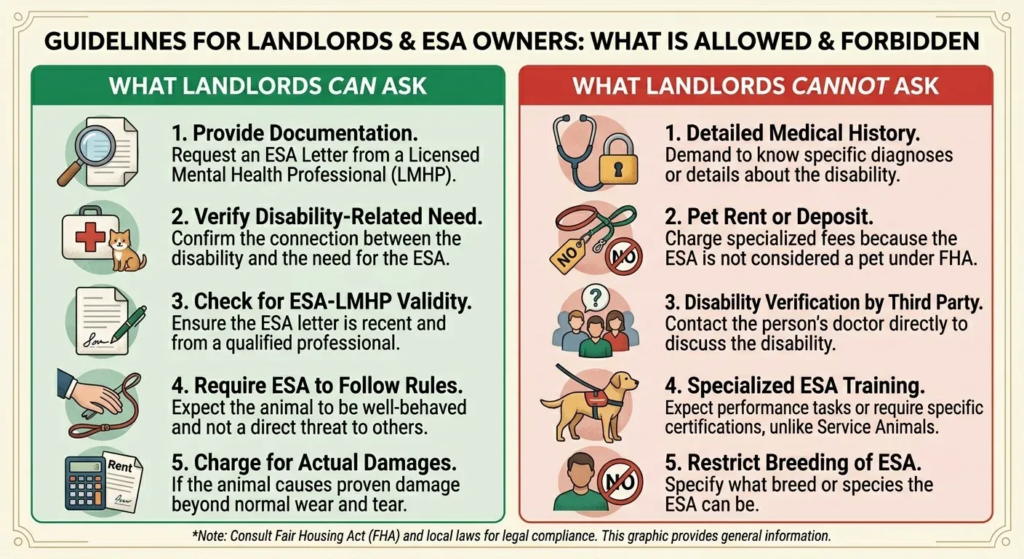
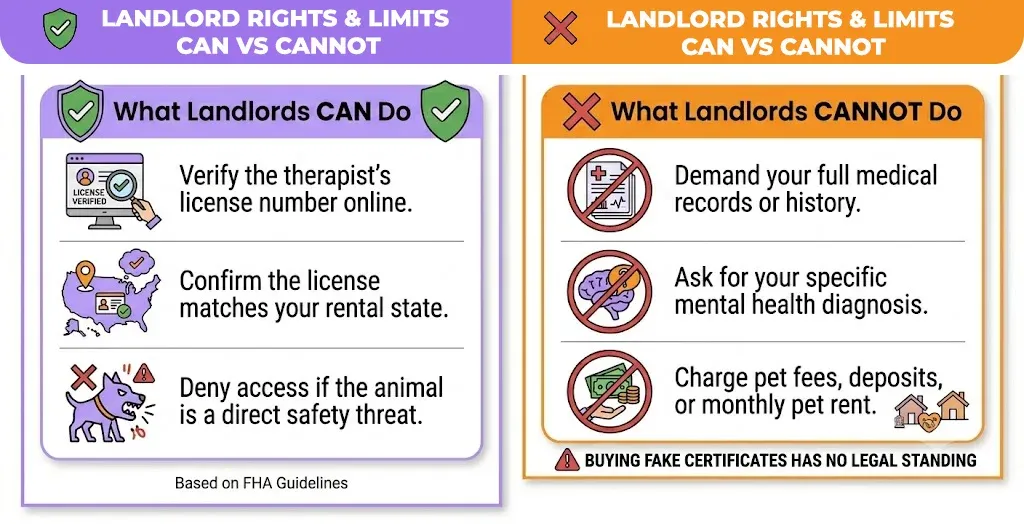
Under FHA reasonable accommodation rules, a landlord who has received and verified your ESA letter must waive standard pet policies that would otherwise block your animal. This includes pet deposits (refundable or non-refundable), monthly pet rent fees, breed restrictions, and weight limits. These policies simply do not apply to a recognized emotional support pet.
This is one of the most practically significant protections: in cities where pet fees can run $500 or more up front, plus $50–$100 monthly, the financial relief of a valid ESA letter is substantial.
This is an area where both landlords and tenants frequently get things wrong. Here is what the law actually permits:
What a landlord CAN legally do:
Verify the therapist’s license number against the state licensing board database
Confirm the professional is licensed in the same state as the rental property
Request a new letter if the existing one appears outdated or suspicious
Deny accommodation if the animal poses a direct threat to health/safety or if the property qualifies for FHA exemptions (e.g., owner-occupied buildings with four or fewer units)
What a landlord CANNOT legally do:
Demand your full medical history or specific diagnostic information
Require proof of disability beyond the ESA letter from a licensed professional
Ask for the name of your specific diagnosis or the details of your treatment plan
Charge pet fees or deposits once a valid ESA letter has been accepted
| ✅ Your Rights as an ESA Owner | ⚠️ Your Responsibilities |
|---|---|
| Right to request reasonable accommodation for an ESA in housing | Animal must not cause damage to property or pose a nuisance |
| Pet deposits and monthly pet rent must be waived | You remain financially liable for any damage the ESA causes |
| Breed and weight restrictions cannot be enforced against ESAs | Letter must come from an LMHP licensed in your state |
| Landlord cannot demand your full medical history or records | ESA protection applies to housing only — not restaurants, stores, or transit |
| Landlord can only verify the therapist’s license number and state | Fake online registry certificates do not confer any legal protection |
Reference: HUD FHEO — Assistance Animals Notice
An emotional support pet can be a genuinely life-changing addition to a mental health treatment plan — but only when the process is handled correctly. The shortcut of buying an online certification does not just waste money; it actively undermines your ability to claim the legitimate legal protections that the Fair Housing Act provides.
The path is clear: consult a licensed mental health professional who holds an active license in your state, undergo a genuine clinical assessment, and obtain a proper ESA letter on professional letterhead. That single document is the only thing that stands between you and your housing rights.
Your mental health deserves real protection — not a laminated card.
Join the conversation: Have you navigated the process of talking to your doctor about an ESA letter? Do you have questions about your housing rights as an ESA owner? Share your experience or ask a question in the comments below — your story could help someone else find their way through this process.
Need documentation your landlord will actually accept? Establish a compliant clinical connection before you submit your accommodation request, not after it gets denied.

ESA Letter for Apartment: How to Get FHA Approval Without the Pet Fees
ESA Letter for Housing: HUD Rules, Landlord Rights & Sample Letter (2026)
ESA Letter Example: The Complete Guide to a Legally Valid Emotional Support Animal Letter
An emotional support pet is any companion animal that a licensed mental health professional has determined provides therapeutic benefit to a person with a diagnosed emotional or mental disability. Dogs and cats are the most common, but many other domestic species can qualify. The key requirement is not the species — it is the presence of a legitimate clinical determination and a valid ESA letter from an LMHP licensed in your state.
The only legally recognized proof is an official ESA letter written on the professional letterhead of a licensed mental health professional who is actively licensed in your state. The letter must include the practitioner’s license number, license type, state of licensure, a confirmation that you are their patient, and a statement that an ESA is therapeutically indicated for your condition. Commercial certificates, ID cards, vests, and online registry entries are not legal proof and are not recognized by HUD or the Fair Housing Act.
Yes, informed landlords often do, and they are legally entitled to. A landlord can verify that the mental health professional named in your ESA letter holds an active license in the appropriate state by checking that state’s professional licensing board database. What they cannot do is call your therapist and ask for details about your diagnosis or treatment. If your letter came from a legitimate, currently licensed LMHP in your state, verification will confirm its authenticity. If it came from an online registry, verification will expose it as inauthentic.
There is no single “best” emotional support pet. The right animal depends entirely on your lifestyle, living situation, and what kind of companionship helps you most. Dogs are the most versatile ESA choice, offering active engagement and physical affection. Cats suit people who benefit from calm, low-maintenance companionship. Rabbits are quiet and gentle, making them ideal for smaller living spaces. Birds provide consistent routine and vocal interaction that some people find grounding. The most important factor is not the species — it is the genuine therapeutic connection between you and the animal. Discuss this with your mental health provider as part of your ESA evaluation.
Your mental health deserves real protection—not a fake laminated card. Join thousands of happy pet owners who have securely protected their living situations and waived pet expenses using Pet ESA Letter.

Licensed Psychotherapist
Darren is a leading expert in mental health advocacy and assistance animal documentation. He specializes in streamlining the process for obtaining ESA Letters, PSD Letters, and State-specific ESA compliance.

ESA Letters Issued

Successful Consultations

Licensed Therapist Network

Client Satisfaction Rate




Petesaletter.com helps you get your emotional support animal letter online with guidance and support.

Got Questions? Call us 24/7
Copyright © 2020-2026 Petesaletter All rights reserved. Terms | Privacy | Refund
Owned and Operated by Verimedix LLC