
Last Updated on: August 14, 2026
Reviewed by Darren Andrew Rafel
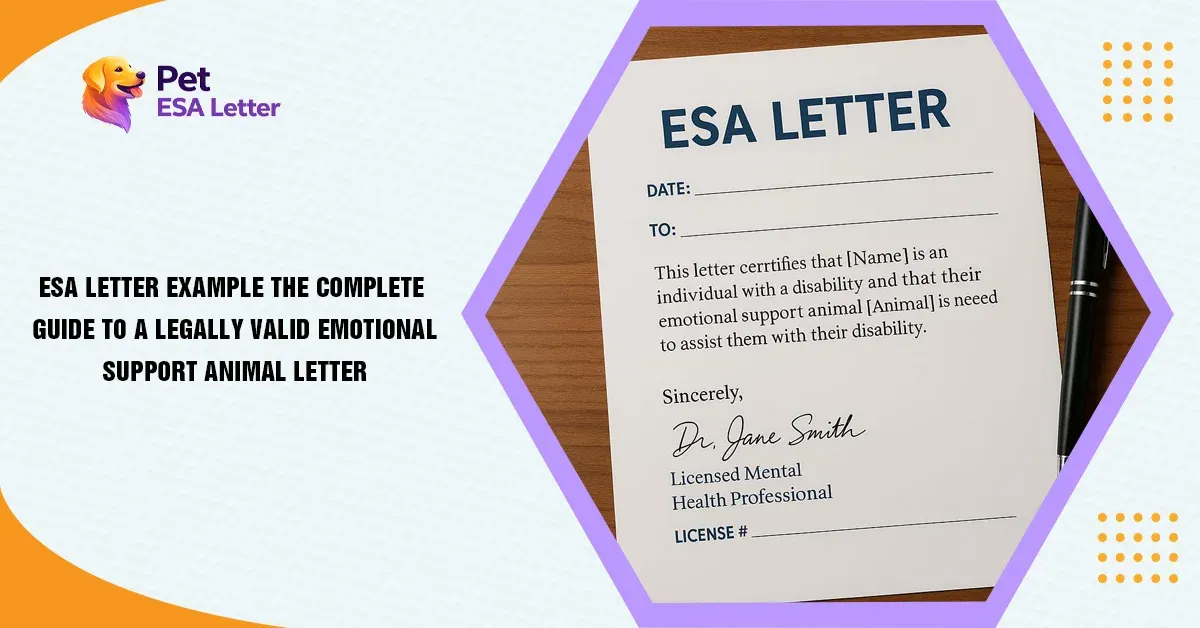
Presenting the wrong document to a landlord can cost you your housing accommodation instantly. Under the Fair Housing Act (FHA), tenants with qualifying disabilities have the right to request reasonable accommodations for emotional support animals — but that right hinges entirely on submitting a letter that meets precise legal and clinical standards. A missing license number, an out-of-state practitioner, or a templated online certificate can give any housing provider legal grounds to deny your request before you even have a conversation.
An ESA letter example that is legally valid is a formal written document issued on a Licensed Mental Health Professional’s (LMHP) official letterhead, affirming that the named individual has a diagnosable mental or emotional disability recognized under the DSM-5, and that an emotional support animal is a prescribed part of their treatment plan. A real example of an ESA letter will always identify the practitioner’s full license type, license number, and state of issuance — and it will never appear on a generic registry printout or offer lifetime status without clinical renewal.
Every valid ESA letter example must contain six discrete structural components. Omit any one of them, and a housing provider applying HUD’s 2020 Assistance Animal Notice — or a state-level statute like California’s AB 468 — has documented legal grounds to reject the accommodation request.
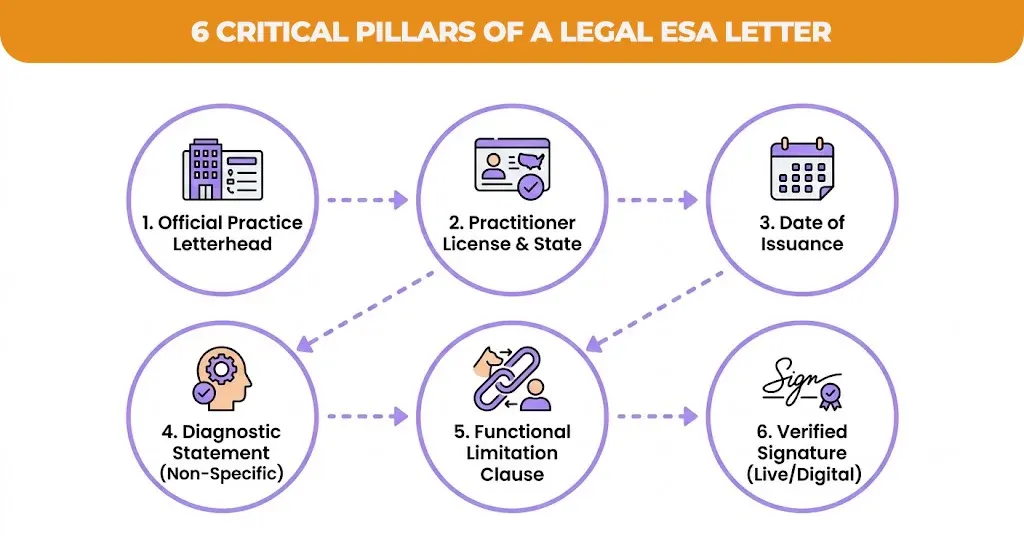
What it is: The letter must be printed on — or include the digital equivalent of — the practitioner’s or clinic’s official letterhead. This header must display the practice name, the treating professional’s full name, a physical office address, a direct phone number, and a professional email address.
Why it matters: Letterhead establishes the provenance of the document. A landlord receiving a letter with no identifiable clinic or professional address cannot verify its authenticity, which gives them defensible grounds for denial under the HUD verification framework. The absence of a physical address alone is a common red flag.
What it is: The specific license type (e.g., LCSW — Licensed Clinical Social Worker, LMFT — Licensed Marriage and Family Therapist, PhD Psychologist, or MD/DO Psychiatrist), the exact license number, and the state of issuance must appear clearly in the document body or signature block.
Why it matters: This is the single most verifiable element of any legal ESA letter example. Landlords are permitted to cross-reference the license number against that state’s licensing board public portal (HUD Assistance Animal Guidance). Critically, an out-of-state license may trigger automatic rejection in states with strict telehealth prescribing laws. California’s AB 468 requires that any LMHP issuing an ESA letter to a California resident must hold an active California license. Even a perfectly formatted letter from an out-of-state therapist fails compliance under this statute.
What it is: A specific issuance date must appear on the letter. Most housing authorities and property managers treat letters older than 12 months as expired and non-compliant.
Why it matters: State laws are increasingly mandating explicit renewal disclosures. Under California AB 468, any LMHP who has not established an ongoing client relationship prior to issuing the letter faces potential license discipline. An undated letter — or one with a generic “valid for lifetime” statement — is a signature characteristic of fraudulent ESA registry documents. Any ESA letter example PDF you encounter that claims permanent validity should be treated as non-compliant.
What it is: The letter must include a statement affirming that the identified patient has a mental or emotional disability recognized in the DSM-5. It does not need to — and generally should not — name the specific diagnosis.
Why it matters: This is a deliberate legal protection. The FHA entitles tenants to privacy regarding specific medical diagnoses. The treating professional affirms disability status without disclosing HIPAA-protected clinical details. A landlord who demands to know the exact diagnosis (e.g., “What disorder do they have?”) is violating federal privacy law. The diagnostic statement in any example of a valid ESA letter is purposefully broad: it confirms a disability exists without revealing its clinical name.
What it is: An explicit statement detailing how the emotional support animal directly alleviates or mitigates at least one functional limitation produced by the disability. This is the clinical nexus — the documented link between the animal and the therapeutic benefit.
What it means in practice: For an ESA dog letter example focused on PTSD, the clause might state that the animal reduces hypervigilance-related sleep disruption and grounds the patient during dissociative episodes. For an ESA cat example letter addressing major depressive disorder, it might specify that the animal’s presence increases behavioral activation and counters social withdrawal. The clause does not need to be lengthy — but it must be specific enough to demonstrate a clinically informed connection.
What it is: A handwritten wet signature or a certified, verifiable digital signature from the treating professional. The signature must correspond to the named practitioner, not an administrative staff member or automated system.
Why it matters: Unsigned letters, letters signed by unlicensed administrative personnel, or letters with clearly copied-and-pasted signatures are automatically non-compliant. Landlords who request to verify a signature by contacting the practitioner directly are within their legal rights under HUD guidelines.
The following templates represent the structure of a legitimate ESA letter used by compliant LMHPs. These are reference frameworks only — a valid letter must be issued by your own licensed treating professional based on a real clinical evaluation.
Use case: Generalized Anxiety Disorder or PTSD with a dog as the prescribed support animal.
[CLINIC OR PRACTICE NAME] [Practitioner Full Name], [Credentials, e.g., LCSW / LMFT / PhD] [Office Address Line 1], [City, State, ZIP] Phone: [Phone Number] | Email: [Professional Email Address] License Number: [State License Number] | State of Licensure: [State]
Date of Issuance: [MM/DD/YYYY]
Re: Emotional Support Animal Accommodation Request Patient Name: [Patient Full Name]
To Whom It May Concern:
I am writing in my professional capacity as a licensed [License Type] currently practicing in the state of [State]. I have been treating [Patient Name] as an established patient since [approximate start date of treatment], and I am familiar with their mental health history.
Based on my clinical assessment, [Patient Name] has a disability as defined under the Diagnostic and Statistical Manual of Mental Disorders (DSM-5). As a direct result of this disability, [Patient Name] experiences functional limitations that significantly impact one or more major life activities.
I have determined, within the scope of my professional judgment, that an emotional support animal is a necessary component of [Patient Name]’s ongoing treatment plan. Specifically, [Patient Name]’s dog, [Animal Name/Breed if applicable], serves to reduce anxiety-related hyperarousal, improve grounding during periods of acute distress, and support consistent daily functioning that would otherwise be compromised by their condition.
This letter is being provided to facilitate a reasonable accommodation request under the Fair Housing Act (42 U.S.C. § 3604(f)(3)(B)) and is valid for a period of twelve (12) months from the date of issuance. Should you need to verify my credentials or licensure, please contact my office using the information provided above.
Sincerely,
[Practitioner Full Name], [Credentials] [Practice Name] License #: [License Number] | [State] | [Expiration Date of License] [Signature]
Use case: Major Depressive Disorder or Persistent Depressive Disorder with a cat as the prescribed support animal.
[CLINIC OR PRACTICE NAME] [Practitioner Full Name], [Credentials, e.g., LPC / Psychologist / MD] [Office Address Line 1], [City, State, ZIP] Phone: [Phone Number] | Email: [Professional Email Address] License Number: [State License Number] | State of Licensure: [State]
Date of Issuance: [MM/DD/YYYY]
Re: Emotional Support Animal Accommodation Request Patient Name: [Patient Full Name]
To Whom It May Concern:
I am a licensed [License Type] practicing in [State], and I have been providing mental health treatment to [Patient Name] as an established patient since [approximate start date].
In my professional clinical opinion, [Patient Name] lives with a mental or emotional disability recognized under the DSM-5 that creates measurable limitations in one or more major life activities, including but not limited to emotional regulation, social engagement, and maintenance of daily routines.
As a clinically indicated component of [Patient Name]’s treatment, I have recommended the use of an emotional support animal. [Patient Name]’s cat, [Animal Name if applicable], provides consistent sensory grounding, encourages behavioral activation, and mitigates the isolating effects of their condition by maintaining routine interaction and daily structure. These therapeutic benefits are meaningfully tied to the functional limitations produced by [Patient Name]’s disability.
This letter constitutes a reasonable accommodation request under the Fair Housing Act. It is valid for twelve (12) months from the date above. Practitioners may verify my licensure through the [State] [Licensing Board Name] at [Licensing Board URL].
Professionally,
[Practitioner Full Name], [Credentials] [Practice Name] License #: [License Number] | [State] | [License Expiration] [Signature]
Use case: Complex or comorbid diagnoses (e.g., bipolar disorder, PTSD with co-occurring depression) requiring a more formal clinical framing.
[PSYCHIATRIC PRACTICE OR CLINIC NAME] [Practitioner Full Name], [MD / DO / PhD / PsyD] [Office Address], [City, State, ZIP] Phone: [Phone Number] | Fax: [Fax Number] | Email: [Email] NPI Number: [NPI if MD/DO] | License #: [License Number] | State: [State]
Date: [MM/DD/YYYY] RE: Psychiatric Evaluation & ESA Prescription Letter Subject: [Patient Full Name] | DOB: [MM/DD/YYYY]
To Housing Authority / Property Manager:
I am a licensed [MD / DO / PhD Psychologist] in the state of [State], with a specialty in [Psychiatry / Clinical Psychology]. I have conducted a formal psychiatric evaluation of [Patient Name] and have established an ongoing therapeutic and/or medication management relationship since [date].
Following this evaluation, I have determined that [Patient Name] meets the diagnostic criteria for a mental or emotional disability as defined in the current edition of the DSM-5. This condition results in clinically significant functional impairments affecting [Patient Name]’s capacity for stable emotional regulation, consistent daily functioning, and maintenance of an adequate quality of life in residential settings.
Within my clinical judgment and as part of [Patient Name]’s structured treatment plan, I am formally recommending an emotional support animal as a therapeutic adjunct. The presence of [Patient Name]’s [animal species], [Animal Name], has been documented in my clinical notes as producing measurable reduction in [e.g., mood cycling frequency / hyperarousal episodes / crisis event frequency], which directly addresses the functional limitations described above.
This ESA prescription letter is issued in compliance with applicable federal law, including the Fair Housing Act (42 U.S.C. § 3604), HUD’s 2020 Assistance Animal Notice (FHEO-2020-01), and any applicable state statutes. This letter is valid for twelve (12) months from the date of issuance.
For verification of licensure or to confirm patient relationship status, please contact my office. Requests for specific diagnostic information beyond what is stated herein are not permissible under HIPAA and applicable FHA privacy provisions.
Sincerely,
[Practitioner Full Name], [Credentials] [Practice/Clinic Name] License #: [License Number] | State: [State] | Expiry: [Date] NPI: [NPI Number — for MD/DO/Psychiatrist only] [Signature]
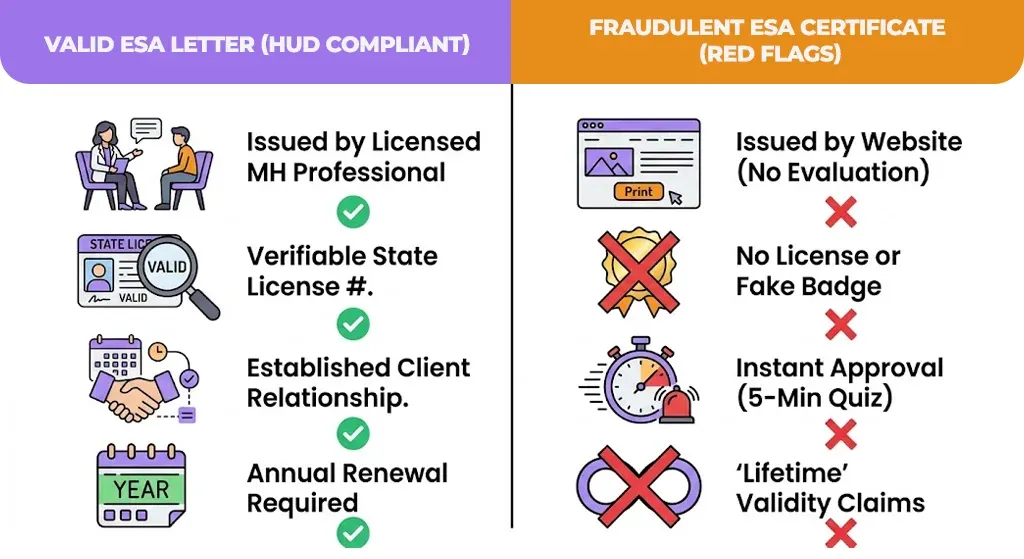
A growing number of websites offer instant “ESA registration” for a flat fee, generating a printable PDF within minutes. These documents present as ESA letter examples but have no legal standing under the Fair Housing Act. Housing providers and their legal counsel are increasingly trained to identify exactly these documents — and rejecting them carries no legal risk for the landlord.
Common red flags in fraudulent documents include:
Lifetime validity: No legitimate ESA letter claims permanent status. Any letter without an expiration or renewal date is automatically suspect.
No named practitioner: Legitimate letters name a specific licensed professional. Registry certificates often list a company name or no issuer at all.
No state license number: If the license number cannot be found on a state licensing board portal, the letter has no legal standing.
Instant approval with no evaluation: Real ESA prescriptions follow a clinical assessment. Any service advertising same-day approval after a 5-minute online quiz is operating outside clinical and legal norms.
Generic badges, seals, or QR codes: These decorative elements have no legal meaning under FHA or HUD frameworks. They exist to make fraudulent documents look official.
| Criterion | Valid ESA Letter Example | Fraudulent Registry Certificate |
|---|---|---|
| Issuing Authority | Licensed Mental Health Professional (LMHP) — LCSW, LMFT, Psychologist, or MD | Unnamed website or automated system with no human clinical contact |
| License Verification | License number, type, and state listed; verifiable on state licensing board portal | No license information; may display fake badge or seal |
| In-Person / Telehealth Evaluation | Based on a real clinical evaluation (in-person or compliant telehealth session) | Instant approval after payment; no evaluation conducted |
| Patient Relationship | Establishes existing therapist-patient relationship | No clinical relationship; one-time online questionnaire |
| HUD Compliance | Complies with HUD’s 2020 Assistance Animal Notice and applicable state law (e.g., CA AB 468) | Non-compliant; flagged as fraudulent by HUD guidelines |
| Landlord Verifiability | Landlord may contact practitioner to confirm letter authenticity | No verifiable contact; phone numbers often go unanswered |
| Expiration & Renewal | Dated; typically valid for one year with required annual renewal | “Lifetime” registration — a recognized fraud indicator |
| Legal Standing in Housing Disputes | Defensible under the Fair Housing Act | Not legally defensible; may expose tenant to discrimination complaint dismissal |
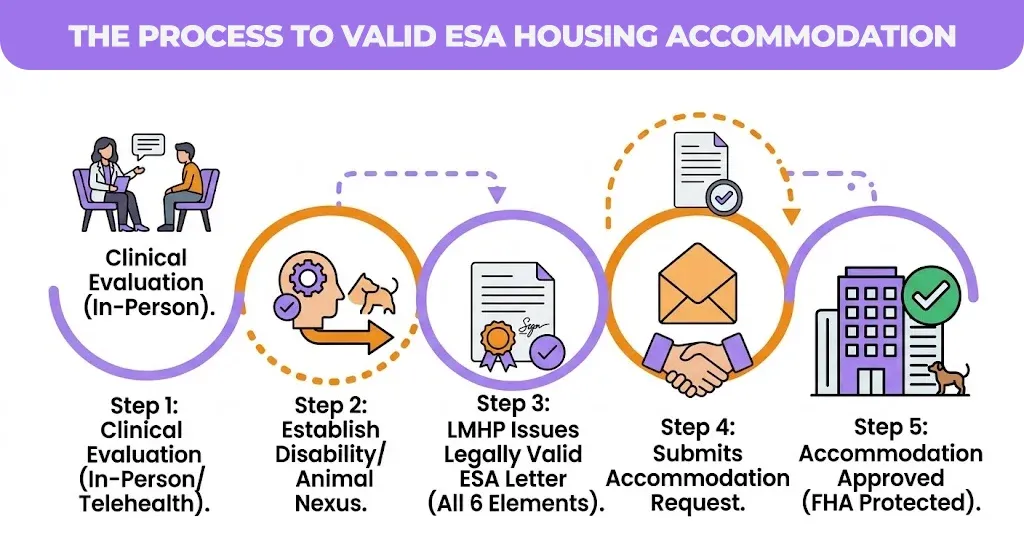
Understanding what a landlord is — and is not — permitted to do when reviewing an example of a legitimate ESA letter is critical for protecting your rights. HUD’s 2020 Assistance Animal Notice establishes a clear framework that preempts most landlord overreach.
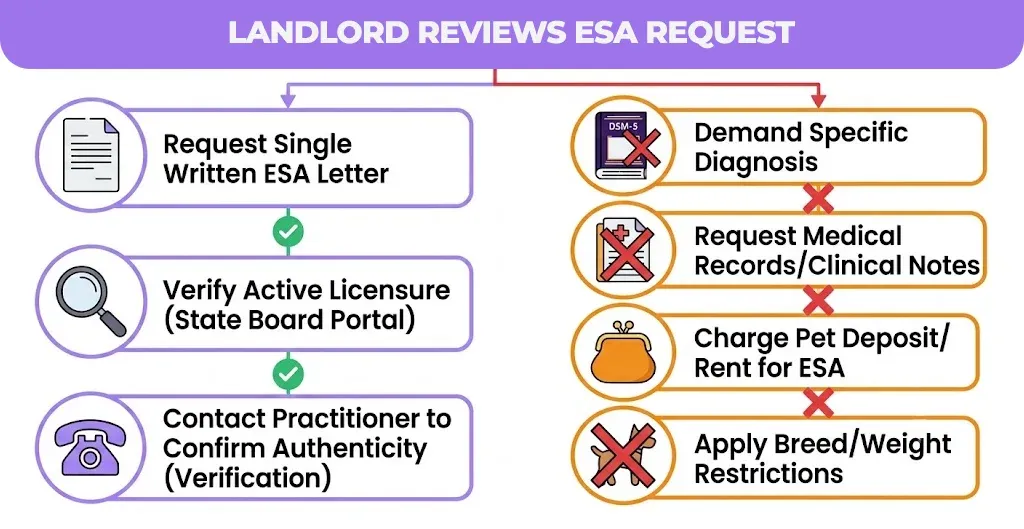
Request a single written letter from an LMHP confirming the disability-related need for an ESA.
Verify active licensure by cross-referencing the practitioner’s name and license number on the relevant state licensing board’s public website.
Contact the practitioner’s office to confirm that the letter is genuine and that the professional is willing to confirm the accommodation recommendation — without requesting medical records.
Deny the request if the letter is undated, contains no license information, was issued by a clearly non-licensed source, or originates from a known fraudulent ESA registry.
Apply a 10-day response window under HUD guidelines before responding to the accommodation request, allowing time for reasonable verification steps.
Demanding the specific diagnosis: A landlord cannot legally require disclosure of which DSM-5 condition you have been diagnosed with.
Requesting medical records or clinical notes: Full treatment records, session notes, or medication histories are protected under HIPAA and are entirely outside the scope of a reasonable accommodation review.
Requiring a second opinion: One letter from a qualified LMHP in an established therapeutic relationship is legally sufficient. Landlords cannot require you to see a practitioner of their choosing.
Charging a pet deposit for an ESA: Under the FHA, emotional support animals are not pets. No pet deposit, pet rent, or additional fee may be charged for an approved ESA accommodation — though tenants remain liable for actual property damage.
Applying breed or weight restrictions: Pet policies — including breed restrictions — do not legally apply to approved emotional support animals.
A compliant ESA letter is not a bureaucratic checkbox — it is the primary instrument protecting your housing rights. Every element covered in this guide exists because federal law and HUD enforcement frameworks have created a specific evidentiary standard that your documentation must meet. A letter that is missing a license number, issued by an out-of-state therapist in a restricted jurisdiction, or generated by an online registry site does not just fail to help you; it can actively undermine your legal position in a housing dispute.
Landlords are not the adversary here. Most are simply following verification protocols designed to filter out the significant volume of fraudulent ESA documentation that exists in the current market. When you present a letter that matches the structural precision of the ESA letter examples detailed above, you give your housing provider nothing to legitimately reject.
Are you preparing to request an ESA accommodation? Visit Petesaletter.com to connect with a licensed mental health professional who can evaluate your needs and issue a fully compliant ESA letter — one that meets every legal standard covered in this guide.
Ready to start the process with a real licensed clinician? Get a proper evaluation and documentation that holds up under 2026 rules — no registries, no instant approvals.
A real ESA letter is a signed, dated document issued on the official letterhead of a Licensed Mental Health Professional (such as an LCSW, LMFT, Psychologist, or Psychiatrist) who has an established clinical relationship with the patient. It will include the practitioner’s full name, license type, license number, and state of issuance.
No. A self-written ESA letter carries zero legal weight under the Fair Housing Act. The entire legal foundation of an ESA accommodation rests on a statement from a Licensed Mental Health Professional who has assessed your condition and prescribed the animal as part of your treatment. A self-certification — regardless of how it is formatted — does not establish the clinician-patient relationship, does not include verifiable license credentials, and will be rejected by any housing provider applying even minimal scrutiny.
Yes. Bipolar disorder is a well-established DSM-5 diagnosis that frequently qualifies as a disability under both the Fair Housing Act and the Americans with Disabilities Act when it substantially limits one or more major life activities. Many treating psychiatrists and psychologists incorporate emotional support animals into structured treatment plans for bipolar patients, particularly as a stabilizing influence during depressive phases and as a behavioral anchor during hypomanic periods.
Increasingly, yes — particularly larger property management companies and corporate landlords. Under HUD’s 2020 Assistance Animal Notice, landlords are explicitly permitted to request reliable supporting documentation and to verify practitioner credentials. Many property managers now use services that cross-reference submitted letters against state licensing databases. Letters from known fraudulent online ESA registries are often caught within minutes.

Licensed Psychotherapist
Darren is a leading expert in mental health advocacy and assistance animal documentation. He specializes in streamlining the process for obtaining ESA Letters, PSD Letters, and State-specific ESA compliance.

ESA Letters Issued

Successful Consultations

Licensed Therapist Network

Client Satisfaction Rate




Petesaletter.com helps you get your emotional support animal letter online with guidance and support.

Got Questions? Call us 24/7
Copyright © 2020-2026 Petesaletter All rights reserved. Terms | Privacy | Refund
Owned and Operated by Verimedix LLC