
Last Updated on: August 14, 2026
Reviewed by Darren Andrew Rafel

If you’re looking into an online ESA evaluation right now, here’s the one thing almost every other guide on this topic hasn’t updated you on: HUD changed how it enforces emotional support animal housing complaints in May 2026, and it changes what “legal ESA letter” really means depending on your state.
You can still get a legitimate online ESA evaluation. You can still get a valid letter. But the rules about who can write it, how long they need to know you first, and what protection it gives you are stricter than they were even a year ago — and they’re not the same everywhere.
This guide walks through the real process, the real costs, the current law state by state, and the honest tradeoffs, so you’re not the person who pays $150 for a letter that a landlord in your state is legally allowed to reject.
In an online ESA evaluation, a licensed mental health professional talks with you through a video call or a secure online session to determine whether you qualify for an emotional support animal, based on a diagnosable mental or emotional condition that an animal’s presence would help manage.
It’s not a quiz. A real evaluation is a clinical conversation. The provider asks about your symptoms, how long you’ve had them, how they affect your daily life, and whether an animal genuinely helps. That’s different from typing your name into a form and getting a PDF back five minutes later — which is the exact pattern that got the ESA letter industry into legal trouble in the first place.
The evaluation itself usually takes 15 to 45 minutes. What happens after — whether you get a letter same-day or have to wait weeks — depends entirely on your state, which we’ll break down below.
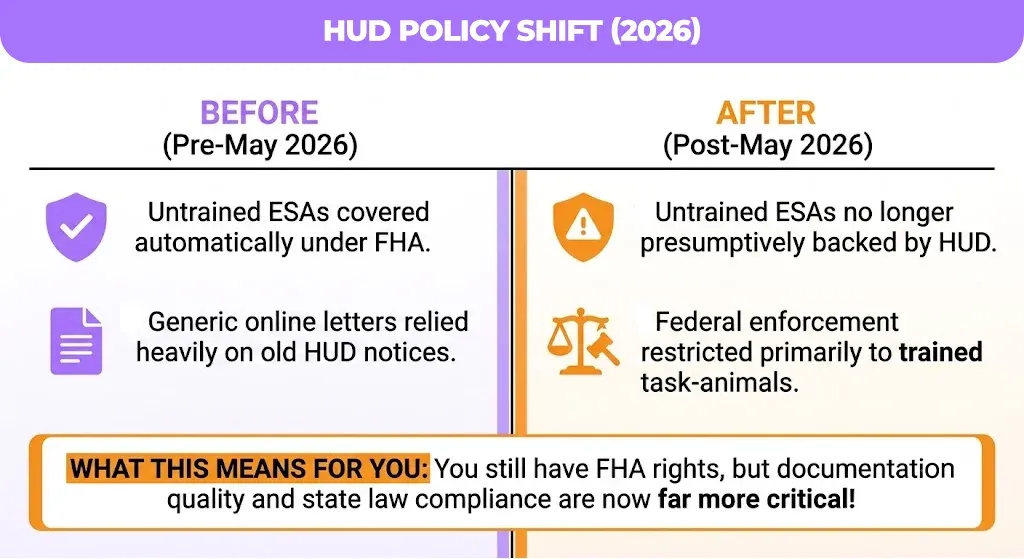
On May 22, 2026, HUD withdrew its long-standing guidance that treated untrained emotional support animals as automatically covered under the Fair Housing Act. Going forward, HUD will only pursue federal enforcement action for animals individually trained to perform a task tied to a disability — the ADA’s service animal standard, not the older ESA standard.
Here’s the timeline, because it matters for anyone reading older articles:
September 17, 2025: HUD withdrew its 2013 and 2020 assistance-animal notices, the documents landlords and letter providers had used as the rulebook for over a decade.
May 22, 2026: HUD issued new enforcement guidance. Going forward, the agency will generally only find “reasonable cause” in animal-accommodation complaints where the animal is individually trained to do work or perform a task connected to the person’s disability. Untrained ESAs no longer get that presumption.
Why did this happen? Two things converged. First, a February 2025 executive order pushed federal agencies to pull back on enforcing anything not directly grounded in statutory text — and the Fair Housing Act’s statute never actually uses the term “emotional support animal.” Second, a federal court in Henderson v. Five Properties LLC (E.D. La., July 2025) found HUD’s older guidance unpersuasive when a landlord challenged it. HUD’s own memo also says plainly that the old guidance helped create “an entire industry” built around converting pets into ESAs with minimal screening.
What this actually means for you: the Fair Housing Act itself hasn’t changed — Congress would have to do that. What changed is how aggressively the federal government will investigate your complaint if a landlord says no. You still have legal standing to request an ESA accommodation and, in many cases, to sue privately if refused unlawfully. But you can no longer count on HUD stepping in on your behalf the way it used to. That makes the quality of your documentation matter more than it did two years ago, not less.
The post-2026 federal shift means instant PDF forms and unverified templates no longer hold up in court. With HUD narrowing its federal enforcement priorities, landlords are scrutinizing online letters more aggressively than ever. Protect your living situation with a rock-solid, individualized letter from an authentic state-licensed clinician. Connect with a licensed professional at PetESALetter to start your compliant evaluation today.
🐾 Protect Your Housing Rights – Start Your Live Assessment!
Federal law (the Fair Housing Act) sets the floor: landlords generally can’t refuse a reasonable ESA accommodation without a valid reason. State law adds requirements on top of that, like how long your provider must know you, whether they need to be licensed in your state, and how often you must renew your letter.
| Federal Law (FHA) | State Law | |
|---|---|---|
| Who enforces it | HUD, but with narrower reach after May 2026 | State attorney general, state housing agencies, private lawsuits |
| Covers untrained ESAs? | No longer presumptively, post-2026 guidance | Varies; some states still explicitly protect ESA requests |
| Provider licensing rules | None specified | Several states require in-state licensure |
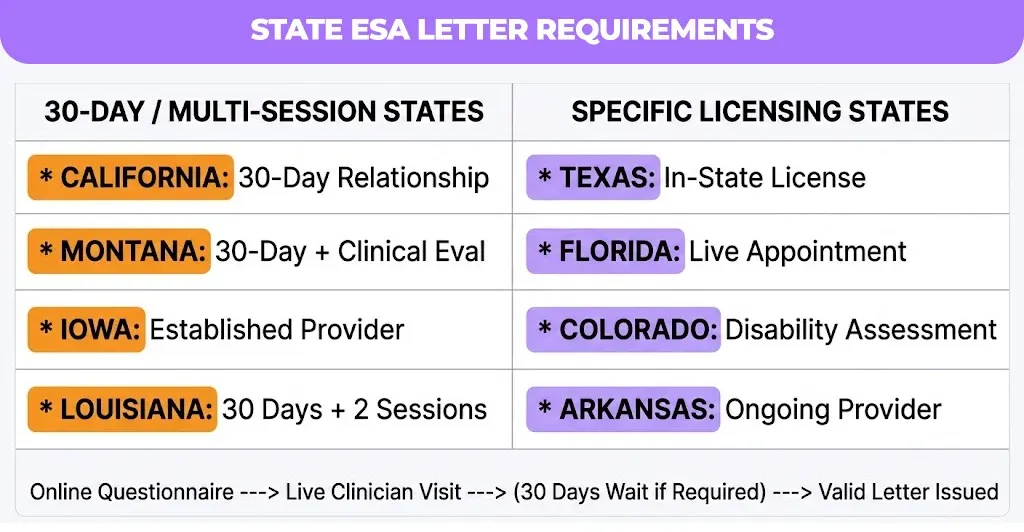
| Minimum relationship length | Not specified | 30 days in CA, MT, IA, LA, AR |
| Letter renewal | Not required | Many states now expect renewal within 12 months |
| Applies to | Housing nationwide (with exemptions) | Only within that state’s borders |
This is the section most competing guides skip entirely, and it’s the part that actually determines whether your online evaluation will hold up.
| State | Key Requirement | What It Means |
|---|---|---|
| California | 30-day provider relationship, in-state license (Health & Safety Code §122318) | A brand-new provider legally cannot issue your letter in under 30 days from first contact |
| Montana | 30-day relationship + clinical evaluation (MCA 70-24-114) | Same-day letters are not valid here regardless of what a website promises |
| Iowa | 30-day relationship with treating provider (Iowa Code §216.8C) | Provider must already know you — a single video call isn’t enough |
| Louisiana | 30-day relationship, minimum two sessions | Two separate contacts are required, not one long call |
| Arkansas | Documentation must come from an established, treating provider (Act 268) | “Established” means an ongoing relationship, not a first-time evaluation |
| Texas | Provider must hold a Texas license | Out-of-state telehealth therapists may not satisfy local housing providers |
| Florida | No “online-only” providers; requires one in-person or telehealth appointment (Fla. Stat. §760.27) | A pure form-fill with no live appointment does not meet the bar |
| Colorado | Provider must have actually met the patient and be licensed to assess disability (CRS §12-245-229) | Rules out letters issued without any real clinical contact |
If your state isn’t listed here, that doesn’t mean anything goes — it means the stricter, named requirements above haven’t been enacted there yet, but the general FHA “reliable third-party documentation” standard still applies everywhere. Confirm current rules with your state’s housing agency or licensing board before you pay for anything, because these laws are still moving.
Living in California, Montana, Iowa, Louisiana, or Arkansas? Same-day letters in these states are illegal and will be rejected by corporate housing screeners. At PetESALetter, we strictly honor your state’s specific clinical timelines (including 30-day requirements) to ensure your letter is 100% legally enforceable and landlord-approved.
Get Your State-Compliant ESA Assessment 🐾
A legitimate process has four steps: intake questionnaire, live evaluation with a licensed clinician, a clinical decision based on real criteria, and — only if you qualify — a signed letter on the provider’s letterhead with their license number.
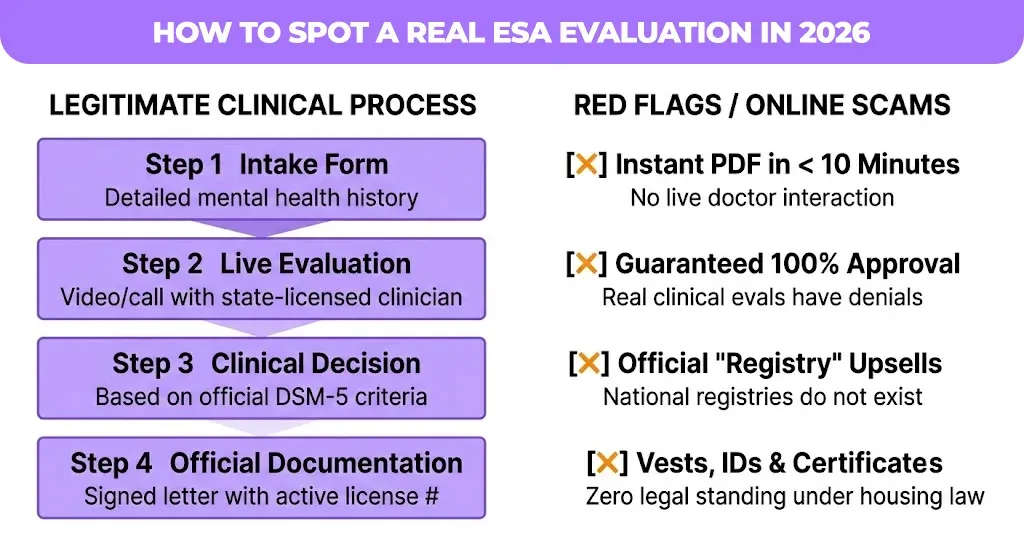
You answer questions about your mental health history, current symptoms, and how an animal helps you cope. This isn’t the evaluation — it’s what the clinician reviews before talking to you.
This is the part scam sites skip. A real evaluation involves an actual conversation — a video call or, in some states, a compliant phone/chat session — with a licensed therapist, counselor, psychologist, or psychiatrist. They’re checking whether you meet criteria for a condition like anxiety, depression, PTSD, or another condition that substantially limits a major life activity.
The provider decides, based on DSM-5-aligned criteria and your specific circumstances, whether an ESA is a legitimate part of your treatment. Not everyone who applies qualifies, and that’s a sign the process is real. If a provider approves 100% of applicants, that’s a red flag, not a selling point.
If approved, you receive a letter that includes the provider’s license type and number, the date, and a statement that you have a disability-related need for the animal. Depending on your state, you may also need to wait out a relationship period before the letter is issued (see the table above).
Only a licensed mental health professional can write a valid ESA letter. This includes licensed clinical social workers (LCSW), licensed professional counselors (LPC), psychologists (PhD/PsyD), psychiatrists (MD), and licensed marriage and family therapists (LMFT). A life coach, wellness coach, or unlicensed “ESA specialist” cannot.
Before you evaluate with anyone, check for:
An active license number you can verify on your state’s licensing board website
Licensure in your state of residence (not just the provider’s home state, in states that require this)
A real, named clinician, not just a company name
Willingness to have an actual conversation with you, not just a form
The clearest sign of a fake ESA letter is a guarantee of approval before any real evaluation happens. Legitimate clinicians can and do decline applicants; a service that promises 100% approval is not doing real clinical work.
Watch for these patterns:
Instant PDFs. If you get a letter within minutes of filling out a form, with no live conversation at any point, it likely won’t hold up in states with relationship requirements.
No license number on the letter. A real letter names the clinician and their credential type. If it’s missing, the letter is not verifiable.
“Registry” upsells. There is no official national ESA registry — federal or state. Any site selling you a spot on one is selling a certificate with no legal weight.
Vests, ID cards, and certificates marketed as “proof.” None of these are legally required or federally recognized for ESAs. A landlord can’t lawfully demand one, and owning one doesn’t strengthen your legal position.
Guaranteed approval language. Real evaluations have a real chance of a “no.” Marketing that promises approval before you’ve even answered a question is a sign the “evaluation” is cosmetic.
An ESA letter is the only document with legal weight. Certificates and registrations are marketing products with no basis in federal or state law.
| Document | Legally Recognized? | Who Issues It | Actual Value |
|---|---|---|---|
| ESA Letter | Yes — this is what the law recognizes | Licensed mental health professional | Establishes disability-related need; the only document landlords are required to consider |
| ESA Certificate | No | Any website | Cosmetic; no legal standing |
| ESA Registration | No | Any website | No such official registry exists |
| ESA Vest/ID Card | No | Any website | Not required, not recognized, doesn’t add legal protection |
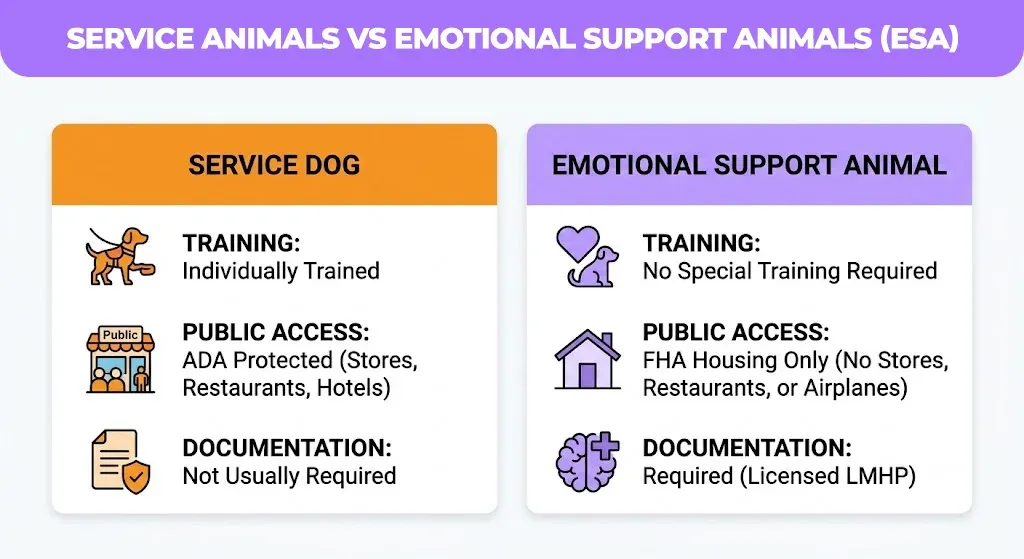
A service dog is individually trained to perform a specific task for a disability and is covered under the ADA in public spaces. An ESA provides comfort through its presence, requires no specific training, and after May 2026 has narrower federal housing enforcement behind it.
| Service Dog | Emotional Support Animal | |
|---|---|---|
| Training required | Yes — task-specific | No |
| Covered under ADA (public access) | Yes | No |
| Covered under FHA (housing) | Yes, and now presumptively reasonable | Yes, but no longer presumptively reasonable post-2026 |
| Allowed in restaurants, stores, planes | Yes | No |
| Species allowed | Dogs (and miniature horses under conditions) | Any species with legitimate documentation |
| Who can issue documentation | Not typically required | Licensed mental health professional |
This distinction is now more consequential than it was before. If your animal is trained to interrupt a panic attack, retrieve medication, or perform another specific task, you may have a stronger legal position under the psychiatric service dog framework than under the ESA framework. That’s a conversation worth having with your clinician directly.
A denial can be lawful when:
The animal poses a direct threat to others’ safety that can’t be reduced through reasonable steps.
The animal would cause substantial physical damage to the property.
The accommodation would impose an undue financial or administrative burden on a small housing provider.
The documentation doesn’t meet your state’s specific requirements (for example, a letter issued in violation of California’s 30-day rule).
The housing is exempt under the FHA — owner-occupied buildings with four or fewer units, for instance.
Landlords get this wrong often, usually in predictable ways:
Demanding a specific ESA form instead of accepting a valid letter. You’re not required to use their form if your letter already meets legal standards.
Asking for your diagnosis. They can ask that you have a disability-related need; they cannot demand to know the specific condition.
Charging a “pet fee” for an ESA. This is not permitted for a properly documented ESA, though you can still be held responsible for actual damage the animal causes.
Rejecting a letter because it’s from an online provider. A letter isn’t invalid just because the evaluation happened online — the legal question is whether the provider is licensed and the process met your state’s requirements, not the medium.
If a landlord denies you improperly, document the exchange in writing and consider contacting your state housing agency or a fair housing attorney; private legal claims remain available even where HUD’s own enforcement has narrowed.
No. Since 2021, airlines are no longer required to accommodate emotional support animals as anything other than pets under Department of Transportation rules. Only trained service animals get in-cabin access without pet fees.
This one surprises a lot of people who assume ESA rules cover air travel the way they cover housing. They don’t, and that hasn’t changed with the 2026 HUD update — it was already settled separately by the DOT years earlier. If you’re evaluating for travel purposes specifically, an ESA letter won’t get your animal free cabin access; you’d need a task-trained service animal that meets DOT and airline documentation requirements.
A legitimate online ESA evaluation typically costs between $80 and $200, usually including the evaluation and the letter if approved. Prices above that with no clear reason, or “guaranteed approval” pricing, are red flags.
| Service | Typical Cost | Notes |
|---|---|---|
| Evaluation only | $50–$100 | Some providers charge separately if you’re not approved |
| Evaluation + letter (approved) | $100–$200 | Most common pricing structure |
| Renewal letter | $50–$100 | Needed annually in states requiring current documentation |
| “Registry” or certificate add-ons | $20–$50 | Optional and legally meaningless — skip these |
Take the first step toward a legitimate ESA letter with a licensed mental health professional. Complete your secure online evaluation and, if you qualify, receive documentation that meets current housing requirements.
Ready to skip the scam registries and get evaluated the right way? Establish a legally sound, clinical relationship with a verified practitioner in your state and protect your companion without stress.
No. Online ESA certifications and registrations have no legal value. A valid ESA letter from a licensed mental health professional, issued after a proper evaluation, is what landlords generally consider.
There is no official or legally recognized online ESA certification. Instead, choose a reputable provider that offers a real evaluation by a licensed mental health professional and issues a legitimate ESA letter if you qualify.
Yes. Many landlords verify ESA letters by checking the provider’s license, contact information, and whether the documentation meets federal and state requirements. They cannot require an ESA certificate or registration.
Yes. Many people have legally received ESA letters through online evaluations with licensed mental health professionals. The key is using a legitimate provider that conducts a real clinical evaluation.

Licensed Psychotherapist
Darren is a leading expert in mental health advocacy and assistance animal documentation. He specializes in streamlining the process for obtaining ESA Letters, PSD Letters, and State-specific ESA compliance.

ESA Letters Issued

Successful Consultations

Licensed Therapist Network

Client Satisfaction Rate




Petesaletter.com helps you get your emotional support animal letter online with guidance and support.

Got Questions? Call us 24/7
Copyright © 2020-2026 Petesaletter All rights reserved. Terms | Privacy | Refund
Owned and Operated by Verimedix LLC