
Last Updated on: August 14, 2026
Reviewed by Darren Andrew Rafel
Quick answer: There is no official ESA registry in the United States. Legitimate emotional support animal registration as a government system simply doesn’t exist — no federal database, no state registry, no recognized certification program. The only document that legally matters is an ESA letter from a licensed mental health professional. Any site selling “registration” or “certification” is not offering anything legally valid.
Search “ESA registration” online and you’ll find dozens of sites promising official certificates, laminated ID cards, and national registry numbers — most for somewhere between $29 and $99. It looks credible. It feels official. And it’s completely meaningless. The concept of legitimate emotional support animal registration as a government-backed system is one of the most persistent myths in the ESA world, and it costs renters real money and real housing access every single day.
Here’s the truth: there is no federal ESA registry. HUD doesn’t run one. The FHA doesn’t require one. No state agency maintains one. No landlord is legally entitled to see a “registration number,” and no registration certificate — no matter how official it looks — carries any legal weight under the Fair Housing Act. What actually protects your housing rights is a single document: an ESA letter from a licensed mental health professional (LMHP). That’s it. Not a database entry. Not a laminated card. A letter.
This article walks through the five biggest myths about legitimate emotional support animal registration, explains what an ESA document actually is, and tells you what to do if you’ve already spent money on a fake certificate. By the time you’re done reading, you’ll be able to spot a scam site in about ten seconds.
Let’s start with the foundational fact: there is no official US emotional support animal registry. Not one maintained by the federal government, not one recognized by HUD, not one that any landlord is legally required to consult. The idea of legitimate emotional support animal registration as a government-administered system simply doesn’t exist in US law. “Legitimate ESA registration,” in the sense that these websites sell it, is a fiction.
The Fair Housing Act (FHA) — the federal law that protects ESA owners in housing — does not mention registration anywhere. HUD’s official guidance on assistance animals is equally clear: what a landlord can request is documentation showing that you have a disability and that the animal provides disability-related support. That documentation is a letter from a licensed mental health professional. Full stop.
Emotional support animals aren’t service animals, either. Service animals are covered under the Americans with Disabilities Act (ADA), which also has no registry requirement. ESAs are covered under the FHA and, in some cases, Section 504 of the Rehabilitation Act. Neither law creates or references any registration system.
So where did the myth come from? Partly from the service-animal world — some vendors started selling “certification” products there, and the same business model migrated to ESAs. Partly from the fact that a legitimate-looking certificate feels more official than a letter. And partly because these websites are really good at search engine optimization. They rank well, they look credible, and they fill a vacuum that scared, confused renters are desperate to fill.
Understanding this matters because if you hand a landlord a registration certificate thinking it satisfies their documentation request, you may be denied. The landlord — if they know the law — will ask for the actual letter. And if you bought a certificate instead of getting a proper evaluation, you don’t have what you need. “Legitimate emotional support animal registration,” as these sites define it, doesn’t get you through the door.
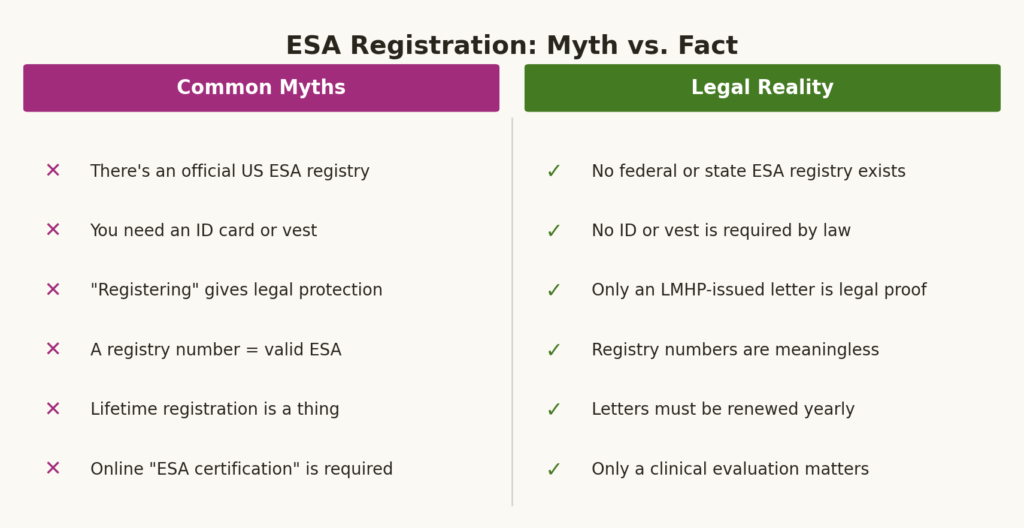
These are the myths that come up constantly — in forums, in landlord-tenant disputes, and in emails from people who’ve already spent money on something that didn’t work. Each one has a simple, provable answer.
The myth about needing a vest or ID card is closely related to the registration myth: vests, patches, and ID cards for ESAs have exactly the same legal standing as registration certificates — which is none. A landlord cannot require you to have them, and having them doesn’t strengthen your housing request at all. They’re costume jewelry for animals. Decorative, not functional.
People often ask: what is an ESA document that actually counts? The answer is always the same — a letter from a licensed mental health professional. Not a registry printout. Not a laminated card. It’s a therapist-signed letter on professional letterhead.
One more thing worth knowing: “legitimate ESA registration” isn’t just a myth in the legal sense — it’s potentially harmful. Buying a fake certificate instead of getting a real ESA letter means you don’t have the actual document that protects you. When the housing dispute actually happens, you’re unprotected.
Myth: There’s an official US ESA registry. Fact: No federal or state ESA registry exists. HUD, the FHA, and no government agency maintains or recognizes any ESA database. A “registration number” on a certificate is an invented number — it refers to nothing.
Myth: Registering your ESA makes it official. Fact: ESAs don’t become “official” through registration. The legal status of an ESA is determined by a licensed mental health professional’s assessment of your disability and therapeutic need — not by any database entry or certificate purchase.
Myth: Landlords require ESA registration documents. Fact: Landlords who understand the law ask for an ESA letter, not a registration certificate. HUD’s guidance is explicit: they can request documentation of disability and need, which means a letter from an LMHP — not a printout from a commercial website.
Myth: Real ESA certification comes from a national organization. Fact: No national organization has authority to certify ESAs. Legitimate emotional support animal certification is a letter signed by a licensed therapist, psychologist, or psychiatrist in your state — not a seal from a registry site.
Myth: ESA registration is required in specific states like NC or Arizona. Fact: Neither North Carolina nor Arizona (nor any other US state) operates an ESA registration program. Searches for “emotional support animal registration NC” and “emotional support animal registration Arizona” lead to the same commercial sites selling legally meaningless products.
So if registration doesn’t work, what is an ESA document that actually does the job? It’s an ESA letter. A real one has a specific structure and comes from a specific source — and understanding both helps you recognize the difference between a document that protects you and one that doesn’t.
An ESA letter is a signed written statement from a licensed mental health professional (LMHP). That includes licensed clinical social workers (LCSWs), licensed professional counselors (LPCs), psychologists, and psychiatrists. The letter must be written on the provider’s letterhead, include their license number and state of licensure, and state that you have a disability under the DSM-5 and that your emotional support animal provides necessary support related to that disability.
What the letter does not need: it doesn’t need to name your diagnosis. It doesn’t need your medical history. It doesn’t need to describe your animal’s specific training (ESAs don’t require training). And it absolutely does not need a registration number from any database.
Here’s the part no one tells you about ESA letters: the quality varies enormously. Some online services connect you with a licensed therapist in your state for a real clinical evaluation — a 20–30 minute conversation where the provider actually assesses your needs. Others auto-generate letters after a five-question online quiz, with no real evaluation at all. The second type won’t hold up if a landlord or HUD scrutinizes it.
A real ESA certification — meaning a legitimate ESA letter — comes from a provider who has actually engaged with you as a patient. HUD’s guidance specifically warns landlords about verifying that documentation comes from a provider with an actual therapeutic relationship or knowledge of your disability. A letter generated without any real evaluation doesn’t meet that standard.
If you want documentation that actually works when it counts, the path is clear: find a licensed mental health professional, complete a real evaluation, and get a letter that reflects an actual professional assessment. Our legitimate ESA letter service connects you with state-licensed therapists who can complete that evaluation online — see how it works at PetESALetter.
If these registration sites are legally meaningless, why do they keep operating? Simple: there’s a market for them, they’re not technically illegal in most cases (selling a certificate isn’t fraud unless they explicitly promise legal protections they can’t deliver), and enforcement is minimal.
Here’s who gets fooled, and it’s worth being honest about this: mostly people who are scared — first-time ESA seekers who don’t know the law. Someone with anxiety or depression who desperately needs to keep their dog in their apartment, who searches for help and finds a site that looks authoritative, charges $49, and sends a certificate within minutes. They feel like they’ve solved the problem. They haven’t.
Picture this: Marcus, a renter in Phoenix, bought a $39 “certificate + vest + ID card” combo from one of these sites. The package arrived in the mail — laminated card, fabric vest with an official-looking patch, a framed certificate with a QR code. It felt real. When he moved into a new apartment and submitted the packet to his property manager, he was told within 48 hours that none of those documents were acceptable. The manager had seen ESA fraud before and knew what a proper ESA letter looked like. Marcus had to scramble to get a real evaluation and letter within his lease signing window — a stressful, avoidable situation that cost him extra time and money on top of the $39 he’d already wasted.
Some of these sites are careful with their language — they use phrases like “register your ESA in our database” rather than claiming registration is legally required. Others are more aggressive and outright lie. Either way, the product is the same: something that looks official and does nothing legally. Searching for “legit emotional support animal registration” feels like the right starting point, but it sends people straight to these vendors.
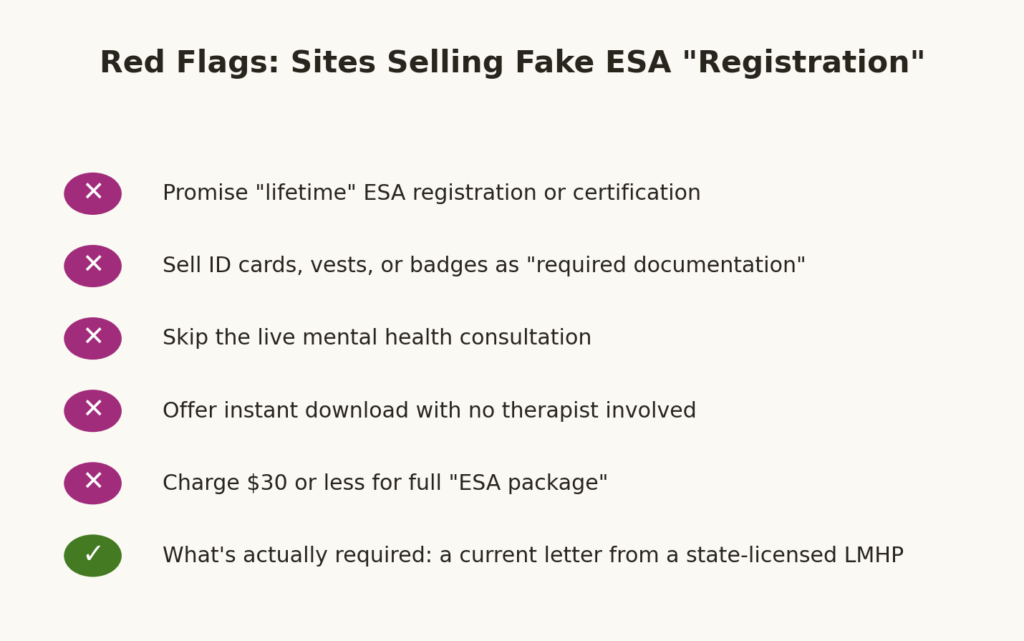
Searching for “legitimate emotional support animal certification” has the same problem. The sites ranking for that phrase aren’t offering actual clinical evaluations — they’re selling packages. Legitimate ESA certification, in the legally meaningful sense, comes only from a licensed professional who has actually evaluated you. The red flags are easy to spot once you know what you’re looking for:
Instant approval with no therapist contact or evaluation
Flat fee for a certificate, ID card, or vest — no consultation included
Claims of a “national database” or “federal registry” for ESAs
Promises that their certificate is “accepted by all landlords” or “legally recognized”
No licensed mental health professional involved in the process at any step
When a landlord asks for your ESA documentation, they’re usually using informal shorthand. What they’re actually entitled to request under HUD’s guidance is proof of two things: (1) that you have a disability, and (2) that the animal provides support related to that disability. That’s it.
The document that satisfies both requirements is an ESA letter from a licensed mental health professional. Not a certificate. Not a registration card. Not a vest with patches. An ESA letter — on letterhead, signed, with license information. The “ESA papers” your landlord wants aren’t from a registry site; they’re from a licensed therapist.
Some landlords, especially those who haven’t dealt with many ESA requests, genuinely don’t know the difference between an ESA letter and a registration certificate. They may ask for documentation because they’ve heard that ESA owners need it, but they’re fuzzy on the specifics. In those cases, submitting a proper ESA letter — and politely noting that this is the documentation HUD recognizes — usually resolves things quickly.
Other landlords know exactly what they’re asking for and are testing whether you have the real thing. A registration certificate in this situation actually raises red flags: it signals that you may not have had a real clinical evaluation, which is precisely what HUD warns about in its guidance on fraudulent ESA documentation.
If you’re in North Carolina, understanding what legitimate ESA documentation actually looks like matters because the state follows federal FHA standards — “emotional support animal registration NC” as a concept simply doesn’t exist under NC law. Same story in Arizona: “emotional support animal registration Arizona” is a search term, not a legal requirement. Both states’ landlords are bound by the same HUD standards as landlords everywhere else. You need a legitimate ESA letter, and you can get one whether you’re in Raleigh, Tucson, or anywhere in between. Check our ESA letters by state page for state-specific guidance, or see dedicated resources for states like Louisiana, West Virginia, and Washington DC, where local rules can add nuance.
The safest thing you can do is arrive with a proper letter before your landlord even asks. Proactive submission — and choosing a process that actually starts with a licensed therapist rather than a website checkout page — eliminates most disputes before they start.
It happens all the time, and it’s not something to feel embarrassed about. These sites are designed to look legitimate. If you’ve already bought a registration certificate, a vest kit, or an ID card from one of these services, here’s how to fix the situation.
First: don’t try to use the certificate with a landlord. If they’re familiar with HUD standards — and many property managers now are — submitting a fake certificate may mark you as someone who purchased fraudulent documentation. That’s a harder conversation to recover from than simply not having submitted anything yet.
Second: get a real ESA letter. This means completing an evaluation with a licensed mental health professional. Online telehealth platforms make this easier than it used to be — you can often complete the evaluation in a 20–30 minute video or phone call, and have a letter within 24 hours. A legitimate ESA letter service like PetESALetter connects you with licensed therapists in your state who understand FHA requirements and can provide documentation that actually holds up.
Third: request a refund from the fake registration site if you’re within their refund window. Some of these sites do offer refunds; many don’t. If you paid by credit card and believe the site misrepresented what its product does legally, you may be able to file a chargeback.
Fourth: if you’ve already been denied housing partly because of a fake certificate, document everything. A denial based on fraudulent-looking documentation is complex — but if you can show you didn’t understand what you were buying, and you now have a real ESA letter, many landlords will reconsider. If they won’t, HUD’s Fair Housing complaint process is available to you.
Going forward, the checklist is simple: real evaluation, real licensed professional, real letter. That’s what legitimate ESA documentation actually looks like — and it’s the only version that protects your housing rights when it matters. You can get started with a free eligibility quiz at PetESALetter to see whether you qualify and get matched with a therapist in your state.
This is where most people get sold something worthless. No registry, website, or “certification board” can issue you a valid emotional support animal document. Only a licensed mental health professional can — and only after actually evaluating you.
Professionals who can write a legitimate ESA letter, assuming they are licensed in your state and have evaluated you:
The animal is irrelevant to who may write it. People often search for a “dog ESA certificate” or a “cat certificate” as though the species changes the paperwork. It does not. The letter documents your disability-related need, so the same licensed clinician writes the same letter whether your animal is a dog, a cat, or a rabbit.
There is no registration step in this process, because there is nothing to register with. The legitimate path has four:
If a service skips step 2 — no evaluation, no clinician, instant approval — whatever it emails you is not an ESA letter, regardless of what the PDF is titled.
Pricing is one of the clearest tells. A real letter carries the cost of a licensed professional’s time, so it is priced like a consultation — typically in the range of a single therapy session, sometimes more where state rules require a longer or in-person evaluation.
Judge the offer by whether you speak to a licensed clinician, not by the price tag. A cheap consultation can be legitimate; an expensive certificate never is.
These are treated as interchangeable across the internet. They are not comparable things — one is a medical document, the other is a product.
The reason the phrasing persists is that registration sites bought the vocabulary. They rank for “register your dog as an emotional support animal” because that is what people type — not because registering is a real step. If you already paid for one, see the section below on what to do next.
Your protection has never come from a registry, and it does not come from HUD guidance either. It comes from statute and regulation:
The practical takeaway is unchanged: a verifiable letter from a licensed clinician is what a housing provider can evaluate. How an individual provider responds still depends on your documentation, your state, and the specifics of your request, so nobody can promise you an outcome in advance.
Want a letter that survives verification? Skip the registry scams and get documentation backed by an actual licensed clinician who can be looked up and confirmed.
No. There is no federal ESA registry, no state-level registry, and no government-recognized database of emotional support animals anywhere in the United States. HUD, the FHA, and no other federal agency maintains or recognizes any such system. Any website claiming to offer official ESA registration in a government database is misrepresenting what it sells.
No. There’s no government registration requirement for emotional support animals. What you do need is a valid ESA letter from a licensed mental health professional — that’s the document the Fair Housing Act and HUD’s guidance recognize. No registration, no certification database, and no ID card is required or recognized under federal law. Legitimate ESA certification starts with an actual therapist, not a website form.
Legally, no. Sites that sell ESA “registration certificates,” ID cards, or vest packages are selling products with no legal standing under the FHA, HUD guidelines, or any state law. A landlord is not required to accept them, and submitting a registration certificate instead of a real ESA letter can raise red flags with landlords who know the law. These sites exist because they’re profitable, not because their products are meaningful.
When landlords ask for documentation, they’re usually asking — in informal terms — for what HUD allows them to request: proof of disability and proof that the animal provides related support. The document that satisfies this is an ESA letter from a licensed mental health professional. Not a registration certificate. If your landlord is asking for ESA papers, a proper ESA letter is what you need to provide.
ESA registration is a commercial product with no legal value — a certificate or ID card sold by private websites. An ESA letter is a signed, dated document from a licensed mental health professional (on their letterhead, with license information) confirming your disability and therapeutic need. The ESA letter is the only document recognized under the Fair Housing Act.
No. Neither North Carolina nor Arizona operates an ESA registry or recognition program. Searches for ESA registration in NC or Arizona return results from commercial sites — not government agencies. Both states follow federal FHA standards, which means a valid ESA letter from a licensed mental health professional is the only documentation that matters. Our ESA letters by state page has state-specific guidance for NC, AZ, and every other state.
Buying a fake registration certificate isn’t necessarily illegal on your part — you’re the one being misled. But submitting one to a landlord as your primary ESA documentation can create problems: a landlord who recognizes fake documentation may view your request skeptically, even if you later produce a real ESA letter. The risk isn’t legal jeopardy for you — it’s that you’ve spent money on something useless and complicated your housing situation needlessly.
Don’t risk a fake letter Get your FHA-compliant ESA letter today from a licensed mental health professional. 100% money-back guarantee. |

Licensed Psychotherapist
Darren is a leading expert in mental health advocacy and assistance animal documentation. He specializes in streamlining the process for obtaining ESA Letters, PSD Letters, and State-specific ESA compliance.

ESA Letters Issued

Successful Consultations

Licensed Therapist Network

Client Satisfaction Rate




Petesaletter.com helps you get your emotional support animal letter online with guidance and support.

Got Questions? Call us 24/7
Copyright © 2020-2026 Petesaletter All rights reserved. Terms | Privacy | Refund
Owned and Operated by Verimedix LLC