
Last Updated on: September 28, 2026
Reviewed by Darren Andrew Rafel
A free ESA letter is usually not the same thing as valid clinical documentation. Free resources can explain the process, help you prepare questions, or provide a personal checklist. A housing request that relies on disability-related need, however, generally calls for a letter created after an individualized evaluation by a licensed mental health professional.
For a practical companion, see our Sample ESA Letter: What a Legitimate One Includes.
Quick answer: You can learn about ESA housing requests and prepare at no cost, but a blank template, registry certificate, or self-written letter does not replace an evaluation by a licensed clinician. If documentation is appropriate for your situation, ask about the clinician’s license, the evaluation process, the fee, and what the letter will actually address.
Free information is useful when it helps you understand terminology and prepare for a real conversation. A checklist can help you gather the animal’s role in your daily life, the housing question you need to solve, and questions for a licensed mental health professional. A sample format can show the kinds of topics a letter may cover, but it cannot create a clinician-patient relationship or make a clinical finding.
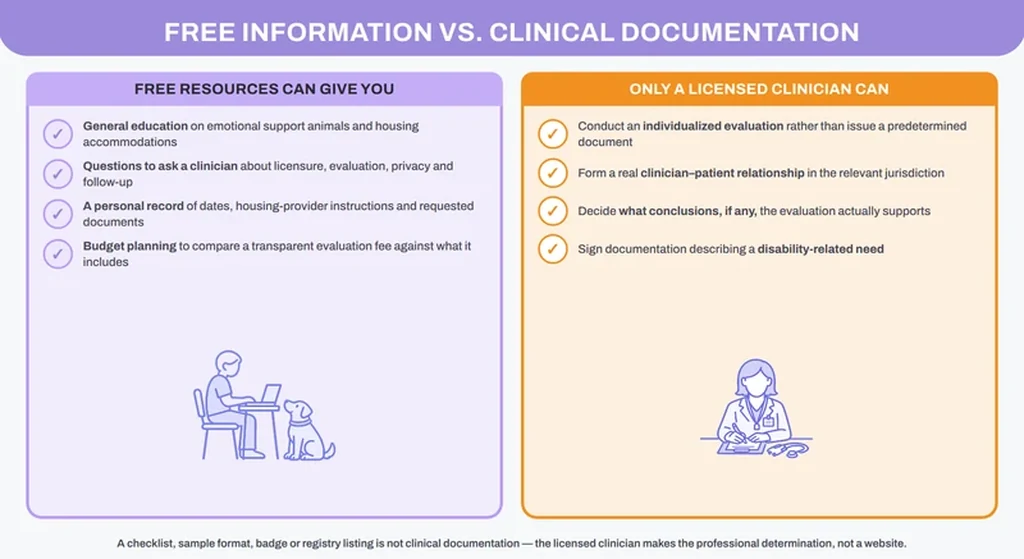
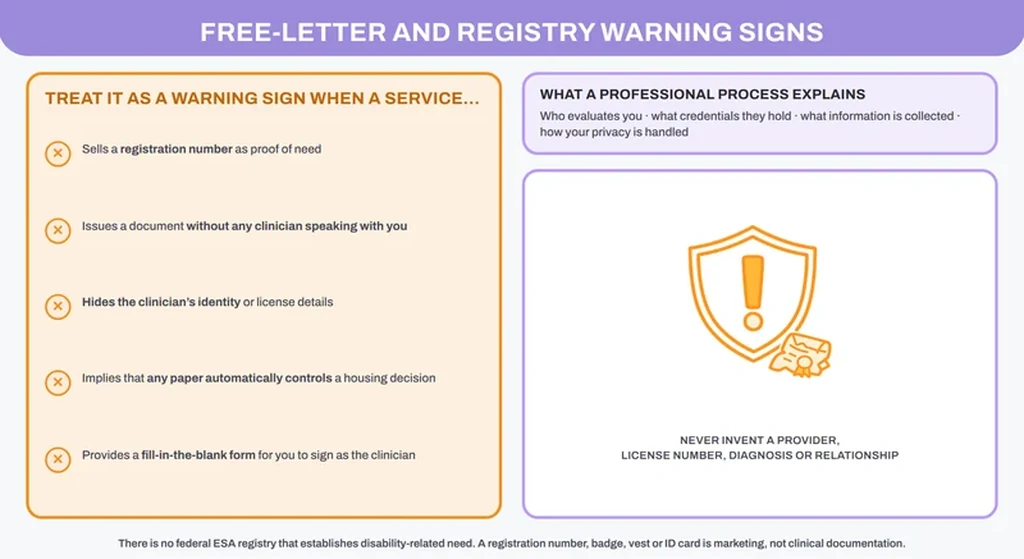
A downloadable certificate, online badge, vest, ID card, or registry listing is not a substitute for clinical documentation. The term “ESA registration” is often used by commercial sites, but there is no federal registry that establishes disability-related need. A form that asks you to fill in the blanks and sign as a clinician is especially risky. Never invent a provider, license number, diagnosis, or relationship.
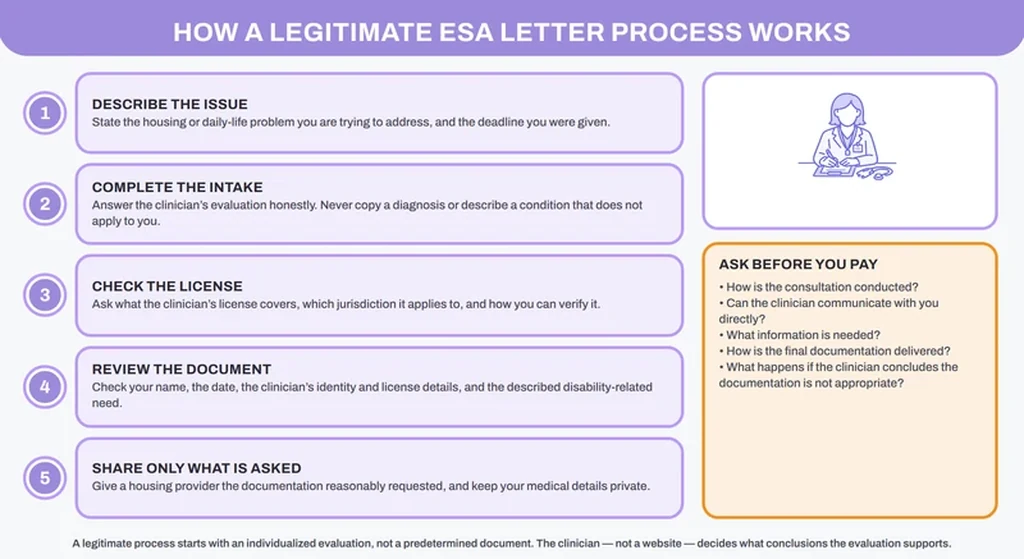
A legitimate process starts with an individualized evaluation, not a predetermined document. The clinician should be licensed for the relevant jurisdiction and should decide what conclusions, if any, are supported. Ask how the consultation is conducted, whether the clinician can communicate with you directly, what information is needed, and how the final documentation is delivered. PetESALetter connects applicants with licensed clinicians who evaluate whether they qualify; the clinician, not a website, makes the professional determination.
The federal baseline is narrower than many “free certificate” advertisements suggest. The Fair Housing Act provision at 42 U.S.C. § 3604(f)(3)(B) addresses reasonable accommodations in rules, policies, practices, or services when necessary to afford an equal opportunity to use and enjoy a dwelling. The implementing regulation, 24 C.F.R. § 100.204, provides the federal regulatory framework. These authorities do not create an ESA registry or turn a free form into a clinician’s documentation.
HUD guidance must be kept separate from the surviving statute and regulation. HUD withdrew the 2020 guidance and earlier guidance documents; the withdrawal notice is recorded at 91 FR 17291. A withdrawn guidance document is not a fallback legal standard. The practical takeaway is to use the current statute, regulation, and a licensed clinician’s individualized evaluation rather than a registry’s marketing language.
Free education and paid clinical evaluation are different categories. A provider may charge for the clinician’s time, review, and documentation. Compare the total fee, what the evaluation includes, whether the clinician is licensed in the relevant state, and what happens if the clinician concludes that the documentation is not appropriate. Our ESA letter cost guide explains the questions to ask, while the PetESALetter pricing page gives the site’s current service details. If you need help understanding the housing context, see the ESA letter for housing service page. To see which services are cheapest once add-ons and renewals are counted, use our cheapest ESA letter services compared ranking.
| Consideration | Free online resources | Licensed clinician evaluation |
|---|---|---|
| Typical cost | Free | A paid clinical consultation |
| What you receive | General education and sample wording | A signed letter from a clinician licensed in your state |
| Who assesses your need | No one | A licensed mental-health professional |
| Usable in a housing request | No, it is not documentation | Yes, it is the documentation a housing provider can review |
| Follow-up if the housing provider asks questions | None available | The issuing clinician can respond to reasonable verification requests |
| Common risk | Registry and certificate sites that sell nothing of legal value | None, provided the clinician is genuinely licensed and evaluates you |
Treat a service as a warning sign when it sells a registration number as proof, offers a document without speaking with you, hides the clinician’s identity, or suggests that any paper automatically controls a housing decision. A professional process should explain who evaluates you, what credentials they hold, what information is collected, and how your privacy is handled. You can also read our legitimate ESA letter checklist and verification guide before paying for any service.
Write down the practical problem you are trying to solve, the type of housing you are applying for, and the deadline you were given. Bring honest answers about how you experience symptoms and how an animal may help you function; do not copy a diagnosis or describe a condition that does not apply. Ask the clinician what documents are needed and how follow-up works. Preparation improves the conversation, but it does not predetermine its outcome.
Free guides and preparation tools can explain the process, but valid clinical documentation depends on an individualized evaluation by a licensed mental health professional. A free certificate, registry entry, or self-written form does not replace that evaluation.
No federal registry establishes that a person qualifies for an emotional support animal. Registration sites may sell certificates or listings, but those products are not the same as documentation from a licensed clinician.
A template may help you understand common topics or organize questions, but it cannot supply a clinician’s evaluation, license, signature, or professional judgment. Do not complete a template in a way that misrepresents a provider.
Ask who the evaluating clinician is, whether the clinician is licensed for your jurisdiction, how the evaluation occurs, what the fee covers, how privacy is handled, and what happens if the clinician does not support documentation for your situation.
No document guarantees a housing outcome. A clinician’s letter may support a reasonable-accommodation request when appropriate, but the request remains subject to the facts, applicable law, and the housing provider’s lawful process.
Want to understand whether an ESA letter may fit your situation? Start with a real evaluation by a licensed clinician and get clear answers about the process.

Licensed Psychotherapist
Darren is a leading expert in mental health advocacy and assistance animal documentation. He specializes in streamlining the process for obtaining ESA Letters, PSD Letters, and State-specific ESA compliance.

ESA Letters Issued

Successful Consultations

Licensed Therapist Network

Client Satisfaction Rate




Petesaletter.com helps you get your emotional support animal letter online with guidance and support.

Got Questions? Call us 24/7
Copyright © 2020-2026 Petesaletter All rights reserved. Terms | Privacy | Refund
Owned and Operated by Verimedix LLC