
Last Updated on: October 18, 2026
Reviewed by Darren Andrew Rafel
A sample ESA letter can illustrate common sections, but it is not a letter you can sign, submit, or use as proof of need. A legitimate housing document comes from a licensed clinician after an individualized evaluation. Use a sample to prepare questions and check for basic information—not to replace clinical judgment.
Quick answer: A sample ESA letter is educational. It may show how a clinician identifies the writer, date, professional relationship, and disability-related need, but only a qualified clinician can decide whether documentation is appropriate for your situation.
A well-labeled sample can help you recognize the difference between a clinical document and a marketing certificate. It may show a date, the recipient or housing context, the clinician’s name and license information, a description of the functional need when appropriate, and a way to verify the professional relationship. It should be presented as an example—not as a fill-in form or a promise that every letter will use identical wording.
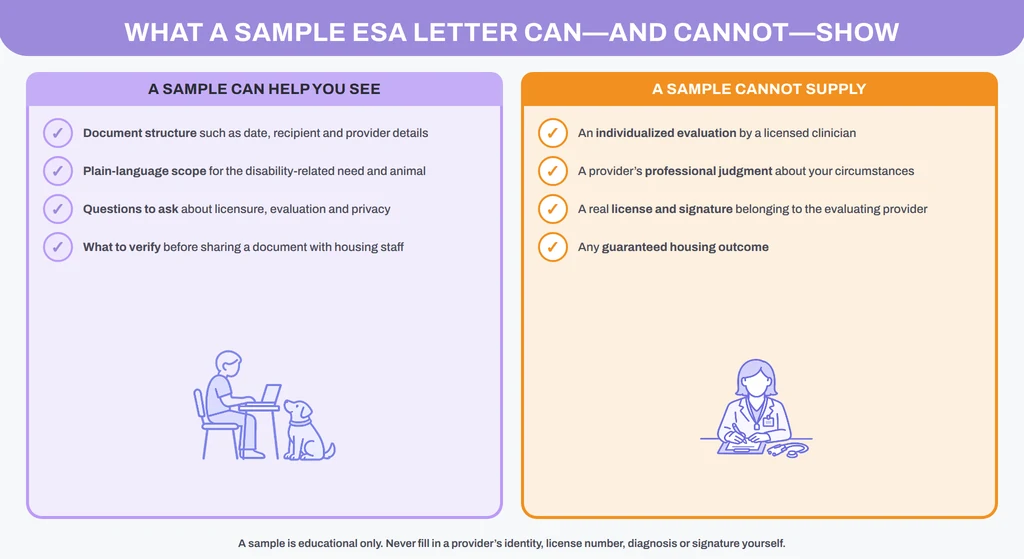
The key feature is not a particular font or magic phrase; it is the clinician’s professional evaluation. The licensed professional should be able to explain the relationship with you, the information considered, the limits of the opinion, and why the documentation is or is not appropriate. A sample cannot supply that relationship, signature, license, or professional judgment.
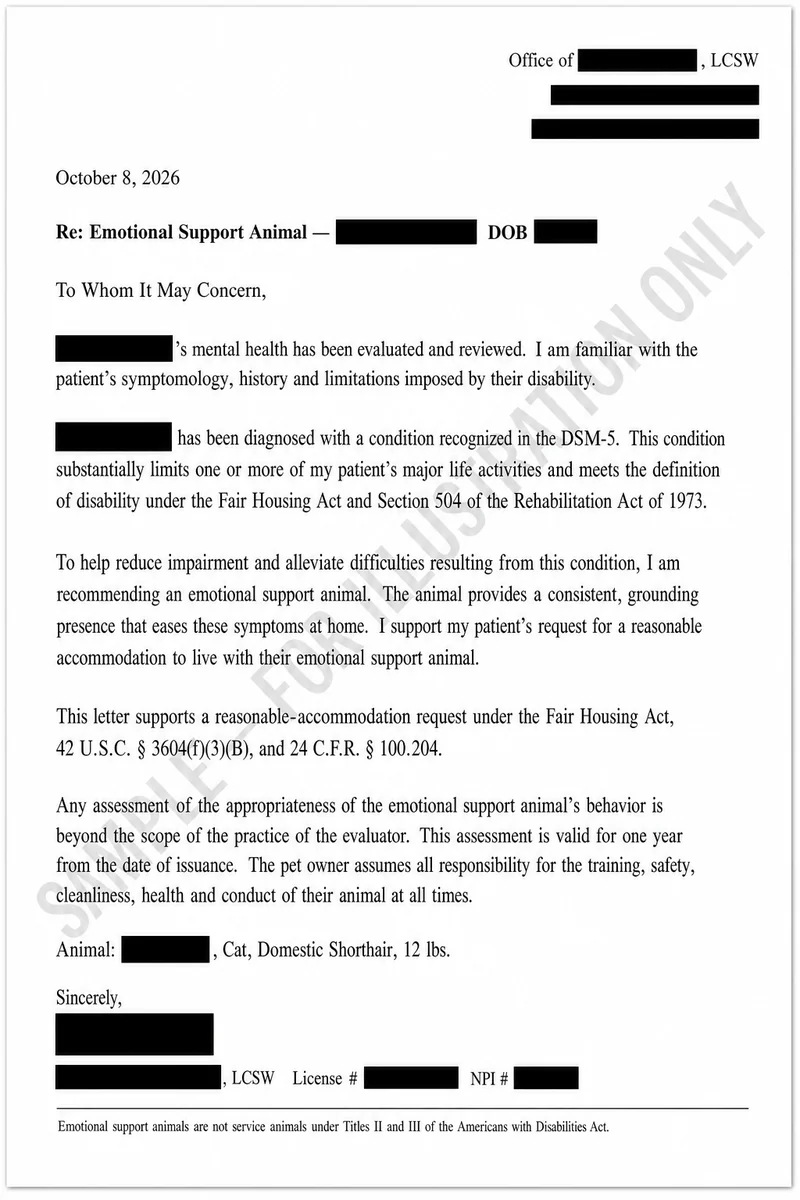
Every letter a clinician writes reads a little differently, but a legitimate one contains the same six parts. This is a description of the layout, not a form to fill in: a letter only counts when the clinician who evaluated you writes and signs it.
| Part of the letter | What it shows | Why it matters |
|---|---|---|
| Provider identity | The practice or clinician’s name and contact details, usually as a letterhead | A housing provider has to be able to tell who wrote the letter and reach them to confirm it |
| License details | License type (for example LCSW, LPC, LMFT or psychologist), license number and issuing state | The number can be checked on the state licensing board’s public lookup; look for an active license in the state where you live |
| Date | The date the clinician issued the letter after evaluating you | No federal rule sets an expiry date, but an old letter invites questions; see the renewal guide |
| Disability statement | That you have a mental or emotional condition that limits a major life activity | It confirms the disability without needing to name your diagnosis |
| Need statement | How the animal helps with that limitation | This link between the condition and the animal is what an accommodation request rests on |
| Signature | The evaluating clinician’s own signature, handwritten or a verifiable e-signature | A letter signed by staff, or with a pasted image of a signature, is the easiest kind to reject |
California adds rules for dogs: under Health and Safety Code § 122318 a clinician must have a client relationship of at least 30 days and complete a clinical evaluation before providing documentation for an emotional support dog, and the documentation must include the clinician’s license information. See the California ESA letter guide for the details.
Depending on the facts, a licensed mental-health professional or another licensed health professional whose scope and jurisdiction permit the relevant evaluation may be able to provide documentation. Rules and professional scopes can differ, so do not rely on a blanket internet list. Ask the provider what license they hold, where it is active, what the evaluation covers, and whether they can support the conclusion they reach.
The surviving federal baseline is the Fair Housing Act provision at 42 U.S.C. § 3604(f)(3)(B), which addresses reasonable accommodations in rules, policies, practices, or services when necessary to afford an equal opportunity to use and enjoy a dwelling. The implementing regulation, 24 C.F.R. § 100.204, provides the regulatory framework. Neither authority creates an ESA registry or makes a sample form clinical documentation.
Do not confuse those authorities with withdrawn HUD guidance. HUD withdrew FHEO-2013-01 and FHEO-2020-01 effective September 17, 2025; the formal notice appears in 91 FR 17291. The May 22, 2026 HUD enforcement memo describes current FHEO enforcement posture, including a stated focus on animals trained to provide disability-related assistance. That internal posture document is not the statute or regulation, and withdrawn guidance is not a fallback standard.
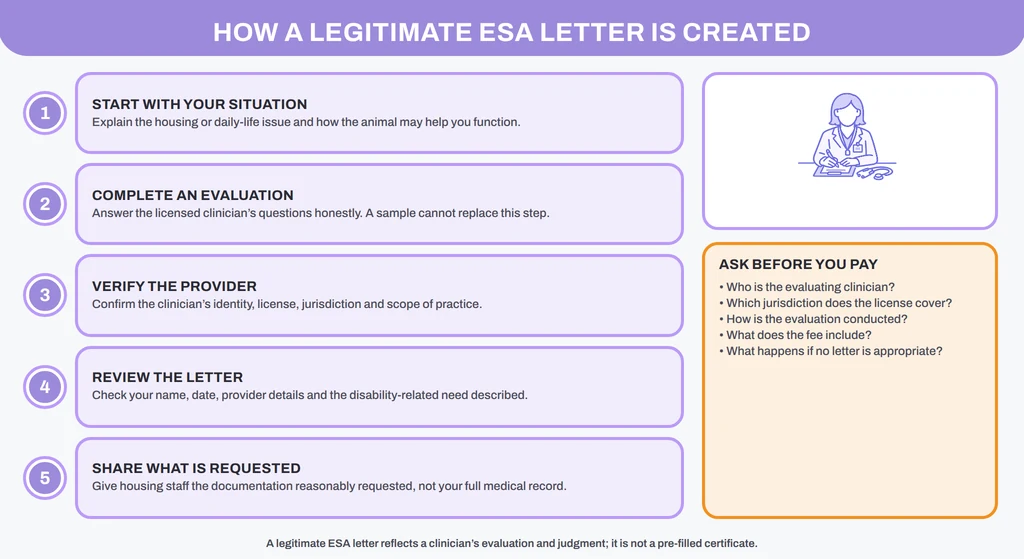
Use a sample as a verification checklist. For a fuller authenticity review, read our legitimate ESA letter guide. A legitimate document should identify the evaluating professional accurately and reflect an actual evaluation. It should not rely on a registration number, sell an animal ID as legal proof, or ask you to invent facts. Keep the comparison focused on provenance and clinical process rather than copying wording.
| Check | Sample | Legitimate documentation |
|---|---|---|
| Purpose | Shows common structure for education | Records an individualized professional opinion |
| Writer | Unknown or fictional in a template | A licensed professional who evaluates you |
| Clinical relationship | None created by the sample | Explained by the evaluating clinician |
| Animal information | Generic example only | Connected to the person’s functional need when appropriate |
| Verification | Certificate, badge, or registry marketing | Provider identity and license can be checked |
Be cautious when a page offers a prewritten letter without a clinician, asks you to fill in a provider’s signature, sells a registry number as proof, or hides who will evaluate you. A vest, ID card, certificate, or directory listing does not establish disability-related need. A legitimate service should explain the evaluator’s credentials, the evaluation steps, fees, privacy practices, and what happens if the clinician does not support documentation.
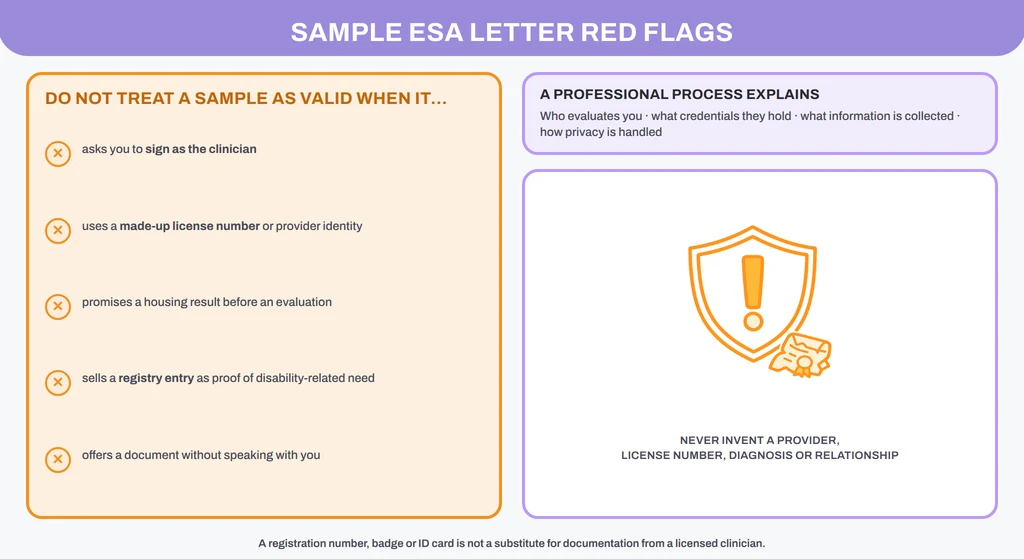
Save a sample for education, then prepare honest questions for a licensed clinician. Note the housing issue, any deadline, and the practical ways an animal may help you function. Do not copy a diagnosis, exaggerate symptoms, or submit a sample as if it came from a provider. For next steps, compare our ESA letter process guide, housing guide, and cost guide.
No. A sample is educational and cannot replace an individualized evaluation or a document issued by a qualified licensed clinician.
It may show common sections such as the date, recipient or housing context, provider identity and license information, the professional relationship, and a concise description of functional need when appropriate. There is no single fill-in template that creates clinical documentation.
If documentation is appropriate, it is signed or issued by the licensed clinician who evaluated you and is acting within the relevant scope and jurisdiction.
No. A sample cannot assess disability-related need or predict a clinician’s conclusion. Only an individualized evaluation can address whether documentation is appropriate.
No federal registry establishes eligibility for an emotional support animal. Commercial listings or certificates are not a substitute for a licensed clinician’s evaluation.
Ask about the evaluator’s license and jurisdiction, how the evaluation occurs, what the fee includes, privacy, follow-up, and what happens if the clinician does not support documentation for your situation.
Need help with the next step? Start by learning how a licensed clinician evaluates an ESA letter request, then review the housing and cost details before choosing a service.
Start an ESA letter evaluation or review ESA housing letters and ESA letter costs.

Licensed Psychotherapist
Darren is a leading expert in mental health advocacy and assistance animal documentation. He specializes in streamlining the process for obtaining ESA Letters, PSD Letters, and State-specific ESA compliance.

ESA Letters Issued

Successful Consultations

Licensed Therapist Network

Client Satisfaction Rate




Petesaletter.com helps you get your emotional support animal letter online with guidance and support.

Got Questions? Call us 24/7
Copyright © 2020-2026 Petesaletter All rights reserved. Terms | Privacy | Refund
Owned and Operated by Verimedix LLC