There is one fact that settles almost every ESA letter dispute before it starts: you can verify the provider’s license in about five minutes on your state’s own licensing board website. If that check comes back clean, the letter is very likely real. If it doesn’t, no amount of official-looking letterhead matters.
This guide works whether you’re a landlord who just received an ESA letter and isn’t sure what to do with it, or a tenant who wants to confirm their own letter will actually hold up before they hand it over. Both situations come down to the same handful of checks — you’re just running them from different sides of the table.
In this guide you’ll learn what a real letter contains, how to verify the provider, the specific documents states now require, and what happens legally when a letter turns out to be fake.
What Makes an ESA Letter Legitimate?
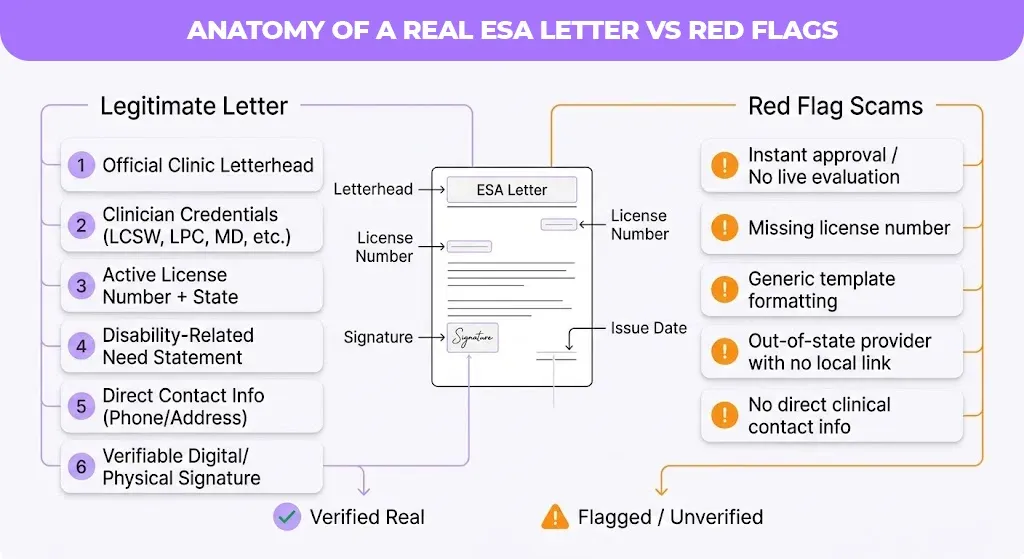
A legitimate ESA letter is written and signed by a licensed mental health professional, is printed on their official letterhead, and states that the person has a disability-related need for an emotional support animal. It also includes the provider’s license number, license type, and state of licensure — details you can independently check.
That last part is what separates a real letter from a scam. Anyone can format a document to look official. Only a real, licensed clinician has a license number that shows up in a public state database, tied to a real name, at a real practice.
Here’s the full list of what a real letter should include:
Provider’s full name and professional credential (LCSW, LPC, LMFT, PhD/PsyD, or MD/DO)
Active license number and the state that issued it
Date the letter was issued
A statement confirming the person has a disability-related need for the animal (no specific diagnosis required)
Provider’s contact information, such as phone, email, or office address
Signature, either physical or a verifiable digital signature
How to Check a Provider’s License in 60 Seconds
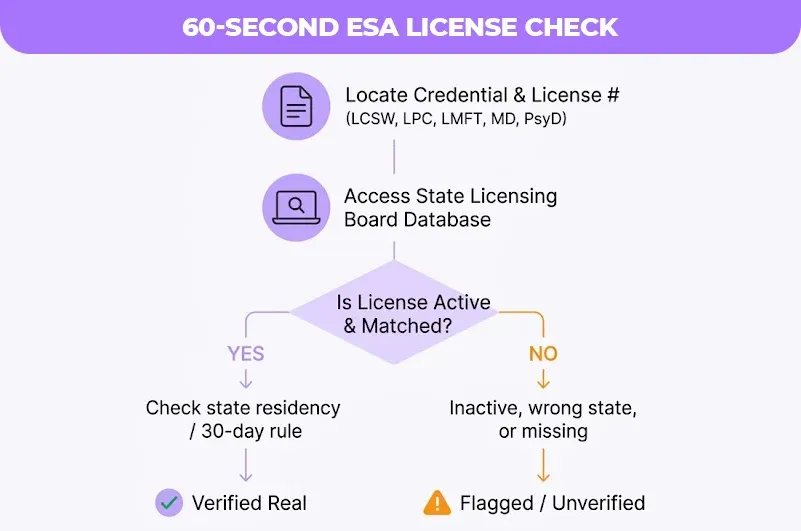
Search your state’s professional licensing board database — every state has one — using the provider’s name or license number listed on the letter. If the license doesn’t appear, is inactive, or belongs to a different name, the letter fails the most important test there is.
Here’s how to do it, step by step:
Identify the credential type on the letter.
Enter the provider’s name or license number exactly as it appears on the letter.
Confirm that the license is active, matches the name on the letter, and was issued in the state the letter claims.
If your state requires the provider’s license to match your state of residence, confirm that too — a valid license in the wrong state can still mean an invalid letter.
If you can’t find the provider in the state database at all, that’s not a minor red flag. It usually means the letter isn’t from a real license holder.
Fake ESA Letter Warning Signs
The clearest sign of a fake ESA letter is the absence of an actual clinical evaluation: if you can get a letter within minutes of filling out a form, with no live conversation, no licensed provider is genuinely making a clinical judgment about you.
Watch for these together, not just one in isolation, since a single missing detail can be an honest mistake:
No license number anywhere on the document
A license number that doesn’t match any name in the state database
Generic, copy-paste language with no reference to an actual evaluation
No provider contact information at all
Guaranteed approval advertised before any evaluation happens
Letter issued instantly with no live call, video session, or documented clinical contact
Formatting that looks like a downloaded template rather than clinic letterhead
Federal Law vs. State Verification Requirements
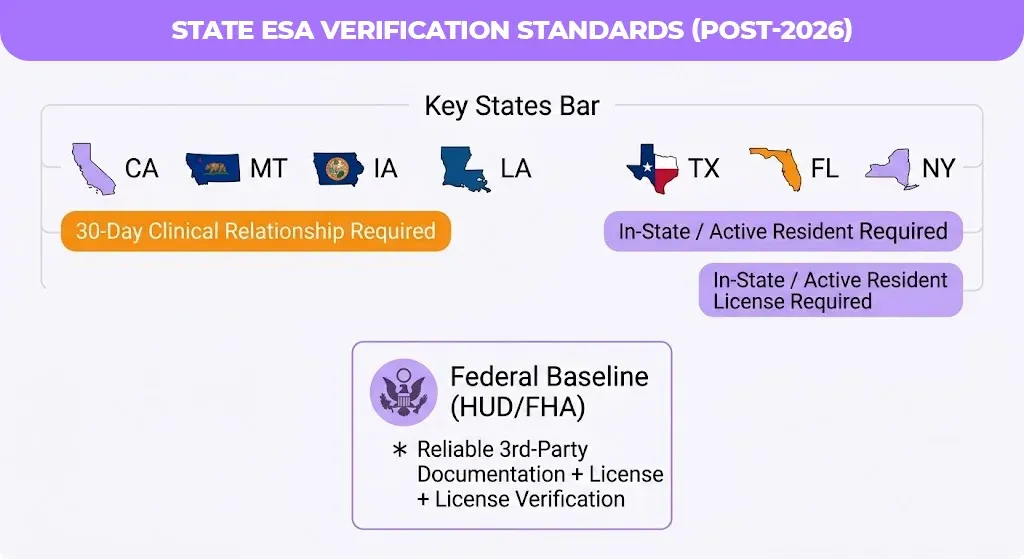
Federal law under the Fair Housing Act requires “reliable documentation” from a third party but doesn’t specify exact verification steps. States have filled that gap with specific rules: some require in-state licensure, some require a minimum provider relationship, and some require both.
State
What Verification Should Confirm
California
Provider holds an active California license and had a 30-day relationship with the patient before issuing the letter (Health & Safety Code §122318)
Montana
Provider is Montana-licensed and had a 30-day relationship plus documented clinical evaluation
Iowa
Provider had a 30-day relationship with the patient as a treating provider
Louisiana
Provider had a 30-day relationship including at least two sessions
Arkansas
Letter comes from an established, treating provider, not a first-time evaluator
Texas
Provider holds a Texas license — an out-of-state telehealth license may not satisfy local housing providers
Florida
Letter came from at least one real in-person or telehealth appointment, not an “online-only” form (Fla. Stat. §760.27)
New York
Provider holds an active New York license, or qualifies through a recognized interstate compact
If your state isn’t listed, the general federal standard of “reliable third-party documentation” still applies — verifying the license and confirming a real evaluation happened covers the baseline everywhere.
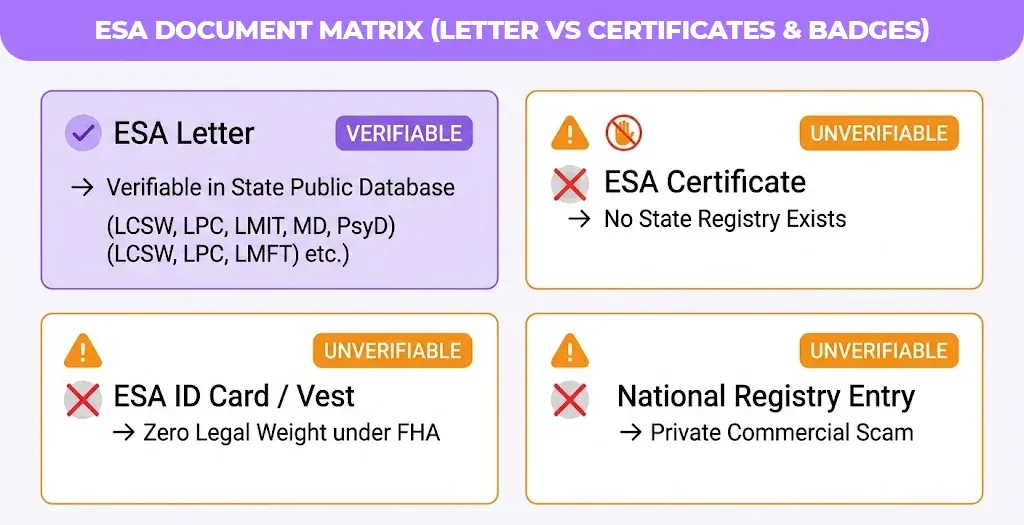
ESA Letter vs. Certificate vs. Registration: Only One Can Be Verified
An ESA letter can be verified because it’s tied to a real, licensed individual in a public database. Certificates and registrations cannot be verified because no official registry or certification body exists for ESAs at all.
Document
Verifiable?
Why
ESA Letter
Yes
Tied to a real license number in a public state database
ESA Certificate
No
Issued by private websites with no licensing authority behind them
ESA Registration
No
No federal or state ESA registry exists
ESA ID Card/Vest
No
Not tied to any licensing or verification system
If someone hands you a certificate or registration number instead of a signed letter with a license number, there’s nothing to check, because there’s no authority behind the document in the first place.
What Changed With HUD’s 2026 Guidance
In May 2026, HUD narrowed its federal enforcement standard for ESA housing complaints, now focusing primarily on animals individually trained for a disability-related task. This changes how aggressively the federal government pursues a landlord who refuses an untrained ESA, but it doesn’t change what makes a letter itself legitimate.
Common Landlord Mistakes When Handling ESA Letters
Rejecting a letter just because it came from an online provider. The delivery method is not what matters — the provider’s license and the evaluation are.
Demanding the tenant’s diagnosis before accepting the letter. This isn’t a legal requirement and can itself expose the landlord to a fair housing complaint.
Requiring a specific in-house form instead of a properly formatted letter. A valid letter that meets legal standards can’t be rejected just for using a different format.
Skipping the license check entirely and accepting any document with the word“therapist”on it. This is how fraudulent letters get through, and it’s also how legitimate applicants get unfairly denied when a landlord later grows suspicious of everyone.
Verify Your ESA Letter With Confidence
Need a legitimate ESA letter you can trust? PetESALetter connects you with licensed mental health professionals for real clinical evaluations. If you qualify, you’ll receive valid documentation that meets current housing requirements.
Want a letter that survives verification? Skip the registry scams and get documentation backed by an actual licensed clinician who can be looked up and confirmed.
🐾 100% Risk-Free Guarantee (full refund if you don’t qualify, or if your landlord rejects the letter)
🐾 Verifiable licence details from a real state-licensed clinician
🐾 No registries, no certificates, no instant approvals
A valid ESA letter must be written by a licensed mental health professional. It should include their name, license number, contact information, signature, date, and a statement confirming you need an emotional support animal.
Yes. Many landlords verify ESA letters by checking the provider’s license, confirming the letter’s details, or requesting reliable documentation if allowed by law.
A landlord, housing provider, or property manager can verify an ESA letter by confirming the mental health professional’s active license. They cannot ask for your diagnosis or detailed medical records.
A real and legitimate ESA letter is printed on a licensed provider’s official letterhead and includes their name, license number, signature, contact details, the date, and confirmation that you have a disability-related need for an emotional support animal.
THE AUTHOR
Darren Andrew Rafel
LMFT, LCSW, LMHP
Licensed Psychotherapist
Darren is a leading expert in mental health advocacy and assistance animal documentation. He specializes in streamlining the process for obtaining ESA Letters, PSD Letters, and State-specific ESA compliance.