
Last Updated on: August 14, 2026
Reviewed by Darren Andrew Rafel
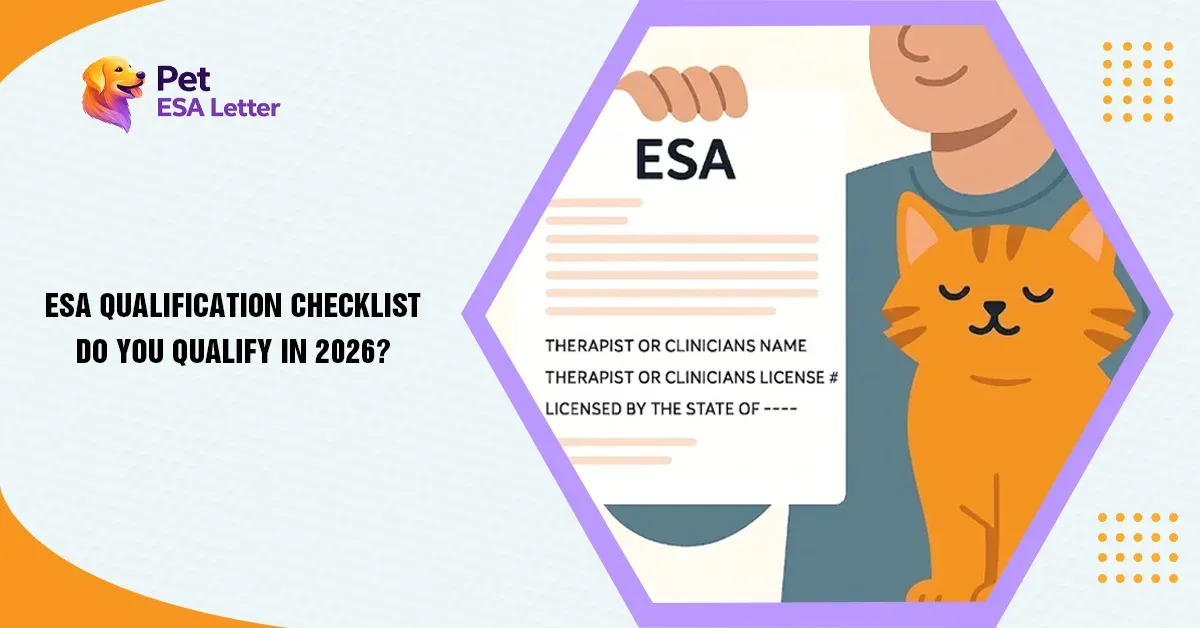
You qualify for an emotional support animal if a licensed mental health professional evaluates you and confirms that you have a diagnosable mental or emotional condition, and that living with an animal helps reduce your symptoms. That is the whole legal standard. No registry, no certificate, no online quiz can grant that status. Only a real evaluation can.
That sounds simple, but the ESA landscape changed in a big way in 2026, and most articles online have not caught up. Housing enforcement shifted. The airline rules already shifted back in 2021. And scam websites keep getting better at looking legitimate. This guide will walk you through every part of the qualification process, what changed this year, and how to protect yourself from a letter that will not hold up when you actually need it most.
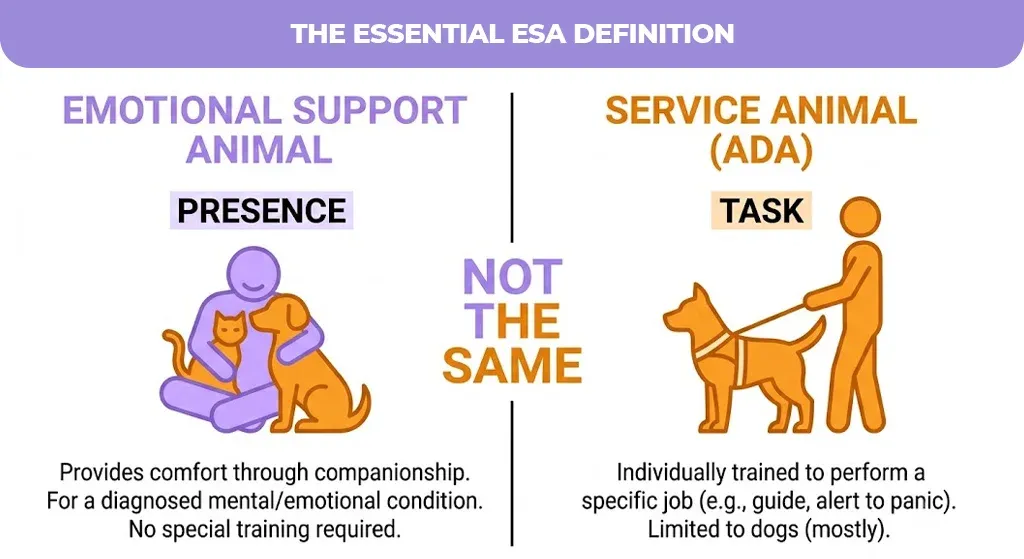
An emotional support animal is a pet that provides comfort to a person with a diagnosed mental or emotional condition through its presence — not because it performs a trained task. That simple distinction, presence versus task, is what separates an ESA from a service animal under federal law.
A service animal under the Americans with Disabilities Act must be a dog that is individually trained to do a specific job, like alerting to a panic attack or guiding someone around obstacles. A therapy animal is different again. It is trained to visit hospitals, schools, or care facilities and comfort many different people, not just its owner. An ESA belongs to one person and does not need any special training at all.
| Feature | Emotional Support Animal | Service Dog | Therapy Animal |
|---|---|---|---|
| Legal basis | Fair Housing Act | Americans with Disabilities Act | No specific federal law |
| Training required | None | Task-specific training | Behavioral training and certification |
| Public access (stores, restaurants) | No | Yes | No |
| Housing access | Yes, with documentation | Yes | No special right |
| Air travel access | Treated as a pet | Yes, as a service dog | No special right |
| Species allowed | Any common household animal | Dogs (miniature horses in limited cases) | Usually dogs, sometimes other species |
| Documentation needed | Letter from a licensed mental health professional | None required by law, though airlines may ask questions | Certification from a therapy animal organization |
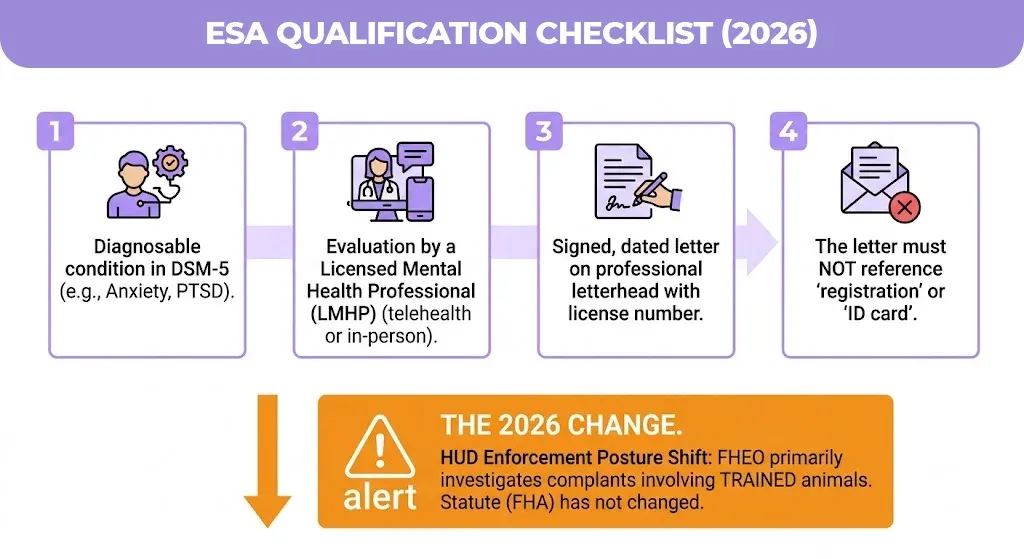
Here is the short version. If you can check every box below, you meet the legal standard for an emotional support animal.
You have a diagnosable mental or emotional condition recognized in the DSM-5, such as anxiety, depression, PTSD, or a phobia.
A licensed mental health professional has actually evaluated you, in person or by telehealth.
That professional has determined, in their clinical judgment, that an animal’s presence would ease one or more of your symptoms.
You have received a signed letter on that professional’s letterhead, dated and including their license number.
The letter does not rely on words like registered, certified, or ESA ID card.
You understand what your letter does and does not cover — meaning housing, not stores or restaurants, and generally not air travel anymore.
If any of these items are missing, you are not legally eligible for an ESA letter yet, even if you already have a piece of paper that says you are.
Qualification is based on the condition, not the animal. Common qualifying conditions are generalized anxiety disorder, major depressive disorder, PTSD, panic disorder, specific phobias, social anxiety, bipolar disorder, OCD, and ADHD when it significantly affects your daily life. Anxiety is the condition that comes up most often; our ESA for anxiety guide covers what the clinician checks for it, and the ESA for ADHD guide does the same for attention-deficit/hyperactivity disorder.
The condition has to be something a clinician can actually diagnose, and it has to meaningfully limit part of your daily life — sleeping, concentration, or your ability to leave the house. Simply feeling stressed at work or wanting company is not by itself a qualifying condition. That is an important distinction, because it is exactly the gap that fake ESA sites exploit when they approve almost anyone who fills out a form.
Here is what actually happens during a real evaluation. The professional will ask you about your symptoms, how long you have had them, how they affect your daily routine, and whether you have tried other treatments. They form a professional opinion, the same way they would before recommending any other treatment. That is why a legitimate evaluation cannot happen in sixty seconds.
A licensed mental health professional, or LMHP, can write your ESA letter, as long as they hold an active license in the state where you live and have actually assessed you. This is not optional. HUD’s own documentation guidance ties a valid letter directly to a licensed provider making an individualized assessment.
Notice that a veterinarian cannot write your letter. Vets evaluate animals, not the human’s mental health, so their opinion carries no legal weight for an ESA request, even though people assume otherwise all the time.
A real ESA letter is short — usually one page — and it reads like a clinical document, not a marketing certificate. It should include all of the following:
The provider’s full name, license type, license number, and state of licensure
The provider’s contact information, so a landlord can verify the license if needed
A statement confirming you have a mental or emotional condition, without necessarily naming the exact diagnosis
A statement that the animal’s presence helps reduce your symptoms
The date the letter was signed
A handwritten or verified digital signature
Notice what is missing from that list: any mention of registration, certification, or an ID number. Federal law does not create an official ESA registry, so any letter or product that references one is a red flag, not a credential.
Here is the update most competing articles have not caught up on yet. On May 22, 2026, HUD’s Office of Fair Housing and Equal Opportunity rescinded its 2020 guidance on emotional support animals and adopted a new enforcement standard. Going forward, FHEO will only pursue reasonable cause findings in animal accommodation complaints involving animals individually trained for a specific disability, which lines federal enforcement up much more closely with the ADA’s service animal definition.
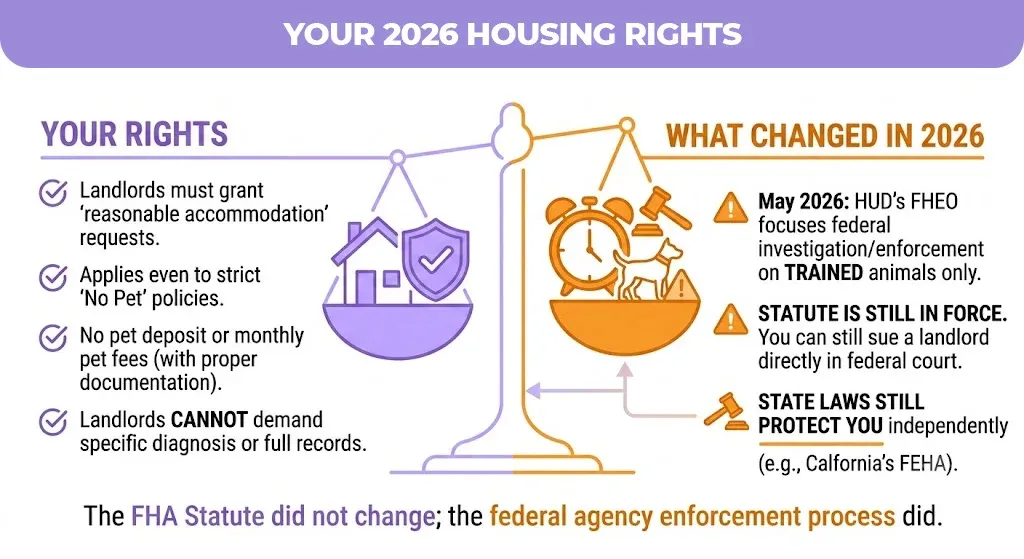
What this actually means: HUD’s investigation and enforcement arm is stepping back from untrained-ESA complaints specifically. It does not mean the Fair Housing Act itself changed. Congress has not touched the statute, and the reasonable accommodation requirement in the law never actually included a training requirement in its text. What changed is how aggressively the federal agency will pursue a complaint on your behalf if a landlord denies your request.
You can still sue a landlord directly in federal court under the Fair Housing Act if they deny a legitimate accommodation request, regardless of HUD’s enforcement posture. The statute’s protections are still fully in force. What has changed is simply whether HUD itself will investigate and pursue the case for you at the federal level.
Several states have their own fair housing laws that operate independently of HUD and are not affected by this change. California’s Fair Employment and Housing Act, for example, is enforced by the state’s own Civil Rights Department and does not condition protection on whether an animal is trained. If you live in a state with its own robust fair housing agency, that agency is often a faster and stronger path than a federal HUD complaint would have been anyway.
Because state protections vary this much, check your own state housing agency’s current guidance before assuming either the best or worst case scenario about your situation.
Under the Fair Housing Act, a housing provider generally must grant a reasonable accommodation request for an assistance animal, including a properly documented ESA, unless the request creates an undue burden or the animal poses a direct threat that cannot be managed. This applies even to buildings that have strict no-pet policies, and it generally means no pet deposit or monthly pet fee for a qualifying ESA.
A landlord can ask for documentation of your disability-related need if it is not obvious, but they cannot demand your specific diagnosis, your full medical records, or proof of certification, since no such certification legally exists. They can ask that the letter come from a licensed provider and that it confirms the connection between your condition and the animal.
Even well-meaning landlords get this wrong often enough that it is worth naming the patterns directly.
Demanding an ESA “registration number” that does not legally exist
Charging a pet deposit or monthly pet rent for a documented ESA
Requiring the animal to complete obedience training, which the FHA does not require for ESAs
Asking for your specific diagnosis instead of just confirmation of a disability-related need
Rejecting a letter solely because it came from a telehealth provider, without checking whether the license is real
Treating a breed or size restriction as an automatic denial reason
If you run into one of these mistakes, it is worth pointing the housing provider to HUD’s own guidance before assuming the worst about your options.
Airlines have not been required to treat ESAs as anything other than pets since January 11, 2021, when the Department of Transportation revised its Air Carrier Access Act rule. Under that rule, only individually trained service dogs keep guaranteed cabin access and fee waivers. Emotional support animals now fly under each airline’s regular pet policy, which usually means a carrier fee, size limits, and advance booking.
| Item | Typical Cost Range | Notes |
|---|---|---|
| Initial evaluation with a licensed provider | $100 to $200 | One-time fee for the first assessment |
| Annual renewal letter | $70 to $150 | Many providers recommend renewing yearly |
| In-person evaluation with your existing therapist | Often included in your regular session cost | Ask directly if you already have a therapist |
| “Registration,” certificates, or ID cards | $30 to $100 | Not legally required, and not worth paying for |
Watch for these signs before you pay anyone for an ESA letter.
The site promises instant approval, or a letter within minutes, with no live consultation
No named clinician, license number, or state of licensure appears anywhere on the site or the letter
The checkout page pushes registration numbers, ID cards, or vests as if they are required
The letter mentions ADA rights or airline access, which real ESA letters do not grant
You cannot find the provider’s license listed in your state’s official licensing board database
The evaluation is a short multiple-choice quiz with no follow-up questions based on your answers
If you can verify a provider’s license number against your state licensing board’s public database, and you actually spoke with a real clinician who asked about your specific symptoms, you are almost certainly dealing with a legitimate service. Our legitimate ESA letter guide explains the document and process checks in more detail.
Ready to start the process with a real licensed clinician? Get a proper evaluation and documentation that holds up under 2026 rules — no registries, no instant approvals.
You can qualify for an emotional support animal if a licensed mental health professional determines that you have a mental or emotional health condition and that an ESA would help reduce symptoms or improve your functioning. The recommendation is documented in an ESA letter after a professional evaluation.
Yes, many landlords verify letters to make sure they are legitimate. They can confirm that the letter was issued by a licensed mental health professional and that it contains the required information. However, they generally should not request detailed information about your diagnosis or medical records.
The main way to demonstrate ESA status is a letter from a licensed mental health professional. Unlike service dogs, emotional support animals do not require any specialized training, certification, or registration under federal law.
A dog does not need special training to be an ESA, but it may not be accepted in some housing situations if it poses a direct threat to others, causes significant property damage, or cannot be reasonably accommodated. Aggressive or uncontrollable behavior can also prevent an animal from qualifying for housing protection.
An ESA letter may be denied if a licensed mental health professional determines that an emotional support animal is not medically appropriate for your situation, if there is insufficient evidence of a qualifying mental or emotional health condition, or if the evaluation does not support the need for an ESA.
No. Simply claiming that your dog is an emotional support animal does not establish ESA status. In most situations where an ESA is recognized, such as requesting a housing accommodation, you will need a valid ESA letter from a licensed mental health professional supporting your need for the animal.

Licensed Psychotherapist
Darren is a leading expert in mental health advocacy and assistance animal documentation. He specializes in streamlining the process for obtaining ESA Letters, PSD Letters, and State-specific ESA compliance.

ESA Letters Issued

Successful Consultations

Licensed Therapist Network

Client Satisfaction Rate




Petesaletter.com helps you get your emotional support animal letter online with guidance and support.

Got Questions? Call us 24/7
Copyright © 2020-2026 Petesaletter All rights reserved. Terms | Privacy | Refund
Owned and Operated by Verimedix LLC