
Last Updated on: September 16, 2026
Reviewed by Darren Andrew Rafel

ADHD can qualify for an emotional support animal (ESA) when a licensed mental health professional evaluates the person and concludes that the ADHD substantially limits a major life activity — concentrating, learning, working, sleeping — and that the animal eases it. The diagnosis alone does not qualify anyone; the clinician’s evaluation does. PetESALetter connects applicants with a clinician licensed in their state; if the clinician finds a qualifying need, the ESA letter arrives in 24–48 hours for $99 flat.
Key takeaways
Yes, when two things are true and a licensed clinician confirms both. The Fair Housing Act protects a person with a “handicap”, which it defines as a physical or mental impairment that substantially limits one or more major life activities (42 U.S.C. § 3602(h)). HUD’s regulation spells out what those activities include — “caring for one’s self, performing manual tasks, walking, seeing, hearing, speaking, breathing, learning and working” (24 C.F.R. § 100.201) — and ADHD lives in exactly that territory. The second condition is that the animal has to do something about it: provide support that alleviates at least one symptom or effect of the condition.
ADHD is not named in the regulation, and it does not need to be. The list is of categories, not diagnoses, and the question a clinician answers is about limitation, not labels. That is why the same diagnosis qualifies one person and not another. An adult with combined-presentation ADHD who has lost two jobs to missed deadlines, sleeps at 3 a.m. because there is no cue to stop, and gets out of bed on time only because a dog needs to go out has a clear case. Someone who was diagnosed at nine, is well managed on medication and mostly wants to skip a pet deposit does not — and a clinician who signs a letter anyway is the clinician landlords have learned to distrust.
Two facts make ADHD unusual among ESA conditions. First, most adults with it were diagnosed late: of the 15.5 million U.S. adults with a current ADHD diagnosis, 55.9% received it at 18 or older (CDC MMWR, October 2024), so many applicants arrive with symptoms they have carried for decades and a diagnosis that is only a year or two old. Second, it rarely travels alone — the National Comorbidity Survey Replication found that roughly three in four adults with ADHD had at least one other psychiatric disorder in their lifetime, most often an anxiety or mood disorder. The clinician evaluates the whole picture, not the label. Our ESA qualification checklist covers the general test; this page is about how it plays out for ADHD, and the ESA for anxiety guide covers the condition most often found alongside it.
The evaluation is a clinical conversation by phone or video with a therapist licensed in the applicant’s own state (the online ESA evaluation page describes the format). For ADHD it covers five things, and they are not the same five as for anxiety:
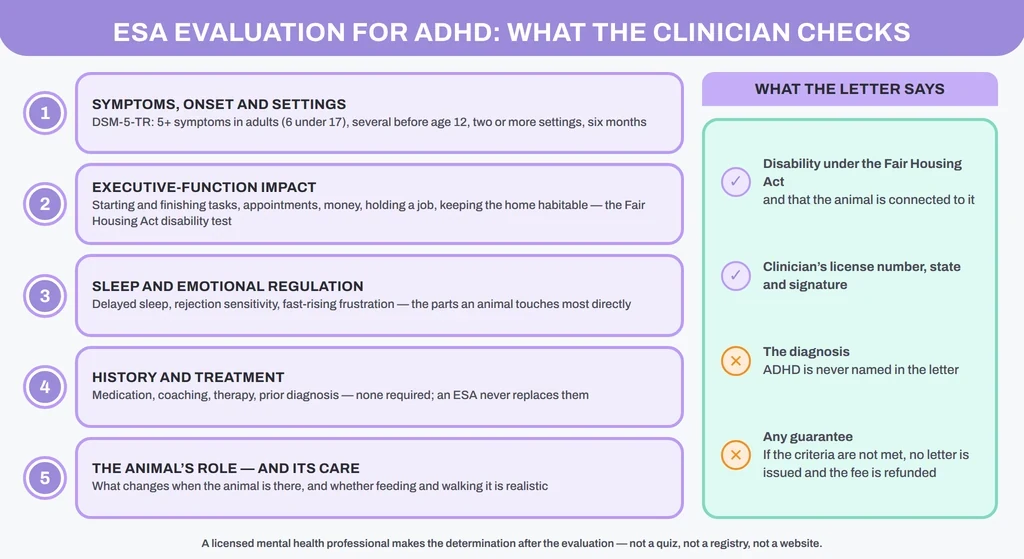
People search for what to say to a doctor to get an ESA letter for ADHD. The answer is: what is true, in specifics. Describe the week the bills went unpaid, the job that ended, the 3 a.m. bedtime — and what is different on the days the animal is there. A clinician can only document what the evaluation supports, and the letter that overstates things is the one that gets challenged. If the answer at the end is no, the fee is refunded under the refund policy.
An ESA has no training requirement and performs no tasks; it helps by being there. For ADHD, “being there” lands on the exact functions the condition disrupts:
What the research does and does not show matters. The best ADHD-specific evidence is for animal-assisted therapy, not for pets at home: a small randomized pilot at UC Irvine (Schuck and colleagues, Journal of Attention Disorders, 2015) found that children whose behavioral program included therapy dogs showed larger drops in ADHD symptom severity than children in the same program without dogs. That is encouraging, and it is not the same thing as an ESA letter. An ESA is a support, not a treatment, and a clinician evaluating ADHD will ask what else is in place. It is not trained to remind anyone to take medication or to interrupt hyperfocus — those are psychiatric service dog tasks, covered next.
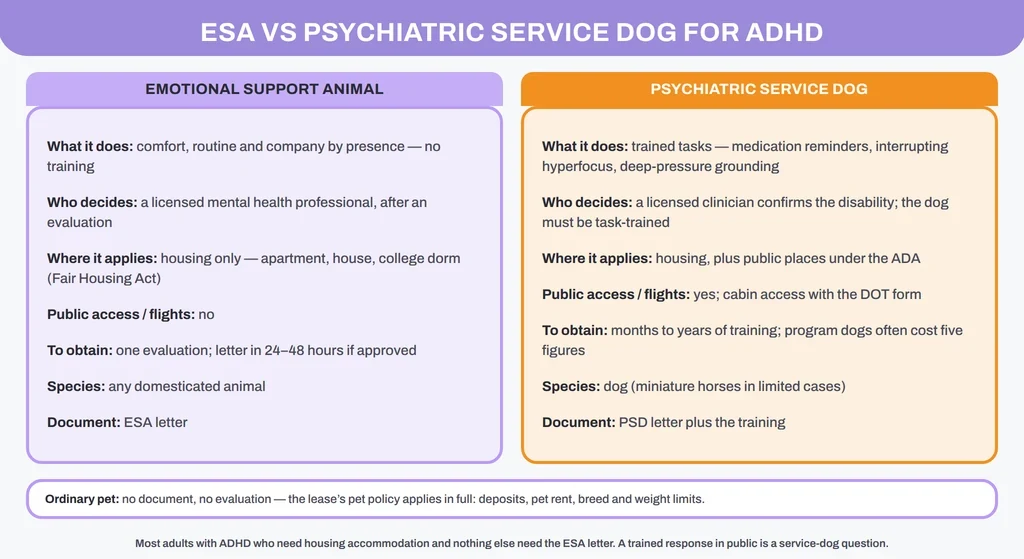
It can, and the SERP for this topic is half service-dog questions, so the distinction is worth getting exactly right. A psychiatric service dog is individually trained to perform tasks for a person whose disability qualifies under the ADA — for ADHD that means things like a timed medication reminder, a trained nudge that breaks hyperfocus, or grounding pressure during a meltdown. An ESA does none of that. The table compares the three categories for a person with ADHD.
| Feature | Emotional support animal | Psychiatric service dog | Ordinary pet |
|---|---|---|---|
| What it does | Comfort, routine and company by presence; no training required | Trained tasks for the disability, e.g. medication reminders, interrupting hyperfocus, deep-pressure grounding | Companionship |
| Who decides | Licensed mental health professional, after an evaluation | Licensed clinician confirms the disability; the dog must be task-trained | Nobody |
| Housing (Fair Housing Act) | Reasonable-accommodation request; landlord may ask for reliable documentation | Same, and HUD’s 2026 enforcement memo treats trained animals as presumptively reasonable | Pet policy applies: deposits, pet rent, breed limits |
| Public access (ADA) | No | Yes | No |
| Airlines | Pet rules and fees | Cabin access with the DOT form | Pet rules and fees |
| Time and money to obtain | One evaluation; letter in 24–48 hours if approved | Months to years of training; program-trained dogs commonly run into five figures, owner-training is allowed under the ADA | Adoption fee |
| Species | Any domesticated animal | Dog (miniature horses in limited cases) | Any |
| Document | ESA letter | PSD letter plus training | None |
For most adults with ADHD who need housing accommodation and nothing else, the ESA letter is the right document. Someone who needs a trained response in public — at work, on campus, in a store — should read about the PSD letter instead; it is a different evaluation, and our guides to what disabilities qualify for a service dog and self-training a service dog cover the training side. The choice of animal is separate from the choice of document: a dog brings the walking and the schedule, a cat brings the company with far less routine load, and an ESA cat is just as valid under the Fair Housing Act.
Four steps, and the first one is free.
If the clinician decides the applicant doesn’t qualify, the fee is refunded within 7 days. If a landlord rejects the letter in writing after our support team has been involved, the refund window is 30 days. Both terms are on the refund policy page. The full walkthrough, including what a finished letter looks like, is in how to get an ESA letter.
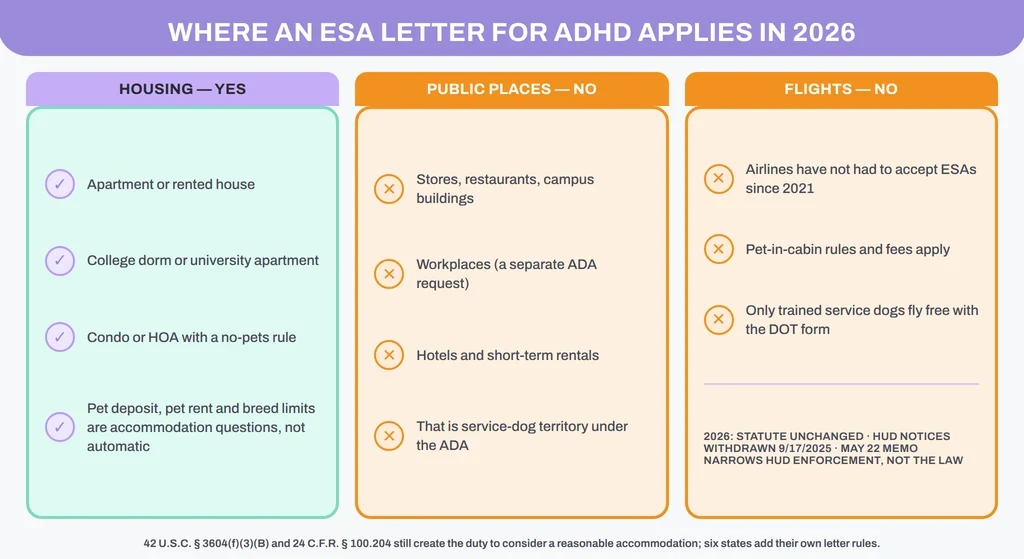
The letter is a housing document, and three separate things are true about housing in 2026. Sites that collapse them into one sentence get all three wrong.
The statute is unchanged. 42 U.S.C. § 3604(f)(3)(B) makes it discrimination to refuse a reasonable accommodation in rules, policies, practices or services when a person with a disability needs it to use and enjoy a dwelling; 24 C.F.R. § 100.204 is the implementing regulation. Neither contains a training requirement, and both are enforceable by private lawsuit and by state agencies.
HUD’s guidance notices are withdrawn. FHEO Notices 2013-01 and 2020-01 — the documents landlords used to cite for how to handle ESA requests — were withdrawn effective September 17, 2025 (91 FR 17291, April 6, 2026). Nothing has replaced them.
HUD’s enforcement posture has narrowed. A May 22, 2026 FHEO memorandum says HUD itself will find reasonable cause and recommend charges only in cases involving animals individually trained to perform disability-related work or tasks. HUD frames this as prioritizing its own enforcement resources, not as a change in the law: open ESA cases go to case-by-case review, Section 504 and the ADA are outside the memo’s scope, and a tenant’s right to sue privately is preserved.
Two points matter more for ADHD than for most conditions. The first is college housing: ADHD is often diagnosed or first treated at university, and the Fair Housing Act applies to dormitories and university-owned apartments as dwellings, so a student with a qualifying need makes the same reasonable-accommodation request to the housing office that a tenant makes to a landlord. Our ESA letter for college dorms guide covers the disability-services process. The second is privacy: the letter confirms a disability and the animal’s connection to it without naming ADHD, and in Florida and Montana the statute itself bars a housing provider from demanding the diagnosis, its severity or medical records. How to hand the letter over, and what a landlord can and cannot ask, is in ESA letter to landlord.
Six states regulate who may write the letter and what has to happen first. A letter that ignores them is easy to challenge, which is why PetESALetter matches each applicant with a clinician licensed in their own state. Arkansas is worth a special note for ADHD: its statute requires the clinician to re-evaluate the need every year, which suits a condition whose impact changes with medication and life stage.
| State | Statute | What it requires of the letter writer |
|---|---|---|
| California | Cal. Health & Safety Code § 122318 (AB 468, 2021) | Licensed in California; a client-provider relationship of at least 30 days before the letter; a clinical evaluation; license details in the letter |
| Louisiana | La. R.S. 46:1974 (Act 558 of 2024) | Louisiana license; a therapeutic relationship of at least 30 days and at least two sessions; a disability assessment and clinical evaluation |
| Arkansas | Ark. Code Ann. § 20-14-1003 (Act 268 of 2023) | Licensed in the jurisdiction; 30-day client-provider relationship; clinical evaluation at least once a year and yearly review of the need |
| Montana | Mont. Code Ann. § 70-24-114 (HB 703, 2023; amended 2025) | Montana-licensed mental health professional; client-provider relationship of at least 30 days; clinical evaluation; a registry or ID card is not sufficient on its own |
| Florida | Fla. Stat. § 760.27 (SB 1084, 2020) | Personal knowledge of the disability, acting within the scope of the license; an out-of-state practitioner must have provided in-person care at least once. No 30-day rule |
| Colorado | C.R.S. § 12-245-229; housing side C.R.S. § 24-34-502.2 as amended by HB26-1045 (eff. Aug 12, 2026) | In-person meeting, sufficient familiarity with the patient, and a written finding on disability and need. No waiting period; an assistance animal is a presumed reasonable accommodation |
Everywhere else the federal framework applies on its own. Our California ESA letter and Louisiana ESA letter pages go through the two strictest states in detail, and the state pages linked in the navigation cover the rest.
ADHD and an “approved in minutes” button are a bad combination — impulsivity is part of the condition, and the worst of the ESA industry is built for it. Four things should end the conversation:
And sometimes the honest answer is that an ESA is the wrong tool. An animal is a daily responsibility with no snooze button, and for some people with ADHD that structure is exactly the point; for others it is one more thing to forget, feel guilty about and eventually rehome. A clinician who says “not yet” is doing the job properly. The evaluation is not a sales funnel — the fee is refunded if the answer is no.
The bottom line. ADHD can qualify for an emotional support animal when a licensed clinician finds that it substantially limits daily life and that the animal alleviates it. The letter covers housing — apartment, house or dorm — and nothing else; six states add their own rules about who writes it; and the 2026 changes narrowed HUD’s enforcement, not the statute. PetESALetter’s evaluation is by a clinician licensed in the applicant’s state, the fee is $99 flat billed only after eligibility is confirmed, and the letter arrives in 24–48 hours if the need is there.
Not sure whether ADHD qualifies? A licensed clinician in your state evaluates whether an emotional support animal fits the situation — and the first step is a free five-minute screen.
Yes, when a licensed mental health professional evaluates the person and finds that the ADHD substantially limits a major life activity — learning, working, concentrating, sleeping, caring for oneself — and that the animal alleviates it. A diagnosis by itself does not qualify anyone, and an evaluation can conclude that the criteria are not met.
No. The evaluation is where a licensed clinician assesses whether ADHD is present and whether it meets the criteria; more than half of U.S. adults with ADHD were diagnosed at 18 or older. Someone with an existing diagnosis should bring the date and any treatment history. Nobody is turned away for lacking one, but the clinician may not issue a letter if the evaluation does not support it.
The one the person can reliably look after. A dog adds a fixed schedule and daily exercise, which suit ADHD well but demand consistency; a cat gives the same company with far less routine load. The letter is species-neutral under the Fair Housing Act, so the clinician’s question is whether the animal helps and whether its care is realistic, not which species it is.
It can, if the disability qualifies under the ADA and the dog is individually trained to perform tasks for it — medication reminders, interrupting hyperfocus, grounding during a meltdown. That is a psychiatric service dog, with public-access rights and a different evaluation, and training takes months to years. An ESA needs no training and covers housing only.
The Fair Housing Act protects any household member with a disability, including a child, and the accommodation request is made by the parent or guardian. The letter has to come from a licensed professional who has evaluated the child; a clinician who already treats the child is usually the right person to ask.
Usually, yes. University housing is a dwelling under the Fair Housing Act, so a student with a qualifying need makes a reasonable-accommodation request to the school’s housing or disability-services office with the letter. The school may ask for reliable documentation from a licensed professional and can set reasonable rules about the animal’s care and conduct.

Licensed Psychotherapist
Darren is a leading expert in mental health advocacy and assistance animal documentation. He specializes in streamlining the process for obtaining ESA Letters, PSD Letters, and State-specific ESA compliance.

ESA Letters Issued

Successful Consultations

Licensed Therapist Network

Client Satisfaction Rate




Petesaletter.com helps you get your emotional support animal letter online with guidance and support.

Got Questions? Call us 24/7
Copyright © 2020-2026 Petesaletter All rights reserved. Terms | Privacy | Refund
Owned and Operated by Verimedix LLC