ESA Letter Validity: What Actually Makes One Legal in 2026
Last Updated on: August 14, 2026
Reviewed by Darren Andrew Rafel
Licensed Agent
@ Petesaletter
Most people find out their ESA letter has a problem at the worst possible time — mid-lease, in front of a landlord, with a denial letter in hand. That happens because a letter can look official and still not hold up. And this year, the rules around what makes an ESA letter matter actually changed at the federal level.
A valid ESA letter must be written by a licensed mental health professional (LMHP) who has done a real clinical evaluation of you, confirms that you have a mental or emotional disability, and explains that the animal helps you with a symptom of that disability. That part of the law has not changed. What changed in May 2026 is how the federal government enforces it, and that changes what your letter can actually do for you.
Is My ESA Letter Still Valid After the 2026 HUD Changes?
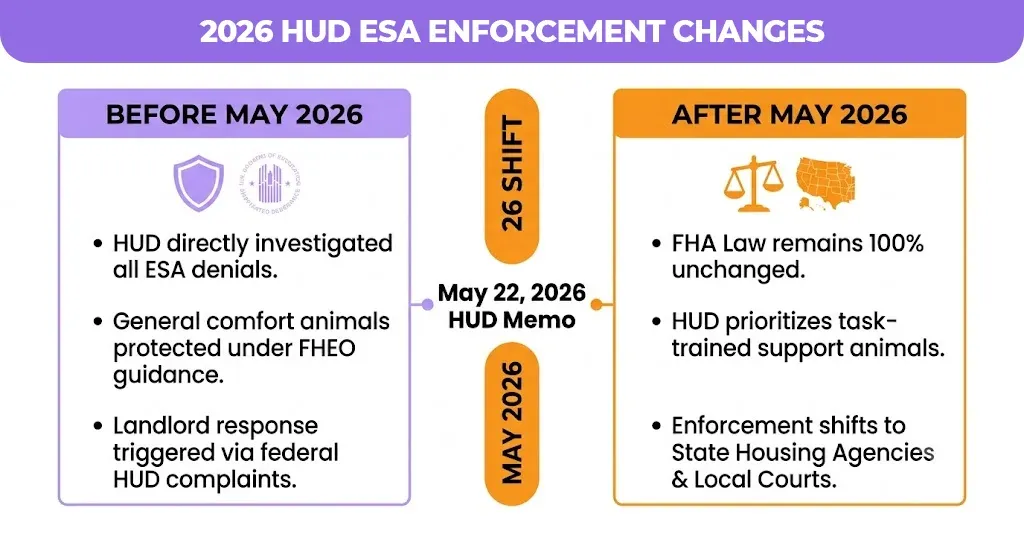
Yes, your letter is still legally valid under the Fair Housing Act itself, which has not been amended. But on May 22, 2026, HUD’s Office of Fair Housing and Equal Opportunity permanently withdrew its 2020 guidance and said it will now only pursue federal housing discrimination complaints for animals individually trained to do a task tied to a disability, not general emotional support.
In plain terms, the law protecting you did not disappear, but the federal agency that used to back you up on ESA complaints specifically stepped back. Your options now run more through state fair housing agencies and the courts than through a HUD complaint.
Why This Change Happened
HUD’s own memo says an “online certification industry” grew around ESA letters, and by 2026 more than 20% of the agency’s fair housing caseload involved untrained ESA disputes. A federal court also ruled against HUD’s old guidance in Henderson v. Five Properties LLC (E.D. La. 2025), calling it unclear on what counts as a reasonable accommodation. HUD used both of those as reasons to fall back on the Americans with Disabilities Act’s stricter, trained-animal definition instead of writing new ESA-specific rules.
What This Means for You Right Now
Your ESA letter still works as documentation. What changes is where you go if a landlord refuses it. Before May 2026, a HUD complaint alone often pushed a landlord to comply. Now, a denial is more likely to require a complaint to your state’s fair housing agency, or a private lawsuit citing the Fair Housing Act directly, since the statute itself is unchanged by an internal HUD memo.
This is not legal advice; if you are facing an active denial, a fair housing attorney or your state housing agency will tell you the fastest path in your specific state.
What Makes an ESA Letter Legally Valid?
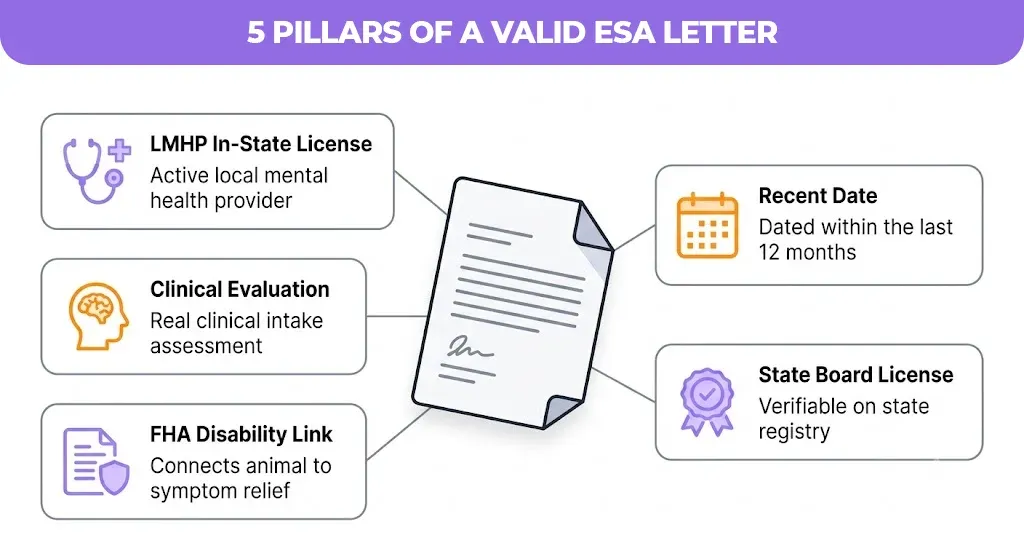
A valid ESA letter has five required elements: it comes from a licensed mental health professional, it’s on that provider’s letterhead, it states you have a disability under the FHA, it explains the animal’s connection to that disability, and it includes the provider’s license number and state. For a practical authenticity checklist, see our legitimate ESA letter guide. Missing any one of these gives a landlord a legitimate reason to question it.
Here’s what each element actually requires:
Licensed Provider, Licensed to Practice in Your State
A therapist licensed in a different state than where you live is a common reason letters get challenged.
Genuine Clinical Relationship
A single 10-minute phone call with no real evaluation is the single biggest reason letters fail scrutiny. Telehealth is fine; a rubber stamp is not.
Specific Language About Disability and Need
The letter doesn’t have to name your exact diagnosis, but it does need to say you have a condition that substantially limits a major life activity, and that the animal helps with a symptom of it.
Current Date
Most landlords and housing providers expect a letter dated within the last 12 months.
Verifiable License Number
This lets a landlord confirm the provider is real and in good standing with their state licensing board — one of the few things a housing provider is legally allowed to check.
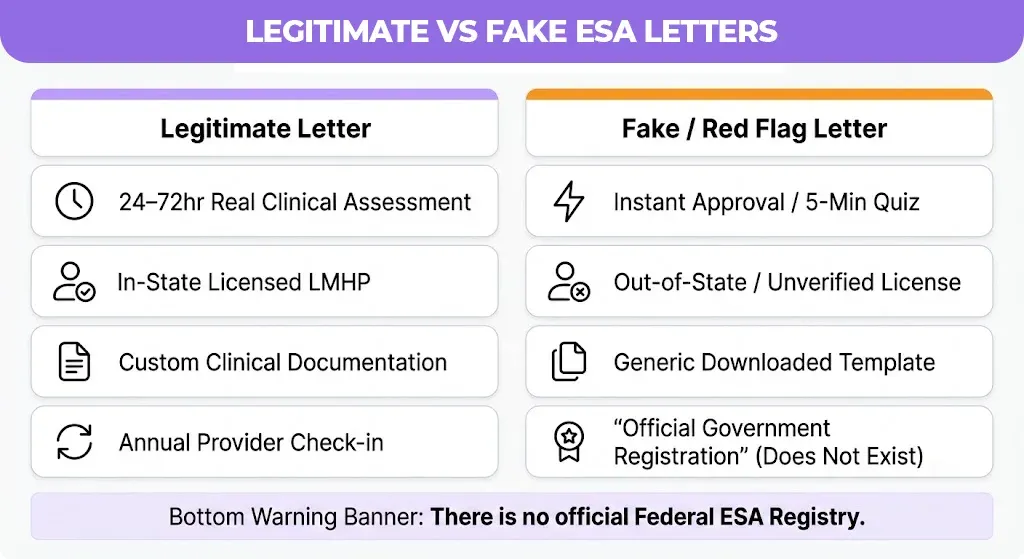
Legitimate ESA Letter vs. Fake ESA Letter: How to Tell the Difference
Signal
Legitimate Letter
Fake or Invalid Letter
Evaluation process
Real intake and clinical assessment, even if done by telehealth
Instant approval after a short quiz, no real evaluation
Provider license
Licensed LMHP in your state, license number included
No license number, or provider not licensed in your state
Turnaround time
Typically 24–72 hours after a genuine evaluation
“Guaranteed” same-day or instant download
Content
States disability and animal’s connection to a symptom
Generic template with no personalized clinical language
Renewal
Requires a follow-up check-in, typically annually
Sold as a one-time purchase with no renewal process
Registries and ID cards
Not required by law; may be offered as an extra, never as proof
Marketed as “official” or “federally registered,” which does not legally exist
There is no such thing as a federal ESA registry. Any site claiming to register your animal with the government is selling something the law doesn’t require and that carries no legal weight on its own.
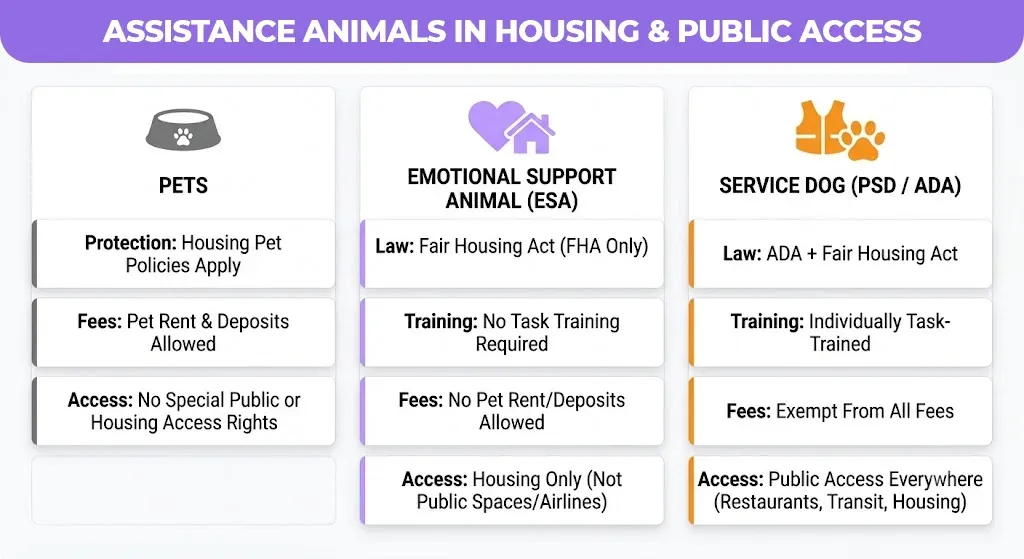
ESA Letter vs. Service Dog Certification: They Are Not the Same Document
Factor
ESA Letter
Service Dog Documentation
Governing law
Fair Housing Act (housing only)
Americans with Disabilities Act (public access)
Training required
No individual training required
Must be individually trained for a specific task
Where it applies
Housing, generally not public spaces
Stores, restaurants, transit, and other public places
Air travel access
Not required since the 2021 DOT rule change
Not applicable — service dogs were never classified as ESAs
Documentation needed
Letter from a licensed mental health professional
No certification required by law; providers may ask what task the dog performs
2026 HUD enforcement
Enforcement narrowed to trained animals only
Unaffected — ADA definition was already the standard
If someone tells you an ESA letter gets your animal into restaurants or stores, that’s incorrect. ESAs are a housing-specific protection, and airlines have not been required to accommodate them since the Department of Transportation’s rule change took effect in 2021.
How to Get a Valid ESA Letter: The Actual Process
Find a licensed mental health professional in your state. This can be a therapist, psychologist, psychiatrist, licensed clinical social worker, or counselor, either in person or via telehealth.
Complete a real evaluation. Expect questions about your mental health history, current symptoms, and how the animal helps you manage them. This step is what separates a valid letter from a legally weak one.
Receive the letter, not a certificate. The letter itself is the legal document. Certificates, ID cards, and vests are optional extras with no independent legal standing.
Give the letter to your housing provider when you request accommodation, not before you have a need to.
Renew annually, or per your provider’s recommendation, since most housing providers expect current documentation.
What Landlords Can and Cannot Legally Ask
Landlords CAN
Landlords CANNOT
Ask for a letter from a licensed provider if your disability isn’t obvious
Ask for your specific diagnosis
Verify the provider’s license is active and valid
Charge a pet deposit, pet rent, or pet fee for a legitimate ESA
Deny a request if the animal poses a direct threat or would cause significant property damage
Require a specific registration, certificate, or ID card from a commercial website
Ask what the reasonable accommodation is needed for, if not obvious
Deny a request solely because of breed, weight, or species, without evidence of an actual threat
Request a reasonable amount of time to process the request (HUD’s prior guidance suggested around 10 business days as a benchmark)
Ask you to disclose your full medical or therapy records
Before You Rely on Your Letter
The law protecting ESA owners in housing has not disappeared, but 2026 changed who enforces it and how fast. A valid letter from a licensed provider who actually evaluated you is still your strongest tool, whether your case ends up in front of a landlord, a state housing agency, or a court. If you’re not sure whether your current letter would hold up, getting one properly evaluated and documented now is a lot easier than fixing a denial later.
A valid ESA letter starts with a real evaluation by a licensed mental health professional. At PetESALetter, we provide secure online assessments and, if you qualify, issue legitimate ESA letters that meet current housing requirements. Get the documentation you need with confidence and peace of mind.
Ready to start the process with a real licensed clinician? Get a proper evaluation and documentation that holds up under 2026 rules — no registries, no instant approvals.
🐾 100% Risk-Free Guarantee (full refund if you don’t qualify, or if your landlord rejects the letter)
🐾 Live consultation with a state-licensed mental health professional
🐾 Documentation that meets your state’s clinical-relationship rules
Generally, an ESA letter is valid for one year, although some housing providers may accept older letters. Many people renew their ESA letter annually to make sure it reflects their current mental health needs.
A two-year-old ESA letter may not be accepted by many landlords or housing providers. It is usually best to obtain an updated letter from a licensed mental health professional before requesting an accommodation.
Yes, many landlords verify ESA letters. They can confirm that the letter was issued by a licensed mental health professional and that the documentation meets legal requirements, but they cannot ask for your specific diagnosis.
An ESA letter can be considered invalid if it is not written by a licensed mental health professional, if it lacks required provider information, if it contains false or outdated details, or if it was issued without a proper clinical evaluation.
THE AUTHOR
Darren Andrew Rafel
LMFT, LCSW, LMHP
Licensed Psychotherapist
Darren is a leading expert in mental health advocacy and assistance animal documentation. He specializes in streamlining the process for obtaining ESA Letters, PSD Letters, and State-specific ESA compliance.