
Last Updated on: August 14, 2026
Reviewed by Darren Andrew Rafel
An emotional support animal can be the difference between managing a mental health condition and losing ground to it, but landlords in 2026 are tightening how they verify that support is real. The days of a $40 online certificate protecting your tenancy are over. Meeting the current ESA letter requirements now means understanding both the clinical standard your document must satisfy and a landmark federal policy shift that redrew the rules this year.
Below is the fast answer, followed by the full legal breakdown you need to secure — and defend — a compliant letter.
Written by a Licensed Mental Health Professional (LMHP) or physician actively licensed in your state of residence
Issued after a live clinical evaluation — not a text-based quiz or automated PDF
States a diagnosed mental or emotional impairment that substantially limits a major life activity
Includes a therapeutic nexus statement connecting the animal to symptom relief, plus the provider’s license number and signature
Every valid document has to satisfy the same baseline ESA letter legal requirements, regardless of which state you live in. These requirements exist to distinguish a genuine clinical accommodation from a pet owner’s convenience purchase, and courts and landlords alike now scrutinize them closely.
The letter must come from a Licensed Mental Health Professional — a psychiatrist, psychologist, LCSW, or LMFT — or a licensed physician who is actively licensed in the state where you live. This is non-negotiable under the required ESA letter standard: a therapist licensed in Florida cannot lawfully issue a letter for a tenant in Ohio.
Multiple states have launched crackdowns on telehealth “signature mills” that issue letters in bulk without jurisdiction over the patient’s home state. If your provider is not licensed where you actually reside, the letter carries no legal weight, no matter how official it looks.
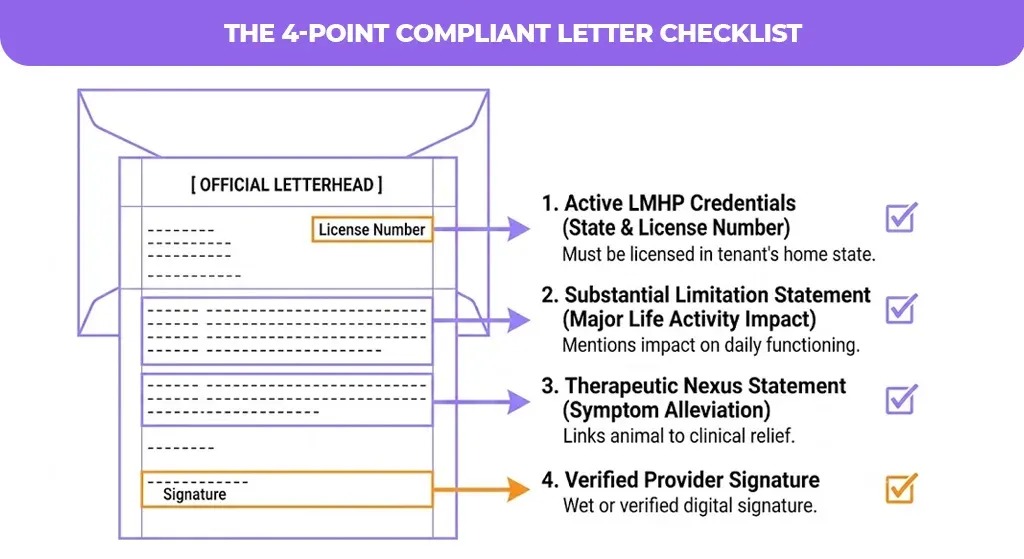
Beyond the provider’s credentials, what is required in an ESA letter comes down to four specific content elements. A landlord — or a court — will look for all four before treating the document as valid.
Official letterhead: provider name, practice contact information, and a wet or verified digital signature.
Active license number and state of issuance: verifiable against the relevant state licensing board.
Diagnosis and impairment statement: explicit language confirming a diagnosed mental or emotional impairment that substantially limits at least one major life activity.
Therapeutic nexus: a direct statement connecting how this specific animal alleviates symptoms of the diagnosed condition.
Understanding ESA letter requirements for housing in 2026 requires understanding a genuine regulatory earthquake. HUD ESA letter requirements shifted dramatically this year, and every tenant and landlord needs to know exactly what changed — and what didn’t.
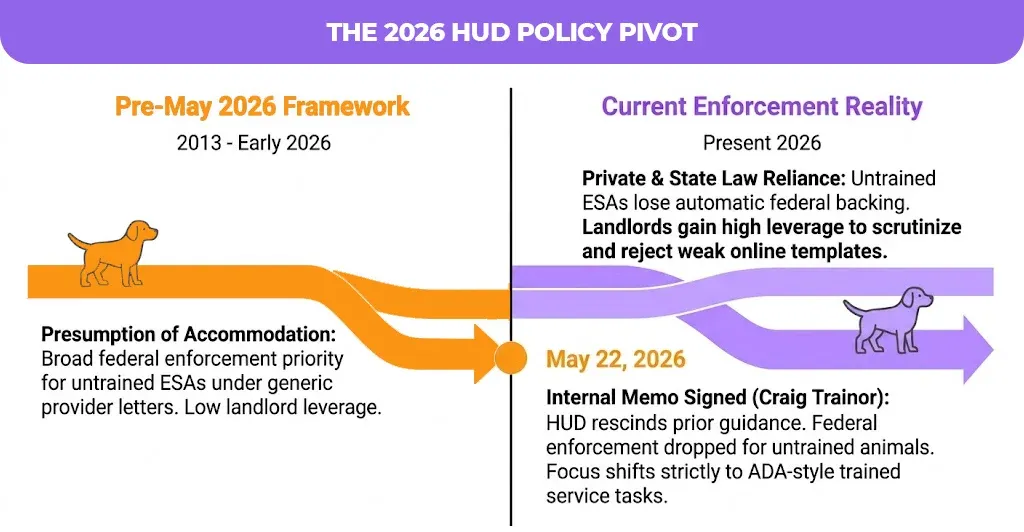
For over a decade, the Fair Housing Act (FHA) operated alongside HUD guidance that extended a near-automatic “presumption of accommodation” to untrained emotional support animals backed by a standard provider letter. That presumption protected tenants from pet fees, security deposits, and breed or size restrictions, and it made a basic letter functionally sufficient nationwide.
That foundation shifted on May 22, 2026, when HUD’s Office of Fair Housing and Equal Opportunity (FHEO) issued an internal enforcement memorandum, signed by Assistant Secretary Craig Trainor, that permanently rescinded the agency’s 2013 (FHEO-2013-01) and 2020 (FHEO-2020-01) guidance notices on assistance animals.
Under the new standard, FHEO will pursue enforcement charges for housing discrimination complaints only where the assistance animal has been individually trained to perform specific disability-related work or tasks, a standard drawn directly from the ADA’s definition of a service animal. General comfort, companionship, or emotional support no longer qualifies for federal enforcement priority on its own.
HUD cited a February 2025 executive order directing federal agencies to de-prioritize enforcement not grounded in the plain text of a statute, along with a federal court ruling in Henderson v. Five Properties LLC that questioned the prior guidance. FHEO also noted that untrained-ESA complaints had grown into an unsustainable share of its caseload.
Here is the legal nuance that matters most: the Fair Housing Act statute itself has not changed, and it has not been repealed. Private rights of action in federal and state court remain fully intact, and tenants can still sue a landlord directly over a wrongful denial.
What has changed is federal enforcement priority. Because HUD dropped its presumption of accommodation for untrained animals, landlords now have substantially more leverage to challenge or deny weak, templated online letters — particularly in the roughly eight states that relied primarily on the federal FHA rather than an independent state ESA law. Most states with their own fair housing statutes remain unaffected by the federal memo.
The memo applies only to complaints filed under the federal Fair Housing Act. It does not affect Section 504 of the Rehabilitation Act, the ADA itself, or any state or local fair housing law — and it does not retroactively strip previously approved ESAs of their status.
Meeting every requirement for an ESA letter is a process, not a form to fill out. Here is the procedure that produces a document able to withstand landlord pushback and, if necessary, legal scrutiny.
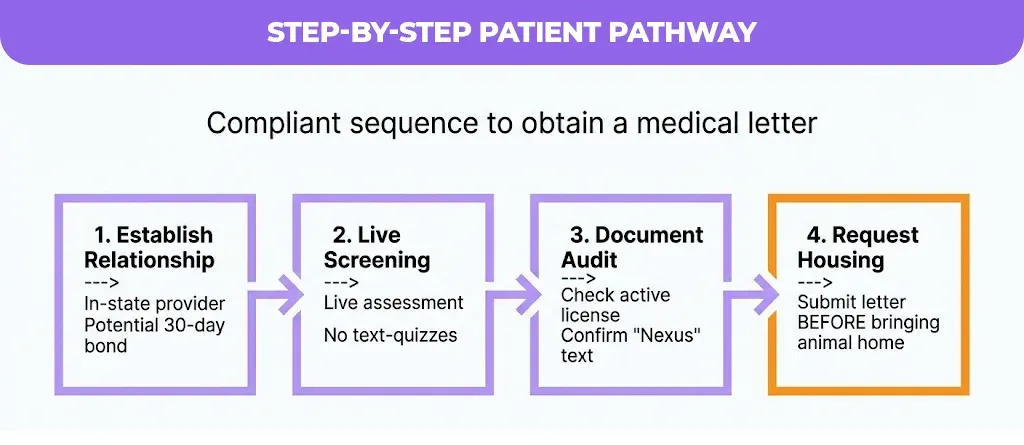
Establish an authentic provider relationship. Schedule an evaluation with a practitioner licensed in your state. Many states now legally require an active client-provider relationship, sometimes lasting 30 days or spanning multiple sessions, before a letter can be issued.
Undergo a comprehensive mental health screening. Participate in a live diagnostic assessment, whether in person or via interactive telehealth, and document how your symptoms affect daily functioning. Are exams required for ESA letter approval? Yes — a live clinical interaction is mandatory, and text-based chat quizzes or instant PDF generators are not valid substitutes.
Verify the regulatory documentation details. Confirm the finished letter explicitly documents the clinical relationship, references your functional limitations, and lists a verified, active license number, along with any responsive behaviors the animal exhibits to alleviate your distress.
Formally request the housing accommodation. Submit the letter to your landlord alongside a written request for reasonable accommodation, and do this before bringing the animal onto the property to remain within lease compliance.
Yes. Does having an ESA letter guarantee housing approval automatically? No — landlords are legally permitted to cross-reference a provider’s license number against the relevant state licensing board, and many now do so as standard practice given the 2026 enforcement shift.
The letter originated from an unaccredited online commercial registry — a source HUD explicitly flagged in its 2026 guidance as fueling widespread pet-to-ESA fraud.
The issuing provider holds no valid license in the tenant’s current state of residence.
The document omits the required statement confirming a substantial limitation on a major life activity.
The table below distills the legitimate ESA letter requirements against the hallmarks of a fraudulent package, useful for a quick side-by-side gut check on any letter you’re reviewing.
| Feature | Legitimate State-Licensed ESA Letter | Fraudulent Online Registry Package |
|---|---|---|
| Issuing Party | Licensed Mental Health Professional (LMHP) or physician actively licensed in your state | Anonymous “certification team” with no verifiable license |
| Clinical Basis | Based on a live diagnostic evaluation and an ongoing provider relationship | Based on a short online quiz with no live clinical contact |
| Content | States a diagnosed impairment, functional limitation, and therapeutic nexus to the animal | Generic template with no individualized diagnosis or nexus statement |
| Verifiability | License number can be confirmed on the state medical or counseling board website | No license number, or a number that fails board verification |
| Legal Standing | Withstands landlord scrutiny and supports a private FHA claim if challenged | Frequently rejected outright and cited by HUD as a source of ESA fraud |
| Cost Signal | Reflects the cost of a genuine clinical evaluation | Flat, low fee promising instant approval, often with a promised 100% approval rate |
The federal regulatory landscape shifted decisively in 2026, and the era of bypassing legitimate documentation with a generic online certificate is over. A properly issued letter — grounded in a real clinical relationship, a licensed provider, and a documented therapeutic nexus — remains the only reliable path to lawful housing protection.
Secure a letter that actually stands up to landlord verification, and don’t leave your housing security to chance under the new 2026 guidelines. PetESALetter provides an official, fully legal path to protecting your companion.
Ready to start the process with a real licensed clinician? Get a proper evaluation and documentation that holds up under 2026 rules — no registries, no instant approvals.
You generally qualify if you have a diagnosable mental or emotional condition — such as anxiety, depression, or PTSD — that a licensed provider confirms demonstrably disrupts a major life activity like working, sleeping, or maintaining relationships.
Many clinicians document real benefits: a consistent animal-care routine can provide grounding and emotional stabilization during both manic and depressive episodes, though the letter must still tie that benefit to your specific diagnosis.
Yes. Property managers are within their legal rights to confirm a provider’s license number through the applicable state licensing board, and rejections increasingly cite a failed verification check.
Approval is straightforward if you have a legitimate, documented condition evaluated honestly by a licensed professional; it becomes difficult only when someone tries to shortcut the clinical evaluation entirely.
Generalized anxiety qualifies only when it causes measurable functional impairment in daily life; ordinary, situational nervousness on its own does not meet the legal threshold.
Common reasons include a provider who lacks state licensure, an animal that displays dangerous or disruptive behavior, or a letter traceable to a known certificate mill rather than a genuine clinical relationship.

Licensed Psychotherapist
Darren is a leading expert in mental health advocacy and assistance animal documentation. He specializes in streamlining the process for obtaining ESA Letters, PSD Letters, and State-specific ESA compliance.

ESA Letters Issued

Successful Consultations

Licensed Therapist Network

Client Satisfaction Rate




Petesaletter.com helps you get your emotional support animal letter online with guidance and support.

Got Questions? Call us 24/7
Copyright © 2020-2026 Petesaletter All rights reserved. Terms | Privacy | Refund
Owned and Operated by Verimedix LLC