
Last Updated on: August 14, 2026
Reviewed by Darren Andrew Rafel

You can bring an emotional support animal into your college dorm. But the process runs through your school’s disability services office, not your landlord, and that’s the part most guides get wrong.
Colleges aren’t regular landlords. Your dorm is covered by the Fair Housing Act like any rental, but your school is also bound by Section 504 of the Rehabilitation Act, which applies to nearly every college in the country because almost every college takes federal funding. That means there are two overlapping sets of rules, one office in charge of both, and a very specific paper trail you need before move-in day.
This guide covers the actual steps, realistic timelines around semester deadlines, what your school can and can’t ask you, and what changed in HUD’s federal guidance this year that every student with an ESA should know about.
Yes. If you have a qualifying mental health condition and a valid ESA letter from a licensed provider, your college must allow your ESA in your dorm room as a reasonable accommodation, and cannot charge pet fees or enforce “no pet” policies against a properly documented ESA.
This applies whether you’re at a public university or a private one, and whether you live in a traditional dorm, a suite, or campus apartments. The animal doesn’t need any training. What it needs is a legitimate, documented connection to your mental health, established through a real evaluation with a licensed clinician.
The one place this gets complicated is the shared room. Roommates don’t get veto power over your legally accommodated ESA, but schools do have to work out allergy conflicts, and that’s usually handled through room reassignment rather than denying your request.
Your dorm room is covered by the Fair Housing Act, the same law that covers apartments off campus. Section 504 of the Rehabilitation Act adds a second layer because your school receives federal funding, giving you additional grounds to request accommodations through the school’s own disability office.
Here’s why this matters practically: the FHA is what makes your dorm room a “dwelling” that can’t discriminate based on pet policy. Section 504 is what makes the school’s disability services office the required point of contact and gives you an internal appeals process if they say no. You’re not choosing one or the other — both apply at the same time, and your school’s ESA policy is usually built to satisfy both at once.
Where people get confused is bringing in the ADA. The ADA governs public spaces like classrooms, dining halls, and libraries, and it only recognizes trained service animals there, not ESAs. Your ESA has strong rights in your dorm room. It does not have automatic rights to sit with you in a lecture hall, because that’s a different law with a different, stricter standard.
| Law | What It Covers | What It Means for You |
|---|---|---|
| Fair Housing Act (FHA) | Your dorm room as a residence | No pet fees, no breed bans, must accommodate a valid ESA |
| Section 504 (Rehabilitation Act) | Any program at a federally funded school | Requires the school to have an accommodation process and appeals path |
| ADA | Public campus spaces (classrooms, dining halls) | Only trained service animals qualify here — not ESAs |
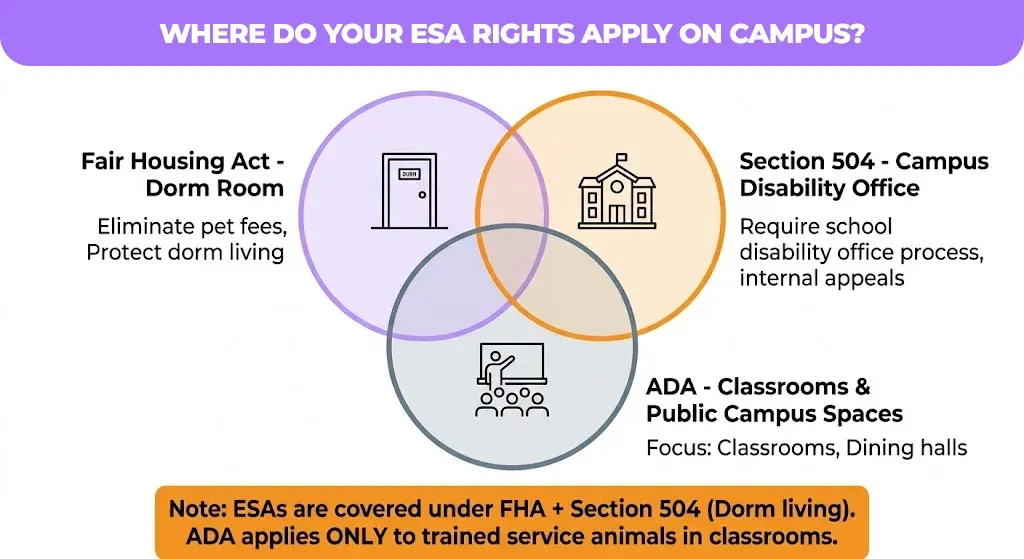
In May 2026, HUD narrowed its federal enforcement standard for ESA housing complaints nationwide, focusing on trained animals rather than untrained ESAs. This affects how aggressively HUD itself will pursue landlord complaints, but it does not remove your Section 504 rights through your school, which run on a separate legal track.
On September 17, 2025, HUD withdrew its 2013 and 2020 guidance documents on assistance animals — the documents most housing providers, including many college housing offices, had used for years to evaluate ESA requests. On May 22, 2026, HUD replaced that guidance with a narrower standard: going forward, federal enforcement will generally focus on animals individually trained to perform a disability-related task, the same standard the ADA uses for service animals.
For off-campus renters, this is a real shift, because HUD was often the primary enforcement path if a landlord refused an ESA. For college students, the practical impact is smaller. Your accommodation request runs through your school’s own disability services office under Section 504, and most university ESA policies were written to independently satisfy that law regardless of HUD’s current enforcement posture. That said, if your school ever refuses your request and you need to escalate, understand that a HUD complaint alone is no longer the strong lever it used to be; a complaint to the Department of Education’s Office for Civil Rights, which enforces Section 504, is now often the more direct path for students.
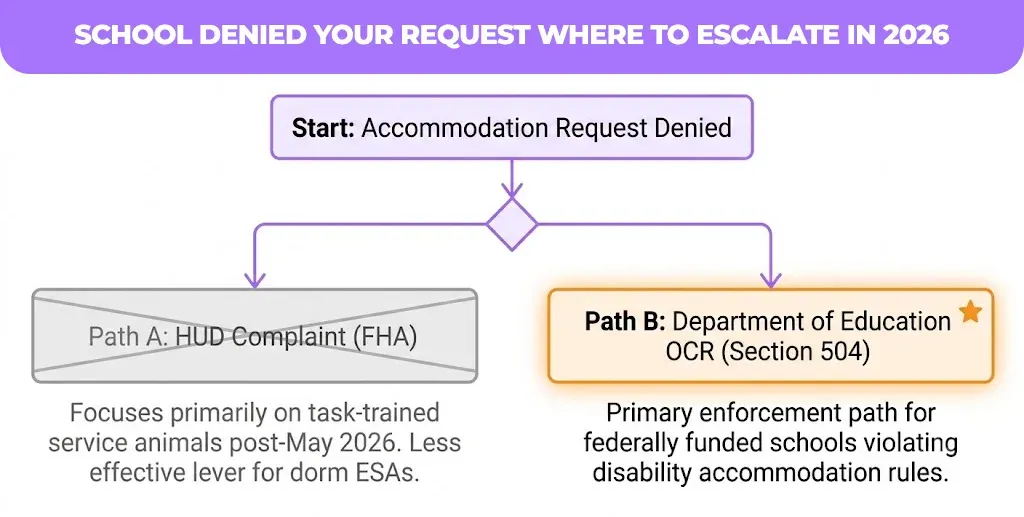
Before you move into your college dorm, contact the school’s disability services office, submit your ESA letter along with any required documents, and wait until you receive written approval for your accommodation — all before bringing your emotional support animal to campus. Submitting your paperwork does not mean your request has been approved.
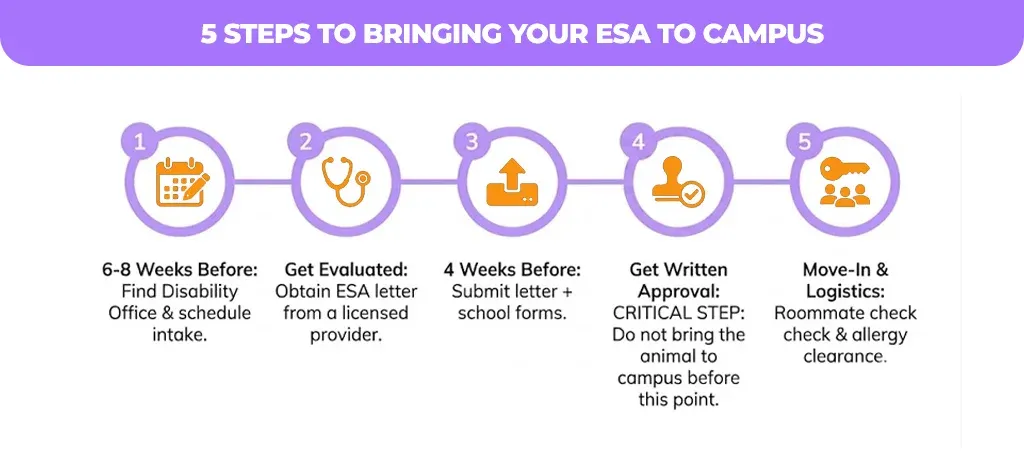
Every college has one, though the name varies — Disability Resource Center, Student Accessibility Services, Office of Disability Services. This office, not your resident advisor or housing office, is who processes ESA requests.
Most schools require an actual meeting or call before they will process your paperwork. This is not a formality — it’s where they explain the school’s specific documentation requirements and timeline.
Your letter needs to come from a licensed mental health provider and should state that you have a disability-related need for the animal. Some schools also require their own verification form filled out by your provider, in addition to the letter.
Don’t bring the animal to campus based on submission alone. Schools can take anywhere from a few days to several weeks, and moving in early with an unapproved animal can violate housing policy regardless of how strong your underlying case is.
If you have an assigned roommate, the disability office generally checks for allergy conflicts and can reassign rooms rather than deny your accommodation. This step is often the source of delays, so start early.
Only a licensed mental health professional can write a valid ESA letter for college housing: a therapist, licensed clinical social worker, psychologist, psychiatrist, or licensed counselor. A campus wellness coach, RA, or academic advisor cannot issue one.
Some schools will accept a letter from your existing campus counseling center. Others prefer or require an outside licensed provider, especially if your campus counseling center has a policy against writing ESA documentation for its own patients, which is common, because many university counseling centers separate therapeutic treatment from disability documentation on purpose. Check your school’s specific policy before assuming your campus therapist can write the letter.
If your state has additional requirements, like California’s 30-day provider relationship rule, those still apply even for a college-related letter, because state ESA law generally doesn’t carve out exceptions for students.
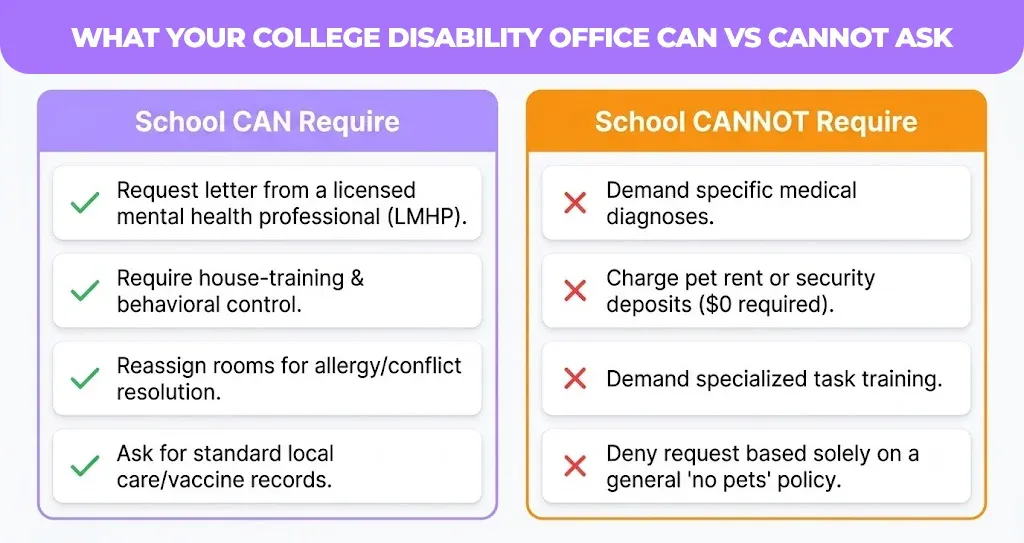
Your school can ask for documentation of a disability-related need for the animal and reasonable proof the animal is house-trained. Your school cannot ask for your specific diagnosis, cannot charge a pet deposit, and cannot require the animal to perform any trained task.
| Your School CAN | Your School CANNOT |
|---|---|
| Require a letter from a licensed provider | Require you to disclose your specific diagnosis |
| Ask reasonable questions if your need isn’t obvious | Charge pet rent or a pet deposit for a valid ESA |
| Require the animal be house-trained and under control | Require the animal be professionally trained |
| Reassign rooms to resolve allergy conflicts | Deny the request solely due to a “no pets” policy |
| Ask you to follow standard care and cleanup rules | Retaliate against you or single you out publicly |
The animal poses a direct threat to health or safety that can’t be reduced through reasonable steps.
The animal would cause significant property damage based on documented behavior.
Approving it would create an undue financial or administrative burden for the housing program.
Your documentation doesn’t meet the school’s stated requirements or your state’s specific ESA laws.
Moving in with the animal before getting written approval. Even a strong case can be treated as a policy violation if you skip the formal decision step.
Assuming your campus therapist can write the letter. Many university counseling centers won’t do this for their own clients — ask early, not the week before move-in.
Waiting until the week before the semester starts. Disability offices get flooded right before each term. Submitting your request 4–6 weeks ahead avoids getting stuck in a backlog.
Not telling your roommate in advance. Surprise animals in shared rooms create avoidable conflict, even when your accommodation is fully valid.
Assuming the ESA has classroom access. It doesn’t, under most schools’ policies, because the ADA, not the FHA, governs those spaces.
| Milestone | When to Act |
|---|---|
| Get your ESA letter | 6–8 weeks before move-in, longer if your state requires a provider relationship period |
| Contact disability services | As soon as you have your letter, ideally before housing assignments are finalized |
| Submit all required forms | At least 4 weeks before move-in |
| Get written approval | Before you bring the animal to campus — not after |
| Renew documentation | Check your school’s policy; many require annual or per-enrollment renewal |
| Item | Typical Cost |
|---|---|
| Online ESA evaluation and letter | $80–$200 |
| School-specific verification form (if required) | Often included, sometimes $25–$50 extra from your provider |
| Renewal letter for a new academic year | $50–$100 |
| Pet deposit or pet rent for a valid ESA | $0 — not legally chargeable |
Need an ESA for your college dorm? Connect with a licensed mental health professional through PetESALetter. If you qualify, you’ll receive a legitimate ESA letter to help support your campus housing accommodation request.
Need documentation your landlord will actually accept? Establish a compliant clinical connection before you submit your accommodation request, not after it gets denied.
Colleges and universities must consider valid ESA accommodation requests for campus housing under applicable disability and housing laws. Students usually need to submit a legitimate ESA letter through the school’s disability services office for approval.
Yes, an emotional support animal can help some people with bipolar disorder by providing comfort, reducing stress, and offering emotional stability. However, you must be evaluated by a licensed mental health professional to determine if an ESA is appropriate for your needs.
An ESA letter for college dorms is a document from a licensed mental health professional stating that you have a disability-related need for an emotional support animal. It also helps you request a housing accommodation from your college or university.
Yes, many apartments verify ESA letters by checking the licensed provider’s information and confirming the documentation meets legal requirements. They cannot require an ESA registration or certificate, but they can verify that the letter is legitimate.

Licensed Psychotherapist
Darren is a leading expert in mental health advocacy and assistance animal documentation. He specializes in streamlining the process for obtaining ESA Letters, PSD Letters, and State-specific ESA compliance.

ESA Letters Issued

Successful Consultations

Licensed Therapist Network

Client Satisfaction Rate




Petesaletter.com helps you get your emotional support animal letter online with guidance and support.

Got Questions? Call us 24/7
Copyright © 2020-2026 Petesaletter All rights reserved. Terms | Privacy | Refund
Owned and Operated by Verimedix LLC