
Last Updated on: August 14, 2026
Reviewed by Darren Andrew Rafel
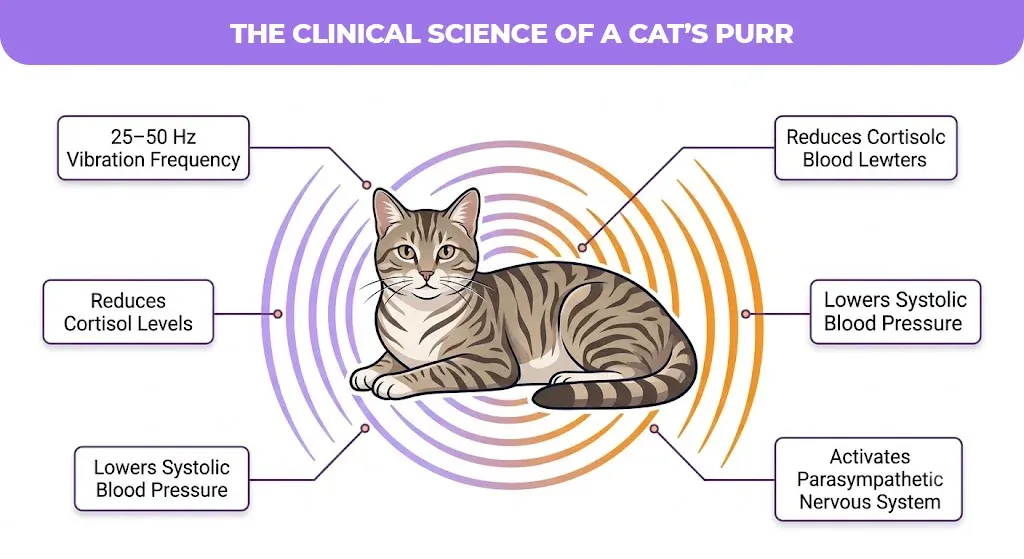
At a neurological level, a cat’s purr — vibrating between 25 and 50 Hz — has been clinically linked to reductions in cortisol, lower systolic blood pressure, and activation of the parasympathetic nervous system. For millions of people navigating depression, PTSD, and chronic anxiety disorders, that sound is not background noise: it is therapy. An ESA cat formalizes that therapeutic relationship within a legal framework that can protect where you live.
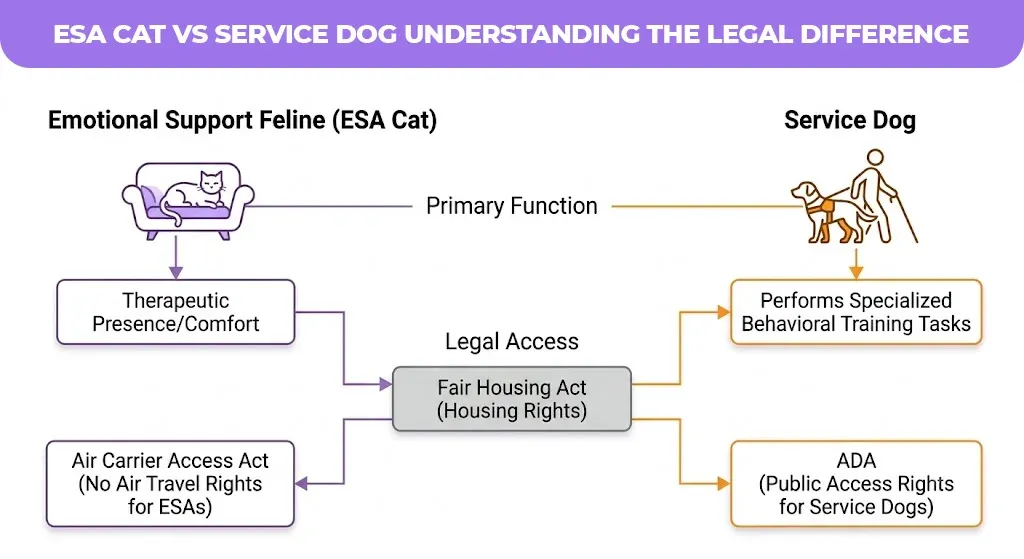
An ESA cat is a domestic feline that provides therapeutic emotional comfort to an individual with a documented mental or emotional disability, under a framework established by a licensed healthcare professional. Unlike a service animal, an ESA cat does not require specialized behavioral training; the animal’s consistent, calming presence is itself the therapeutic instrument. The legal recognition of that relationship begins and ends with a properly issued ESA letter for cats from a Licensed Mental Health Professional (LMHP), not with any commercial registration website.
This guide covers everything from the clinical science behind feline therapy to the step-by-step process of registering a cat as an ESA correctly — including why “free ESA cat registration” sites offer nothing of legal value and what modern federal housing policy actually requires.
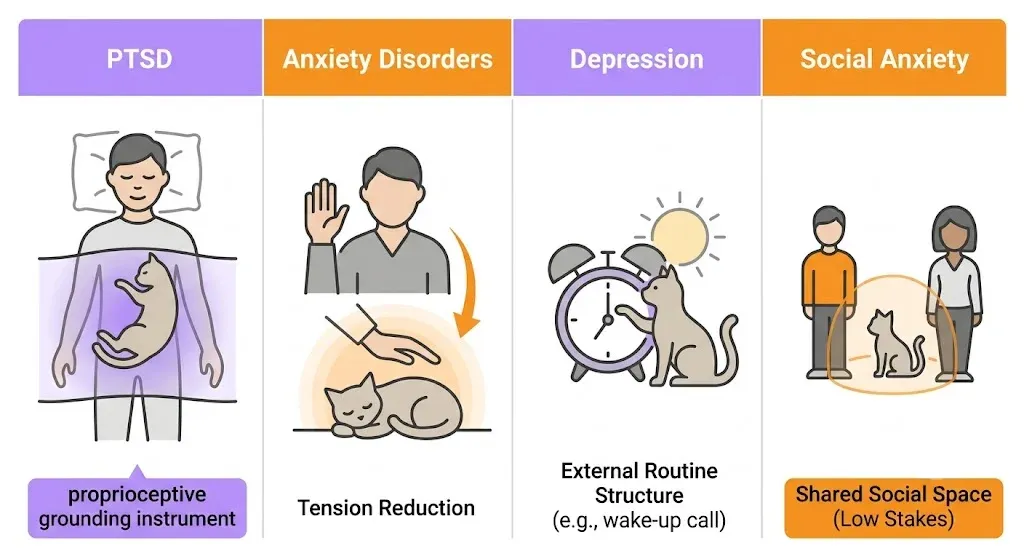
Can a cat be an ESA? Absolutely — and there is a growing body of peer-reviewed research supporting why. Studies published in behavioral medicine journals have documented that cat ownership is associated with a 30–40% reduced risk of cardiovascular events related to chronic stress. For individuals with PTSD, the cat’s physical weight and warmth during nighttime hyperarousal episodes provide proprioceptive grounding similar to weighted blanket therapy.
For social anxiety disorders, cats normalize the home environment as a shared social space without the demands of human interaction. Because ESA cats do not require verbal communication or adherence to social cues in the way humans do, they create a low-stakes relational experience that rebuilds interpersonal tolerance incrementally.
Can cats be ESA options for specific psychiatric conditions? Clinically speaking, felines are most frequently recommended for depression, generalized anxiety disorder, PTSD, bipolar disorder, agoraphobia, and autism spectrum disorder — though any DSM-5 diagnosis that produces functional impairment can qualify an individual for an ESA.
Compared to dogs, an ESA cat arrangement carries a distinct practical advantage for people in low-energy depressive episodes or those living in smaller apartment settings. Cats are self-sufficient for extended periods, do not require outdoor exercise, and are generally quiet enough not to trigger noise-sensitive anxiety conditions.
Their independence mirrors therapeutic boundaries in a useful way: a cat initiates and withdraws from physical contact on its own terms, which teaches clients with attachment dysregulation to receive comfort without experiencing pressure. Cats also establish highly predictable routines — morning vocal cues, evening lap-seeking, consistent sleep positioning — that provide external structure for individuals whose mental health conditions disrupt their own internal scheduling capacity.
No — and this distinction is legally critical. There is no federally recognized database, government registry, or certification body for emotional support animals of any species. Any website offering ESA cat registration, paid badges, ID cards, or certificate PDFs is selling a document that carries zero legal weight under the Fair Housing Act or any other federal statute. The term “ESA certification for cats” has no legal definition in federal law.
Sites offering free ESA cat registration or paid ESA registration services typically generate printable PDFs within seconds, with no clinical evaluation, no licensed professional, and no therapeutic relationship. When a landlord’s legal team flags these documents — and they increasingly do — the tenant loses their accommodation request, potentially their housing, and has no legal recourse, because the document they submitted was never legally valid.
The only legally recognized path to registering a cat as an ESA is through a licensed mental health professional who has conducted a real clinical evaluation. The resulting ESA letter for a cat must meet the same structural standards as any ESA documentation: practitioner letterhead, license type and number, state of issuance, a statement of disability, the functional limitation clause, and a defined validity period.
The process of registering a cat as an ESA legitimately works like this:
Establish care with a licensed therapist, psychologist, or psychiatrist in your state (in-person or via compliant telehealth).
Discuss your mental health condition and how your cat meaningfully mitigates its functional limitations.
If clinically appropriate, your LMHP issues a signed ESA letter on official letterhead, dated and valid for 12 months.
Submit the letter (not a registry printout, not a badge, not an ID card) to your housing provider as a reasonable accommodation request under the FHA.
Renew annually per your provider’s reassessment and relevant state law requirements.
The regulatory landscape for ESA cats shifted meaningfully in 2020 when HUD issued its Assistance Animal Notice (FHEO-2020-01). This guidance did not eliminate ESA protections — but it formalized a two-tier framework that now applies directly to how landlords assess documentation.
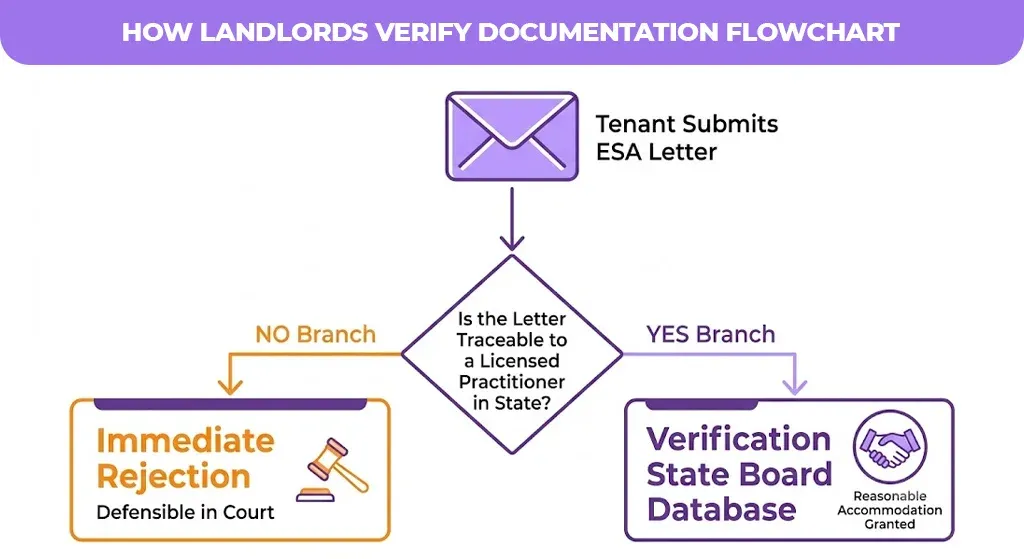
Under the updated framework, housing providers are now expected to scrutinize ESA letters more carefully, applying standards closer to those used for trained service animals when the disability nexus is not immediately apparent. What this means practically: any document that cannot be traced back to a named, verifiable, actively licensed practitioner in the tenant’s state will be rejected — and that rejection is now defensible in court.
State laws and individual civil rights litigation still provide meaningful protections for ESA holders. But relying on generic ESA certification for cats purchased online, or any form of commercial ESA registration service, exposes tenants to immediate rejection and eliminates their strongest legal defense.
The answer is simple but narrow: you prove it with a valid ESA letter for a cat issued by your licensed treating professional. No other document — no badge, no national registry card, no “emotional support animal certification” — satisfies the legal standard a housing provider is entitled to apply.
A landlord is permitted to verify the letter by confirming the practitioner’s active licensure through the state licensing board’s public database. They are not permitted to demand your diagnosis, request clinical records, or require a second opinion from a practitioner of their choosing.
| Criterion | Legitimate ESA Letter for Cat (LMHP) | Online Scam Registry / Paid Certificate |
|---|---|---|
| Who issues it | A named Licensed Mental Health Professional (LCSW, LMFT, PhD, MD) with verifiable credentials | An anonymous website or automated system; no licensed practitioner involved |
| Clinical evaluation | Based on a real telehealth or in-person assessment establishing a therapist-patient relationship | Instant approval after a 2-minute online quiz and payment |
| License information | Full license type, number, state of issuance, and expiry date clearly shown | No license details; decorative badge or QR code substituted |
| Landlord verifiability | Housing provider may call or email practitioner to confirm validity | Phone number rings out or leads to non-clinical call center |
| HUD compliance | Complies with HUD FHEO-2020-01 and applicable state statutes | Explicitly rejected under HUD’s 2020 enforcement guidance |
| Validity period | Typically 12 months; annual reassessment required | Claims permanent or “lifetime” status — a primary fraud indicator |
| Legal protection in FHA disputes | Fully defensible as reasonable accommodation documentation | No legal standing; accommodation request may be lawfully denied |
A cat that is anxious, overstimulated, or behaviorally dysregulated cannot provide consistent emotional support — regardless of how valid your ESA documentation is. The 3-3-3 rule for cats is a behavioral framework used by feline adoption specialists and behavioral consultants to structure the acclimation period for a newly introduced or rehomed cat. Protecting your cat’s mental wellness is inseparable from maximizing their therapeutic value to you.
In the first 72 hours, your new cat is operating primarily from its threat-response system. It does not yet recognize your home as safe territory, and it likely does not associate you with safety, food, or comfort. Behavioral signs — hiding under furniture, refusing food, dilated pupils, and near-complete stillness — are neurologically normal, not indicators of a poor temperament or a bad match.
What to do:
Confine the cat to a single “sanctuary room” containing food, water, a litter box, a hiding spot (cardboard box or covered bed), and minimal sensory stimulation.
Do not force interaction. Sit near the cat’s space and read aloud, use a low voice, or simply be present without eye contact — this builds initial trust passively.
Keep the environment consistent. The same feeding schedule, the same room temperature, and the same ambient sound level tell the cat’s nervous system that this place is predictable.
This stage directly mirrors what your cat may need emotionally from you as an ESA owner: quiet presence over active demand. The dynamic is therapeutic in both directions.
By week two or three, your cat’s baseline cortisol levels begin dropping. The threat response recedes and curiosity — a marker of psychological safety — emerges. The cat will begin mapping the rest of your home territory, testing boundaries, and observing your daily patterns.
What to expect and reinforce:
Let the cat expand its territory organically. Open additional rooms progressively; avoid flooding the cat with the entire home at once.
Feed at exactly the same time every day. Routine is the primary behavioral signal to a cat that their environment is secure.
Introduce play. Interactive toys (wand toys, laser pointers) activate the hunt-catch-eat cycle and reduce chronic stress hormones — in both the cat and the owner.
Note the personality emerging. A formerly silent cat that begins vocalizing, following you from room to room, or initiating contact has made the cognitive leap: you are now associated with positive outcomes.
At the three-month mark, a successfully acclimated cat displays what animal behaviorists call “secure base behavior” — they explore confidently, return to you for contact, and respond to your emotional cues. This is the developmental stage at which an ESA cat becomes most therapeutically effective: the animal is reading your affective state, modulating its own behavior in response, and providing consistent, reliable comfort.
Cats that have completed the 3-3-3 acclimation are far more likely to seek you out during periods of emotional dysregulation, to remain calm in high-anxiety household environments, and to maintain the behavioral consistency that makes them valuable therapeutic companions. Rushing this process by forcing early social contact or over-stimulating the animal in the first weeks actively undermines the bond — and the therapeutic relationship — you are trying to build.
An ESA cat relationship is not established by a badge on your cat’s collar or a PDF on your phone; it is established through a legitimate clinical assessment and a properly issued letter from a licensed professional. That letter is the instrument that protects your right to housing under federal law, that your landlord is legally required to consider, and that no registry site can replicate.
The combination of getting compliant documentation, understanding your verification rights, and giving your cat the behavioral runway it needs through the 3-3-3 framework creates a therapeutic partnership that is both legally sound and practically durable.
Thinking about making your feline friend an official ESA? Visit Petesaletter.com to connect with a licensed mental health professional who will evaluate your needs and issue a fully compliant ESA letter — protecting your housing rights from day one.
Ready to make it official for your cat? A licensed clinician evaluates your need and issues documentation that works for housing — no cat registry required.
To get a legitimate ESA letter for a cat, you must be evaluated by a Licensed Mental Health Professional (LMHP) — a licensed clinical social worker, therapist, psychologist, or psychiatrist — with whom you have an established clinical relationship. During the evaluation, your provider assesses whether you have a diagnosable DSM-5 condition that produces functional impairment, and whether your cat demonstrably mitigates that impairment.
An ESA cat is a domestic feline that provides documented therapeutic emotional support to an individual living with a mental or emotional disability recognized under the DSM-5. The designation is established not through a registry, certification, or badge, but through an official letter from a Licensed Mental Health Professional who has evaluated the individual and determined that the cat’s presence directly mitigates a functional limitation caused by their condition.
You prove your cat is an ESA by presenting a valid, dated, signed letter from a licensed mental health professional to your housing provider. The letter must include the practitioner’s name, license type, license number, state of issuance, a statement confirming a qualifying disability, and an affirmation that the cat is a necessary part of your treatment. Nothing else — no ID card, no QR code badge, no national registry membership, no “ESA certification for cats” printout — satisfies the legal standard.
The 3-3-3 rule for cats is a behavioral acclimation framework that outlines the adjustment stages a newly homed cat typically experiences: the first three days (acute stress, hiding, minimal interaction), the first three weeks (exploratory behavior, routine-learning, early trust-building), and the first three months (secure bonding, full territorial comfort, consistent support behavior).
No — and any website claiming otherwise is operating a scam. There is no federally recognized ESA registry, database, or certification system for any species. Free or paid ESA registration services generate printable documents that look official but carry zero legal protection under the Fair Housing Act. Housing providers are increasingly trained to identify these documents and are legally entitled to reject them.
Your cat protects your mental peace. Let us help protect their place in your home. While you focus on building a secure bond using the 3-3-3 rule, Pet ESA Letter handles the legal groundwork safely and quickly.

Licensed Psychotherapist
Darren is a leading expert in mental health advocacy and assistance animal documentation. He specializes in streamlining the process for obtaining ESA Letters, PSD Letters, and State-specific ESA compliance.

ESA Letters Issued

Successful Consultations

Licensed Therapist Network

Client Satisfaction Rate




Petesaletter.com helps you get your emotional support animal letter online with guidance and support.

Got Questions? Call us 24/7
Copyright © 2020-2026 Petesaletter All rights reserved. Terms | Privacy | Refund
Owned and Operated by Verimedix LLC