
Last Updated on: September 30, 2026
Reviewed by Darren Andrew Rafel

It depends on your state. Federal law still lets an ESA owner ask a landlord to waive pet rent, pet deposits and pet fees as a reasonable accommodation, but HUD’s guidance treating those charges as off-limits was withdrawn in September 2025. Kentucky, Virginia, Illinois, Maine and Minnesota bar them by statute; elsewhere the waiver is a request the landlord weighs. Every request starts with an ESA letter from a clinician licensed in your state — $99 flat at PetESALetter.
Key takeaways
Three charges usually sit in a pet addendum, and it pays to separate them before asking for anything. Pet rent is a monthly add-on to the rent. A pet deposit is a refundable sum held against damage and returned at move-out. A pet fee is a one-time charge that does not come back. Take a lease with $40 a month in pet rent and a $400 pet deposit: over 12 months, $880 is tied to the animal before it has scratched anything.
Under federal law none of the three is automatically off the table for an emotional support animal, and none is automatically allowed. The Fair Housing Act makes it discrimination to refuse “reasonable accommodations in rules, policies, practices, or services, when such accommodations may be necessary” for a person with a disability to have equal use of a home (42 U.S.C. § 3604(f)(3)(B); HUD’s own regulation, 24 C.F.R. § 100.204, says the same). Waiving a pet policy, and the charges attached to it, is one of those accommodations. The tenant asks; an ESA housing letter shows the disability and the disability-related need for the animal; the housing provider decides whether the waiver is necessary and reasonable.
From 2020 to 2025 that decision was close to a formality on fees, because HUD’s 2020 notice told landlords that pet fees could not be assessed for assistance animals. That notice has been withdrawn, so in 2026 the answer comes from three places at once: the federal statute, which still supports the request; your state’s law, which in some states settles the question outright; and the facts of your case. In Kentucky, Virginia, Illinois, Maine and Minnesota a statute bars the charges. In most other states you ask in writing, with the letter, and the landlord weighs it.
Three separate events, often blurred together online — including by most of the pages that rank for this question, which still describe the pre-2025 rules as current federal law.
September 17, 2025: the guidance was withdrawn. HUD’s Office of Fair Housing and Equal Opportunity (FHEO) withdrew FHEO-2013-01 and FHEO-2020-01, the two notices that told landlords how to handle assistance animals, effective that day. The withdrawal was published at 91 FR 17291 on April 6, 2026. Those notices were guidance, not law, and the Federal Register notice itself says that actions which do not comply with the text of the Fair Housing Act remain subject to enforcement.
July 16, 2025: a federal court upheld one animal fee. In Henderson v. Five Properties, LLC (E.D. La., No. 2:24-cv-00750), a tenant with an ESA asked her landlord to waive a $400 non-refundable animal fee charged to every resident with an animal. The landlord offered a payment plan she conceded she could afford, and Judge Sarah S. Vance granted the landlord summary judgment: on those facts the waiver had not been shown to be necessary or reasonable. The court called HUD’s 2020 notice “unpersuasive” on fees, and also wrote that it was “not holding that animal fees can always be enforced against someone with an ESA.” It is one district-court ruling and binds no other court.
May 22, 2026: HUD narrowed its own enforcement. A memorandum signed by Assistant Secretary Craig W. Trainor says FHEO will find reasonable cause and recommend charges only in cases involving animals individually trained to do disability-related work or tasks, and that requests to waive pet policies for untrained ESAs are no longer treated as presumptively reasonable. The memo is framed as a decision about HUD’s own enforcement resources: it covers Fair Housing Act complaints only, sends open ESA cases for case-by-case review, and says nothing in it affects a tenant’s right to sue in court within two years.
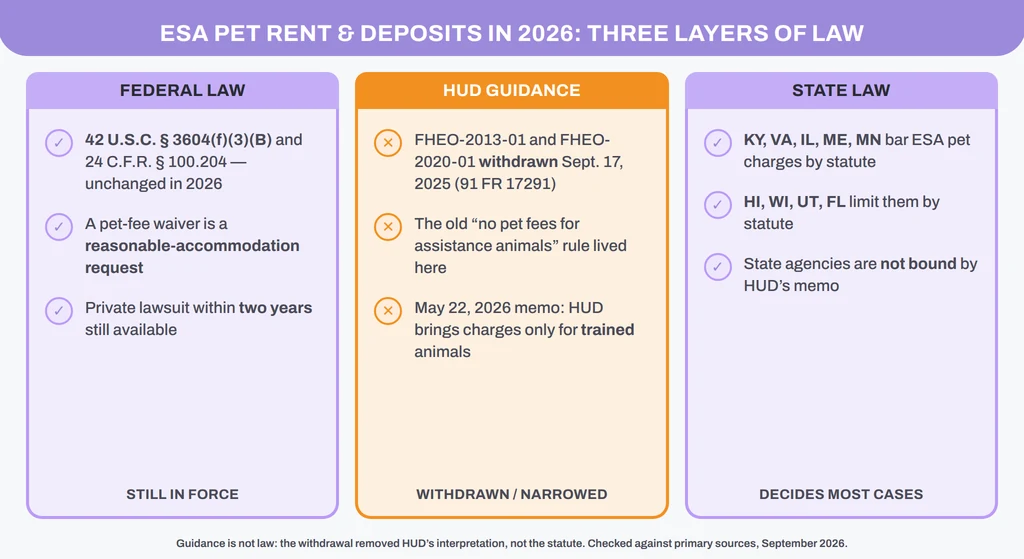
Put together: the statute and 24 C.F.R. § 100.204 still support a fee-waiver request for an untrained ESA, a complaint to HUD about pet rent for an ESA is now unlikely to produce a charge, and state law, state civil-rights agencies and private lawsuits carry the weight. It also cuts the other way: as of August 2026 the United States was still litigating an ESA accommodation case in federal court (United States v. Five Properties, E.D. La., No. 2:25-cv-01213), so “ESAs lost their housing rights” is not an accurate summary either.
Since the federal guidance went away, a state statute is the strongest position a renter can have, because it does not depend on HUD. These nine states write a limit on assistance-animal charges into their own code, and each defines the protected animal to include untrained emotional support animals. Who can write the letter, complaint deadlines and local agencies are on each state’s page.
| State | Statute | What it bars | Worth knowing |
|---|---|---|---|
| Kentucky | KRS 383.085(4) | A pet fee, deposit or any additional rent for an assistance animal | The statute’s definition includes emotional support animals |
| Virginia | Va. Code § 36-96.3:1(A) | A pet fee, deposit or any additional rent | Small landlords exempt under § 36-96.2 fall outside it |
| Illinois | 310 ILCS 120/10(f) | A pet-related deposit, pet fee or related pet assessment | Applies even where other tenants with pets pay them |
| Maine | 5 M.R.S. § 4582-A(3) | Any fee or security deposit as a condition of the animal | Monthly pet rent is untested in court; the Maine Human Rights Commission reads it as barred |
| Minnesota | Minn. Stat. § 504B.113, subd. 3 | Any additional fee, charge or deposit | Since Jan. 1, 2025 a lease with a pet policy must disclose the ban |
| Hawaii | HRS § 521-44(b)(1)(B) | An extra pet deposit for an assistance animal | Deposit only; pet rent is covered by agency guidance |
| Wisconsin | Wis. Stat. § 106.50(2r)(br) | Extra compensation as a condition of continued residence | Whether an up-front deposit counts is not settled |
| Utah | Utah Code § 26B-6-803(1)(b) | An extra fee or deposit for a support animal | “Support animal” is defined by reference to federal law |
| Florida | Fla. Stat. § 760.27 | Extra compensation for an emotional support animal | Written to apply to the extent federal law requires |
A second group says “no ESA fees” in agency guidance rather than statute: California’s Civil Rights Department FAQ, and the fair-housing agencies of Maryland, New Jersey, New York, Pennsylvania, Vermont and Washington. Guidance tells you how the state agency will treat a complaint, but a landlord can argue with it. Massachusetts is its own case: G.L. c. 186 § 15B limits what any landlord may take at the start of a tenancy, so an up-front pet deposit is off the table there for every tenant, animal or not.
A third group points the other way. Alaska’s landlord-tenant act allows an extra pet deposit of up to one month’s rent for any animal that is not a trained service animal (AS 34.03.070(h)). North Carolina lets a landlord charge “a reasonable, nonrefundable fee for pets” (G.S. 42-53). Delaware’s deposit exemption covers only trained support animals (25 Del. C. § 5514(i)(3)). Iowa struck its express pet-fee waiver in 2024 (SF 2268). In those states the federal accommodation request is still available; it simply has no state statute behind it. See Alaska, North Carolina, Delaware and Iowa.
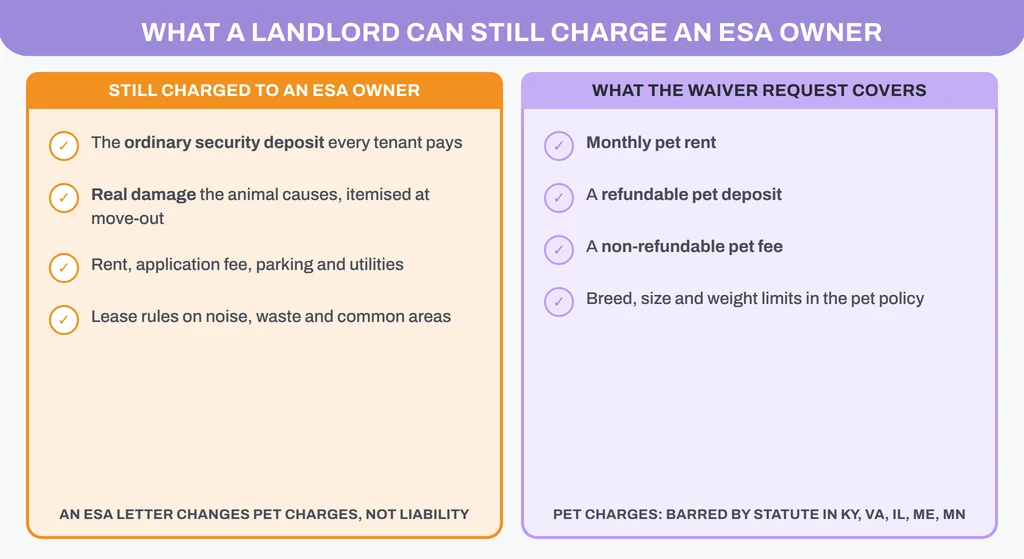
An ESA letter supports a request about the pet policy. It does not rewrite the rest of the lease, and several of the statutes above say so in terms.
The ordinary security deposit. Whatever every tenant pays, the ESA owner pays too, within the state’s deposit cap.
Real damage. A tenant is liable for damage the animal causes. Utah’s statute lets the landlord “recover a reasonable cost to repair damage,” and Montana’s makes the tenant liable for damage caused by the ESA (Mont. Code Ann. § 70-24-114(6)). In practice it comes out of the ordinary deposit at move-out, itemised like any other deduction.
Charges every tenant pays. Rent, application fees, parking and utilities are not pet charges and are not part of an ESA request.
Rules about behaviour. Noise, waste and leash rules in common areas apply to an ESA as they do to anything else in the unit. A landlord who bills for a specific repair is not charging pet rent.
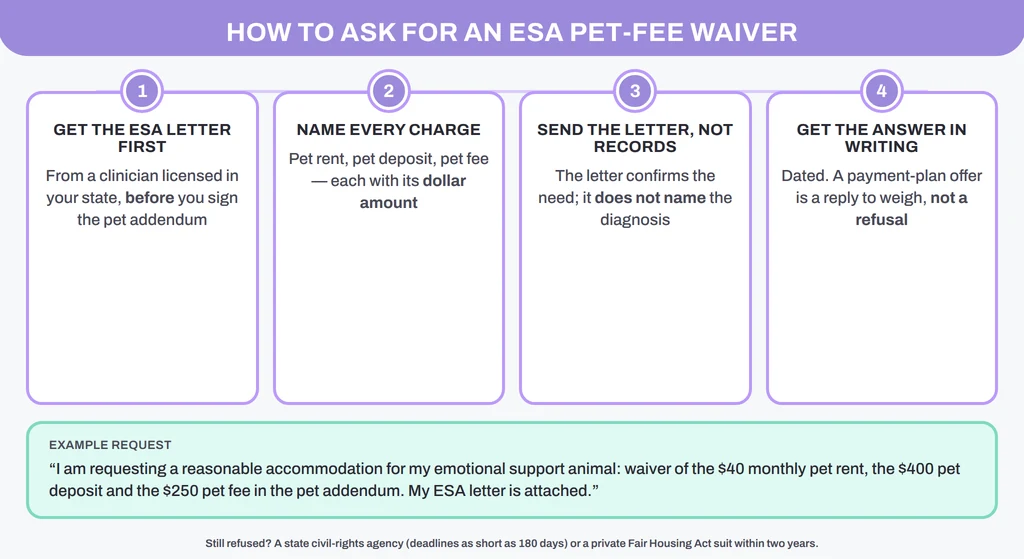
The request is a short email or letter with the ESA letter attached. Four steps keep it from turning into an argument.
Landlords may verify a letter — license number, license type, state and date — and that is normal. PetESALetter’s $99 flat includes landlord verification: the clinician confirms the letter directly when a housing provider asks, and in the 30-day states the follow-up contact the law requires is included too. ESA letter pricing lists what the fee covers, and how to verify an ESA letter shows what a landlord checks.
A common version: the pet deposit went in on the 3rd and the ESA letter arrived on the 4th. No statute makes a letter reach backwards on its own, but an accommodation request can be made at any point in a tenancy. Three practical routes:
Ask for pet rent to stop from the next due date. Pet rent is monthly, so a waiver granted now saves every remaining month of the lease — at $40 a month with nine months left, $360.
Ask for the pet deposit back, or folded into the ordinary deposit. A refundable pet deposit comes back at move-out under state deposit law anyway, less itemised damage. Asking for it now is a request; in Kentucky, Virginia, Illinois, Maine, Minnesota or Utah, cite the section. A non-refundable pet fee already paid is the hardest charge to recover outside those states.
In Minnesota, check the lease. Since January 1, 2025, a Minnesota lease with a pet policy has had to disclose the ban on fees and deposits for service and support animals. If it did not, a tenant who shows they would have requested an accommodation and would likely have received it can sue to recover fees, charges and deposits already paid (Minn. Stat. § 504B.113, subd. 3).
The animal’s legal category decides how strong the fee request is. An emotional support animal needs no training and its role is presence; a psychiatric service dog is individually trained to do tasks for the disability, which is exactly the line HUD’s 2026 memo now draws.
| Charge or rule | Pet with no documentation | ESA with a letter | Trained service dog or PSD |
|---|---|---|---|
| Pet rent, deposit, pet fee | As the lease says | Waiver requested as an accommodation; barred by statute in KY, VA, IL, ME, MN | Waiver requested; training is the strongest basis after the May 2026 memo |
| Damage the animal causes | Tenant pays | Tenant pays | Tenant pays |
| Breed, size and weight limits | Apply | Waiver requested with the same accommodation | Waiver requested with the same accommodation |
| HUD enforcement after May 22, 2026 | — | Charges unlikely; state agencies and private suits remain | Reasonable-cause findings still made |
| Public places (ADA) | No access rights | No access rights | Access for a trained service dog |
| Document | None | ESA letter from a licensed clinician after an evaluation | None in public; a PSD letter documents the housing need |
For most renters the animal already at home becomes an ESA now, and a trained dog is a separate decision for later. The PSD letter page covers the document a trained dog’s handler uses for housing, and service dog vs therapy dog vs ESA covers the wider distinctions. Calling an ESA a service animal to avoid a pet fee is not a shortcut: North Carolina, for one, makes it unlawful to disguise an animal as a service animal (G.S. 168-4.5).
Start by asking for the reason in writing. Then the options, roughly in order of speed:
A state or local civil-rights agency. Most states run one, and deadlines are short: 180 days at New Jersey’s Division on Civil Rights, 300 days at the Maine Human Rights Commission. These agencies apply state law and are not bound by HUD’s May 2026 memo; the Maine commission published its own statement on the memo on August 4, 2026.
A private lawsuit. The Fair Housing Act lets a tenant sue in federal or state court within two years of the discriminatory practice, and both HUD’s withdrawal notice and its memo say that right is unaffected. A fair-housing attorney or a local legal-aid office can say whether the facts justify it.
A HUD complaint. Still possible, but since May 22, 2026 HUD finds cause only for trained animals and sends open ESA cases for individual review. For an untrained ESA and a pet-rent dispute, the state agency is usually the faster route.
One thing never helps: an online “ESA registration” or certificate. No law recognises one, and Montana’s statute says a registration is not by itself enough to show a disability-related need (ESA registration myths). This page is general information, not legal advice; every statute cited was checked on official state code sites in September 2026.
Facing pet rent or a pet deposit on a new lease? A licensed clinician in your state evaluates whether an emotional support animal fits your situation — and the first step is a free five-minute quiz.
It depends on the state. Kentucky and Virginia bar pet fees, deposits and additional rent for an assistance animal by statute, and Illinois, Maine and Minnesota bar pet fees and deposits. Elsewhere a tenant asks for a waiver as a reasonable accommodation under the Fair Housing Act, with an ESA letter from a licensed clinician; since HUD withdrew its guidance in September 2025, the landlord weighs whether the waiver is necessary and reasonable.
Not in states whose statutes bar it — Kentucky, Virginia, Illinois, Maine, Minnesota, Hawaii and Utah among them — once the landlord has the accommodation request. In other states the deposit waiver is part of the federal accommodation request, and Alaska expressly allows an extra pet deposit for any animal that is not a trained service animal. The ordinary security deposit every tenant pays still applies.
You can ask at any point in a tenancy. Pet rent can be waived from the next due date, and a refundable pet deposit can be returned or folded into the ordinary deposit if the landlord agrees or a state statute applies. In Minnesota, a lease with a pet policy that has not disclosed the state’s fee ban since January 1, 2025 can let a tenant sue to recover fees already paid.
Yes. An ESA letter waives pet charges, not liability. Utah’s statute lets a landlord recover a reasonable cost to repair damage and Montana’s makes the tenant liable for it; in practice the repair comes out of the ordinary security deposit at move-out, itemised like any other deduction.
No. No federal or state law recognises an ESA registry, ID card or certificate, and Montana’s statute says a registration is not by itself enough to show a disability-related need. The document that supports a fee waiver is an ESA letter from a licensed mental health professional who evaluated you.
Many do, and they may confirm the letter is genuine: the clinician’s license number, license type, state and date. California, Arkansas and Louisiana require those details on the letter by statute. PetESALetter’s clinicians answer landlord verification requests as part of the $99 flat fee.

Licensed Psychotherapist
Darren is a leading expert in mental health advocacy and assistance animal documentation. He specializes in streamlining the process for obtaining ESA Letters, PSD Letters, and State-specific ESA compliance.

ESA Letters Issued

Successful Consultations

Licensed Therapist Network

Client Satisfaction Rate




Petesaletter.com helps you get your emotional support animal letter online with guidance and support.

Got Questions? Call us 24/7
Copyright © 2020-2026 Petesaletter All rights reserved. Terms | Privacy | Refund
Owned and Operated by Verimedix LLC