


ESA Letter in Maine for Your Emotional Support Animal
A licensed Maine clinician evaluates you. If you qualify, a $99 ESA letter supports your housing request under state and federal law. Clinically reviewed by Darren Rafel, LCSW.






ESA LETTER MAINE
What Is an ESA Letter in Maine?
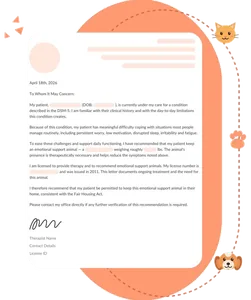
An ESA letter is a signed statement from a licensed clinician who has evaluated you. It says you have a disability and that your animal eases its effects. Maine keeps no official ESA registry, ID card or certificate. Landlords rely on the letter.
Maine law calls this an “assistance animal.” Under 5 M.R.S. § 4553(1-H), it needs no training once a licensed health professional finds it necessary for your disability.
PetESALetter charges one flat $99. The eligibility quiz is free. If the clinician finds you don't qualify, you get a full refund.

How Do You Get an ESA Letter in Maine?
Here is how to get an ESA letter in Maine without ever visiting an office.

Take the Free Quiz
Spend about five minutes on private questions about your symptoms, your routines and the animal you live with. The quiz costs nothing.

Pay and Get Matched
Pay the $99 at checkout. We then pair you with a mental health professional licensed in Maine, who reads your answers before you meet.

Talk With Your Clinician
You speak by video, phone or secure online visit. The clinician asks about your history and decides whether an ESA fits your needs.

Get Your Signed Letter
If you qualify, the letter usually reaches your inbox within 24–48 hours after the evaluation. It lists the clinician's name, license type, license number, state and date.
Who Qualifies for an Emotional Support Animal in Maine?
Maine defines disability more broadly than federal law. Under 5 M.R.S. § 4553-A, an impairment that significantly impairs mental health for more than six months counts. Major depressive disorder and bipolar disorder are listed regardless of severity.
Conditions a licensed clinician may evaluate for an ESA letter include:
Maine ESA Laws: What the Human Rights Act Says
Maine ESA laws live in a state statute. The Maine Human Rights Act (MHRA) added assistance animals through LD 1601, effective July 29, 2016. The Fair Housing Act adds a federal layer.
Untrained Animals Count
Section 4553(1-H)(A) covers an animal found necessary by a physician, psychologist, nurse practitioner, licensed social worker, licensed professional counselor or other licensed health professional. No task training is needed.
Refusal Is Unlawful
Under 5 M.R.S. § 4582-A(3), refusing to permit an assistance animal is housing discrimination. A no-pet rule is no defense. The landlord has to prove one of three narrow exceptions, covered further down this page.
No Fee or Deposit
The same section says use of an assistance animal “may not be conditioned on the payment of a fee or security deposit.” The Maine Human Rights Commission (MHRC) also tells landlords to skip other animal-related fees. You still pay for real damage.
Limits on Questions
A landlord may ask for reasonable confirmation that a licensed professional made the determination. MHRC Housing Rule § 8.04(G)(1) bars questions about the nature or severity of your disability.
An Emotional Support Dog Isn't a Service Dog
Maine limits service animals to dogs trained to do work or tasks, and emotional support does not count (§ 4553(9-E)). An emotional support dog in Maine has housing rights only. Task-trained dog? Ask about our PSD letter.
Emotional Support Animal Rights in Maine Rentals
The FHA, 42 U.S.C. § 3604(f)(3)(B), and the MHRA apply side by side. The state's exemptions are narrower than the federal ones, so nearly every landlord here is covered.
Landlords and Managers
The MHRA exempts only one unit of an owner-occupied two-family home, or up to four rooms in an owner's home (§ 4581(4)(B)). Unlike federal law, it has no owner-occupied three- or four-unit exemption.
Homeowners Associations
An HOA generally has to consider a documented accommodation request, even when community rules limit animals.
Condo Boards
A condo board generally has to weigh a documented request on its merits. A no-pet condo rule does not end the discussion.
Campus Housing
Colleges usually route ESA requests through the disability services office, often with their own forms. Ask early, well before housing deadlines.
A Direct Threat
The landlord shows that this particular animal poses a direct threat to the health or safety of others. The statute puts that burden on the landlord, not on you.
Substantial Property Damage
The landlord shows the animal would cause substantial physical damage to the property of others. A general worry about pets is not the same thing.
Disturbing Other Residents
State law adds a defense federal law lacks: the animal would substantially interfere with other residents' reasonable enjoyment of the housing.
TRAVEL RULES
Can Your ESA Fly or Stay in Maine Hotels?
Not with ESA rights. Under the DOT's 2020 Air Carrier Access Act rule, in effect since January 11, 2021, airlines may treat an emotional support animal as a pet, with pet fees and size limits.
An ESA letter gives you no right to a free cabin seat. Under that rule, trained service dogs are the animals airlines must still accommodate.
The MHRC housing rule treats bed-and-breakfasts and vacation rentals not used as residences as public accommodations. There, only service dogs have access rights, so check the pet policy before booking.
Maine Service Dog Laws and ESA Misrepresentation
Maine service dog laws and the assistance-animal rules share one penalty statute. It is a civil matter, not a crime, and it reaches anyone who knowingly creates or hands over false documents.
What misrepresentation can cost you:
WHY CHOOSE US
Why Maine Renters Pick PetESALetter
Maine-Licensed Clinicians
A mental health professional licensed in Maine reviews your answers and talks with you. Software never approves a letter by itself.
Usually Ready in 24–48 Hours
If you qualify, the signed letter usually arrives within 24–48 hours after your evaluation, so you can send it to your landlord quickly.
Letters Landlords Can Check
Each emotional support animal letter Maine landlords receive from us is on professional letterhead, with the clinician's license type, number and state.
Evaluated From Home
Meet your clinician by video, phone or secure online visit. State law sets no in-person rule.
Private and HIPAA-Conscious
We treat your health information with HIPAA-conscious care and never sell it. Your landlord sees the letter, not your records.
A Flat $99, No Extras
No subscription, auto-renewal or upsells. If the clinician finds you don't qualify, you can request a full refund within 7 days.
Help With Landlord Questions
Our support team answers your landlord's verification questions. If a landlord rejects the letter, send us the written denial within 30 days for a refund.
Real People on Support
Email support@petesaletter.com or call (470) 887-9106. A person replies before, during and after your evaluation.
TRUSTPILOT REVIEWS
Rated 4.8 on Trustpilot
They got back to me right away, they asked me if the information was correct and if not they can change it on the letter and send it back. They were very helpful, and kind. I loved their service. They can send you an email or a text which I think was very helpful. And the pricing is very good with very thing it comes with
FAQ
Maine ESA Questions, Answered
Start with an evaluation by a licensed clinician. If the clinician finds an animal necessary for your disability, you get a letter to share with your landlord.
A physician, psychologist, nurse practitioner, licensed social worker, licensed professional counselor or other licensed health professional who knows your disability-related need. State law sets no 30-day wait.
Only for a direct threat, substantial property damage or substantial interference with others' enjoyment. Owner-occupied duplex units and up to four rooms in an owner's home are exempt.
No. Maine has no ESA registry, ID card or certificate. Knowingly providing false documents can bring a civil fine of up to $1,000 per occurrence under 17 M.R.S. § 1314-A.
Not under state law. HUD's May 22, 2026, memo limits HUD's own cause findings to trained animals; the Fair Housing Act itself is unchanged. The Maine Human Rights Commission said on Aug. 4, 2026 that it “changes nothing in Maine.”
File with the Maine Human Rights Commission within 300 days (5 M.R.S. § 4611). Filing is free, and the final complaint is notarized. A Superior Court suit generally has two years.