


ESA Letter in Virginia: Licensed Clinicians, State-Law Housing Protection, $99 Flat
A Virginia ESA letter comes from a licensed clinician who evaluates you one-on-one and supports your housing request. If you qualify, ours costs $99 flat. Clinically reviewed by Darren Rafel, LCSW.






ESA LETTER VIRGINIA
Emotional Support Animal Letters in Virginia, Explained
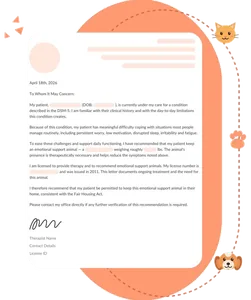
An emotional support animal letter in Virginia is a signed note from a licensed mental health professional. It states that you have a disability and that your animal eases one or more of its symptoms. You hand it to a landlord to request a housing accommodation.
Two laws back that request: the federal Fair Housing Act and the Virginia Fair Housing Law. The state code calls an ESA an “assistance animal” and says it is not a pet. No official ESA registry exists, here or anywhere else.

How Does an ESA Evaluation in Virginia Work?
An ESA letter follows a clinical decision; it is not a product you simply buy. A licensed professional decides whether an emotional support animal helps with your symptoms, and only then writes a letter.

A Private Screening Quiz
Spend about five minutes on confidential questions about your symptoms and your animal. It costs nothing.

One-on-One Clinical Review
A clinician licensed in Virginia talks with you by video, phone or secure online visit, then decides.

A Signed Letter if You Qualify
Your letter goes out on professional letterhead, usually within 24 to 48 hours of the evaluation.

Your Request Goes to the Landlord
Send the letter along with a brief written accommodation request, and keep a dated copy.
Who Qualifies for an Emotional Support Animal in Virginia?
You may qualify if a mental or emotional condition substantially limits a major life activity, such as sleeping, working, concentrating or being around people. That tracks the disability definition in Va. Code § 36-96.1:1. A licensed clinician decides, after evaluating you, whether an animal eases your symptoms.
Conditions clinicians commonly evaluate include:
How to Get an ESA in Virginia, Step by Step
No Virginia law dictates the wording of an ESA letter. These five steps follow what the statute lets a landlord ask for and what a careful clinician needs.
Choose a Clinician Licensed Where You Live
Virginia practice rules generally require the clinician to hold a Virginia license, or to practice under a compact such as PSYPACT.
Have a Real Clinical Conversation
Expect questions about your symptoms, your treatment history and how daily life feels. Honest answers support a sound decision.
Explain What Your Animal Does for You
Describe which symptoms your animal eases, like nighttime panic or isolation. Virginia law calls this emotional support that alleviates symptoms.
Get a Signed Letter With Full Credentials
If you qualify, the letter lists the clinician's name, license type, license number, state and date on professional letterhead.
Put Your Accommodation Request in Writing
Send the letter with a short written request. No statute sets a reply deadline, but undue delay could count as a denial.
Virginia ESA Laws: Va. Code § 36-96.3:1 and Your Housing Rights
Virginia wrote ESA protection into its own Fair Housing Law in 2017, alongside the federal Fair Housing Act. Va. Code § 36-96.1:1 says an assistance animal may provide emotional support, is not a pet and needs no individual training.
No-Pet Rules Yield to a Valid Request
A reasonable, necessary request “shall be granted” under § 36-96.3:2(A), unless it causes undue burden or fundamental alteration.
No Pet Fee, Deposit or Pet Rent
Va. Code § 36-96.3:1(A) bars charging a pet fee, deposit or additional rent to keep an assistance animal.
Breed, Size or Type Alone Cannot Justify a No
A landlord cannot call your animal a threat based “solely” on its breed, size or type (§ 36-96.3:2(D)).
Everyday Rules Still Apply
Leash, cleanup and vaccination rules still apply, and you pay for damage when pet owners would.
Small-Landlord Exemptions
An owner who lives in a building of up to four units, or who owns three or fewer single-family houses and rents without a broker, is exempt (§ 36-96.2).
Undue Burden or a Real Threat
The request may fail if it causes undue burden or fundamental alteration, or if this particular animal poses a genuine threat.
No Reliable Documentation
Without reliable proof of a disability and a disability-related need, a landlord may deny. Registry cards prove neither.
AIR TRAVEL
Does a Virginia ESA Letter Cover Air Travel?
No. The Department of Transportation revised its Air Carrier Access Act rule, effective January 11, 2021. Since then, airlines may treat an emotional support animal as an ordinary pet, not a service animal.
That means pet fees, carrier size limits and the airline's own booking rules can apply. Each carrier sets its policy, and some accept small animals in the cabin in a carrier. Your letter is a housing document, and it does not change any of this.
Trained psychiatric service dogs follow separate DOT rules. Read your airline's current pet policy before booking, and confirm any cabin approval in writing.
Is There Emotional Support Animal Registration in Virginia?
No. The state keeps no registry, certificate or ID card for ESAs, and no federal one exists. Emotional support animal registration sold online is a paid listing, not legal proof.
Where the real legal risk sits:
WHY CHOOSE US
Why Virginia Renters Choose PetESALetter
Built on Virginia Housing Law
Our letters speak to both the Fair Housing Act and the Virginia Fair Housing Law.
Clinicians Licensed in Virginia
A mental health professional licensed in Virginia evaluates you, and their license number appears on your letter.
Letters in About 24–48 Hours
Your letter usually arrives by secure email within 24 to 48 hours after the evaluation.
ESA vs. Virginia Service Dog Laws
Virginia service dog laws cover trained dogs only (§ 51.5-40.1). Is your dog task-trained? Ask about our PSD letter.
$99 Flat, No Upsells
One price covers the evaluation and the letter. No subscription, no auto-renewal, and a full refund if you don't qualify.
A Clear Refund Policy
If the clinician finds you don't qualify, request a full refund within 7 days. Written landlord denial? Send it to support within 30 days for a refund.
Landlord Verification Help
If your landlord has verification questions, our support team answers them. Reach us at (470) 887-9106.
Private, HIPAA-Conscious Care
Your answers go only to your clinician. We treat health data with HIPAA-conscious safeguards and never sell it.
REVIEWS
What Clients Say on Trustpilot
The service was excellent! From the time I submitted the questionnaire to when I received my letter, it was less then 24 hours! Carlos and Darren were super kind and professional, and answered my questions super quickly. Definitely recommend!
FAQs
Questions Virginia Renters Ask
Yes, on narrow grounds. Va. Code § 36-96.3:2(D) permits a denial for no disability, no related need, undue burden or fundamental alteration.
Sometimes. A Veterans Affairs clinician may write one if they choose, but need not. PetESALetter is private and separate from the VA.
Choose a clinician licensed where you live who truly evaluates you. Since 2023, fraudulent documentation from a provider violates the Virginia Consumer Protection Act.
They can. Virginia guidance lets landlords ask where care happened, how many in-person sessions you had in the past 12 months, and where the clinician is licensed.
Not in most rentals. Va. Code § 36-96.3:1(A) bars pet fees, deposits and extra rent for an assistance animal, though exempt small landlords fall outside it.
No. The May 22, 2026, HUD memo binds only HUD staff. The Fair Housing Act is unchanged, and Virginia law does not require training.
Mail, email or fax the form to the Virginia Fair Housing Office within one year (§ 36-96.9). A lawsuit can follow within two years (§ 36-96.18).
Yes. Dogs and other animals can qualify as assistance animals, and breed, size or type alone cannot justify a denial.