


ESA Letter in North Carolina From Licensed Clinicians
An ESA letter in North Carolina is a licensed clinician's signed support for a housing accommodation. Ours costs $99 flat. Clinically reviewed by Darren Rafel, LCSW.





ESA LETTER NORTH CAROLINA
Having an ESA in North Carolina: What the Letter Does
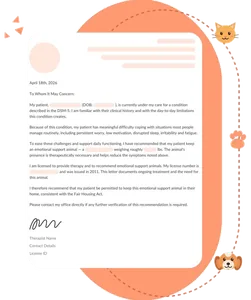
An emotional support animal letter in North Carolina is a signed statement from a licensed mental health professional. It says you have a mental or emotional disability and that your animal eases its symptoms. You give it to your landlord with a request to keep the animal despite a no-pet rule.
Two laws back that request: the federal Fair Housing Act (42 U.S.C. § 3604(f)(3)(B)) and the State Fair Housing Act, G.S. 41A-4(f)(2). Neither one requires an ESA to have training.
No official ESA registry exists in North Carolina or anywhere else. The only state animal registry, run by NC DHHS, is voluntary and covers trained service animals. Paid ESA registrations and ID cards carry no legal weight.

How Do You Get an ESA Letter in North Carolina?
Four steps take you from a short screening to a signed letter. You skip the office visit, and a licensed clinician makes every clinical decision.

Take the Free Five-Minute Eligibility Quiz
Answer private questions about your symptoms, your daily routine and what your animal does for you. The quiz costs nothing.

Check Out and Get Matched With a Licensed Clinician
You pay $99 at checkout. We then pair you with a mental health professional licensed to practice in North Carolina.

Talk One-on-One About How You Feel
Your clinician meets you by video, phone or secure online visit. After that conversation, they decide whether an animal helps your condition.

Get Your Signed Letter if You Qualify
Your letter comes on professional letterhead, usually within 24 to 48 hours. If the clinician finds you don't qualify, you get a full refund.
Who Qualifies for an Emotional Support Animal in North Carolina?
You may qualify if a mental or emotional condition substantially limits a major life activity, such as sleep, work, focus or time with other people. NC law calls this a handicapping condition (G.S. 41A-3(3a)). Conditions clinicians often evaluate include:
North Carolina ESA Laws: What Chapter 41A Actually Says
North Carolina ESA laws are thinner than most vendor pages claim. The state has no statute written for emotional support animals. The phrase never appears in its fair housing, landlord-tenant or disability chapters, so your rights rest on fair housing law.
The Accommodation Duty in G.S. 41A-4(f)(2)
Refusing a reasonable accommodation that may be necessary for a disabled person's equal use of a home is unlawful. Proof of intent is not needed (§ 41A-5(a)(3)).
Service Animal Law Covers Trained Animals
G.S. 168-4.2 protects a service animal "trained to assist" a person with a disability. An untrained ESA falls outside it and relies on fair housing law.
Small Landlords: NC Covers More
Unlike federal law, § 41A-6 has no single-family house exemption. It exempts only owner-occupied buildings of four or fewer units and rooms in the owner's home.
Pet Fees Are Legal Here, Waivers Are Not Automatic
G.S. 42-53 allows a reasonable, nonrefundable pet fee, and no NC law waives it for ESAs. Landlords generally have to consider a waiver request under the federal FHA.
Complaints Go to the NC Human Relations Commission
File a written, verified complaint within one year of the denial (G.S. 41A-7(b)). The Commission sits in the Civil Rights Division of the Office of Administrative Hearings.
Can a Landlord Deny an ESA in North Carolina?
Sometimes, but only for specific reasons. A covered landlord generally has to consider a reasonable accommodation request and grant it when the law's conditions are met. Here is how that plays out.
Answer Your Request
A landlord covered by the FHA or Chapter 41A has to review your written request and reply without undue delay.
Set Aside No-Pet Rules
A no-pet clause generally gives way when a clinician's letter shows a disability-related need for the animal.
Consider Fee Waivers
Under the federal FHA, a landlord generally has to weigh a request to waive pet fees. Any refundable deposit balance is due within 30 days after the tenancy ends (§ 42-52).
Look at the Animal, Not the Breed
Breed and weight limits are rules you can ask a landlord to waive. A safety denial should rest on facts about your animal.
Ask for Reliable Proof
A landlord may ask for reliable documentation of a disability and a disability-related need. A signed letter from a licensed clinician is the usual form.
Refuse Real Threats
Under G.S. 41A-6(b), no one has to rent to a tenant who poses a direct threat or would cause substantial property damage.
Bill You for Damage
An accommodation does not cover damage. You still pay for harm your animal causes, as any tenant would.
AIR TRAVEL
Can You Fly With an ESA From North Carolina?
Not with special rights. The Department of Transportation's revised Air Carrier Access Act rule took effect January 11, 2021. Since then, airlines may treat an emotional support animal as a pet. Expect pet fees, carrier size limits and each airline's own booking rules.
Your letter is a housing document. It gives you no cabin rights on domestic or international flights. Check your airline's current pet policy before you book.
Trained psychiatric service dogs follow separate DOT rules. ESAs also have no right to enter stores or restaurants, because § 168-4.2 covers trained animals only.
North Carolina Service Dog Laws and Misrepresentation Penalties
No North Carolina crime targets ESA letters or ESA owners. The one animal-misrepresentation offense covers service animals. It matters because some people call an ESA a service animal to dodge a pet fee.
What the statutes actually say:
WHY CHOOSE US
Eight Reasons NC Renters Use PetESALetter
Clinicians Licensed for North Carolina
A mental health professional licensed to practice in North Carolina evaluates you. Their name and license number appear on your letter.
Letters Usually Within 24–48 Hours
Once your evaluation ends, your signed letter usually reaches you by secure email within 24 to 48 hours. Some cases take longer.
HIPAA-Conscious Handling of Health Data
Your answers go to your clinician, not to landlords or advertisers. We protect your records and never sell your data.
Help When Your Landlord Wants to Verify
If your landlord has questions about verifying your letter, our support team answers them at (470) 887-9106 or support@petesaletter.com.
A Real Evaluation, Not an Auto-Approval
A licensed clinician reviews every case and can say no. If the clinician finds you don't qualify, you can request a full refund within 7 days.
Letters Carry Full Clinician Credentials
Each letter shows the clinician's name, license type, license number, state and date on letterhead. No NC statute sets letter content, so we include all of it.
ESA or Psychiatric Service Dog?
Is your dog trained to do specific tasks for a psychiatric condition? Ask about our PSD letter. North Carolina service dog laws protect trained animals only.
$99 Flat, With a Clear Refund Policy
No subscription, no auto-renewal, no upsells. If your landlord rejects the letter, send support the written denial within 30 days to request a refund.
REVIEWS
Recent Trustpilot Reviews From Our Clients
The team was super quick and got me the letter I needed verified by an in-state licensed therapist. Cheapest option I found and worked great!
I had a great experience with PetesaLetter.com. The process was simple, fast, and easy to understand. The staff was helpful, and I appreciated how smooth everything went from start to finish. I would recommend them to anyone needing an ESA letter and looking for a convenient service.
FAQs
North Carolina ESA Questions, Answered
Yes, in limited cases. A landlord can refuse if a tenancy poses a direct threat or would cause substantial property damage (G.S. 41A-6(b)). Small owner-occupied buildings are exempt, and missing documentation can sink a request.
No. The state keeps no ESA list. NC DHHS registers trained service animals only and says emotional support dogs do not qualify.
Many do. A landlord may check the clinician's license, and our support team answers verification questions. No NC statute sets a verification standard.
They can start with one. G.S. 42-53 permits a reasonable, nonrefundable pet fee, and refundable deposits fall under § 42-51(b) caps. Ask in writing for a waiver, which landlords generally have to consider under the federal FHA.
No. HUD's memo of May 22, 2026, changes only how HUD investigates; it now finds cause only for trained animals. The Fair Housing Act and private lawsuits are unchanged, and § 41A-4(f)(2) has no training rule.
File a written, verified complaint with the NC Human Relations Commission within one year (§ 41A-7(b)). A state-law suit first needs a right-to-sue letter; a federal FHA suit has a two-year deadline.