
Last Updated on: August 14, 2026
Reviewed by Darren Andrew Rafel
You cannot actually register a cat as an emotional support animal, because no official registry exists at the federal or state level. What you need is a letter from a licensed mental health professional confirming that you have a disability-related need for your cat.
That distinction matters more now than it did a year ago. On May 22, 2026, HUD changed how it enforces emotional support animal housing complaints, and it’s a bigger shift than most sites covering this topic have caught up to. We’ll walk through what actually protects you, what changed, and how to avoid the registration scams that flood search results for this exact question.
No, you cannot register a cat as an emotional support animal, because no government agency — including HUD — maintains an ESA registry. What actually matters is a letter from a licensed mental health professional confirming that you have a disability and that your cat helps manage the symptoms of that condition.
Any website selling ESA registration, a certificate, an ID card, or an official database listing is selling a novelty product with no legal weight. Landlords and airlines are not required to recognize it, and several real housing cases have gone against tenants who relied on registration alone instead of a real letter.
A cat qualifies as an emotional support animal when a licensed mental health professional determines, after an evaluation, that you have a diagnosable mental health condition and that living with the cat helps manage a symptom of that condition. No training is required for the cat itself, unlike a service animal.
Common qualifying conditions include anxiety disorders, depression, PTSD, and panic disorder. The specific diagnosis matters less than the clinician’s professional judgment that the animal provides a documented therapeutic benefit. There is no official list of species that qualify. Cats, dogs, birds, and even rabbits have all been recognized as ESAs in real housing cases.
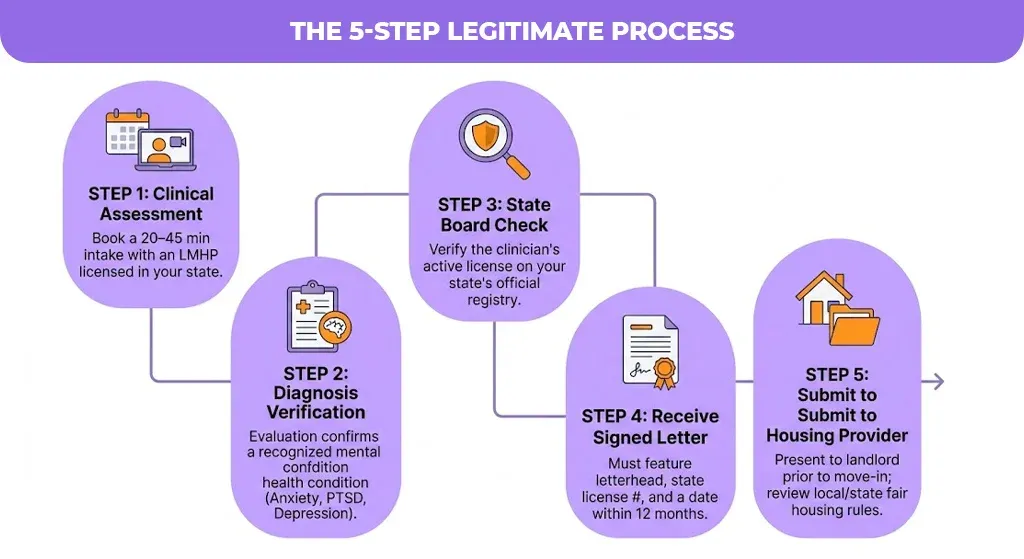
Every legitimate ESA letter comes from a licensed therapist, counselor, psychologist, or psychiatrist who evaluates you — either in person or through a real telehealth session — and who is licensed in the state where you live. The evaluation generally takes 20 to 45 minutes and works like an actual clinical intake, not a two-minute form.
Steps to get a real letter:
Book an appointment with your existing therapist, or a licensed telehealth ESA provider
Complete a real clinical evaluation, not a quiz with instant results
Receive a signed letter on the clinician’s letterhead with their license number and state
Confirm the letter is dated within the last 12 months, since most landlords require recent documentation
Verify the clinician’s license on your state’s licensing board website before you rely on the letter
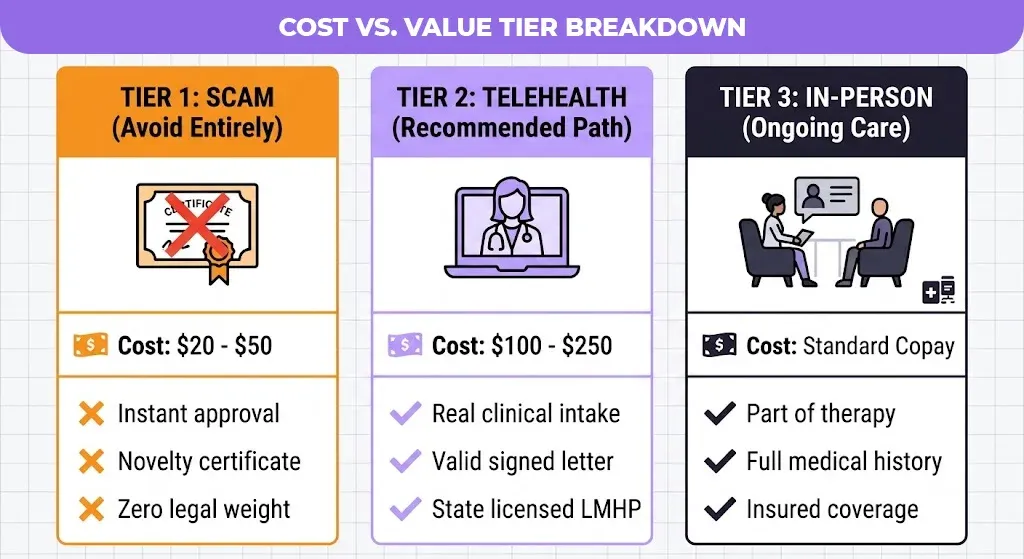
A legitimate ESA evaluation generally costs more than the $29 instant-approval scam sites, because a clinical evaluation takes real clinician time. Expect a real telehealth ESA letter to run somewhere between $100 and $250 depending on the provider and whether it includes a follow-up visit.
| Service Type | Typical Cost | What You Actually Get |
|---|---|---|
| Scam “instant approval” site | $20–$40 | A worthless PDF with no legal standing |
| Legitimate telehealth ESA evaluation | $100–$250 | Real clinical evaluation and a valid signed letter |
| In-person therapist evaluation | Varies by provider, often covered partly by insurance | A valid letter as part of ongoing care |
| “ESA registration,” certificate, or ID kit | $50–$150 | A novelty item with no legal function |
If a price feels too low for what should be a real clinical evaluation, that’s usually because it is.
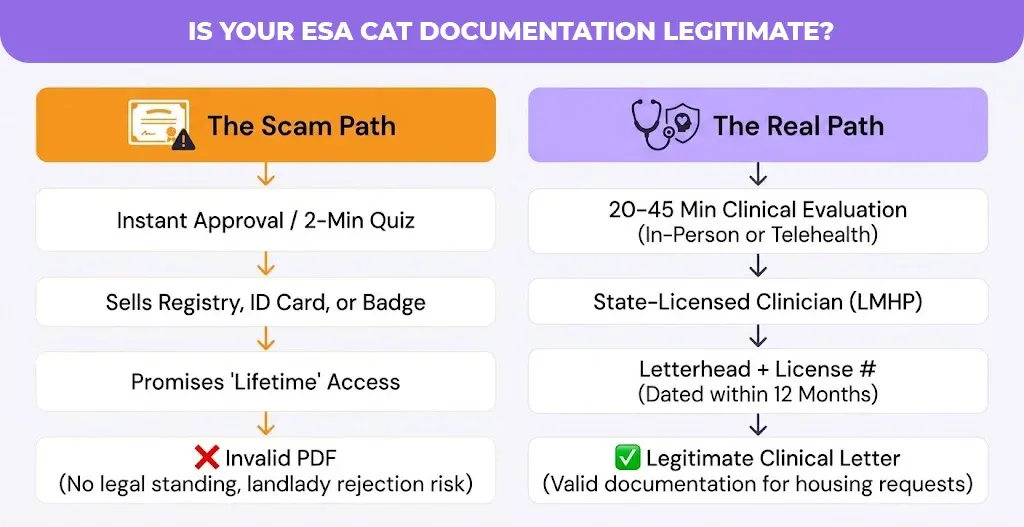
The clearest sign of a fake ESA letter site is instant approval without any evaluation, since a licensed clinician cannot legally assess whether you have a qualifying condition in the time it takes to submit a form. A handful of other red flags show up together on most scam sites.
Warning signs to watch for:
Instant or same-day “guaranteed approval” with no consultation
No license number, or a license listed in a state where you don’t live
The site sells “registration,” a certificate, or an ID card as the main product
Marketing language like “lifetime approval” (real letters expire and need renewal, usually annually)
No way to verify the clinician on your state licensing board’s website
Countdown timers or urgency pressure to buy before checking anything
If you can’t look up the clinician’s license on your state’s board website, treat the letter as worthless, regardless of how professional the site looks.
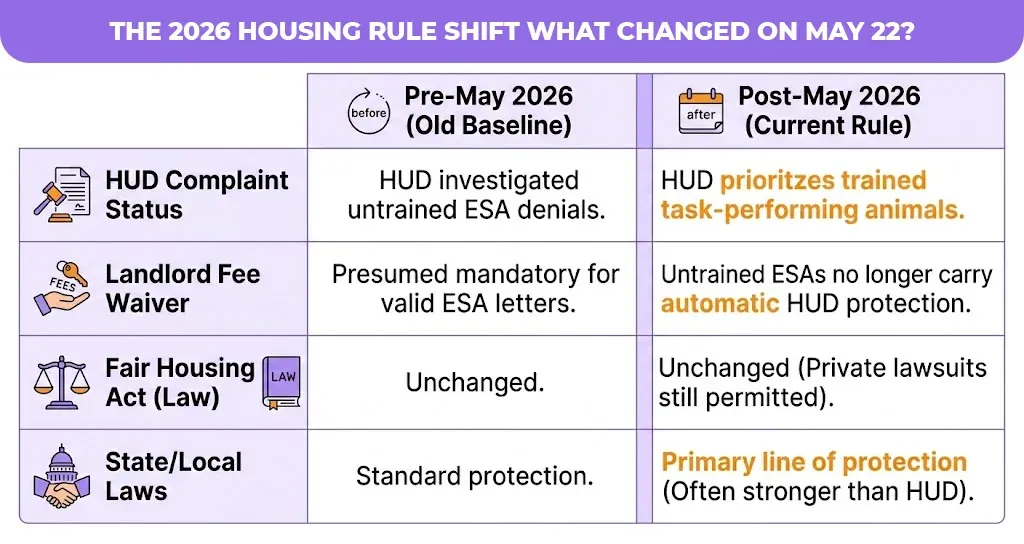
On May 22, 2026, HUD’s Office of Fair Housing and Equal Opportunity permanently rescinded its 2020 guidance on emotional support animals and will now generally only pursue housing discrimination complaints involving animals trained to perform a specific disability-related task, the same standard used under the ADA. This is a major shift most articles on this topic haven’t updated for yet.
Here’s what that actually means in plain terms. Before this change, a landlord who received a real ESA letter was expected to waive no-pet policies and pet fees for an ESA, and HUD would investigate if they didn’t. Under the new enforcement posture described by law firms including Holland & Knight and Duane Morris, HUD will no longer treat a landlord’s denial of an untrained ESA, including a cat, as presumptively a fair housing violation.
What this doesn’t change: the Fair Housing Act itself was not amended, and the underlying “reasonable accommodation” language still exists in the statute. Tenants can still file a private lawsuit in court within two years of a denial, separate from a HUD complaint. State and local fair housing laws are also unaffected, and some states provide stronger ESA protections than the new federal posture.
A landlord can ask for a letter from a licensed healthcare provider confirming a disability-related need, but cannot require a specific form, ask for your diagnosis, or demand proof of registration or training. If your disability is already obvious or known, a landlord isn’t allowed to ask for documentation at all.
Landlords also cannot charge a pet deposit specifically labeled for an ESA the way they might for a pet, though after the May 2026 change, they have more room to apply standard pet policies to untrained ESAs than before. Always check your specific state’s fair housing law, since several states still require broader accommodation than the new federal enforcement standard.
Yes, a growing number of states have made it a criminal offense to intentionally misrepresent a pet as a service animal or claim disability-related protections that you are not entitled to, generally as a misdemeanor with fines between $100 and $500. A couple of states escalate repeat violations to a felony.
This applies most directly to falsely claiming a pet is a trained service animal in a public place, since that carries the strongest legal protections. Misusing a fake ESA letter to avoid a landlord’s pet policy carries less criminal exposure in most states, but it can still cost you the letter’s credibility, the housing opportunity, and in some cases civil liability for fraud.
Confirm your letter is from a licensed clinician in your state
Verify the clinician’s license on your state board’s website
Check that the letter is dated within the last 12 months
Review your state and local fair housing laws, since they may offer more protection than the current federal posture
Keep a copy of the letter and any correspondence with your landlord in writing
Sorting out what actually protects you and your cat can be confusing, especially with the rules shifting this year. If you want help understanding where you stand under your state’s specific housing laws, reach out through PetESALetter’s contact page, and we’ll walk you through it honestly, without trying to sell you a certificate you don’t need.
No breed is required, and no breed is disqualified. An ESA is defined by your disability-related need, not by pedigree — a shelter cat qualifies exactly as readily as a pedigree one. Temperament is still worth thinking about, because a calmer cat is easier to live with day to day.
Pick for the individual animal’s temperament over the label on the breed. Your clinician is documenting your need, not assessing your cat.
People search for “how to get a therapy cat” when they mean an emotional support cat. The two are legally distinct, and the difference decides which rules apply to you.
If your goal is to live with your cat, you want the ESA letter route below, not a therapy-animal programme.
Ready to make it official for your cat? A licensed clinician evaluates your need and issues documentation that works for housing — no cat registry required.
No — but keep in mind there is no official government ESA registration at all. To qualify, you need a valid ESA letter from a licensed mental health professional confirming that your cat provides emotional support related to a mental health condition.
You can prove your cat is an emotional support animal by providing a valid ESA letter from a licensed mental health professional. The letter should include the provider’s license details, the date, and confirmation that the animal supports your emotional well-being.
To qualify for an ESA cat, you must have a mental or emotional health condition that affects your daily life and receive an evaluation from a licensed mental health professional. If approved, the professional can provide an ESA letter for your cat.
The 3-3-3 rule explains how cats usually adjust to a new home. It means that the first 3 days are for settling in, 3 weeks for learning routines, and around 3 months for fully feeling comfortable and becoming part of the family.

Licensed Psychotherapist
Darren is a leading expert in mental health advocacy and assistance animal documentation. He specializes in streamlining the process for obtaining ESA Letters, PSD Letters, and State-specific ESA compliance.

ESA Letters Issued

Successful Consultations

Licensed Therapist Network

Client Satisfaction Rate




Petesaletter.com helps you get your emotional support animal letter online with guidance and support.

Got Questions? Call us 24/7
Copyright © 2020-2026 Petesaletter All rights reserved. Terms | Privacy | Refund
Owned and Operated by Verimedix LLC