
Last Updated on: November 2, 2026
Reviewed by Darren Rafel, LCSW
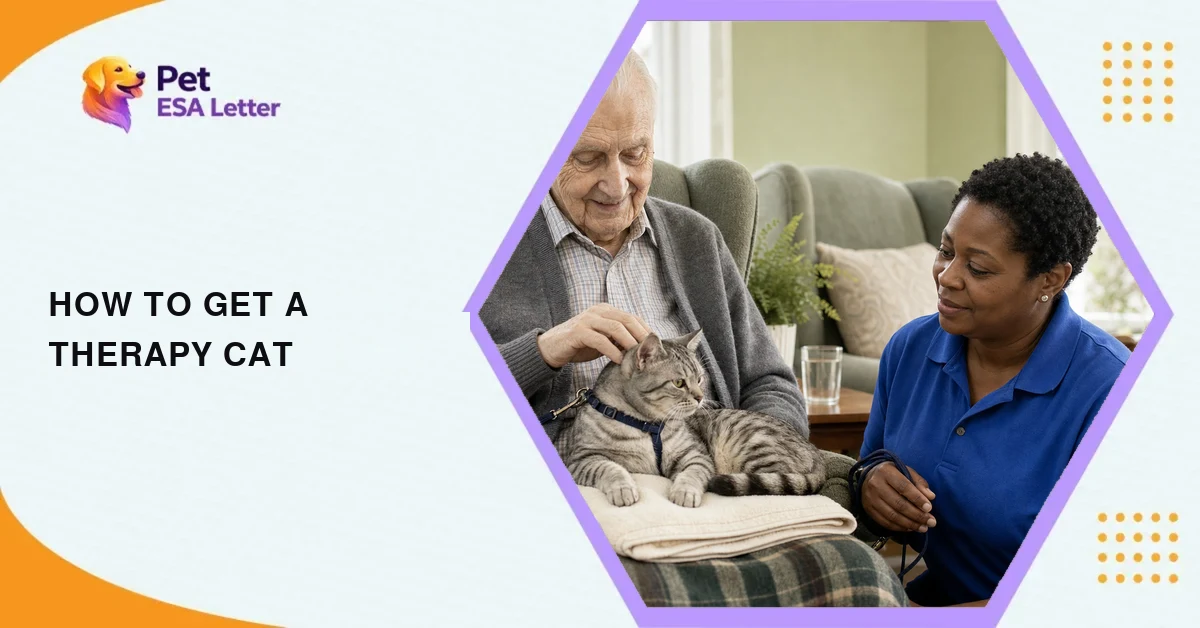
To get a therapy cat, you and your own cat are evaluated and registered as a therapy animal team by Pet Partners or Love on a Leash: the cat must be at least a year old and pass a vet screening and a temperament test, and you take a handler course — $95 at Pet Partners, $100 at Love on a Leash. A cat that eases your own anxiety at home is an emotional support cat and needs an ESA letter.
Key takeaways
A therapy cat is a pet cat that its owner takes, on a harness and leash, to visit people who are not its owner: residents of a care home, patients on a hospital ward, children at a reading program, students at a campus stress-relief event. The owner is the handler and a volunteer. The cat is screened for temperament and health by a private therapy-animal program, which registers the pair as a “team” and insures the visits. Pet Partners, which registers nine species, describes itself as “one of the only therapy animal organizations that offers therapy animal team registration to cats and their human handlers.” Love on a Leash is the other national program with a cat application packet.
An emotional support cat is the opposite arrangement. It helps one person — its owner — with a mental or emotional disability, simply by being there, and it does so at home. Nobody tests the cat. What is evaluated is the person: a licensed mental health professional decides whether that person has a disability and whether the animal eases it, and documents the finding in an ESA letter. That letter is what a housing provider looks at when a renter with a no-pet lease asks to keep the cat. The What Is an Emotional Support Animal guide covers the definition in full; the emotional support cat page covers cats specifically.
The confusion is built into the language. “Therapy” sounds like treatment, so “therapy cat for anxiety” reads as a cat prescribed for your anxiety. In the vocabulary the programs, HUD and the courts use, a therapy animal is the volunteer-visit animal and an assistance animal or emotional support animal is the one that lives with the person it helps. Google’s own AI Overview for this search now ends by asking which of the two you mean. This page answers both, in that order.
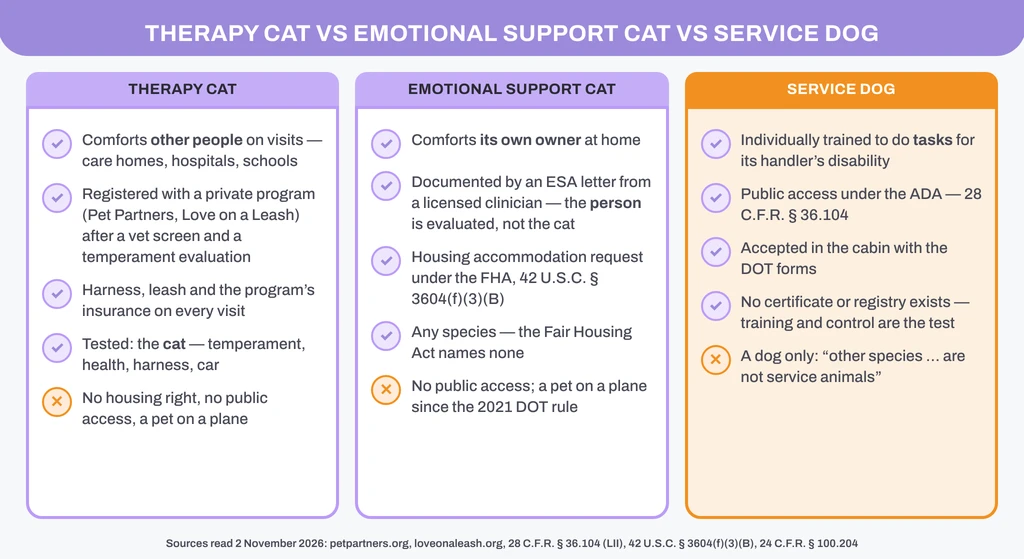
A third category sits beside them and is the only one with public-access rights. A service animal, under the ADA regulation at 28 C.F.R. § 36.104, is “any dog that is individually trained to do work or perform tasks for the benefit of an individual with a disability.” The same sentence rules the other two out: “Other species of animals, whether wild or domestic, trained or untrained, are not service animals,” and “the provision of emotional support, well-being, comfort, or companionship do not constitute work or tasks.” A cat cannot be a service animal under that definition however well it is trained, which is why the service dog vs therapy dog vs ESA guide treats the three as separate legal objects rather than three grades of the same thing.
Breed matters less than the programs’ temperament language, which is specific. Pet Partners requires an animal that will “welcome, not merely tolerate, interactions with strangers,” with “no history of aggression or causing serious injury to other people or pets,” reliably house-trained and comfortable in the program’s equipment. Love on a Leash puts it in a sentence every cat owner can test at home: a cat that “looks as if he’s only tolerating being petted” will not work out. The cat has to seek out the stranger’s hand, not endure it.
The practical checklist, drawn from both programs’ requirements pages, looks like this for a cat:
Pet Partners’ 2023 study of its own cat teams, run with the company Cat Person, found that many of the therapy cats were mature rescue cats, that 82% of handlers said the volunteering improved their bond with their cat, and that every interview participant said more cat teams are needed to meet the requests facilities make — partly because, as one facility put it, cats give “patients who are afraid of dogs” a way to take part. A calm nine-year-old shelter tabby is a stronger candidate than a kitten of any pedigree.
There is no exam you can sit online and no licence a state issues. “Therapy cat certification” means membership of a program that has evaluated you and your cat as a team, and the two cat-accepting national programs run the process differently. Pet Partners, step by step from its own guide:
Love on a Leash runs on supervised visits instead of a single evaluation: the cat is evaluated by a veterinarian using the program’s cat packet, then the team completes ten in-training visit hours — no more than an hour a day, at least five of the visits supervised by the same certified member, the last one included — and submits the application within a year of the evaluation. Processing takes up to four weeks. The 2026 fee schedule (effective January 1, 2026) is $100 for a new team including insurance and $50 a year to renew.
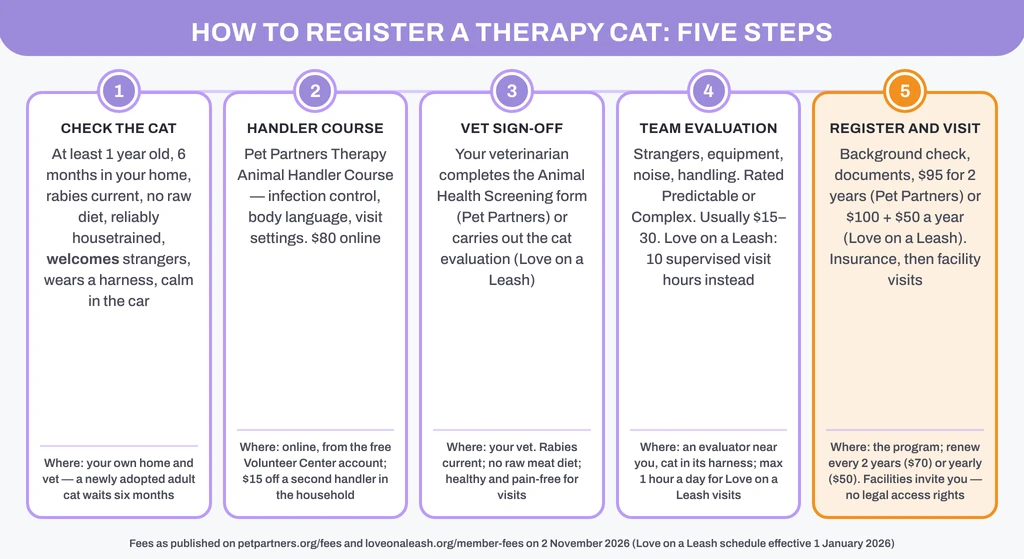
Three things neither program will do. Neither certifies a cat to go to work with you: Love on a Leash states that its certification and insurance “does not extend to our members’ places of employment during work hours” and tells teachers, counsellors and therapists who want a cat in the office that it is “not the right fit.” Neither registers a cat for its owner’s benefit — if the application reads “I need my cat for my anxiety,” it is the wrong application, and the section after next explains the right one. And neither lets you skip the evaluation by paying: the websites selling a “therapy cat certificate” with no evaluator, no vet form and no supervised visit are selling a PDF, and a facility that asks for proof of registration and insurance will not accept it.
| Requirement | Pet Partners | Love on a Leash |
|---|---|---|
| Cat’s minimum age | 1 year at the evaluation | 1 year before the evaluation |
| Time in your home | 6 months | Not stated |
| Health screening | Vet completes the Animal Health Screening form; rabies current; no raw meat diet | Vet carries out the cat evaluation (cat application packet) |
| Handler training | Therapy Animal Handler Course, $80 online | Not a separate course; learning happens on supervised visits |
| Evaluation | Team evaluation by a licensed evaluator, usually $15–30; rated Predictable or Complex | Vet evaluation, then 10 in-training visit hours (max 1 hour a day), 5+ supervised by the same certified member |
| Fee to register (2026) | $95 new team, covers 2 years; renewal $70; $50 discounted rate for 55+, under-18, military and people with a disability | $100 new team incl. insurance; $50 annual renewal; $80 to add a pet |
| Background check | Included in the fee, US handlers 18+ | Not stated on the fee page |
| On the visit | Program equipment; visits matched to the team’s rating | Harness on a 4-foot leash the whole time; stroller allowed; must tolerate dogs |
| Legal access rights | None — facility invitation only | None — facility invitation only; not for your own workplace |
Figures read on petpartners.org (Requirements, Fees, “How to Volunteer With Your Pet”) and loveonaleash.org (Become a Member, Memberships & Fees, Therapy Cats & Rabbits) on November 2, 2026. Both programs change their fee pages; check the current page before you post an application.
No, and this is the sentence that separates a therapy cat from the other two categories. A therapy animal registration is a private membership. It carries the program’s insurance and its code of conduct, and it opens the doors of facilities that have invited the program in. It creates no right to enter any other building, no right to keep the cat in a no-pet apartment, and no right to fly with it in the cabin.
Housing is where the mix-up does real damage. The Fair Housing Act requires a housing provider to make “reasonable accommodations in rules, policies, practices, or services, when such accommodations may be necessary to afford such person equal opportunity to use and enjoy a dwelling” (42 U.S.C. § 3604(f)(3)(B); 24 C.F.R. § 100.204). The person has to have a disability and the animal has to be necessary to that person’s use of the home. A therapy cat registration says nothing about its owner’s health; it says the cat is friendly with strangers. Sending a landlord a therapy-animal registration in reply to a no-pet clause is sending the wrong document. The ESA letter for housing guide lists what the right one contains, and the ESA letter to landlord guide covers how a housing provider may respond — including that the statute obliges a landlord to consider a reasonable accommodation, not to grant every request.
Stores, restaurants and public buildings follow the ADA, and under 28 C.F.R. § 36.104 the only service animal is a dog individually trained to do work or tasks. A therapy cat, an emotional support cat and a pet cat stand in exactly the same place at a shop door: welcome if the shop allows cats, not otherwise. Flights follow the Department of Transportation’s rule, under which, since January 11, 2021, an airline may treat an emotional support animal as a pet, and the only animals it recognises as service animals are trained service dogs, with the DOT forms; the which airlines allow emotional support animals guide goes through the carriers one by one. A therapy cat is a pet in the cabin everywhere.
| Question | Therapy cat | Emotional support cat | Service dog |
|---|---|---|---|
| Who does it help? | Other people, on visits | Its own owner, at home | Its own handler, everywhere |
| What makes it official? | Registration with a private program (Pet Partners, Love on a Leash) | An ESA letter from a licensed mental health professional about the owner | Individual training to do disability-related tasks; no certificate exists |
| Is the animal tested? | Yes — temperament evaluation and vet screening | No — the person is evaluated | No test, but the dog must be trained and under control |
| Housing with a no-pet lease | No special right | Reasonable-accommodation request under the FHA (42 U.S.C. § 3604(f)(3)(B)) | Reasonable-accommodation request under the FHA |
| Stores, restaurants, offices | No right of entry | No right of entry | Public access under the ADA (28 C.F.R. § 36.104) |
| Airline cabin | As a pet, if the airline carries pets | As a pet since the 2021 DOT rule | Accepted with the DOT service-animal forms (14 C.F.R. Part 382) |
| Species | Cats accepted by two national programs | Any species — the FHA names none | Dogs only under the ADA (miniature horses by separate provision) |
| Renewal | Every 2 years (Pet Partners) or yearly (Love on a Leash) | Letters are written for 12 months | None |
| Can the same cat be this and an ESA? | Yes | Yes | Not a cat |
Then the word you are looking for is emotional support animal, and the process is shorter than registering a therapy cat, because the cat is not the one being assessed. A licensed mental health professional — a psychologist, a clinical social worker, a counsellor or a psychiatrist licensed in your state — evaluates whether you have a mental or emotional disability and whether the cat is connected to it. Anxiety and depression are the two conditions most often behind a request; the ESA for anxiety and ESA for depression guides describe what the clinician looks for in each, and the ESA qualification checklist is the short version. Having a diagnosis is not the test on its own; the clinician has to find that the condition limits daily life and that the animal eases it.
What you do not need: a registration, a certificate, a vest, an ID card or a test for the cat. There is no federal or state ESA registry, and the ESA registration myths page explains who sells “registrations” anyway. A therapy-cat program will not take an application built on your own condition, and a site offering to “certify your cat as a therapy cat for anxiety” in ten minutes is selling you neither thing. The register a cat as an ESA page walks through the real 2026 process from the cat owner’s side — what the letter says, what to send the landlord, and what to expect back.
One practical difference is worth knowing before you choose. A therapy cat has to welcome strangers; an emotional support cat only has to help you. The shy one-person cat that hides from visitors and sleeps on your chest through a bad night is a poor therapy-cat candidate and a perfectly good emotional support animal. Nothing about the ESA evaluation asks the cat to perform.
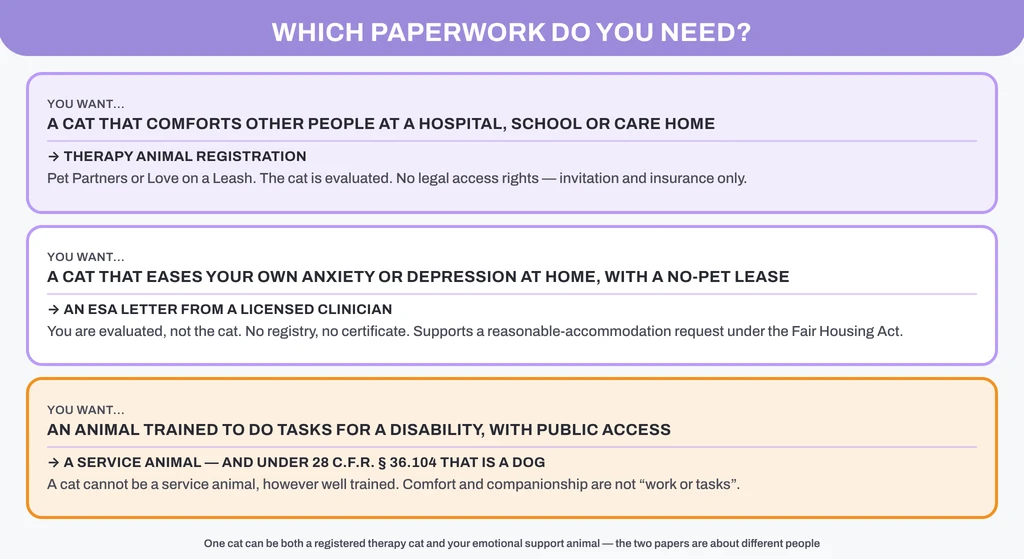
Yes. The two labels attach to different people, so nothing stops one cat carrying both. A registered therapy cat that visits a memory-care unit on Tuesday afternoons can be, for its owner, the emotional support animal named in an ESA letter — provided its owner qualifies on their own account. Neither program asks whether the cat is also its handler’s ESA, and a clinician writing an ESA letter has no reason to care that the cat holds a Pet Partners badge.
Keep the paperwork apart, though, because landlords and facilities read them differently. The housing request goes in with the ESA letter and nothing else: attaching the therapy registration to a lease accommodation request invites the reply that “therapy animals are not assistance animals,” which is true. The facility sees the registration and the insurance certificate and has no business seeing your clinician’s letter. The one place both show up is the college dorm: a student may keep an emotional support cat in campus housing through the school’s accommodation process while the same cat, registered, turns up at the library’s exam-week de-stress event through the campus wellness office.
For an adult, the process takes four steps, and a cat changes none of them.
If the clinician decides you don’t qualify, the refund is requested within 7 days. If a landlord rejects the letter in writing after our support team has been involved, the refund window is 30 days. Both terms are on the refund policy page. The full walkthrough, and the letter itself, is on the ESA letter page.
State rules. The species does not change the ESA letter rules; the state does. Several states add their own rules about who may write an ESA letter and what has to happen first, and a letter that ignores them is easy to challenge — which is why PetESALetter matches each applicant with a clinician licensed in their own state.
| State | What has to be in place before the letter is signed | Who may sign | Statute |
|---|---|---|---|
| California | A client-provider relationship of at least 30 days and a clinical evaluation; license details stated in the letter | A practitioner licensed in California | Cal. Health & Safety Code § 122318 (AB 468, 2021) |
| Louisiana | A therapeutic relationship of at least 30 days, at least two sessions, a disability assessment and a clinical evaluation | A Louisiana-licensed provider | La. R.S. 46:1974 (Act 558 of 2024) |
| Arkansas | A 30-day client-provider relationship and a clinical evaluation, reviewed at least once a year | A provider licensed in the jurisdiction | Ark. Code Ann. § 20-14-1003 (Act 268 of 2023) |
| Montana | A client-provider relationship of at least 30 days and a clinical evaluation; a registry card is not sufficient on its own | A Montana-licensed mental health professional, license details in the letter | Mont. Code Ann. § 70-24-114 (HB 703, 2023; amended 2025) |
| Iowa | A written finding that states whether the provider-patient relationship has lasted at least 30 days; the state’s own form has the signer certify that it has | A licensed physician, PA, nurse, psychologist, social worker or behavioral-science professional, in Iowa or in good standing in another state | Iowa Code § 216.8C (SF 2268, 2024) |
| Florida | Personal knowledge of the disability; no waiting period. An out-of-state practitioner must have provided in-person care at least once | A practitioner acting within the scope of the license | Fla. Stat. § 760.27 (SB 1084, 2020) |
| Colorado | An in-person meeting and a written finding on disability and need; no waiting period | A mental health licensee with sufficient familiarity with the patient | C.R.S. § 12-245-229; HB26-1045 (eff. Aug 12, 2026) |
Everywhere else the federal framework applies on its own. The California ESA letter and Louisiana ESA letter pages go through the two strictest states in detail, the Florida ESA letter page covers a state with its own statute and no waiting period, and the state pages linked in the navigation cover the rest. Therapy-cat registration, by contrast, has no state layer at all: the same Pet Partners or Love on a Leash process applies in every state.
The red flags are the same whichever paper you are after. A “therapy cat certificate” issued online with no evaluator, no vet form and no supervised visit — the programs that facilities recognise do not work that way. A letter in minutes — “instant approval” means nobody evaluated anyone, and the how to verify an ESA letter is real guide lists what a genuine one contains. A registration number, certificate or ID card for an emotional support cat — there is no registry. And a promise that the landlord “must” accept the letter — the statute obliges a housing provider to consider a reasonable accommodation, not to grant every request.
The bottom line. To get a therapy cat, you and your own calm, stranger-loving, harness-trained cat are registered as a team by Pet Partners ($95, two years) or Love on a Leash ($100, ten supervised hours), and the two of you visit people who need cheering up; the registration gives you insurance and invitations, not legal rights. To get a cat that helps with your own anxiety or depression at home, you need no registration at all — you need a licensed clinician to evaluate you and write an ESA letter, which is what the Fair Housing Act recognises. One cat can hold both roles. PetESALetter evaluates adults, with a clinician licensed in their state, for $99 flat and a full refund if the clinician finds no qualifying need.
Looking for a cat that helps with your own anxiety or depression — not one to take on visits? That is an emotional support animal, and a licensed clinician in your state evaluates whether one fits your situation — the first step is a free five-minute screen.
Yes, with a private therapy-animal program that accepts cats. Pet Partners registers cats that are at least one year old, have lived with you for six months, are rabies-vaccinated and not on a raw diet, pass a vet health screening and a team evaluation, after you take its $80 handler course; the new-team registration fee is $95 for two years. Love on a Leash evaluates the cat through a veterinarian, then requires ten supervised in-training visit hours; a new team is $100 with $50 annual renewal. There is no government licence for a therapy cat, and the registration gives no legal access rights.
It can. The test is not the diagnosis but whether a licensed mental health professional finds that the anxiety limits your daily life and that the animal eases it. If so, the clinician writes an ESA letter, which is the document a housing provider considers under the Fair Housing Act. PetESALetter matches adults with a clinician licensed in their state; in most states a qualifying letter follows within 24–48 hours, and if the clinician finds you don’t qualify, you get a full refund. A therapy-cat registration is not the right document for your own anxiety.
Under the ADA regulation at 28 C.F.R. § 36.104, every animal except a dog: “Other species of animals, whether wild or domestic, trained or untrained, are not service animals.” A separate provision covers miniature horses. So a cat cannot be a service animal however it is trained, and the regulation also says that providing “emotional support, well-being, comfort, or companionship” is not a task. A cat can be a registered therapy animal or an emotional support animal, neither of which has public-access rights.
Not as a product: a therapy cat is your own pet, registered after it passes a program’s evaluation, so what you pay is the program’s fees — $80 for the Pet Partners course plus $15–30 for the evaluation and $95 to register, or $100 to join Love on a Leash. If the search means a cat that helps with your own mental health, shelters often reduce or waive adoption fees, and what makes it an emotional support animal is an ESA letter from a licensed clinician, which the eligibility quiz checks for free before anyone pays.
The handler course can be online — Pet Partners’ Therapy Animal Handler Course is an $80 online class — but no legitimate program certifies the cat online. Both cat-accepting national programs require a veterinarian’s screening and an in-person evaluation of the cat (Pet Partners) or supervised in-person visits (Love on a Leash). A website offering a “therapy cat certificate” with no evaluator and no vet form is selling a PDF that facilities do not recognise. The same is true of online “ESA registrations”: an emotional support animal is documented by a clinician’s letter, not a certificate.
For an emotional support cat, the breed is beside the point: the clinician evaluates you, not the cat, and the cat that already calms you is the right one whatever it is. For a therapy cat, the programs choose on temperament rather than breed — a cat that welcomes strangers, walks in a harness and stays calm in a car — and Pet Partners’ 2023 study noted that many of its therapy cats were mature rescue cats. The emotional support cat guide covers what to expect from a cat in a rental; the breed lists online are a starting point, not a requirement.

Licensed Clinical Social Worker
Darren is a leading expert in mental health advocacy and assistance animal documentation. He specializes in streamlining the process for obtaining ESA Letters, PSD Letters, and State-specific ESA compliance.

ESA Letters Issued

Successful Consultations

Licensed Therapist Network

Client Satisfaction Rate




Petesaletter.com helps you get your emotional support animal letter online with guidance and support.

Got Questions? Call us 24/7
Copyright © 2020-2026 Petesaletter All rights reserved. Terms | Privacy | Refund
Owned and Operated by Verimedix LLC