
Last Updated on: August 14, 2026
Reviewed by Darren Andrew Rafel

The landlord said no. Or they said yes but added a $500 pet deposit. Or they told you your dog’s breed is not allowed. If you have a legitimate ESA letter, every one of those responses is likely a violation of federal housing law.
But 2026 changed the enforcement picture, and a lot of tenants do not know which parts of the law still protect them and which parts got harder to enforce. This guide gives you the full, honest answer.
Under the Fair Housing Act (42 U.S.C. § 3604), tenants with a qualifying disability have the right to request a reasonable accommodation to live with an emotional support animal, even in housing that does not allow pets.
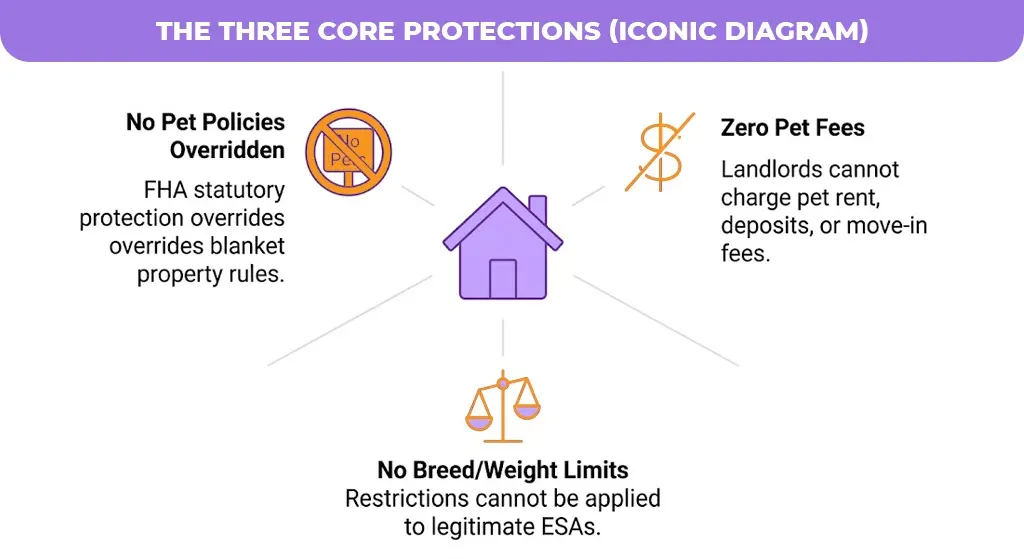
Three protections are core. First, landlords must allow your ESA. A blanket no-pets policy does not override the Fair Housing Act. Second, landlords cannot charge you pet deposits, pet rent, or move-in pet fees for an ESA. These animals are not classified as pets under federal law. Third, landlords cannot apply breed or weight restrictions to an ESA. If your dog is a Rottweiler and your letter is legitimate, the breed restriction does not apply.
These protections are not HUD guidance. They are statutory, written directly into federal law by Congress. That matters in 2026, as explained below.
On May 22, 2026, HUD issued an internal enforcement guidance memo canceling its prior 2020 ESA guidance. The memo instructs HUD investigators to stop pursuing fair housing complaints on behalf of ESA owners whose animals are not individually trained to perform disability-related tasks.
The Fair Housing Act itself has not changed. Congress did not act, and no court has ruled that ESAs are excluded from housing protections. HUD has simply decided to step back from enforcing these complaints for people who use untrained ESAs.
What this means in practice: if your landlord denies your ESA accommodation and you file a complaint with HUD, federal investigators are less likely to pursue it unless your animal is task-trained. HUD now applies the ADA’s trained-task standard when evaluating whether to take a case.
What this does not mean: your ESA letter is not invalid. The FHA is not repealed. Blanket denial of an ESA request is still disability discrimination under federal law. You still have the right to pursue a private lawsuit in federal court, which is often more effective than a HUD complaint anyway. And most importantly, state fair housing laws across most of the country are completely unaffected.
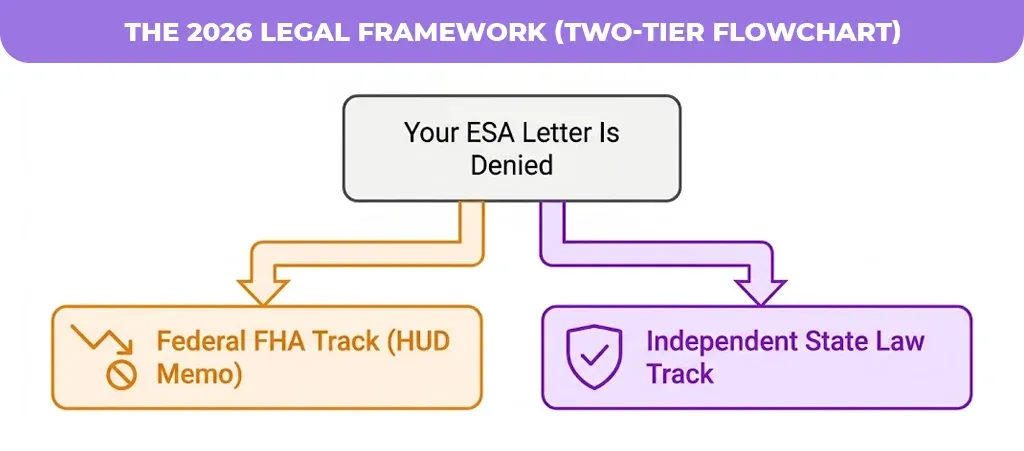
Most tenants are better protected than the May 2026 headlines suggested, because most states have their own independent ESA housing laws.
State laws are unaffected. California, New York, Florida, Illinois, Massachusetts, and many other states have independent fair housing protections that do not depend on what HUD does.
Here is what the landscape looks like in specific states:
| State | State Law Protection | Additional Requirements for Letters |
|---|---|---|
| California | FEHA (Gov’t Code § 12955) — strong independent protection | 30-day clinical relationship required (Health & Safety Code § 122318) |
| New York | Human Rights Law — independent protection | Standard LMHP letter; no 30-day rule |
| Florida | HB 969 — independent protection | No online-only providers; one appointment required (Fla. Stat. § 760.27) |
| New Jersey | Independent state fair housing law | LMHP letter; specific pet behavior rules may apply |
| Pennsylvania | PA Human Relations Act | Standard LMHP letter |
| Nebraska | FHA only (no state-specific ESA law) | Standard LMHP letter; landlords have more room to challenge post-HUD memo |
| Colorado | CRS § 12-245-229 — independent protection | Provider must have met patient and be licensed in CO |
| Iowa | Iowa Code § 216.8C | 30-day relationship with treating provider |
| Montana | MCA 70-24-114 | 30-day relationship required |
| Arkansas | Act 268 | Must come from established treating provider |
If you live in a state with its own ESA protection law, your housing rights operate independently of what HUD does at the federal level. Your state’s fair housing agency or civil rights office is your enforcement avenue, not HUD.
If you live in a state like Nebraska that relies primarily on the federal FHA, a landlord now has more legal room to challenge your accommodation request. In that situation, a task-trained psychiatric service dog provides stronger and more portable protection.
The FHA covers almost all residential housing. Knowing the exceptions matters, because landlords sometimes incorrectly claim they are exempt.
Covered:
Apartment complexes
Condominiums and co-ops
HOA-governed communities
College dormitories at institutions receiving federal funding
Most single-family rentals, when the landlord owns more than four units or uses a real estate agent
Long-term Airbnb rentals (30 or more days, when operated as a regular rental business)
Not covered:
Owner-occupied buildings with four or fewer units where the owner lives on-site (the “Mrs. Murphy” exemption)
Buildings used exclusively by religious organizations
Private clubs that restrict residency to members
Most landlords who claim exemption under the four-unit rule do not actually qualify, because they use a real estate agent, advertise through commercial listing services, or own additional rental properties. If a landlord claims this exemption, ask specifically whether all the conditions are met.
This is where most landlord violations happen. Knowing the lines clearly helps you respond correctly rather than escalating unnecessarily.
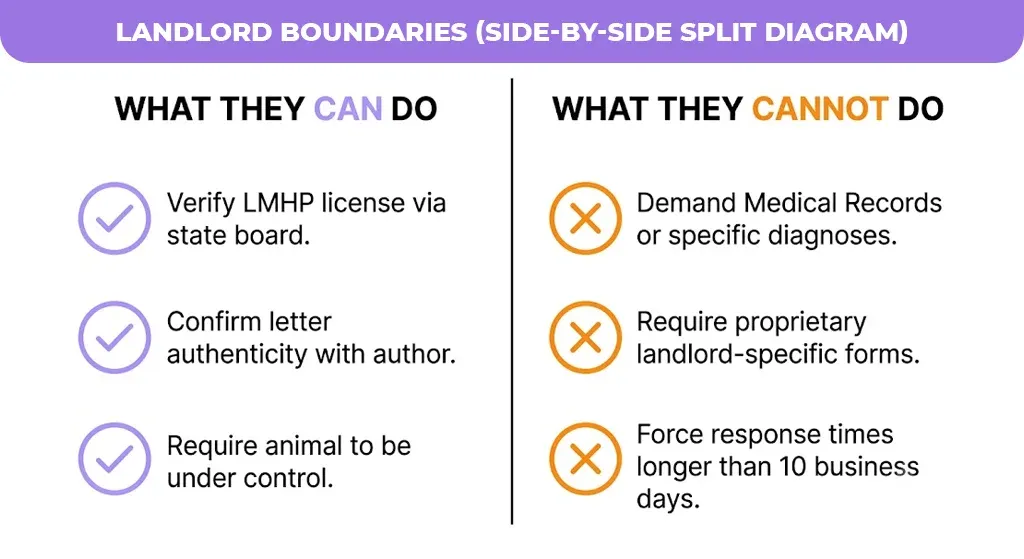
| Landlords CAN Legally Do | Landlords CANNOT Legally Do |
|---|---|
| Ask for an ESA letter from a licensed mental health professional | Require a specific form or proprietary template from the clinician |
| Verify the clinician’s license through the state licensing board | Ask for your medical records, diagnosis, or treatment history |
| Contact the clinician to confirm they authored the letter | Require the clinician to make sworn or notarized statements |
| Deny an ESA that poses a documented, objective safety threat | Enforce breed, weight, or size restrictions against an ESA |
| Charge for actual property damage caused by the animal | Charge pet deposits, pet rent, or move-in pet fees |
| Request a response timeframe for the accommodation | Take longer than 10 business days to respond without explanation |
| Require the animal to be housebroken and under control | Deny an ESA based solely on a no-pets policy |
One thing many landlords do that crosses the line: requiring the tenant to use a specific landlord-provided form that the clinician must sign. HUD made clear in its 2020 guidance that landlords cannot require a specific form if the tenant already has a valid LMHP letter. That guidance has been rescinded, but the statutory prohibition on disability discrimination remains. Requiring an inaccessible documentation format to block an accommodation request is still housing discrimination.
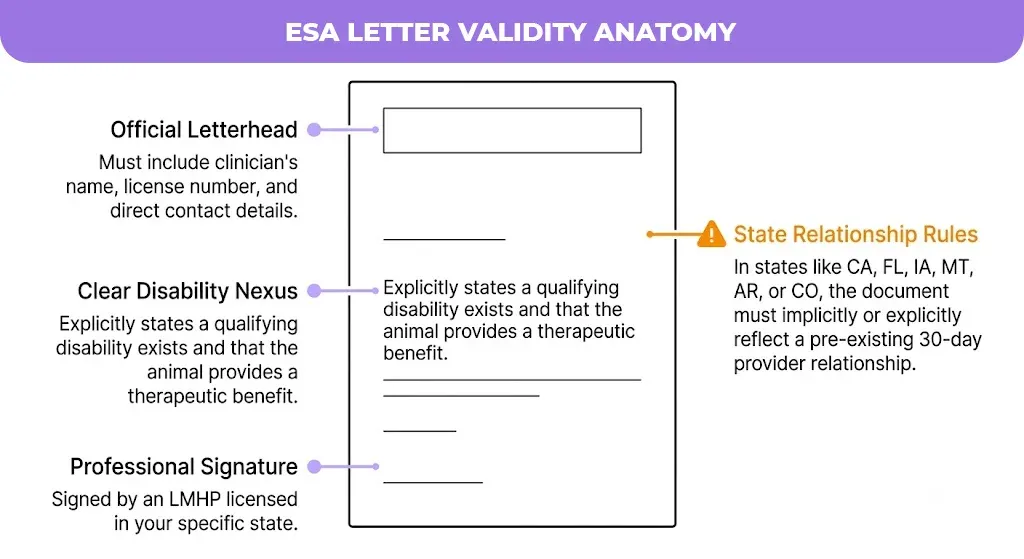
A valid ESA letter for housing must meet the following requirements. Any letter missing these elements can be legally challenged by a landlord.
Written on the provider’s professional letterhead
Signed by a licensed mental health professional — a therapist, psychologist, psychiatrist, licensed clinical social worker, or equivalent — who is licensed in your state
Includes the clinician’s full name, license number, and direct contact information
Confirms that you have a qualifying disability
States that an emotional support animal provides therapeutic benefit related to your disability
What the letter does not need to include: your specific diagnosis, your treatment plan, your therapy history, or any medical records. Landlords cannot require that information. Asking for it may itself be a fair housing violation.
In states with additional requirements, the letter must also reflect the mandated clinical process. In California, Montana, Iowa, Louisiana, and Arkansas, that means an established provider relationship (generally 30 days); in Florida, at least one real in-person or telehealth appointment; in Colorado, a clinician who has actually met you and is licensed in the state. A letter from a provider who processed you through an online questionnaire without a live appointment may not satisfy these state standards.
A landlord can deny an ESA accommodation in only a narrow set of situations. These exceptions are taken seriously because HUD used to investigate them strictly, and private courts still apply them.
Direct threat to health or safety. The animal must pose an actual, objective risk that cannot be reduced to an acceptable level through conditions or restrictions. A general fear of dogs is not a direct threat. A documented history of unprovoked aggression toward people is a different situation and must be evaluated individually.
Fundamental alteration of the nature of the housing. This exception applies almost never in residential housing. It exists mainly for situations where allowing the animal would change the core character of the property, such as a working farm with livestock-adjacent housing.
Undue financial or administrative burden. Also rare. A large apartment complex claiming this exception would need to show significant documented hardship, not just inconvenience.
No valid documentation submitted. A landlord can withhold accommodation until proper documentation is provided. If you have not submitted a valid LMHP letter, the landlord’s hands are not tied yet.
What a landlord cannot do: deny your request because your dog is a breed the building’s insurance policy excludes. Insurance policy breed exclusions do not override the Fair Housing Act. This is one of the most common illegal denials in 2026.
If your landlord denies a properly submitted ESA accommodation, you have options. Document everything first. Save every email, text, and letter. Note the date you submitted your documentation and the date of the denial.
Contact your state’s fair housing agency or civil rights office. Most states with independent ESA laws have active enforcement. California, New York, Florida, New Jersey, and Colorado all have state agencies that handle housing discrimination complaints separately from HUD.
File a complaint with HUD only if your state does not have independent protection. After the May 2026 guidance change, HUD is less likely to act on untrained ESA complaints, but the complaint creates a record and may still prompt landlord compliance.
Contact the National Fair Housing Alliance for referrals to local fair housing organizations that can provide legal support at no cost. Private attorneys who handle disability discrimination cases can also work on contingency.
Before submitting your accommodation request, confirm each of these:
Your ESA letter comes from a licensed mental health professional licensed in your state
The letter includes the clinician’s license number and contact information
The letter states your disability and the therapeutic benefit of your animal
Your state’s specific requirements are met (30-day relationship in CA, MT, IA, LA, AR; one real appointment in FL; clinician has met you in CO)
You are submitting a written accommodation request, not just handing over the letter verbally
You have saved a copy of the letter and your submission for your records
You know your state’s fair housing agency contact information if needed
Need documentation your landlord will actually accept? Establish a compliant clinical connection before you submit your accommodation request, not after it gets denied.
No, landlords usually cannot evict tenants for having a valid ESA. However, eviction can occur for lease violations, property damage, threats, or other disruptive behavior.
Yes, landlords in Indiana can deny an ESA request if the tenant does not qualify, lacks valid documentation, or the animal creates a legitimate safety risk.
Yes, landlords may verify ESA letters by checking provider credentials and documentation. They cannot usually demand private medical records or diagnosis details.
Yes, Missouri landlords may deny ESA requests in certain situations, such as invalid documentation, unreasonable accommodation, or safety concerns.

Licensed Psychotherapist
Darren is a leading expert in mental health advocacy and assistance animal documentation. He specializes in streamlining the process for obtaining ESA Letters, PSD Letters, and State-specific ESA compliance.

ESA Letters Issued

Successful Consultations

Licensed Therapist Network

Client Satisfaction Rate




Petesaletter.com helps you get your emotional support animal letter online with guidance and support.

Got Questions? Call us 24/7
Copyright © 2020-2026 Petesaletter All rights reserved. Terms | Privacy | Refund
Owned and Operated by Verimedix LLC