


Live Comfortably With Your ESA — A Valid ESA Letter in Massachusetts Makes It Official
Massachusetts residents with a qualifying mental or emotional health condition have the right to live with their emotional support animal, even in buildings that restrict pets, when they have proper documentation.






ESA LETTER MASSACHUSETTS
ESA Letter Massachusetts — What the Document Actually Is
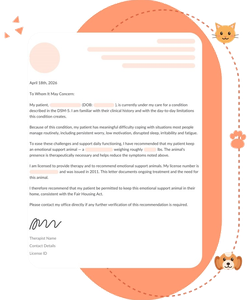
An ESA letter in Massachusetts is a clinical document signed by a licensed mental health professional confirming that you have a qualifying condition and that your emotional support animal provides therapeutic support. It is not a certificate or registration.
A valid ESA letter gives you housing protection under the Fair Housing Act and requires a landlord to consider your accommodation request.
A compliant Massachusetts ESA letter includes the provider’s name, license details, and a clear statement of need. A letter lacking these details cannot protect your housing rights.

Getting Your Letter Is Simpler Than You Think
Four clear steps take you from intake to a compliant, ready-to-submit letter. Start and finish from home like no clinic visits, no referrals, no months-long wait times.

Start the Form
Complete a short intake questionnaire covering your mental health history, current challenges, and the role your animal plays in supporting you daily.

Connect With a Provider
Get matched with a licensed mental health professional authorized to conduct ESA evaluations and issue documentation in Massachusetts.

Clinical Consultation
Your assigned provider reviews your case through a genuine clinical conversation, not a quick approval button. Your eligibility is assessed based on real professional judgment.

Receive Your Letter
If you qualify, your signed letter sent digitally and it is immediately ready to submit to your landlord, your property manager or the housing association.
See If You Qualify Before You Spend a Minute Worrying
Most people living with a diagnosed mental or emotional health condition meet the basic eligibility threshold for an ESA letter in Massachusetts.
You do not need to currently own an animal to qualify.
Common conditions that may qualify include:
Massachusetts ESA Laws Every Resident Should Know
Massachusetts follows federal Fair Housing Act protections and does not maintain its own separate state ESA certification system. That means federal standards set the baseline but understanding how those rules apply locally helps you navigate housing conversations with confidence.
No Registry Exists
Massachusetts has no official ESA registry. Any website selling ESA registration, certificates, or official-looking ID cards has no legal standing — only a clinician's letter matters.
Licensed Providers Only
Under Massachusetts ESA letter requirements, only a licensed mental health professional — a psychologist, licensed clinical social worker, psychiatrist, or licensed mental health counselor — is qualified to issue a valid ESA letter.
What Your Letter Needs
A proper Massachusetts ESA letter must include the LMHP's license number, license type, state of licensure, and a written statement linking your condition to your therapeutic need for an ESA. Anything less is incomplete.
Your Landlord Must Engage
When you submit a valid Massachusetts ESA housing letter, your landlord is required by federal law to participate in an interactive review process. A flat refusal without engagement violates the Fair Housing Act.
No Public Access Rights
An emotional support animal in Massachusetts does not have the right to enter restaurants, stores, or other public spaces under the ADA. ESA protections apply to housing — and that boundary matters.
Fair Housing Act Protections for Massachusetts ESA Owners
The Fair Housing Act is your primary legal shield as an ESA owner in Massachusetts. Under the FHA, housing providers must make reasonable accommodations for tenants with disabilities and that includes allowing an emotional support animal regardless of a property's no-pet policy.
Cannot Charge Pet Fees
A landlord may not charge you a pet deposit, monthly pet fee, or any additional rent for an emotional support animal. ESAs are not pets under fair housing law.
Must Review Your Request
When you submit a valid Massachusetts ESA housing letter, the landlord is legally required to consider and respond to your request in good faith. Silence or outright dismissal is not a valid response.
Cannot Demand Medical Records
Your housing provider can ask for documentation of your disability-related need for an ESA, but they cannot demand your full psychiatric history, diagnosis records, or therapy notes.
Protections Apply Broadly
FHA coverage extends to most rental housing in Massachusetts, including units with strict no-pet lease clauses — with narrow exceptions for very small owner-occupied properties.
Genuine Safety Threat
If the specific animal has demonstrated a documented and verifiable history of dangerous behavior that cannot be reasonably mitigated.
Non-Compliant Documentation
If the letter fails HUD standards for example, if it was issued without a clinical evaluation or lacks the provider's required credentials.
True Undue Hardship
In limited cases where a very small housing provider can show that accommodating the ESA creates an extreme and unavoidable financial burden.
TRAVEL LAWS
Traveling From Massachusetts With Your Emotional Support Animal
Air travel rules for emotional support animals changed in 2021, and airlines now treat ESAs as regular pets. Standard pet fees, size limits, and carrier requirements apply regardless of your documentation.
Before booking a flight, check your airline’s pet policy. A Massachusetts ESA letter does not guarantee cabin access or special travel rights.
Your housing protections remain unchanged. The Fair Housing Act still requires qualifying landlords to accommodate your ESA.
The Real Risk of Using Fraudulent ESA Documentation
Federal fair housing law prohibits fraudulent disability accommodation requests. While Massachusetts does not have a standalone ESA fraud statute, federal fair housing violations carry significant legal exposure for tenants and providers alike.
Legal Consequences for Improper ESA Use:
WHY US
Here Is Why Massachusetts Residents Come to Us First
Fully FHA Compliant
Every letter we issue meets current Fair Housing Act requirements, giving your request real legal standing from the moment it is submitted.
Licensed Massachusetts Providers
You work with mental health professionals licensed to practice in Massachusetts not out-of-state providers operating outside their authorized jurisdiction.
Real Evaluations, Always
We do not sell instant approvals or overnight letters. Every ESA letter follows a genuine clinical consultation conducted by a qualified professional.
Same-Day Digital Delivery
Approved letters are delivered digitally — no printing, no mailing, no waiting a week to move forward with your housing request.
Landlord Verification Included
Our letters include all required provider credentials so landlords can confirm authenticity quickly and your housing approval moves without delays.
Transparent Flat Pricing
You see exactly what you are paying before you start. There are no hidden fees, no surprise charges and also no upsell disguise as the legal requirement.
Responsive Support Team
Questions before, during, or after your evaluation are answered by a real support team — not automated responses that leave you more confused.
HIPAA-Secure Platform
Your health information is protected under strict HIPAA-compliant data practices. Your records are never shared without your direct consent.
TESTIMONIALS
What Our Massachusetts Clients Are Saying
The therapist listen to me very well and it looks like a real appointment to me and my landlord approved my ESA request within a few days of receiving the letter.
FAQs
Answers to Common Questions
You can get an ESA letter by being evaluated by a licensed mental health professional who determines that an emotional support animal provides therapeutic support for a qualifying condition.
Yes. Many landlords and property managers verify the provider’s credentials, check that the letter meets Fair Housing Act requirements, and may reject fraudulent or incomplete letters.
A legitimate ESA letter must come from a licensed healthcare or mental health professional who has properly evaluated your condition.
Generally, no. Valid ESA letters are protected under federal housing law. A landlord may deny an ESA only if the animal poses a safety risk, causes significant damage, or the housing qualifies for a limited exemption.
Yes — landlords can prohibit pets in general, but they cannot refuse a valid emotional support animal accommodation covered by the Fair Housing Act.