
Last Updated on: September 10, 2026
Reviewed by Darren Andrew Rafel

An ESA letter for a dog is a signed letter from a licensed mental health professional stating that you have a mental or emotional health condition and that your dog helps you manage it. You use it to ask a landlord for a reasonable accommodation to a no-pets, pet-rent, breed or weight rule. PetESALetter connects you with a clinician licensed in your state; if you qualify, the letter arrives in 24–48 hours for $99 flat.
Key takeaways
Whatever you call it — ESA dog letter, emotional support dog letter, emotional support letter for dogs — it is the same document, and it documents two things a housing provider is entitled to know: that you have a disability as the Fair Housing Act defines it, and that your dog is connected to that disability. With those two facts on a clinician’s letterhead, you can request a reasonable accommodation under 42 U.S.C. § 3604(f)(3)(B) — the part of the Act that makes it discrimination to refuse a reasonable change to rules and policies when a person with a disability needs it.
In practice that means asking your landlord to set aside a no-pets clause, a pet deposit, monthly pet rent, or a breed or weight limit for this one dog. It does not mean your dog can enter restaurants, hotels or offices — only a trained service dog has public-access rights under the ADA — and since 2021 U.S. airlines treat emotional support animals as ordinary pets. If you need housing rights, an ESA letter is the right document. If you need public access, you need a psychiatric service dog, which is a different evaluation.
You qualify if a licensed mental health professional, after evaluating you, concludes that you have a mental or emotional health condition and that your dog helps alleviate one or more of its symptoms. Anxiety, depression, PTSD, panic disorder and ADHD are the conditions clinicians see most often in ESA evaluations, but the list is not closed. The clinician makes that call — not a website, not a quiz, and not PetESALetter’s staff.
Your dog does not have to be a particular breed, age or size, and it does not need any training. The evaluation is about you. That is why the first step is a free five-minute questionnaire rather than a form about the dog: it tells you whether an evaluation is worth booking before you spend anything.
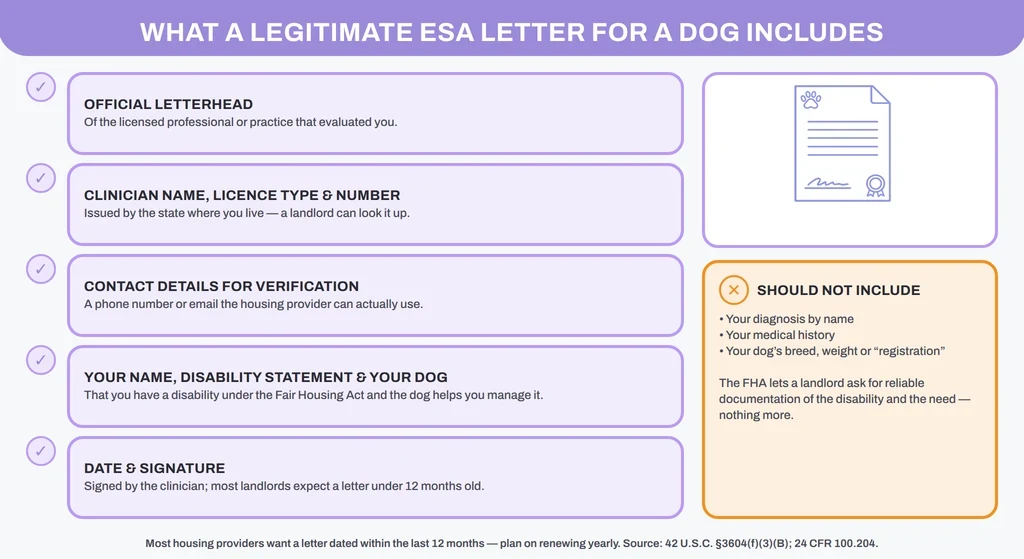
Landlords and property managers reject letters for missing details far more often than for what they say. A letter that will hold up has all of the following:
What it should not include: your diagnosis by name. The Fair Housing Act lets a landlord ask for reliable documentation of the disability and the need, not your medical history. A good clinician writes to that line and no further. You can see a full annotated example in our sample ESA letter guide.
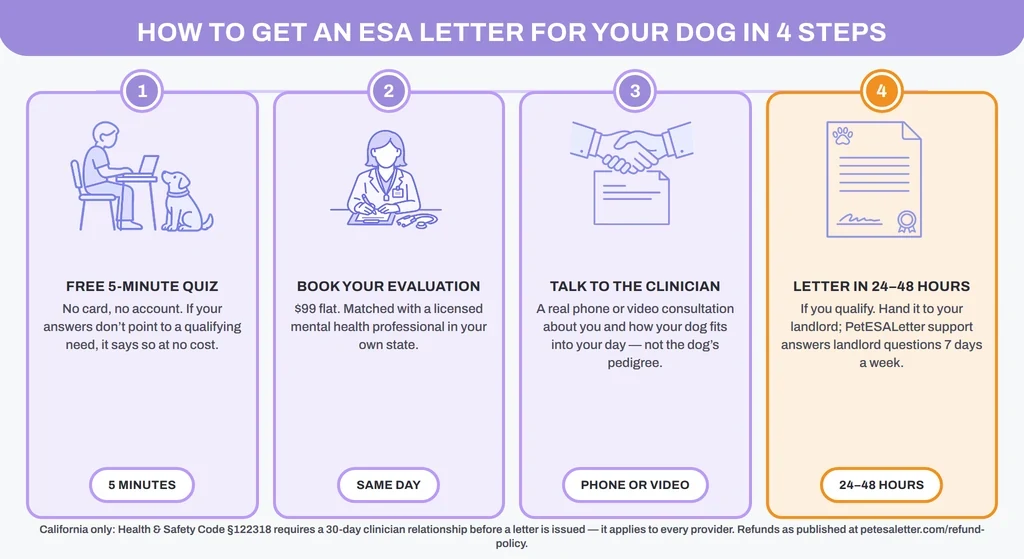
The whole process at PetESALetter takes four steps and, for most people, one to two days:
The general version of this process, including how to write the request to your landlord, is in How to Get an ESA Letter.
This is the question dog owners ask most, and the honest answer in 2026 has three parts.
The statute. The Fair Housing Act’s reasonable-accommodation duty (42 U.S.C. § 3604(f)(3)(B), restated in HUD’s regulation at 24 C.F.R. § 100.204) has not changed. A housing provider still has to consider a request for an assistance animal on its facts, and a blanket “no pit bulls” or “under 25 lb” rule is a policy, which is exactly what an accommodation request asks to modify. What a provider may still do is refuse a specific dog that poses a direct threat to others or would cause substantial property damage — judged on that dog’s actual behaviour, not on its breed.
The withdrawn guidance. HUD’s 2020 assistance-animal notice said breed and size restrictions should not be applied to assistance animals. Both that notice and its 2013 predecessor were withdrawn effective September 17, 2025 (91 FR 17291). So you can no longer point a landlord to a HUD document that says breed limits don’t apply. The duty in the statute is what remains.
State law. Many states have their own fair-housing statutes and their own ESA provisions, and those did not change. California’s Civil Rights Department issued a legal alert on July 20, 2026 reminding housing providers that state protections for emotional support animals continue regardless of HUD’s enforcement choices. Check your state’s page — for example California — before you assume the federal picture is the whole picture.
None of this means a landlord “must” accept your dog on sight, and we won’t tell you it does. It means a well-documented request, made in writing, is still the strongest position a renter with a dog can be in — and if a landlord rejects the letter in writing, PetESALetter refunds the fee under its published policy.
Keep three things separate, because most articles blur them.
One data point that cuts against “ESAs are finished”: the U.S. Department of Justice is currently litigating a Fair Housing Act case in Louisiana, United States v. Five Properties, LLC, over a landlord’s refusal to accommodate an untrained emotional support dog. The court denied the landlord’s motion for summary judgment on November 5, 2025. Federal ESA accommodation claims are live law, being argued by the federal government, in 2026.
For renters the practical shift is this: the federal complaint route is weaker, state law and private enforcement carry more of the weight, and documentation quality matters more than it did — which is the opposite of a reason to buy a $79 “certificate”. Our ESA letter for housing guide covers the request process step by step.
Very little, and none of it is about breed. An emotional support animal is not required to be trained, certified, a particular size, or a particular breed — the qualification is yours, not the dog’s. The things that can genuinely sink a request all come down to the individual dog’s conduct:
If you have two dogs, it is possible for both to be covered, but each one has to be tied to a disability-related need in the evaluation. That is its own conversation with the clinician — see ESA letter for two dogs before you book.
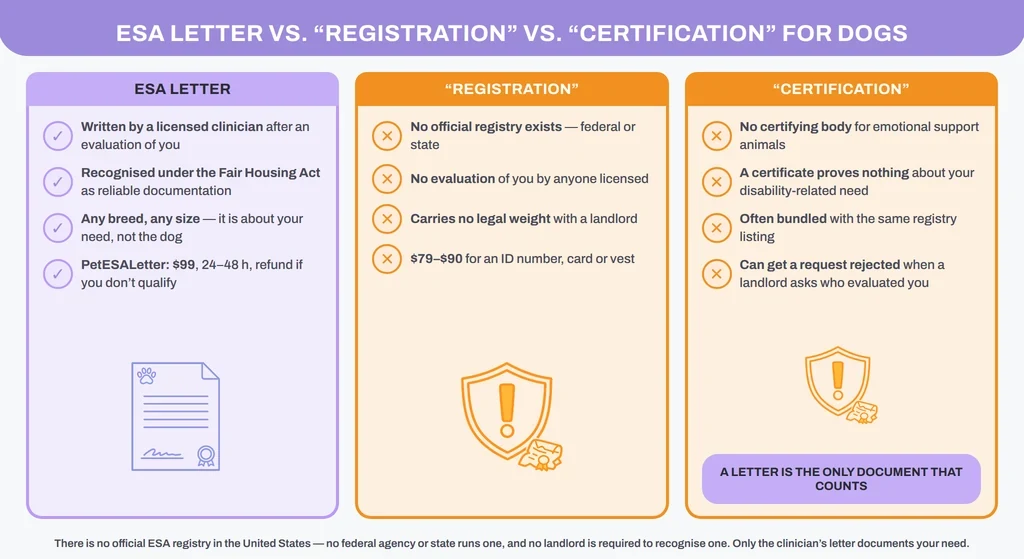
Two of the top results for this search are registries selling an “official” listing for a dog. There is no official ESA registry in the United States — no federal agency runs one, no state runs one, and no landlord is required to recognise one. A registration number, an ID card or a vest proves nothing about your need, which is the only thing the Fair Housing Act cares about. The full explanation is in ESA registration myths.
| What you get | PetESALetter ESA letter | Typical online ESA letter | “Registration” or “certificate” |
|---|---|---|---|
| Evaluation by a licensed clinician in your state | Yes — phone or video | Yes, from reputable providers | No |
| Recognised for a housing accommodation request | Yes | Yes | No legal standing |
| Turnaround | 24–48 hours | 1–7 days | Instant (nothing is checked) |
| Price | $99 flat | $149–$159 (Pettable, CertaPet, ESA Doctors) | $79–$90 |
| Any breed or size | Yes | Usually | Irrelevant |
| Landlord support after delivery | 7 days a week, included | Varies | None |
| Refund if you don’t qualify / if rejected in writing | Yes / yes (published policy) | Varies | No |
The established online providers publish their prices: Pettable $149, CertaPet $149.99, ESA Doctors $159. PetESALetter is $99 flat, with the same licensed-clinician evaluation, because the price of a letter should not be the reason a renter keeps a dog or gives one up. Full terms are on the pricing page.
Most of the time the request is granted without a fight, because a properly documented accommodation request is one a property manager’s own lawyer will tell them to grant. When it isn’t, what matters is that you don’t face the pushback alone. One of our customers described the outcome in their own words:
“I was able to live in my apartment with my pet, Leroy, all because of Pet ESA. … I got my ESA letter in one day.”
— Geneva Igwama, PetESALetter customer (video testimonial on our homepage)
Two things back that up in writing. First, landlord support is included: if a housing provider has questions or refuses, our team helps you respond, seven days a week, at no extra charge. Second, the refund policy: if the clinician decides you don’t qualify, you’re refunded within 7 days; if a landlord rejects the letter in writing after our support team has been involved, you’re refunded within 30 days. Both are on the refund policy page, not just on this page.
An ESA letter for a dog is a clinical document, not a product you buy off a shelf. Get it from a licensed clinician in your state, make your request to the landlord in writing, and lean on state law as much as federal law in 2026. Skip anything that calls itself a registry. If you’re not sure you qualify, the quiz is free and takes five minutes — and if you do, the letter is in your inbox within two days.
Ready to get an ESA letter for your dog from a real licensed clinician? Any breed, any size — the evaluation is about you, and the letter arrives in 24–48 hours if you qualify.
You can, and some family physicians will write one. Many decline because ESA evaluations are outside their day-to-day practice, and a letter from a licensed mental health professional is what landlords are used to seeing. Either way the letter must come from a licensed provider who evaluated you; a note from a vet does not count.
Yes, if it comes from a licensed clinician who actually evaluated you by phone or video and who is licensed in your state. It is not legitimate if a site issues it instantly, skips the consultation, or sells it as a registration or certificate. Landlords can and do verify licence numbers.
It is possible when each dog is tied to a disability-related need in the clinician’s evaluation. It is not automatic. Read our guide to ESA letters for two dogs before you book so you can raise it in the consultation.
No. Emotional support animals are not trained to perform tasks and have no public-access rights, so there is nothing to certify. Vests and ID cards are sold by registries and have no legal effect. The letter is the only document that matters.
Nothing in the Fair Housing Act sets an expiry, but most housing providers ask for a letter dated within the last 12 months, so plan on an annual renewal. If you move, your new landlord will usually want a current letter as well.
The Fair Housing Act’s duty to make reasonable accommodations is unchanged, and a pet-rent policy is the kind of rule an accommodation request asks a landlord to modify. HUD’s 2020 guidance, which said fees should not be charged for assistance animals, was withdrawn in 2025, so the answer now depends on the request being properly documented and on your state’s law. Make the request in writing and keep a copy.

Licensed Psychotherapist
Darren is a leading expert in mental health advocacy and assistance animal documentation. He specializes in streamlining the process for obtaining ESA Letters, PSD Letters, and State-specific ESA compliance.

ESA Letters Issued

Successful Consultations

Licensed Therapist Network

Client Satisfaction Rate




Petesaletter.com helps you get your emotional support animal letter online with guidance and support.

Got Questions? Call us 24/7
Copyright © 2020-2026 Petesaletter All rights reserved. Terms | Privacy | Refund
Owned and Operated by Verimedix LLC