If you are looking for a pet ESA letter, an online support group may help you compare experiences and prepare questions—but it is not the person who evaluates you. A legitimate housing document comes from an appropriate licensed clinician after an individualized evaluation. Use a group for education and community, not as a registry, certificate seller, or substitute for clinical care.
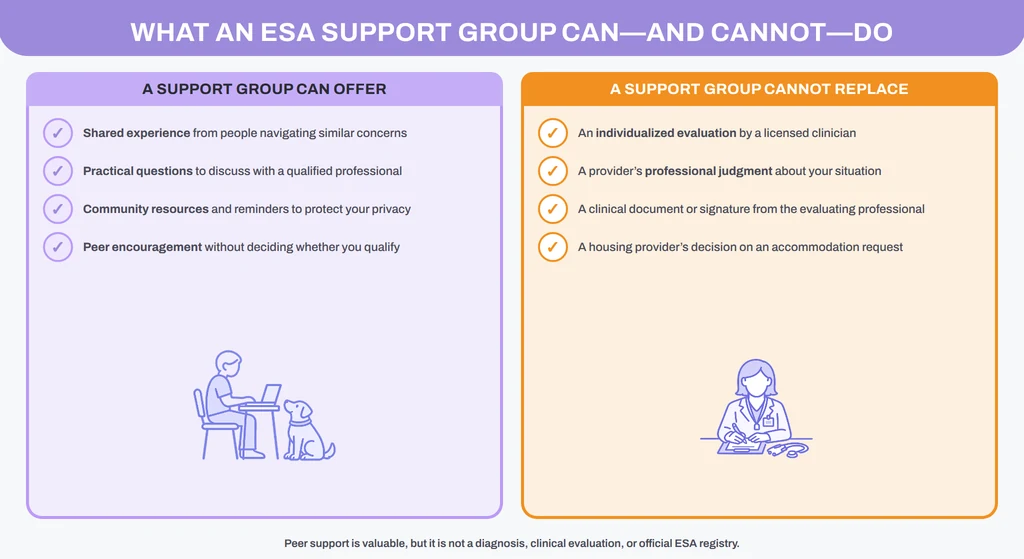
Quick answer: An ESA support group can offer peer discussion, practical questions, and community resources. It cannot diagnose you, decide whether documentation is appropriate, issue a clinician’s opinion, or determine a housing provider’s response.
Is an ESA support group the same as mental-health treatment?
Not always. A peer-led group is generally a community setting where people exchange experiences, while therapy or other clinical care is provided by a licensed professional in a professional relationship. For example, a group moderator may suggest questions about housing paperwork, but only a qualified clinician can evaluate your disability-related need and decide whether documentation is appropriate.
What can an ESA support group offer?
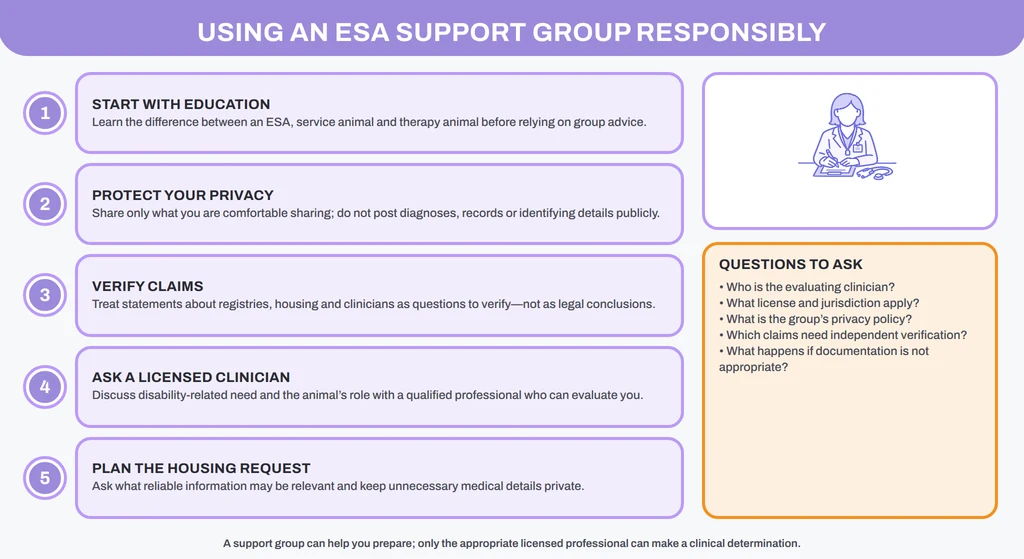
A responsible group can help you understand common terms, hear how others prepared for an appointment, and find questions to ask about licensure, privacy, fees, and follow-up. It can also remind you that an emotional support animal, a service animal, and a therapy animal have different roles. Advice from peers is a starting point—not a legal conclusion or a clinical finding.
What can’t a support group decide?
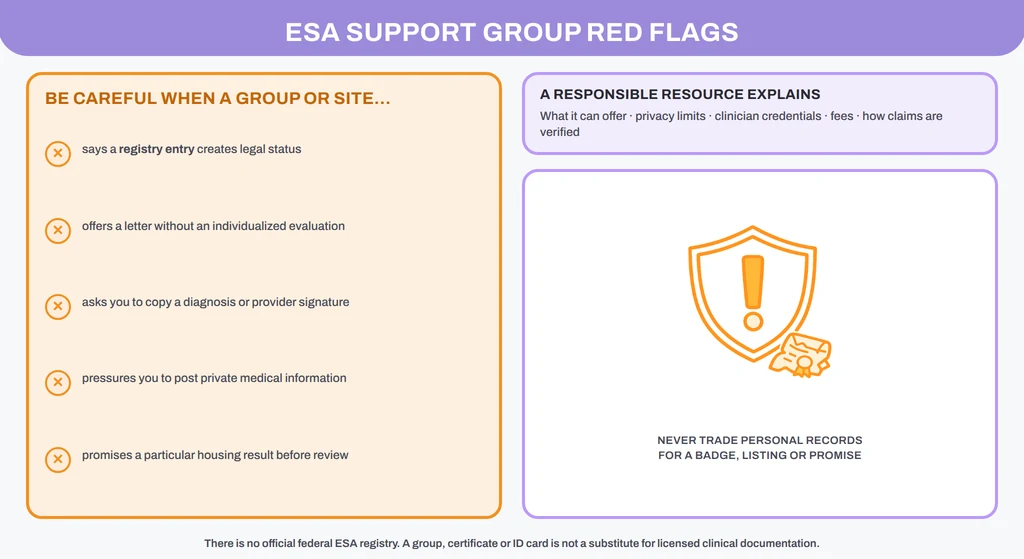
A group cannot determine whether you have a disability, prescribe treatment, create a clinician-patient relationship, sign an ESA letter, or decide how a housing provider must respond. A certificate, listing, membership number, or animal ID does not change those limits. If a group encourages you to copy a diagnosis or provider signature, treat that as a serious red flag.
What does federal housing law actually say?
The surviving federal baseline is the Fair Housing Act provision at 42 U.S.C. § 3604(f)(3)(B), which addresses reasonable accommodations in rules, policies, practices, or services when necessary to afford an equal opportunity to use and enjoy a dwelling. The implementing regulation, 24 C.F.R. § 100.204, provides the regulatory framework. These authorities do not create an ESA registry or turn peer-group advice into clinical documentation.
Keep the statute and regulation separate from withdrawn HUD guidance and current enforcement posture. HUD withdrew FHEO-2013-01 and FHEO-2020-01 effective September 17, 2025; the action appears in 91 FR 17291. The May 22, 2026 HUD enforcement memo describes current FHEO enforcement posture. It is not a replacement for the FHA statute or regulation, and withdrawn guidance is not a fallback standard.
How should you assess ESA advice in a group?
Ask where a claim comes from and whether it is about law, clinical care, or someone’s personal experience. A post saying “my landlord accepted this” is an anecdote, not a nationwide rule. Check official sources for legal language, verify a provider’s license through the relevant authority, and ask a licensed clinician about your own situation.
Resource
What it may provide
What to verify
Peer discussion
Shared experiences and questions
Personal accounts are not legal or clinical determinations
Licensed clinician
Individualized evaluation and professional judgment
License, scope, jurisdiction and relationship
Official legal source
Statute, regulation or agency publication
Date, authority and whether guidance remains current
Registry or certificate seller
Commercial badge, listing or document
No official federal ESA registry establishes eligibility
← swipe to compare →
How can you use a support group safely?
Protect your privacy before posting. Do not upload a medical record or publish a diagnosis merely to receive a badge, and read the group’s moderation and data practices. Keep a short list of questions—such as who the evaluating clinician is, what license applies, and how an evaluation works—then take those questions to the appropriate professional.
When should you talk with a licensed clinician?
Talk with a licensed clinician when you need an individualized opinion about disability-related need, the role of an animal, or whether documentation is appropriate. Ask about the professional’s active license, jurisdiction, scope, evaluation method, fee, privacy practices, and what happens if the clinician does not support an ESA letter. A genuine evaluation can include that outcome.
No. A support group may offer peer education and shared experience, but it cannot replace an individualized evaluation or issue a clinician’s professional opinion.
Not necessarily. A peer group may provide community and practical discussion, while therapy or other clinical care is delivered by a licensed professional within the relevant scope and relationship.
No. There is no official federal ESA registry. A group membership, certificate, badge, or ID card does not establish disability-related need or replace licensed clinical documentation.
No. Qualification-related questions require an individualized assessment by an appropriate licensed professional. A group can help you prepare questions, but it cannot make that clinical determination.
Avoid posting diagnoses, medical records, addresses, or other identifying details unless you understand the group’s privacy practices and are comfortable with the risk. Ask how information is stored and moderated.
Start with the applicable law and a licensed clinician’s evaluation, then review the housing provider’s process. Our ESA housing guide explains the documentation and request context without treating a support group as a legal or clinical substitute.
Need help with the next step? Start by learning how a licensed clinician evaluates an ESA letter request, then review the housing and cost details before choosing a service.
• Individualized evaluation by a qualified clinician
• Clear explanation of documentation and next steps
• Privacy-conscious process with transparent service details
Darren is a leading expert in mental health advocacy and assistance animal documentation. He specializes in streamlining the process for obtaining ESA Letters, PSD Letters, and State-specific ESA compliance.