
Last Updated on: September 25, 2026
Reviewed by Darren Andrew Rafel
Yes — bipolar disorder qualifies for an emotional support animal when a licensed mental health professional evaluates the person and finds that it substantially limits daily life (working, caring for oneself, sleep) and that the animal alleviates it. Bipolar I, bipolar II and cyclothymia are judged the same way, on limitation rather than label. PetESALetter matches each applicant with a clinician licensed in their state; if the evaluation supports it, the letter arrives in 24–48 hours for $99 flat.
Key takeaways
It does when two things are true and a licensed clinician confirms both. The Fair Housing Act protects a person with a “handicap”, defined as a physical or mental impairment that substantially limits one or more major life activities (42 U.S.C. § 3602(h)). HUD’s regulation lists what those activities are — “caring for one’s self, performing manual tasks, walking, seeing, hearing, speaking, breathing, learning and working” (24 C.F.R. § 100.201). Bipolar disorder reaches that list from both directions: a depressive episode lands on caring for oneself and on working, and the weeks after a manic or hypomanic episode — the lost job, the failed semester, the apartment nobody cleaned — land on working and learning. The second condition is that the animal has to do something about it: provide support that alleviates at least one symptom or effect.
Bipolar disorder is not written into the regulation, and it does not need to be. The list is of limitations, not diagnoses, so the same diagnosis qualifies one person and not another. A person on a mood stabiliser whose last depressive episode kept them off work for six weeks, who has not slept a regular night since, and whose clinician can say the cat is the reason the alarm gets answered has a clear case. A person whose bipolar II has been stable on treatment for three years, who is working and sleeping normally, and who mostly wants to stop paying pet rent does not — and a clinician who signs a letter anyway is the clinician landlords have learned to distrust.
The scale of the condition is why this question comes up so often. The National Institute of Mental Health puts bipolar disorder at 2.8% of U.S. adults in the past year and 4.4% at some point in their lives, and among those who have it 82.9% have serious impairment — “the highest percent serious impairment among mood disorders”. Adolescents run at 2.9%, and more than 70% of people who develop the condition show its features before the age of 25, which is why so many of these evaluations involve a first lease, a shared apartment or a college dorm. Our ESA qualification checklist covers the general test; this page is about how it plays out for bipolar disorder, and the ESA for depression and ESA for anxiety guides cover the two conditions most often diagnosed alongside it.
Not for the letter, and it helps to know why, because the label is the first thing most applicants worry about. The DSM-5-TR defines the three by their episodes. Bipolar I requires at least one manic episode: a persistently elevated or irritable mood with increased energy lasting at least seven consecutive days, or any length at all if it needs hospital admission, with three or more of the seven listed symptoms (four if the mood is only irritable) — and a depressive episode is not required for the diagnosis, although most people with bipolar I have them. Bipolar II requires at least one hypomanic episode — the same picture for at least four consecutive days, not severe enough to cause marked impairment and without psychosis — plus at least one major depressive episode, and never a full manic one. Cyclothymic disorder is two years (one year under 18) of swings that never reach either threshold but are present at least half the time.
The evaluation does not stop at the label because the Fair Housing Act does not. A person with bipolar II can be far more limited than a person with bipolar I whose treatment is working; the depressive episodes in bipolar II are typically longer and more frequent than the hypomanias, and they are what keeps people off work. What the clinician needs is the diagnosis as it stands — from a treating psychiatrist or therapist if there is one, or from the evaluation itself — and then the honest picture of the last year. A person who has never been formally diagnosed but describes the pattern can be evaluated; a clinician can reach a diagnosis or decline to, and either way the letter follows the functional test, not the chapter heading. The one thing the type does change is the conversation about the animal, which is the next section.
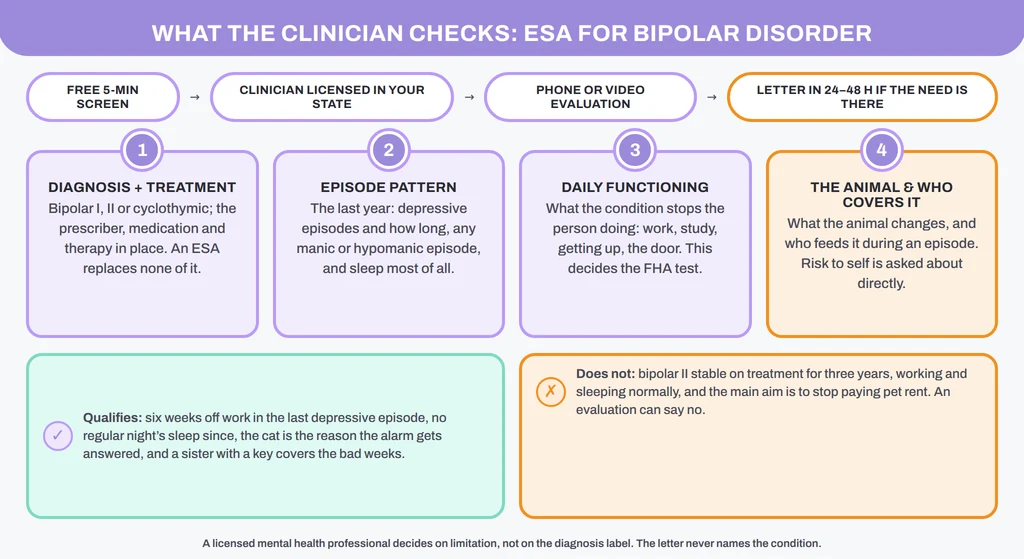
The evaluation is a clinical conversation by phone or video with a therapist licensed in the applicant’s own state (the online ESA evaluation page describes the format). For bipolar disorder it covers four things, and the fourth is the one no other condition page on this site has:
The diagnosis and the treatment around it. Which type, when it was made, and what is in place — a prescriber, a mood stabiliser or antipsychotic, psychotherapy, a crisis plan. Bipolar disorder “usually requires lifelong treatment”, in NIMH’s words, and an ESA is never a substitute for any of it. A clinician who hears that someone stopped their medication because the dog helps more will say so, and will not write a letter that implies otherwise. A prior diagnosis is welcome and shortens the conversation; it is not required.
The episode pattern over the last year. How many depressive episodes and how long; whether there was a manic or hypomanic episode and what it did; what the periods in between look like; sleep, most of all. The clinician is building the timeline that the functional test needs, and sleep is where bipolar disorder shows first and worst — the DSM-5-TR lists “decreased need for sleep” as a symptom of mania and insomnia or hypersomnia as a symptom of depression, and both are on the list of things a landlord never hears about.
Daily functioning. What the condition actually stops the person doing: getting up before noon during a depressive episode, keeping a job through the concentration problems and the absences, finishing a term, paying the rent on time in the month after a spending spree, answering the door. This is the part that decides whether the condition counts as a disability under the Fair Housing Act, and it is where most evaluations are decided.
The animal — and who else can look after it. Two questions that other conditions do not get. What does the animal change, in a depressive episode and in the weeks after a high? And when the person cannot get out of bed, or is three days into a hypomania and has not been home, who feeds it? An animal that is the reason the alarm is answered is support; an animal that will be neglected for a fortnight twice a year is a welfare problem and a source of guilt that deepens the next low. The clinician will also ask, directly, about risk to self, because the depressive pole of bipolar disorder carries it. An ESA is not a crisis plan: anyone in the U.S. who is in crisis can call or text 988, the Suicide & Crisis Lifeline, at any hour, and a clinician who hears risk in an evaluation deals with that before anything about a letter.
A common worry before the call is having to defend the diagnosis to a stranger, or being judged for it. Specifics about the present do the work: the six weeks off work last winter, the three nights without sleep in April and what followed, the sister who has a key and feeds the cat when the applicant cannot — and what is different on the ordinary days when the animal is there. There is no script, and there should not be; a clinician can only document what the conversation supports, and an overstated letter is the one a landlord challenges. When the conclusion is that the criteria are not met, the fee comes back under the refund policy.
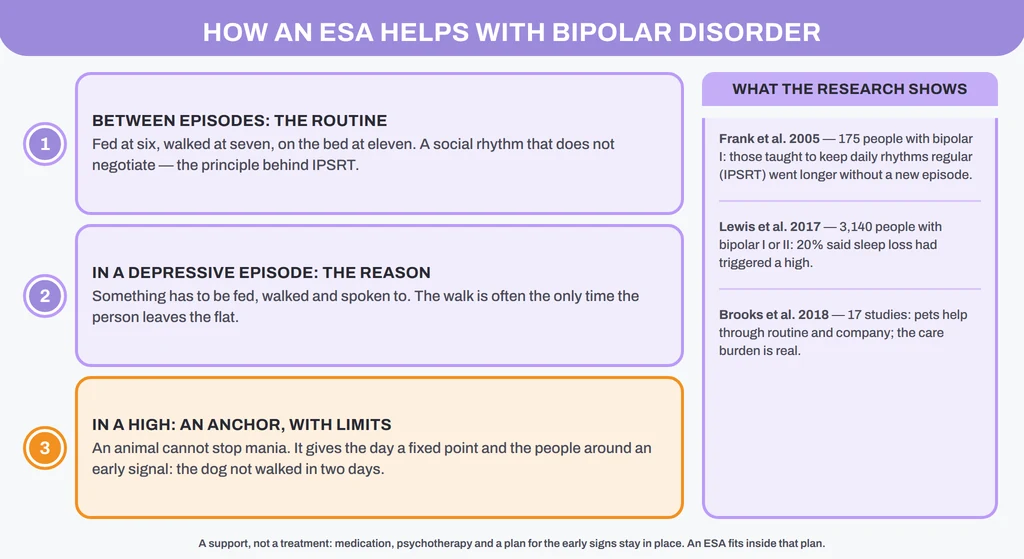
An ESA has no training requirement and performs no tasks; it helps by being there. For bipolar disorder, “being there” means something different in each phase of the illness, and the evidence is strongest for the least dramatic one.
Between episodes: the routine. The best-supported psychotherapy for bipolar disorder that is not about talking through the past is about keeping the clock regular. Interpersonal and Social Rhythm Therapy (IPSRT) trains people to hold the same wake time, meal times, activity and bedtime every day, on the theory that disrupted rhythms trigger episodes. In the randomised trial that tested it, 175 acutely ill people with bipolar I were treated, and those who received IPSRT in the acute phase “survived longer without a new affective episode” during maintenance than those who did not (Frank et al., Archives of General Psychiatry, 2005). Sleep is the rhythm that matters most: in a study of 3,140 people with bipolar I or II, 20% reported that losing sleep had triggered an episode of high mood (Lewis et al., British Journal of Psychiatry, 2017). A dog that needs to go out at seven and be fed at six is a social rhythm that does not negotiate, and a cat that sits on the bed at eleven is a bedtime. No competitor page connects the two; the applicants do.
In a depressive episode: the reason. The symptoms that decide most evaluations — not getting up, not eating, not going out, not answering anyone — are the ones an animal interrupts by needing things. People describe the walk as the only time they left the flat for a month, and the animal as the only thing they spoke to. Company that asks for no conversation is easier than company that does.
In a manic or hypomanic episode: the anchor, with limits. An animal cannot stop a high, and nobody honest will tell an applicant it can. What it does is give the day a fixed point when everything else is speeding up, and give the people around the person an early signal: the dog that has not been walked in two days is the first thing a partner notices. This is also where the next section comes from.
What the research does and does not show matters here, because “get a dog, it fixes bipolar” is the slogan of the worst of this industry. The systematic review of companion animals and mental health (Brooks et al., BMC Psychiatry, 2018 — 17 studies, bipolar disorder among the conditions covered) concluded that pets “provide benefits to those with mental health conditions” through routine, distraction from symptoms, and a relationship without judgement, and it also recorded the burden of care and the grief of losing an animal as real drawbacks. In the interview study behind it (Brooks et al., BMC Psychiatry, 2016), 54 people with long-term mental health conditions mapped their support networks; of the 25 with pets, 15 put the animal in the central, most valued circle — and the same study found that pets were “unanimously neither considered nor incorporated into individual mental health care plans”. The honest reading is that an ESA is a support, not a treatment: a clinician evaluating bipolar disorder will ask what else is in place. The choice of animal is separate from the choice of document — a dog brings the walk and the schedule, a cat brings the company with far less routine load, which for some people is the point — and our guides to the best emotional support dog breeds for anxiety and depression and to an ESA cat cover both.
This is the section the rest of the results page will not write, and it is the one a good clinician cares about most. Three situations, in order of how often they come up.
The animal was acquired during a high. Impulsive decisions with painful consequences are a diagnostic symptom of mania — buying sprees, sudden commitments — and a puppy at 2 a.m. is a common one. That does not disqualify the animal, and it does not disqualify the person; what the clinician asks is whether, three months on, the animal is part of the recovery or part of the damage. If it is being fed, walked and loved on the flat days, it can be an ESA. If it is being resented, the evaluation is the moment to say so, and rehoming with help is a better answer than a letter.
Nobody can cover the depressive episodes. The International Bipolar Foundation’s own guidance on pets says the quiet part: a pet can increase stress rather than relieve it when the person is not in a position to care for it, and it recommends enlisting family or friends to share the load during episodes. An evaluation is not complete without that plan — a neighbour with a key, a partner, an automatic feeder, a boarding arrangement that can be triggered by text. A clinician who writes a letter without asking has skipped the question that decides whether the animal is a support at all.
The animal is the only thing in the plan. Bipolar disorder is treated with medication, psychotherapy and, for many people, a written plan for what happens when the early signs appear. An animal fits inside that; it does not replace any of it, and an applicant who wants a letter because the dog “works better than the pills” will hear the clinician say that the two are not alternatives. When the answer to the evaluation is that an ESA is the wrong move right now, the fee is refunded under the published policy, and the honest outcome is worth more than the document.
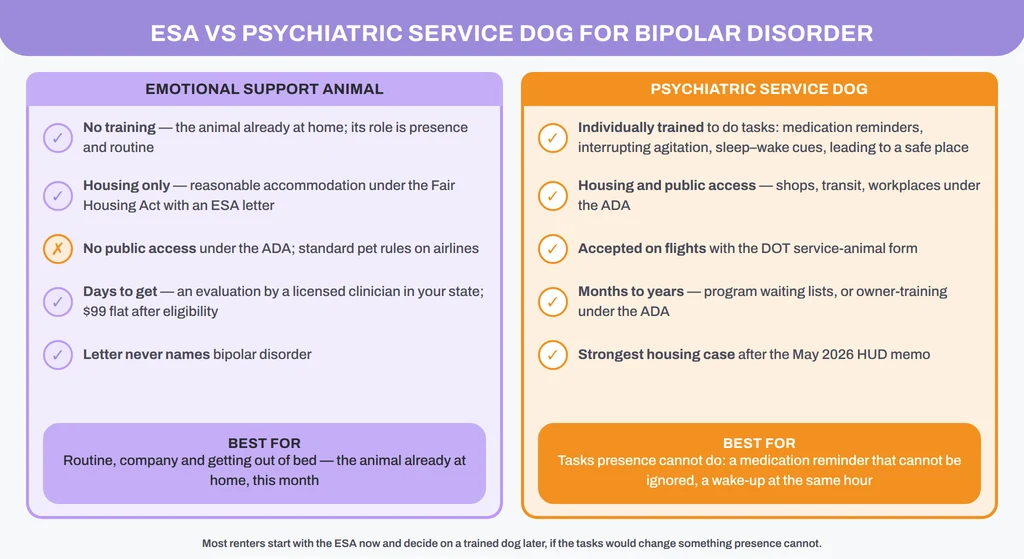
Half the results for this search are service-dog programs, and the two are different jobs. An emotional support animal is the animal a person already has; it needs no training and its role is presence. A psychiatric service dog is individually trained to do work or tasks for the disability — for bipolar disorder the tasks usually cited are reminding the handler to take medication on schedule, interrupting agitation or repetitive behaviour, cueing a fixed sleep and wake time, and leading the handler to a safe place or fetching a phone — and because of that training it has public-access rights under the Americans with Disabilities Act that an ESA never has. ADA.gov draws the line in one sentence: emotional support animals “have not been trained to perform a specific job or task”, so they are not service animals, while a dog trained to remind a person with depression to take their medication is. The PSD letter page covers the document a trained dog’s handler uses for housing, the psychological service dog guide goes through the tasks, and self-training a service dog covers the owner-training route, which the ADA allows.
| For bipolar disorder | Emotional support animal | Psychiatric service dog | Pet with no documentation |
|---|---|---|---|
| Training | None required | Individually trained to do work or tasks for the disability | None |
| What it does | Presence: routine, company, a reason to get up and go out | Tasks: medication reminders, interrupting agitation, sleep–wake cues, leading to a safe place | Company |
| Housing (FHA) | Reasonable accommodation request with an ESA letter | Reasonable accommodation; the training itself is the strongest case after the 2026 HUD memo | Subject to the lease: pet rent, deposits, breed and weight limits |
| Public places (ADA) | No access rights | Shops, restaurants, transit, workplaces | No access rights |
| Air travel | Standard pet rules since the 2021 DOT rule | Accepted with the DOT service-animal form | Standard pet rules |
| Document | ESA letter from a licensed mental health professional after an evaluation | None required in public; a PSD letter documents the need for housing | None |
| Time to get | Days, if the evaluation supports it | Months to years of training or program waiting lists | — |
For most people with bipolar disorder who rent, the practical sequence is the obvious one: the animal already at home becomes an ESA now, and a trained dog is a separate decision for later, if the tasks — a medication reminder that cannot be ignored, a dog that wakes the handler at the same hour — would change something the presence cannot. A program-trained psychiatric service dog is commonly quoted at $20,000–$30,000 with a waiting list measured in months to years; owner-training is allowed and takes most of a year of consistent work, which is itself a test of whether the routine is there. The broader legal distinctions — including therapy dogs, which are a third thing — are in service dog vs therapy dog vs ESA, and the paperwork side is in ESA letter vs PSD letter.
The whole process takes four steps and, if the evaluation supports it, about two days.
Answer the free five-minute screen. Six or seven questions — is there a condition that affects daily life, is there an animal that helps, which state — so that nobody books an evaluation that cannot go anywhere. Nothing is charged here.
Get matched with a clinician licensed in the applicant’s state. Not a clinician somewhere in the country: one licensed where the applicant lives, because California, Louisiana, Arkansas, Montana, Florida and Colorado each have their own rules about who may sign and what has to come first. This matters for bipolar disorder in particular, because the person who knows the history best is often a psychiatrist in another state, or a prescriber who does not write housing letters as a matter of policy.
Do the evaluation by phone or video. It runs through the four checks above. Useful to have to hand: the date of the diagnosis and its type, current medication, the name of the treating psychiatrist or therapist if there is one, and the name of the person who covers the animal during an episode; none of them is required. The fee is $99 flat and is fully refundable if the clinician finds you don't qualify — no membership, no auto-renewal, no add-ons (details on the ESA letter pricing page).
Receive the letter within 24–48 hours if the clinician finds a qualifying need. It states that the person has a disability under the Fair Housing Act and that the animal is connected to it, carries the clinician’s license number, state and signature, and does not contain the words bipolar, mania or depression. If the housing provider calls to verify, that is included. Letters are written for twelve months; bipolar disorder is lifelong and episodic, so the renewal a year later is a short re-evaluation, not a fresh application — the ESA letter renewal guide covers what a landlord can and cannot ask at that point.
If the clinician decides the applicant doesn’t qualify, the fee is refunded within 7 days. If a landlord rejects the letter in writing after our support team has been involved, the refund window is 30 days. Both terms are on the refund policy page. The full walkthrough, including what a finished letter looks like, is in how to get an ESA letter, and who can write an ESA letter goes through every license type, including whether a prescribing psychiatrist can sign.
The letter is a housing document, and the housing picture in 2026 has three separate parts. Any site that gives one sentence for all three is wrong about at least two.
The law itself has not moved. 42 U.S.C. § 3604(f)(3)(B) makes it discrimination to refuse a reasonable accommodation in rules, policies, practices or services when a person with a disability needs it to use and enjoy a dwelling, and 24 C.F.R. § 100.204 is HUD’s own regulation restating that duty. Neither contains a training requirement, and both can be enforced by a private lawsuit and by state fair-housing agencies.
HUD’s how-to notices are gone. FHEO Notices 2013-01 and 2020-01 — the checklists landlords and tenants both used to quote — were withdrawn effective September 17, 2025 (91 FR 17291, April 6, 2026), and nothing has replaced them. That includes the passage that said pet deposits and pet rent could not be charged for an assistance animal: whether a fee can be charged is now a case-by-case reasonableness question rather than a rule HUD stands behind.
HUD’s own enforcement has narrowed. A May 22, 2026 FHEO memorandum says HUD will find reasonable cause and recommend charges only in cases involving animals individually trained to perform disability-related work or tasks. HUD describes this as prioritising its own resources, not as a change in the statute: open ESA cases go to case-by-case review, Section 504 and the ADA are outside the memo, and the right to sue privately is untouched. In practice it means the quality of an ESA letter carries more of the weight than it did, and a trained psychiatric service dog has the stronger housing case of the two.
For bipolar disorder the part people care about most is privacy, and they are right to: it is a diagnosis people are more reluctant to disclose to a leasing office than almost any other. The letter confirms a disability and the animal’s connection to it without naming the condition; Florida’s statute (§ 760.27(3)(a)) and Montana’s (§ 70-24-114(4)(a)) go further and bar a housing provider from asking for the diagnosis, its severity or medical records, and Montana requires the landlord to answer in writing. The request itself can be made in writing, so nobody has to explain themselves across a counter. What a housing provider may still do is ask for reliable documentation from a licensed professional, verify the letter with the clinician, and set reasonable rules about the animal’s conduct. How to make the request, and what happens if it is refused, is in ESA letter to landlord; the HUD and landlord-rights background is in ESA letter for housing.
Six states add their own rules about who may write the letter and what has to happen first, and a letter that ignores them is easy to challenge — which is why PetESALetter matches each applicant with a clinician licensed in their own state. For bipolar disorder, where the diagnosis usually predates the evaluation by years, the 30-day relationship four of these states require is rarely the obstacle; the licence is. A psychiatrist in Texas cannot sign for a tenant in California.
| State | What has to be in place before the letter is signed | Who may sign | Statute |
|---|---|---|---|
| California | A client-provider relationship of at least 30 days and a clinical evaluation; license details stated in the letter | A practitioner licensed in California | Cal. Health & Safety Code § 122318 (AB 468, 2021) |
| Louisiana | A therapeutic relationship of at least 30 days, at least two sessions, a disability assessment and a clinical evaluation | A Louisiana-licensed provider | La. R.S. 46:1974 (Act 558 of 2024) |
| Arkansas | A 30-day client-provider relationship and a clinical evaluation, reviewed at least once a year | A provider licensed in the jurisdiction | Ark. Code Ann. § 20-14-1003 (Act 268 of 2023) |
| Montana | A client-provider relationship of at least 30 days and a clinical evaluation; a registry card is not sufficient on its own | A Montana-licensed mental health professional, license details in the letter | Mont. Code Ann. § 70-24-114 (HB 703, 2023; amended 2025) |
| Florida | Personal knowledge of the disability; no waiting period. An out-of-state practitioner must have provided in-person care at least once | A practitioner acting within the scope of the license | Fla. Stat. § 760.27 (SB 1084, 2020) |
| Colorado | An in-person meeting and a written finding on disability and need; no waiting period. Housing side: an assistance animal is a presumed reasonable accommodation | A mental health licensee with sufficient familiarity with the patient | C.R.S. § 12-245-229; C.R.S. § 24-34-502.2 as amended by HB26-1045 (eff. Aug 12, 2026) |
Everywhere else the federal framework applies on its own. Our California ESA letter and Louisiana ESA letter pages go through the two strictest states in detail, the Montana ESA letter page covers the state that spells out that a registry card proves nothing, and the state pages linked in the navigation cover the rest.
The red flags are the same for every condition, and they are at their most predatory with someone who is exhausted and wants the problem solved tonight. A letter in minutes — “instant approval” means nobody evaluated anyone, and the signs of a legitimate ESA letter are listed on that page. A registration number, certificate, vest or ID card — U.S. law has no ESA registry, Montana’s statute spells out that a card proves nothing on its own, and our ESA registration myths page takes the claims apart one by one. A “service dog certification” for an untrained pet — the training is the qualification, and misrepresenting an assistance animal carries a penalty in Florida, Colorado and a growing list of states. And a promise that the landlord “must” accept it — the statute obliges a housing provider to consider a reasonable accommodation, not to grant every request, and after the 2026 HUD memo the quality of the letter carries more of the weight, not less.
The bottom line. Bipolar disorder — I, II or cyclothymic — can qualify for an emotional support animal when a licensed clinician finds that it substantially limits daily life and that the animal alleviates it. The best case for an ESA in this condition is the routine it enforces, the honest limit is that it treats nothing and needs a plan for the episodes, and a psychiatric service dog is a separate, trained animal for a later decision. The letter never names the diagnosis, six states add their own rules about who writes it, and the 2026 changes narrowed HUD’s enforcement, not the statute. PetESALetter’s evaluation is by a clinician licensed in the applicant’s state, the fee is $99 flat with a full refund if the clinician finds no qualifying need, and the letter arrives in 24–48 hours if the need is there.
Not sure whether bipolar disorder qualifies — or whether an ESA is the right move right now? A licensed clinician in your state evaluates whether an emotional support animal fits the situation — and the first step is a free five-minute screen.
Yes, when a licensed mental health professional evaluates the person and finds that the bipolar disorder substantially limits a major life activity — working, learning, caring for oneself, or the sleep all three depend on — and that the animal alleviates it. Bipolar I, bipolar II and cyclothymic disorder are all judged on that functional test, not on the label. A diagnosis by itself does not qualify anyone, and an evaluation can conclude that the criteria are not met.
Bipolar disorder can qualify a person for a psychiatric service dog under the ADA, provided the dog is individually trained to do tasks for the disability — medication reminders, interrupting agitation, sleep–wake cues, leading to a safe place. A program-trained dog is commonly quoted at $20,000–$30,000 with a waiting list of months to years; owner-training is allowed and takes most of a year. An emotional support animal is different: no training, housing rights only, and it can be the animal already at home.
No. A legitimate letter states that the person has a disability under the Fair Housing Act and that the animal is connected to it, with the clinician’s license details and signature; the diagnosis is not named. In Florida and Montana the statute also bars a housing provider from asking for the diagnosis, its severity or medical records.
Often, if they are willing and licensed in the state where the person lives — many prescribers decline as a matter of practice policy, and a psychiatrist licensed in another state cannot sign for a tenant in California, Louisiana, Arkansas, Montana, Florida or Colorado. An independent evaluation by a licensed clinician in the applicant’s own state is the alternative, and bringing the treating psychiatrist’s name and the current medication to it shortens the conversation.
No. Bipolar disorder is treated with medication, psychotherapy and a plan for the early warning signs, and NIMH describes it as usually requiring lifelong treatment. What an animal contributes is routine — the same wake time, walk and bedtime every day, which is the principle behind Interpersonal and Social Rhythm Therapy — and company during a depressive episode. A licensed clinician evaluating bipolar disorder will ask what else is in place before writing a letter.
It can, if three months on the animal is being cared for and is part of the recovery rather than part of the damage. Impulsive decisions are a symptom of mania, and a clinician will not hold the purchase against the person; what the evaluation asks is whether the animal helps on the ordinary days and who looks after it during an episode. If the honest answer is that the animal is a burden, rehoming with help is the better outcome, and the evaluation fee is refunded.

Licensed Psychotherapist
Darren is a leading expert in mental health advocacy and assistance animal documentation. He specializes in streamlining the process for obtaining ESA Letters, PSD Letters, and State-specific ESA compliance.

ESA Letters Issued

Successful Consultations

Licensed Therapist Network

Client Satisfaction Rate




Petesaletter.com helps you get your emotional support animal letter online with guidance and support.

Got Questions? Call us 24/7
Copyright © 2020-2026 Petesaletter All rights reserved. Terms | Privacy | Refund
Owned and Operated by Verimedix LLC