
Last Updated on: October 26, 2026
Reviewed by Darren Rafel, LCSW
Yes — a lizard can be an emotional support animal for housing. The Fair Housing Act names no species; what counts is a licensed mental health professional finding a disability the animal eases. It has to be legal to keep: Hawaii bars bearded dragons and geckos, and New York City and Florida ban iguanas, monitors and tegus. PetESALetter matches adults with a clinician licensed in their state; in most states a qualifying letter follows within 24–48 hours, for $99 flat.
Key takeaways
Yes. Nothing in the Fair Housing Act or HUD’s regulation limits an emotional support animal to a dog or a cat. The statute makes it discrimination to refuse “reasonable accommodations in rules, policies, practices, or services, when such accommodations may be necessary to afford such person equal opportunity to use and enjoy a dwelling” (42 U.S.C. § 3604(f)(3)(B)), and 24 C.F.R. § 100.204 restates that duty. An exception to a lease clause that says “no pets” or “no reptiles” for a bearded dragon in a tank is exactly that kind of accommodation. The questions are the ones asked about any animal: does the person have a disability, and does this animal help with it?
What has changed is the guidance around the law. For years, tenants and housing providers worked from HUD Notice FHEO-2020-01, which listed animals “commonly kept in households” — dogs, cats, small birds, rabbits, hamsters, fish, turtles — and asked anyone requesting a different kind of animal to show a disability-related need for that specific type. Lizards were not on the list. That notice and the earlier FHEO-2013-01 were withdrawn effective September 17, 2025 (91 FR 17291, April 6, 2026), so neither the list nor its extra step is HUD’s guidance any more. A lizard request now rests where every request rests: on a credible letter, and on whether the accommodation is reasonable for that building.
A lizard has real advantages in that conversation. It lives in a closed enclosure, makes no noise, needs no walks, sheds no fur and never meets the neighbor’s dog in the hallway. Its weak points are the ones a manager who has never dealt with a reptile will raise first: the lamp that runs all day, whether the animal can get out, and the bacteria it carries. That is why this page spends as much time on species, enclosures and hygiene as on the letter itself.
Two things a lizard never needs: registration and an ID card. U.S. law has no ESA registry, and the Facebook post that ranks for this question, quoting a doctor who said the dragon “has to be registered”, has it backwards: there is nothing to register with. The ESA registration myths page takes apart the certificate and harness-tag sellers. What a housing provider can rely on is an ESA letter from a licensed clinician who evaluated the person. The same logic runs through the other species guides on this site: the emotional support snake page is this one’s reptile sister, and the emotional support rabbit, emotional support bird and emotional support ferret guides cover the animals most often requested alongside them.
For a housing request, the best emotional support lizard is usually the one that already helps — provided it is legal where the person lives and fits in a normal apartment. Species matters less to the clinician than to the property manager, and to the manager it comes down to three things: how big the lizard gets, how long it lives and whether the law lets anyone keep it. VCA Animal Hospitals, the Royal Veterinary College and the Merck Veterinary Manual give the first for the species people most often ask about, the third column is the law as read on each regulator’s page, and the last is our read of how each one lands in a shared building.
| Lizard | Adult size and life span | Where it is banned as a pet (verified) | Fit in a rental (our read) |
|---|---|---|---|
| Bearded dragon (Pogona vitticeps) | 18–22 inches; about 7–12 years (VCA); Merck lists 5–10 | Hawaii | Easiest request: docile, handled daily, one 60- to 100-gallon tank with a basking lamp and UVB |
| Leopard gecko (Eublepharis macularius) | Up to 10 inches; up to 20 years (RVC); Merck lists 20+ | Hawaii (all geckos) | Easy: small, quiet, active at dawn and dusk; a 36 × 18 × 18 inch vivarium |
| Crested gecko | Small; not covered by the veterinary sources used here | Hawaii (all geckos) | Easy; same ban as other geckos |
| Green anole | Small; 4–8 years (Merck) | None verified | Easy, but short-lived and rarely handled — a weaker case for “this animal helps” |
| Old World chameleons | 3–8 years (Merck) | None verified | Possible; delicate, not a handling animal |
| Green iguana (Iguana iguana) | 5–15 years (Merck); far larger than a bearded dragon | Florida (Prohibited since 2021); New York City | Hard: size alone worries managers |
| Monitors and tegus | Large | New York City (all monitors, all tegus); Florida (all tegus, the Nile monitor) | Not a rental animal |
| Gila monster, Mexican beaded lizard | — | New York City | Not an ESA candidate: venomous |
Two cautions sit under that table. First, a species never qualifies a person: the clinician evaluates the human, not the lizard, and a docile bearded dragon earns no letter on its own. Second, size changes everything about the request. An adult bearded dragon of 18 to 22 inches in a 60- to 100-gallon tank (VCA) is a quiet piece of furniture to most managers; a green iguana grows far larger, needs an enclosure most apartments cannot hold and is banned as a pet in Florida and New York City; monitors and tegus are banned in the same places. The usual emotional support lizard is one the person already has, already handles and already knows helps — and in 2026 that is overwhelmingly a bearded dragon or a leopard gecko.
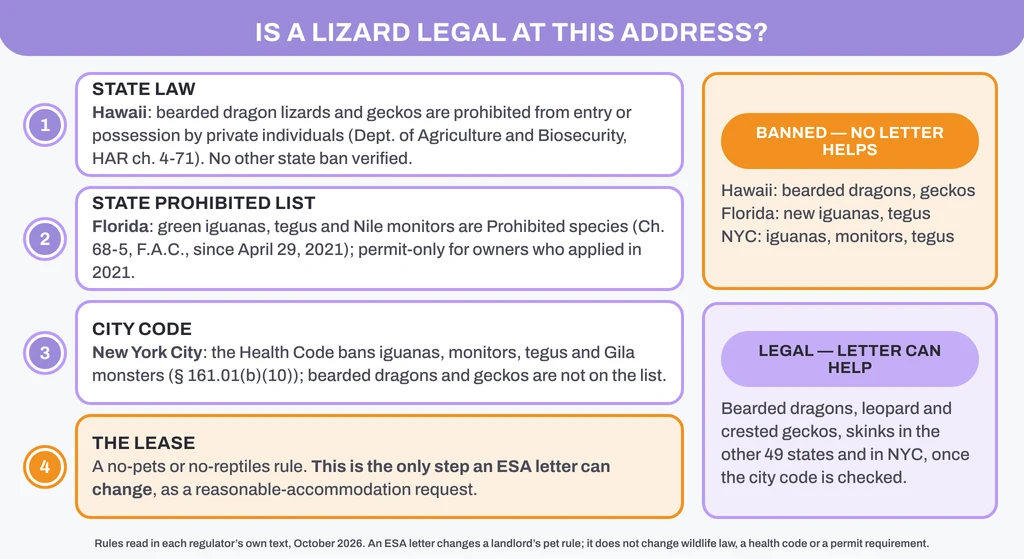
An ESA letter is a housing document. It asks a housing provider to bend a pet rule; it does not license anyone to keep an animal the law says they may not keep. Lizards run into that line in three ways, and the People Also Ask box under this search — “What states are bearded dragons illegal in?” — gets an answer from every forum and no rule from anyone. Here are the rules, read on each regulator’s own page in October 2026.
| Place | The rule | What it says | Does an ESA letter change it? |
|---|---|---|---|
| Hawaii | Department of Agriculture and Biosecurity, Plant Quarantine Branch (HAR ch. 4-71) | Names “bearded dragon lizards” and “geckos” among animals “prohibited from entry or possession by private individuals in the State” | No |
| Florida | Chapter 68-5, F.A.C. (Fish and Wildlife Conservation Commission; effective April 29, 2021) | Green iguana, all tegus and the Nile monitor are Prohibited species; a pet owner needed an FWC permit applied for by July 28, 2021 | No — a clinician’s letter is not a wildlife permit |
| New York City (all five boroughs) | NYC Health Code § 161.01(a)(1) and (b)(10) | No person may “possess, harbor, keep, or yard” the listed wild animals, which include Gila monsters and beaded lizards, every monitor, every iguana and every tegu; bearded dragons and geckos are not listed | No for the listed families; the common ESA lizards are allowed |
| Everywhere else | State wildlife rules and the city or county animal code | Bearded dragons, geckos, anoles and skinks are ordinary pets in most places; a few cities limit reptiles by species or length | Only the lease — a no-pets or no-reptiles rule is the one line an ESA letter can change |
Hawaii. The state’s Department of Agriculture and Biosecurity runs a closed list, and its Plant Quarantine Branch names “bearded dragon lizards” and “geckos” among animals that are “prohibited from entry or possession by private individuals in the State” (Hawaii Administrative Rules chapter 4-71), alongside snakes and snapping turtles. The two most common emotional support lizards in the other 49 states are therefore not available in Hawaii at all, and a letter from a clinician — ours or anyone’s — changes nothing. Hawaii is the only state whose ban on bearded dragons and geckos we verified on the regulator’s text; the claim that other states ban them circulates online without a citation, and we did not find one. The Hawaii ESA letter page covers the housing side for the animals that are allowed there.
Florida. The Fish and Wildlife Conservation Commission added the green iguana (Iguana iguana), all tegus (genera Salvator and Tupinambis) and the Nile monitor to its Prohibited species list by rule changes to Chapter 68-5 of the Florida Administrative Code, approved February 25, 2021 and effective April 29, 2021. Owners who already had a green iguana or a tegu as a pet had 90 days, until July 28, 2021, to apply for a permit, tag the animal and upgrade its indoor caging; outside that permit, possession is limited to research, exhibition and similar purposes. Bearded dragons, geckos and anoles are not on Florida’s list. The Florida ESA letter page covers the state’s ESA statute.
New York City. The Health Code makes it unlawful to “possess, harbor, keep, or yard” the wild animals it lists (§ 161.01(a)(1)), and the reptile paragraph is written by family: “All Helodermatidae (gila monster and Mexican beaded lizard)”, “any member of the family Varanidae” — the monitors, from the savannah monitor to the Komodo dragon — “any member of the family Iguanidae, including the green or common iguana” and “any member of the family teiidae”, the tegus (§ 161.01(b)(10)). Bearded dragons belong to the family Agamidae and leopard and crested geckos to the gecko families, none of which appear, so both are lawful in the five boroughs. The New York ESA letter page covers the state’s housing rules.
City and county codes. Many cities and counties have their own exotic-animal ordinances, and some limit reptiles by species or by length. Check the local animal code before a move, not after, and keep the purchase or adoption record with the species named; it answers the question before a manager or an animal-control officer asks it.
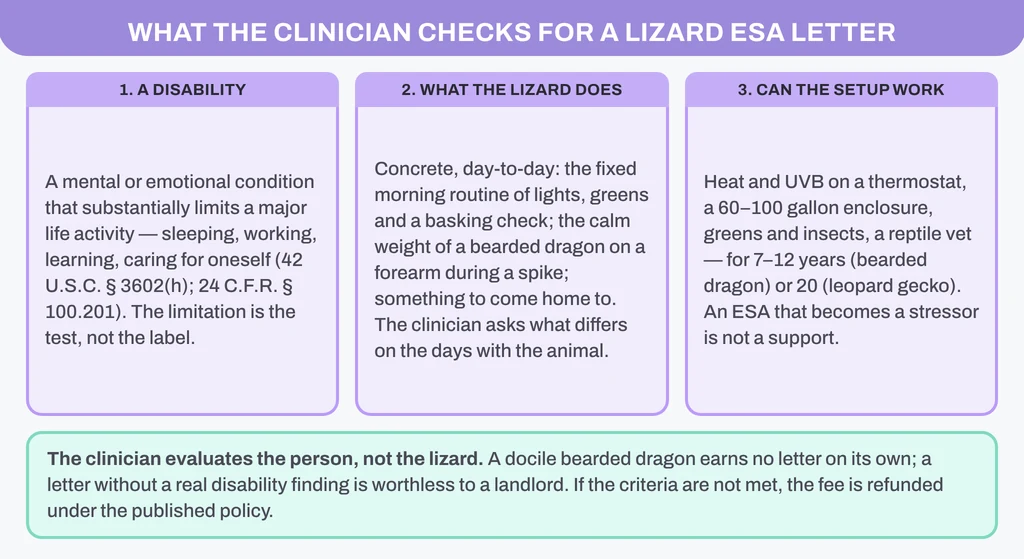
The evaluation is with a therapist licensed in the applicant’s own state, by phone or video in most states (the online ESA evaluation page describes the format). It is about the person first and the lizard second, and it covers three things.
A disability under the Fair Housing Act. That means a mental or emotional condition — anxiety, depression, PTSD, autism and others — that substantially limits a major life activity such as working, sleeping, learning or caring for oneself (42 U.S.C. § 3602(h); 24 C.F.R. § 100.201). A diagnosis on its own is not the test; the limitation is. The ESA qualification checklist walks through the general standard, and the ESA for anxiety and ESA for autism guides show how it plays out for the two conditions reptile owners mention most; one of the Reddit threads Google shows for this search is in r/autism.
What the lizard actually does. Owners describe it in concrete terms: the fixed morning routine of lights on, greens chopped and a basking check that gets a person out of bed on the days nothing else does; the slow, warm weight of a bearded dragon on a forearm during a panic spike; an animal that never startles at a raised voice and is always in the same place. The clinician asks what is different on the days with the animal compared with the days without. Most research on animals and mental health studies dogs and cats, so the case for a lizard rests on the person’s own evaluation rather than on a reptile-specific study.
Whether the arrangement can work. A good clinician also asks whether the person can keep up with the animal on the hardest weeks, because an ESA that becomes another source of stress is not a support. For a lizard that means heat and UVB on a thermostat and timer, a cleaned enclosure, fresh greens or live insects, and a veterinarian who sees reptiles — for the 7 to 12 years of a bearded dragon or the 20 of a leopard gecko. When the conclusion is that the criteria are not met, the fee comes back under the refund policy.
Sometimes, and it helps to know exactly when. The housing picture in 2026 has three separate parts, and most answers online blur them — including the AI summary at the top of this search, which still says a landlord cannot charge pet fees or pet rent for a bearded dragon.
The law itself has not moved. The reasonable-accommodation duty in 42 U.S.C. § 3604(f)(3)(B) and 24 C.F.R. § 100.204 is unchanged, contains no training requirement, and can be enforced by a private lawsuit and by state fair-housing agencies. It obliges a housing provider to consider a reasonable accommodation, not to grant every request.
HUD’s how-to notices are gone. With FHEO-2013-01 and FHEO-2020-01 withdrawn, so is the passage saying pet rent and pet deposits could not be charged for an assistance animal. Whether a fee can be charged is now a case-by-case question under federal law, but nine states cap or bar ESA fees in their own statutes (Kentucky, Virginia, Illinois, Maine, Minnesota, Hawaii, Wisconsin, Utah and Florida), while Alaska and North Carolina expressly allow pet charges and Iowa repealed its waiver in 2024. The ESA pet rent and deposits guide has the state-by-state detail.
HUD’s own enforcement has narrowed. A May 22, 2026 FHEO memorandum says HUD will find reasonable cause and recommend charges only in cases involving animals individually trained for disability-related work or tasks. HUD frames that as prioritizing its resources, not as a change in the statute: open ESA cases go to case-by-case review, and the right to sue privately is untouched. In practice a well-documented letter and a sensible request carry more of the weight than they used to.
Within that framework, there are real grounds for a no. The statute says nothing requires housing for a tenant “whose tenancy would constitute a direct threat to the health or safety of other individuals or whose tenancy would result in substantial physical damage to the property of others” (42 U.S.C. § 3604(f)(9)). With a lizard the threat argument is thinner than with a snake — a bearded dragon in a latched tank bites nobody in the next unit — but it is not empty: a Gila monster is venomous, an adult iguana is a large animal, and Salmonella is a real question in a building with young children in the shared laundry room. The assessment has to be about the specific animal and the specific setup, not about reptiles in general. Some housing is outside the Act altogether, including an owner-occupied building with four or fewer units (42 U.S.C. § 3603(b)(2)). And a housing provider may still verify the letter with the clinician and set reasonable conduct rules for the animal.
For a lizard, the realistic friction is the lamp and the fear. A manager pictures a heat lamp on a wooden dresser running fourteen hours a day, and a tenant who cannot explain the thermostat and the timer loses the argument before it starts. The accommodation changes the no-pets rule; it does not suspend the rest of the lease, and a written plan that answers those worries is worth more than the letter alone. How to make the request, and what to do if it is refused, is in ESA letter to landlord.
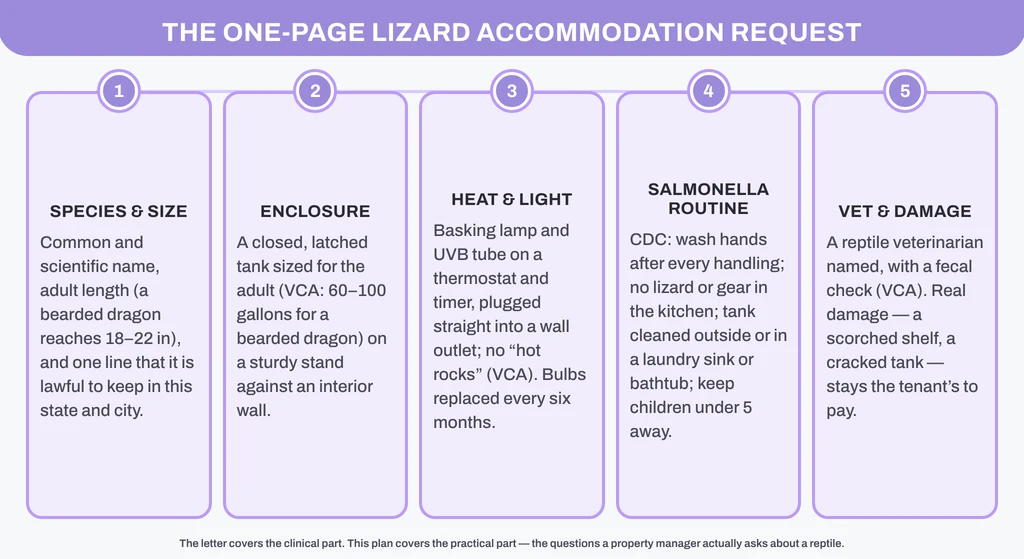
The letter covers the clinical part: that the person has a disability and that the animal is connected to it. The practical part — why the building is safe with this animal in it — belongs in the tenant’s written request, and for an animal most property managers have never dealt with it is often what turns a hesitant reply into a yes.
The species. Common and scientific name, expected adult size, and one plain line that it is not venomous and is lawful to keep in the state and the city. For a bearded dragon that is Pogona vitticeps, 18 to 22 inches as an adult, kept as an ordinary pet everywhere except Hawaii.
The enclosure. A closed, latched tank sized for the adult animal — VCA Animal Hospitals puts a grown bearded dragon in a 60- to 100-gallon tank or larger, at least three times the lizard’s length — on a sturdy stand against an interior wall, with a lid that locks. A lizard loose in the walls of a multi-unit building is the scenario managers fear; a latched front and a lid answer it.
Heat and light. This is the question the manager will actually ask. A bearded dragon needs a basking spot of 90 to 100ºF, a cooler end of 75 to 80ºF and a UVB tube (VCA). Say how it is done safely: the basking lamp and the UVB tube wired to a thermostat and a timer, plugged directly into a wall outlet rather than a chain of extension cords, the fixture clamped or mounted so it cannot fall onto bedding, and the bulbs replaced on VCA’s six-month schedule. Add that no “hot rock” is used — VCA warns they burn the animal, and a manager hears “no unattended hot surface”.
Salmonella. The CDC says even healthy reptiles can carry Salmonella, that reptiles are not recommended for households with children under 5, adults 65 and older or people with weakened immune systems, and that hands are washed with soap and running water after handling the animal, its food or anything in its tank. Bearded dragons have their own outbreak record: a CDC investigation that closed on December 10, 2024 counted 26 people infected with the outbreak strain across 13 states, two-thirds of them under 5, and the agency’s advice is plain — wash hands after every contact, don’t kiss or snuggle the animal, keep it and its gear out of the kitchen and away from where young children play, and clean its supplies outside or in a laundry sink or bathtub, never where food is prepared. Writing that routine into the request, with where the tank is cleaned, answers the one health question a manager is entitled to ask.
Feeding. Bearded dragons are omnivores; adults take most of their nutrition from leafy greens, with crickets or dubia roaches for the rest (VCA). Leopard geckos eat insects only (RVC). Feeder insects live in a sealed tub, not loose in the unit, and nothing about the diet involves the freezer that a snake request has to explain.
A veterinarian. VCA recommends an exam with a reptile-familiar veterinarian soon after a bearded dragon comes home, with a fecal sample checked for parasites. Naming the vet in the request is a small detail that tells a manager the animal is looked after.
One lizard or several. One ESA letter can cover more than one animal if the clinician believes that more than one ESA is clinically reasonable for the person; a reptile collection kept as a hobby is a different thing. Request every animal at once, in writing; a lizard added after the accommodation is granted is a new request, not an extension of the first.
Damage stays with the tenant. An ESA letter changes pet rules and, in some states, pet charges. It does not change liability: the ordinary security deposit still applies, and real damage — a scorched shelf under a lamp, a water-stained floor from a spilled tank — is still the tenant’s to pay for. Saying so plainly in the request takes one sentence and removes the manager’s biggest worry.
No to both, and the reason is the same: an emotional support animal’s federal protection is housing only. Under the Americans with Disabilities Act a service animal is a dog individually trained to do work or tasks for a person with a disability, and the definition says that emotional support and companionship do not count as tasks (28 C.F.R. § 36.104). A lizard cannot meet it, so it has no right to enter shops, restaurants or public transit, whatever it is called. A store that lets a bearded dragon in is being kind, not following a law.
Air travel changed in 2021, when the Department of Transportation’s revised rule took effect on January 11. Its service-animal definition is also limited to dogs (14 C.F.R. § 382.3), and airlines may treat emotional support animals as pets. Whether any reptile can travel at all is set by each airline’s own pet policy, so check the carrier’s pet page before planning a trip. The which airlines allow emotional support animals guide covers the 2026 airline picture. College housing is a separate case: student rooms run through the school’s accommodation process, and the ESA letter for college dorms guide covers what universities ask for.
| For a lizard | Lizard with an ESA letter | Lizard kept as an ordinary pet | Trained service dog (for comparison) |
|---|---|---|---|
| Can a lizard be one? | Yes, if a clinician finds a disability-related need and the lizard is lawful to keep | Yes, if lawful to keep | No: the ADA and DOT definitions cover dogs only |
| No-pets lease | Reasonable accommodation request with the letter | Lease rules apply in full | Reasonable accommodation; training is the strongest case after the 2026 HUD memo |
| Pet rent and deposits | Case by case since 2025; barred or capped by statute in nine states | Whatever the lease says | Case by case; state statutes vary |
| State and local animal laws | Still apply in full (Hawaii, Florida, New York City above) | Apply | Apply |
| Heat lamp, UVB, tank | Tenant’s responsibility; a written safety plan helps the request | Tenant’s responsibility | Not applicable |
| Damage to the unit | Tenant still responsible | Tenant responsible | Tenant responsible |
| Stores, restaurants, transit | No access rights | No access rights | Access under the ADA |
| Flights | Airline’s pet policy since the 2021 DOT rule | Airline’s pet policy | Accepted with the DOT service-animal form |
| Document | ESA letter from a licensed mental health professional after an evaluation | None | None in public; housing still runs through an accommodation request |
For an adult, the process takes four steps, and the lizard changes almost none of them — except that the first check is whether the species is legal where the person lives.
Answer the free five-minute quiz. A handful of questions — is there a condition that affects daily life, is there an animal that helps, which state — so that nobody books an evaluation that cannot go anywhere. The quiz is the only free step.
Get matched with a clinician licensed in the applicant’s state. Not a clinician somewhere in the country: one licensed where the applicant lives, because several states have their own rules about who may sign and what has to come first. The fee is $99 flat, paid at checkout before the evaluation — no membership, no auto-renewal, no add-ons (details on the ESA letter pricing page). If the clinician finds the applicant doesn’t qualify, they get a full refund.
Do the evaluation. It runs through the three checks above. Useful to have to hand: the name of any current therapist or prescriber, how long the lizard has been in the household, what changes on the days with it, and the enclosure and lighting plan; none of them is required.
Receive the letter if the clinician finds a qualifying need. In most states it usually arrives within 24–48 hours of the evaluation. In California, Louisiana, Arkansas, Montana and Iowa the letter follows a 30-day clinical relationship instead, so it comes after the 30 days, not in two. It states that the person has a disability under the Fair Housing Act and that the animal is connected to it, and carries the clinician’s license number, state and signature. If the housing provider calls to verify, the support team answers. Letters are written for twelve months, and the ESA letter renewal guide covers the year after.
If the clinician decides the applicant doesn’t qualify, the refund is requested within 7 days. If a landlord rejects the letter in writing after our support team has been involved, the refund window is 30 days. Both terms are on the refund policy page. The full walkthrough is in how to get an ESA letter.
State rules. The species does not change the ESA letter rules; the state does. Several states add their own rules about who may write an ESA letter and what has to happen first, and a letter that ignores them is easy to challenge — which is why PetESALetter matches each applicant with a clinician licensed in their own state.
| State | What has to be in place before the letter is signed | Who may sign | Statute |
|---|---|---|---|
| California | A client-provider relationship of at least 30 days and a clinical evaluation; license details stated in the letter | A practitioner licensed in California | Cal. Health & Safety Code § 122318 (AB 468, 2021) |
| Louisiana | A therapeutic relationship of at least 30 days, at least two sessions, a disability assessment and a clinical evaluation | A Louisiana-licensed provider | La. R.S. 46:1974 (Act 558 of 2024) |
| Arkansas | A 30-day client-provider relationship and a clinical evaluation, reviewed at least once a year | A provider licensed in the jurisdiction | Ark. Code Ann. § 20-14-1003 (Act 268 of 2023) |
| Montana | A client-provider relationship of at least 30 days and a clinical evaluation; a registry card is not sufficient on its own | A Montana-licensed mental health professional, license details in the letter | Mont. Code Ann. § 70-24-114 (HB 703, 2023; amended 2025) |
| Iowa | A written finding that states whether the provider-patient relationship has lasted at least 30 days; the state’s own form has the signer certify that it has | A licensed physician, PA, nurse, psychologist, social worker or behavioral-science professional, in Iowa or in good standing in another state | Iowa Code § 216.8C (SF 2268, 2024) |
| Florida | Personal knowledge of the disability; no waiting period. An out-of-state practitioner must have provided in-person care at least once | A practitioner acting within the scope of the license | Fla. Stat. § 760.27 (SB 1084, 2020) |
| Colorado | An in-person meeting and a written finding on disability and need; no waiting period | A mental health licensee with sufficient familiarity with the patient | C.R.S. § 12-245-229; HB26-1045 (eff. Aug 12, 2026) |
Everywhere else the federal framework applies on its own. The California ESA letter and Louisiana ESA letter pages go through the two strictest states in detail, and the state pages linked in the navigation cover the rest. Two different sets of rules are in play for a lizard owner: the ESA-letter rules in this table, and the wildlife or health code, which decides whether that lizard can be kept at that address at all. Florida appears in both: its ESA statute governs the letter, and its Prohibited list rules out a new pet iguana or tegu.
The red flags are the same for every species. A letter in minutes — “instant approval” means nobody evaluated anyone, and the how to verify an ESA letter is real guide lists what a genuine one contains. A registration number, certificate, harness tag or ID card for the lizard — there is no registry. A seller happy to write a bearded dragon letter for an address in Hawaii without a word about the ban. And a promise that the landlord “must” accept the letter — the statute obliges a housing provider to consider a reasonable accommodation, not to grant every request.
The bottom line. A lizard can be an emotional support animal for housing when a licensed clinician finds a disability and finds that the animal eases it; the law names no species, and HUD’s old household-animal list is withdrawn guidance, not the test. But a letter cannot make a lizard legal where it is banned — bearded dragons and geckos in Hawaii, iguanas, monitors and tegus in New York City and (without a 2021 permit) in Florida. Elsewhere, the request should answer the heat-lamp, UVB, tank, Salmonella and damage questions before they are asked. There are no flight or public-access rights. PetESALetter evaluates adults, with a clinician licensed in their state, for $99 flat and a full refund if the clinician finds no qualifying need.
Wondering whether your bearded dragon or gecko can be your ESA — and whether it is legal where you live? A licensed clinician in your state evaluates whether an emotional support animal fits the situation — and the first step is a free five-minute screen.
Yes. The Fair Housing Act does not limit emotional support animals to any species, so a bearded dragon can be an ESA for housing when a licensed mental health professional evaluates the person, finds a disability that substantially limits daily life, and finds that the animal helps with it. The exception is legality: Hawaii bars bearded dragons as pets, and no letter changes that.
Hawaii. Its Department of Agriculture and Biosecurity lists “bearded dragon lizards” and “geckos” among animals prohibited from possession by private individuals (HAR ch. 4-71). That is the only state ban we could verify on the regulator’s own text; claims that other states ban them circulate online without a source. Iguanas, monitors and tegus are a different matter — banned in New York City and Prohibited in Florida — and some cities limit reptiles by species or length, so check the local animal code too.
No. The letter is about the person, not the animal: it documents a disability under the Fair Housing Act and the animal’s role in easing it, which is a finding only a licensed mental health professional can make. A veterinarian’s records still matter in the request — a reptile vet’s exam and parasite check show the lizard is cared for — but they do not replace the clinician’s evaluation.
No. There is no ESA registry in U.S. law, and a registration number, certificate, ID card or harness tag gives a bearded dragon no legal status. A housing provider can only rely on an ESA letter from a licensed clinician who evaluated the person. Sites selling registration kits are selling paperwork that nothing in the Fair Housing Act recognises.
Under federal law it is now case by case: the HUD notice that said assistance animals could not be charged pet fees was withdrawn in September 2025. Nine states bar or cap ESA fees in their own statutes, including Florida and Hawaii, while Alaska and North Carolina expressly allow pet charges. What an ESA letter never changes is liability: damage from a lamp or a spilled tank is still the tenant’s to pay for.
Any lizard can, on the same terms: the clinician evaluates the person and the animal’s role, not the species. Leopard geckos are small, quiet and can live 20 years, which makes an easy housing request; crested geckos the same. Both are geckos, so both are barred in Hawaii. A green iguana, a monitor or a tegu can qualify in principle but is banned as a pet in New York City and Prohibited in Florida, and its size makes the request much harder anywhere.

Licensed Psychotherapist
Darren is a leading expert in mental health advocacy and assistance animal documentation. He specializes in streamlining the process for obtaining ESA Letters, PSD Letters, and State-specific ESA compliance.

ESA Letters Issued

Successful Consultations

Licensed Therapist Network

Client Satisfaction Rate




Petesaletter.com helps you get your emotional support animal letter online with guidance and support.

Got Questions? Call us 24/7
Copyright © 2020-2026 Petesaletter All rights reserved. Terms | Privacy | Refund
Owned and Operated by Verimedix LLC