
Last Updated on: October 12, 2026
Reviewed by Darren Andrew Rafel

Yes — a snake can be an emotional support animal for housing. The Fair Housing Act names no species; what counts is a licensed mental health professional finding a disability the snake eases. It must be lawful to keep, which in some states rules out venomous snakes and giant pythons, and gets no flight or public-access rights. PetESALetter matches adults with a clinician licensed in their state; in most states a qualifying letter follows within 24–48 hours, for $99 flat.
Key takeaways
Yes. Nothing in the Fair Housing Act or HUD’s regulation limits an emotional support animal to a dog or a cat. The statute makes it discrimination to refuse “reasonable accommodations in rules, policies, practices, or services, when such accommodations may be necessary to afford such person equal opportunity to use and enjoy a dwelling” (42 U.S.C. § 3604(f)(3)(B)), and 24 C.F.R. § 100.204 restates that duty. An exception to a no-pets rule for a corn snake in a terrarium is that kind of accommodation. The questions are the same as for any animal: does the person have a disability, and does this animal help with it?
What has changed is the guidance around the law. For years, tenants and housing providers worked from HUD Notice FHEO-2020-01, which listed animals “commonly kept in households” — dogs, cats, small birds, rabbits, hamsters, fish, turtles — and asked anyone requesting a different kind of animal to show a disability-related need for that specific type of animal. Snakes were never on the list. That notice and the earlier FHEO-2013-01 were withdrawn effective September 17, 2025 (91 FR 17291, April 6, 2026), so neither the list nor its extra step is HUD’s guidance any more. A snake request now rests where every request rests: on a credible letter, and on whether the accommodation is reasonable for that building.
A snake has some real advantages in that conversation. It lives in a closed enclosure, makes no sound, needs no walks, has no fur and does not meet the neighbor’s dog in the hallway. Its weak points are the ones people fear: that it will get out, and what it eats. That is why this page spends as much time on species, enclosures and feeding as on the letter itself.
Two things a snake never needs: registration and an ID card. U.S. law has no ESA registry. The ESA registration myths page takes apart the certificate and vest sellers, and the cat ESA registration scams guide shows the same pitch aimed at cat owners. What a housing provider can rely on is an ESA letter from a licensed clinician who evaluated the person. The same logic runs through the other species guides on this site, from the emotional support rabbit to the emotional support bird.
For a housing request, the best emotional support snake is usually the one that already helps — provided it is legal where the person lives and fits in a normal apartment. Species matters less to the clinician than to the property manager, and to the manager it comes down to three things: how big the snake gets, how long it lives and whether the law lets anyone keep it. VCA Animal Hospitals and the Merck Veterinary Manual give the first two for the species people most often ask about; the last column is our read of how each one lands in a shared building.
| Snake | Typical adult length (VCA) | Life span in captivity (Merck) | Fit in a rental (our read) |
|---|---|---|---|
| Corn snake | 3–6 feet | 10–15 years | Easiest request: docile, modest enclosure |
| King snake | 3–6 feet | 10–15 years | Easy; one snake per enclosure |
| Ball python | Usually 3–5 feet | 15–20 years | Good: small and calm, though VCA notes it can go long periods without eating |
| Rainbow boa | Up to about 6.5 feet | Not listed | Possible; check local size limits |
| Boa constrictor (red-tailed boa) | Can reach 13 feet | 15–25 years | Hard: needs a very large enclosure as an adult |
| Burmese python | 10–16 feet, up to 200 lb | Not listed | Not a rental animal; on federal and state restricted lists |
| Reticulated python, anacondas | Some pythons reach 20 feet | Not listed | Not a rental animal; on federal and state restricted lists |
| Any venomous snake | — | — | Not an ESA candidate: banned as a pet in New York, permit-only in Ohio |
Two cautions sit under that table. First, a species never qualifies a person: the clinician evaluates the human, not the snake, and a calm corn snake earns no letter on its own. Second, size changes everything about the request. A three-foot corn snake in a closed glass terrarium is a quiet piece of furniture to most managers; a boa that may reach thirteen feet needs an enclosure the size of a closet, and the giant pythons are restricted by federal and state law whatever anyone’s paperwork says. The usual emotional support snake is one the person already has, already handles and already knows helps.
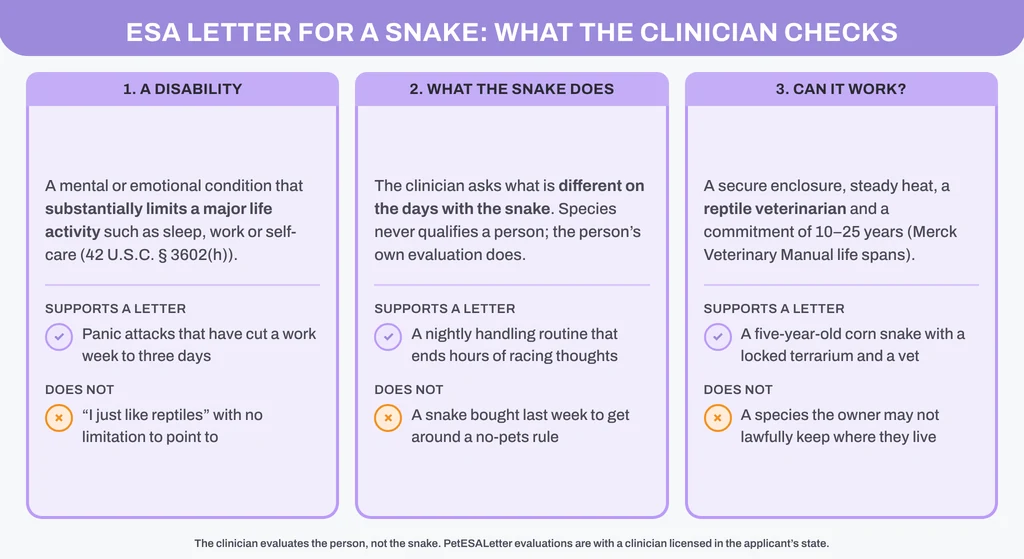
The evaluation is with a therapist licensed in the applicant’s own state, by phone or video in most states (the online ESA evaluation page describes the format). It is about the person first and the snake second, and it covers three things.
A disability under the Fair Housing Act. That means a mental or emotional condition — anxiety, depression, PTSD, autism and others — that substantially limits a major life activity such as working, sleeping, learning or caring for oneself (42 U.S.C. § 3602(h); 24 C.F.R. § 100.201). A diagnosis on its own is not the test; the limitation is. The ESA qualification checklist walks through the general standard, and the ESA for anxiety and ESA for autism guides show how it plays out for two conditions snake owners often mention.
What the snake actually does. Owners describe it in concrete terms: the slow weight of a ball python across the shoulders during a panic spike, a fixed weekly feeding night that gives a chaotic month some structure, an animal that never startles at a raised voice. The clinician asks what is different on the days with the snake compared with the days without. Most research on animals and mental health studies dogs and cats, so the case for a snake rests on the person’s own evaluation rather than on a snake-specific study.
Whether the arrangement can work. A good clinician also asks whether the person can keep up with the animal on the hardest weeks, because an ESA that becomes another source of stress is not a support. For a snake that means steady heat and humidity, a cleaned enclosure, frozen feeders bought ahead and a veterinarian who sees reptiles — for ten to twenty-five years. When the conclusion is that the criteria are not met, the fee comes back under the refund policy.
Sometimes, and it helps to know exactly when. The housing picture in 2026 has three separate parts, and most answers online blur them — including the AI summaries that still say a landlord “must” accept any ESA and cannot charge pet fees.
The law itself has not moved. The reasonable-accommodation duty in 42 U.S.C. § 3604(f)(3)(B) and 24 C.F.R. § 100.204 is unchanged, contains no training requirement, and can be enforced by a private lawsuit and by state fair-housing agencies. It obliges a housing provider to consider a reasonable accommodation, not to grant every request.
HUD’s how-to notices are gone. With FHEO-2013-01 and FHEO-2020-01 withdrawn, so is the passage saying pet rent and pet deposits could not be charged for an assistance animal. Whether a fee can be charged is now a case-by-case question under federal law, but nine states cap or bar ESA fees in their own statutes (Kentucky, Virginia, Illinois, Maine, Minnesota, Hawaii, Wisconsin, Utah and Florida), while Alaska and North Carolina expressly allow pet charges and Iowa repealed its waiver in 2024. The ESA pet rent and deposits guide has the state-by-state detail.
HUD’s own enforcement has narrowed. A May 22, 2026 FHEO memorandum says HUD will find reasonable cause and recommend charges only in cases involving animals individually trained for disability-related work or tasks. HUD frames that as prioritizing its resources, not as a change in the statute: open ESA cases go to case-by-case review, and the right to sue privately is untouched. In practice a well-documented letter and a sensible request carry more of the weight than they used to.
Within that framework, there are real grounds for a no, and with snakes they matter more than with most animals. The statute says nothing requires housing for a tenant “whose tenancy would constitute a direct threat to the health or safety of other individuals or whose tenancy would result in substantial physical damage to the property of others” (42 U.S.C. § 3604(f)(9)). A venomous snake is the plainest case a housing provider could point to, and a giant constrictor is not far behind; a three-foot corn snake in a locked terrarium is a very different question, and the assessment has to be about the specific animal, not about snakes in general. Some housing is outside the Act altogether, including an owner-occupied building with four or fewer units (42 U.S.C. § 3603(b)(2)). And a housing provider may still verify the letter with the clinician and set reasonable conduct rules for the animal.
For a snake, the realistic friction is fear and logistics: the neighbor who does not want to share a wall with it, the maintenance technician who has to enter the unit, the freezer. The accommodation changes the no-pets rule; it does not suspend the rest of the lease, and a written plan that answers those worries is worth more than the letter alone. How to make the request, and what to do if it is refused, is in ESA letter to landlord.
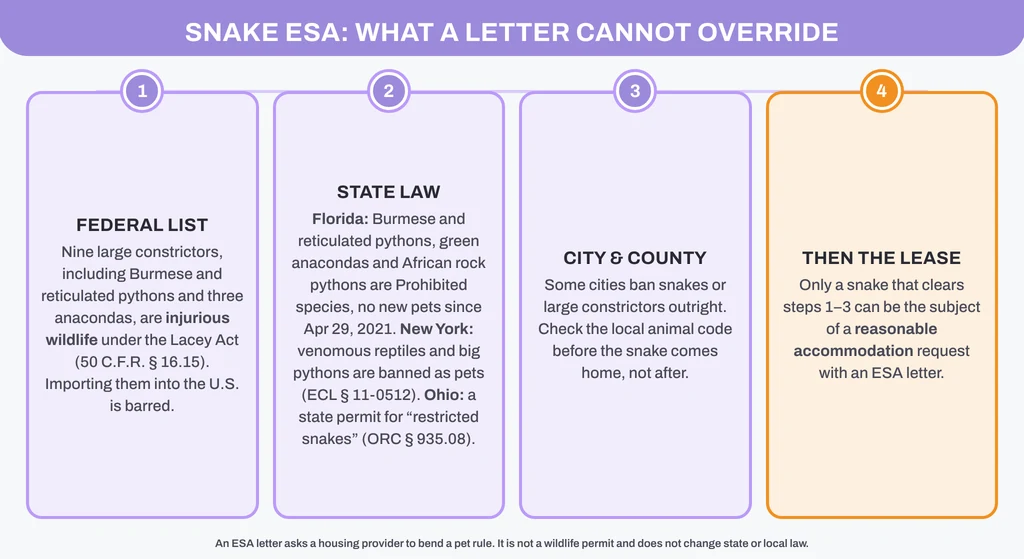
An ESA letter is a housing document. It asks a housing provider to bend a pet rule; it does not license anyone to keep an animal the law says they may not keep. Snakes run into that line more often than most pets, at three levels.
The federal list. Under the Lacey Act, the U.S. Fish and Wildlife Service lists nine snakes as injurious wildlife: the brown tree snake, the Indian and Burmese python, the reticulated python, the Northern and Southern African pythons, and the yellow, DeSchauensee’s, green and Beni anacondas (50 C.F.R. § 16.15). The listing bars bringing them into the country, and a housing request built around one starts on the wrong foot.
State law. States keep their own lists, and the three below show how differently they work. Florida moved the Burmese, reticulated, Northern and Southern African, amethystine and scrub pythons and the green anaconda to its Prohibited list on April 29, 2021; the Fish and Wildlife Conservation Commission says Prohibited species may no longer be acquired as personal pets. New York makes it unlawful to possess a “wild animal” as a pet (Environmental Conservation Law § 11-0512), and its definition covers all venomous reptiles plus the Burmese, reticulated, African rock, Indian and amethystine pythons and the green and yellow anacondas (§ 11-0103(6)(e)). Ohio calls venomous snakes and those big constrictors at twelve feet or longer “restricted snakes” (Ohio Rev. Code § 935.01) and requires a state possession permit within 120 days of acquiring one, with an escape plan filed with the sheriff and a veterinarian’s statement (§ 935.08). A letter from a clinician in any of those states changes none of it. The Florida ESA letter, New York ESA letter and Ohio ESA letter pages cover the housing side of each state.
City and county codes. Many cities and counties have their own exotic- or dangerous-animal ordinances, and some ban snakes, or snakes over a certain length, outright. Check the local animal code before a move, not after. Keeping the purchase or adoption record, with the species named, answers the question before a manager or an animal-control officer asks it.
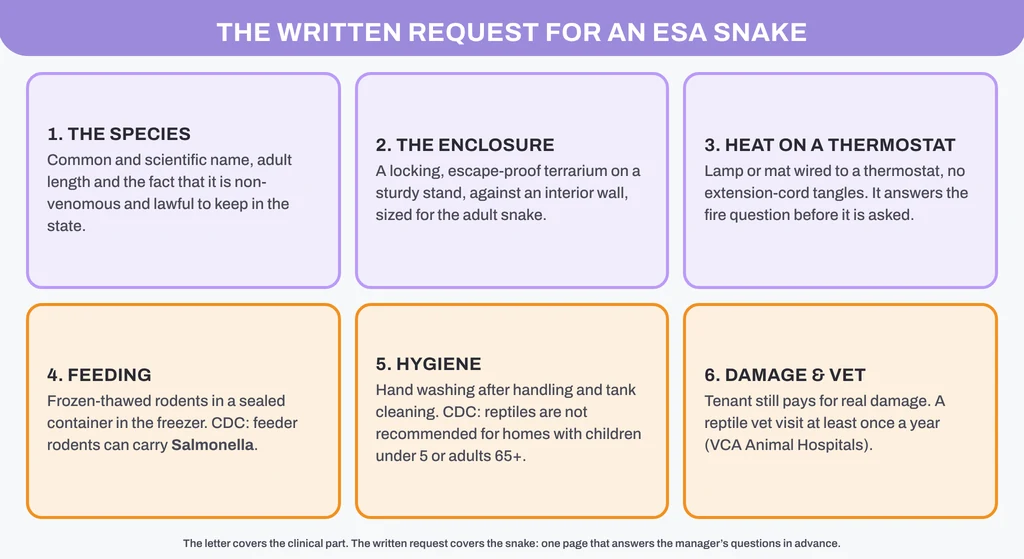
The letter covers the clinical part: that the person has a disability and that the animal is connected to it. The practical part — why the snake will stay in its tank and why the building is safe — belongs in the tenant’s written request, and for an animal most property managers have never dealt with it is often what turns a hesitant reply into a yes.
The species. Common and scientific name, expected adult length, and one plain line that it is non-venomous and lawful to keep in the state. That sentence answers the first two questions any manager has about a snake.
The enclosure. A locking, escape-proof terrarium sized for the adult snake, on a sturdy stand against an interior wall. An escaped snake inside the walls of a multi-unit building is the scenario managers fear most, and a locked front is the answer to it.
Heat. Snakes need a heat source. A lamp or heat mat wired to a thermostat, plugged directly into a wall outlet rather than a chain of extension cords, answers the fire question before it is asked.
Feeding. Most pet snakes eat whole rodents. Frozen-thawed feeders, stored in a sealed container in the freezer and thawed away from food prep, keep live rodents out of the unit. The CDC notes that feeder rodents for snakes and other reptiles can carry germs like Salmonella, so the handling routine is worth a line.
Hygiene. The CDC says reptiles often carry Salmonella in their digestive tracts, even when they look healthy, and that reptiles are not recommended for households with children under 5, adults 65 and older or people with weakened immune systems. Hand washing with soap and running water after handling the snake or cleaning its tank is the standard answer, and in a shared house it is worth saying out loud.
A veterinarian. VCA Animal Hospitals recommends a reptile veterinarian examine a new snake within a week of purchase and at least once a year after that, including a check for parasites. Naming the vet in the request is a small detail that tells a manager the animal is looked after.
One snake or several. One ESA letter can cover more than one animal if the clinician believes that more than one ESA is clinically reasonable for the person; a collection kept as a hobby is a different thing. Request every animal at once, in writing; a snake added after the accommodation is granted is a new request, not an extension of the first.
Damage stays with the tenant. An ESA letter changes pet rules and, in some states, pet charges. It does not change liability: the ordinary security deposit still applies, and real damage — a scorched shelf under a heat lamp, a water-damaged floor from a spilled tank — is still the tenant’s to pay for. Saying so plainly in the request takes one sentence and removes the manager’s biggest worry.
No to both, and the reason is the same: an emotional support animal’s federal protection is housing only. Under the Americans with Disabilities Act a service animal is a dog individually trained to do work or tasks for a person with a disability, and the definition says that emotional support and companionship do not count as tasks (28 C.F.R. § 36.104). A snake cannot meet it, so it has no right to enter shops, restaurants or public transit, whatever it is called.
Air travel changed in 2021, when the Department of Transportation’s revised rule took effect on January 11. Its service-animal definition is also limited to dogs (14 C.F.R. § 382.3), and airlines may treat emotional support animals as pets. In December 2022 TSA officers at Tampa International Airport found a four-foot boa constrictor in a carry-on bag; the passenger called it her emotional support animal, and the airline refused to let it fly in the cabin (CBS News, January 2023). Whether any snake can travel is set by each airline’s own pet policy, so check the carrier’s pet page before planning a trip. The which airlines allow emotional support animals guide covers the 2026 airline picture. College housing is a separate case: student rooms run through the school’s accommodation process, and the ESA letter for college dorms guide covers what universities ask for.
| For a snake | Snake with an ESA letter | Snake kept as an ordinary pet | Trained service dog (for comparison) |
|---|---|---|---|
| Can a snake be one? | Yes, if a clinician finds a disability-related need and the snake is lawful to keep | Yes, if lawful to keep | No: the ADA and DOT definitions cover dogs only |
| No-pets lease | Reasonable accommodation request with the letter | Lease rules apply in full | Reasonable accommodation; training is the strongest case after the 2026 HUD memo |
| Pet rent and deposits | Case by case since 2025; barred or capped by statute in nine states | Whatever the lease says | Case by case; state statutes vary |
| State and local animal laws | Still apply in full | Apply | Apply |
| Damage to the unit | Tenant still responsible | Tenant responsible | Tenant responsible |
| Stores, restaurants, transit | No access rights | No access rights | Access under the ADA |
| Flights | Airline’s pet policy since the 2021 DOT rule | Airline’s pet policy | Accepted with the DOT service-animal form |
| Document | ESA letter from a licensed mental health professional after an evaluation | None | None in public; housing still runs through an accommodation request |
For an adult, the process takes four steps, and the snake changes almost none of them.
Answer the free five-minute quiz. A handful of questions — is there a condition that affects daily life, is there an animal that helps, which state — so that nobody books an evaluation that cannot go anywhere. The quiz is the only free step.
Get matched with a clinician licensed in the applicant’s state. Not a clinician somewhere in the country: one licensed where the applicant lives, because several states have their own rules about who may sign and what has to come first. The fee is $99 flat, paid at checkout before the evaluation — no membership, no auto-renewal, no add-ons (details on the ESA letter pricing page). If the clinician finds the applicant doesn’t qualify, they get a full refund.
Do the evaluation. It runs through the three checks above. Useful to have to hand: the name of any current therapist or prescriber, how long the snake has been in the household, what changes on the days with it, and the enclosure plan; none of them is required.
Receive the letter if the clinician finds a qualifying need. In most states it usually arrives within 24–48 hours of the evaluation. In California, Louisiana, Arkansas, Montana and Iowa the letter follows a 30-day clinical relationship instead, so it comes after the 30 days, not in two. It states that the person has a disability under the Fair Housing Act and that the animal is connected to it, and carries the clinician’s license number, state and signature. If the housing provider calls to verify, the support team answers. Letters are written for twelve months, and the ESA letter renewal guide covers the year after.
If the clinician decides the applicant doesn’t qualify, the refund is requested within 7 days. If a landlord rejects the letter in writing after our support team has been involved, the refund window is 30 days. Both terms are on the refund policy page. The full walkthrough is in how to get an ESA letter.
State rules. The species does not change the ESA letter rules; the state does. Several states add their own rules about who may write an ESA letter and what has to happen first, and a letter that ignores them is easy to challenge — which is why PetESALetter matches each applicant with a clinician licensed in their own state.
| State | What has to be in place before the letter is signed | Who may sign | Statute |
|---|---|---|---|
| California | A client-provider relationship of at least 30 days and a clinical evaluation; license details stated in the letter | A practitioner licensed in California | Cal. Health & Safety Code § 122318 (AB 468, 2021) |
| Louisiana | A therapeutic relationship of at least 30 days, at least two sessions, a disability assessment and a clinical evaluation | A Louisiana-licensed provider | La. R.S. 46:1974 (Act 558 of 2024) |
| Arkansas | A 30-day client-provider relationship and a clinical evaluation, reviewed at least once a year | A provider licensed in the jurisdiction | Ark. Code Ann. § 20-14-1003 (Act 268 of 2023) |
| Montana | A client-provider relationship of at least 30 days and a clinical evaluation; a registry card is not sufficient on its own | A Montana-licensed mental health professional, license details in the letter | Mont. Code Ann. § 70-24-114 (HB 703, 2023; amended 2025) |
| Iowa | A written finding that states whether the provider-patient relationship has lasted at least 30 days; the state’s own form has the signer certify that it has | A licensed physician, PA, nurse, psychologist, social worker or behavioral-science professional, in Iowa or in good standing in another state | Iowa Code § 216.8C (SF 2268, 2024) |
| Florida | Personal knowledge of the disability; no waiting period. An out-of-state practitioner must have provided in-person care at least once | A practitioner acting within the scope of the license | Fla. Stat. § 760.27 (SB 1084, 2020) |
| Colorado | An in-person meeting and a written finding on disability and need; no waiting period | A mental health licensee with sufficient familiarity with the patient | C.R.S. § 12-245-229; HB26-1045 (eff. Aug 12, 2026) |
Everywhere else the federal framework applies on its own. Our California ESA letter and Louisiana ESA letter pages go through the two strictest states in detail, and the state pages linked in the navigation cover the rest. Remember that two different sets of state law are in play for a snake owner: the ESA-letter rules in this table, and the wildlife rules above, which decide whether the snake can be kept at all.
The red flags are the same for every species. A letter in minutes — “instant approval” means nobody evaluated anyone, and the how to verify an ESA letter is real guide lists what a genuine one contains. A registration number, certificate, vest or ID tag for the snake — there is no registry. And a promise that the landlord “must” accept the letter — the statute obliges a housing provider to consider a reasonable accommodation, not to grant every request.
The bottom line. A snake can be an emotional support animal for housing when a licensed clinician finds a disability and finds that the snake eases it; the law names no species, and HUD’s old household-animal list is withdrawn guidance, not the test. The snake has to be one the owner may lawfully keep, which rules out the giant constrictors on federal and state lists and, in states like New York, every venomous species. The request should answer the escape, heat, feeding and Salmonella questions before they are asked, with an honest line about damage. There are no flight or public-access rights. PetESALetter evaluates adults, with a clinician licensed in their state, for $99 flat and a full refund if the clinician finds no qualifying need.
Wondering whether your snake can be your ESA — and how to make the request work in a rental? A licensed clinician in your state evaluates whether an emotional support animal fits the situation — and the first step is a free five-minute screen.
Yes. The Fair Housing Act does not limit emotional support animals to any species, so a snake can be an ESA for housing when a licensed mental health professional evaluates the person, finds a disability that substantially limits daily life, and finds that the snake helps with it. The snake must be one the owner may lawfully keep, and it has no airline or public-access rights.
Usually the snake the person already has and already knows helps. For a rental, small docile species are the easiest request: VCA Animal Hospitals puts adult corn snakes and king snakes at 3–6 feet and ball pythons usually at 3–5 feet. Boa constrictors can reach 13 feet, and the giant pythons and anacondas are restricted by federal and state law.
Not simply for being a snake, but a housing provider may refuse where an animal would be a direct threat to others or cause substantial physical damage (42 U.S.C. § 3604(f)(9)), where the housing is exempt, or where the species is illegal to keep. A venomous snake is the clearest case for refusal. A written plan for the enclosure, heat and feeding answers most other concerns.
Rarely, and in several states not at all. New York bans venomous reptiles and the big pythons and anacondas as pets, Florida has barred new pet Burmese and reticulated pythons since April 29, 2021, and Ohio requires a state permit for them. Nine giant constrictors are also federal injurious wildlife. An ESA letter does not override any of those laws.
No. There is no official ESA registry in the United States, and registration numbers, certificates and ID cards carry no legal weight. What a housing provider can rely on is an ESA letter from a licensed mental health professional who evaluated the person, and it may verify that letter with the clinician.
Not as an ESA. Since the Department of Transportation’s 2021 rule, airlines may treat emotional support animals as pets, and the federal service-animal definition covers dogs only. Whether a snake can fly at all depends on the airline’s own pet policy, which varies by carrier.

Licensed Psychotherapist
Darren is a leading expert in mental health advocacy and assistance animal documentation. He specializes in streamlining the process for obtaining ESA Letters, PSD Letters, and State-specific ESA compliance.

ESA Letters Issued

Successful Consultations

Licensed Therapist Network

Client Satisfaction Rate




Petesaletter.com helps you get your emotional support animal letter online with guidance and support.

Got Questions? Call us 24/7
Copyright © 2020-2026 Petesaletter All rights reserved. Terms | Privacy | Refund
Owned and Operated by Verimedix LLC