


ESA Letter Ohio: Housing Letters From Ohio-Licensed Clinicians
An ESA letter in Ohio is a $99 housing letter from an Ohio-licensed clinician who evaluates you. There is no official ESA registry. Clinically reviewed by Darren Rafel, LCSW.






ESA LETTER OHIO
What Is an Ohio ESA Letter?
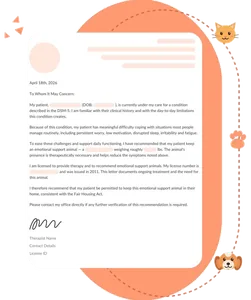
An emotional support animal letter is a signed note from a licensed mental health clinician who has evaluated you. It states that you have a disability and that your animal eases its effects. You hand it to your landlord with a request for a reasonable accommodation, such as an exception to a no-pets rule. It opens no doors in stores or on planes.
Ohio has no ESA statute. Instead, a renter relies on the state’s Civil Rights Act and two state rules that use the term “animal assistant.” Neither the statute nor the rules say the animal must be trained. Under the Civil Rights Commission’s reading, an untrained ESA can count as an animal assistant in housing.
Federal law adds the Fair Housing Act, 42 U.S.C. § 3604(f)(3)(B). HUD’s May 22, 2026, memo narrowed when HUD itself finds cause, to trained animals only. It did not change the Act or Ohio’s rules. Our letter costs $99 flat. No registry, ID card or certificate gives an animal legal status.

How Do You Get an ESA Letter in Ohio?
Getting an emotional support animal letter Ohio landlords can verify takes four online steps. The state sets no 30-day waiting period, so one telehealth evaluation can be enough.

Start With the Free Quiz
Answer a short, private quiz about your symptoms, routine and animal. It takes about five minutes and costs nothing.

Pay $99, Then Meet Your Clinician
You pay $99 at checkout. An Ohio-licensed clinician then evaluates you one-on-one by video, phone or secure online visit.

Your Clinician Decides
The clinician judges, on clinical grounds, whether you have a disability-related need for an animal. Not everyone qualifies; if you don’t, request a full refund within 7 days.

Share the Letter With Your Housing Provider
If you qualify, your signed letter usually arrives by email within 24–48 hours. Send it to your landlord with your accommodation request.
Who Qualifies for an Emotional Support Animal in Ohio?
Ohio law defines disability as “a physical or mental impairment that substantially limits one or more major life activities” (R.C. § 4112.01(A)(13)). A licensed clinician decides whether yours fits.
Conditions that clinicians often evaluate include the ones below, though none qualifies on its own:
Ohio ESA Laws: What R.C. 4112 and the Rules Say
Ohio ESA laws come from a civil rights statute and two state rules. O.A.C. 4112-5-02(C) defines an “animal assistant” as “any animal which aids” a person with a disability.
No ESA Statute in Ohio
No section of the Revised Code defines emotional support animals, and no ESA bill was introduced from 2019 through 2026.
The Accommodation Clause
R.C. § 4112.02(H)(19) makes it unlawful to refuse reasonable accommodations in rules or policies when necessary for a person with a disability to use a home.
Ohio Rule: No Extra Charge
O.A.C. 4112-5-07(C) lets you keep an animal assistant, and you “shall not be required to pay any extra charge” for it. You still pay for any damage it causes.
Stores and Restaurants Can Say No
An ESA letter covers housing only. Public access in shops, restaurants and hotels belongs to trained service animals, so an ESA can be turned away.
Commission Guidance, Now Offline
The Commission’s technical policy T-31 said an ESA “may qualify as an animal assistant,” so the no-extra-charge rule reaches ESAs by its reading. T-31 is not currently posted on its site.
Can Ohio Landlords Deny an ESA?
Only on narrow grounds, and the landlord bears the burden. Ohio’s rules give renters protections that federal law lacks, and HUD’s 2026 memo did not change them.
The Landlord Carries the Burden
Once a landlord refuses you, O.A.C. 4112-5-07(E) places “the burden of establishing the basis for such refusal” on the landlord, not on you.
No Questions About Your Diagnosis
Under R.C. § 4112.02(H)(17), a landlord may not ask about the nature or severity of your disability. Only limited, general questions are allowed.
No Retaliation or Pressure
State law also bars coercing, threatening or interfering with anyone using these rights (R.C. § 4112.02(H)(12)) and bars retaliation for asserting them (§ 4112.02(I)).
One Year to Act
File a charge with the Ohio Civil Rights Commission within one year (R.C. § 4112.05(B)(1)); call 1-888-278-7101. A state-court suit also has a one-year limit (§ 4112.055(A)(1)).
Proven Danger or Damage
A landlord may refuse an animal proven to pose a direct threat or substantial damage (R.C. § 4112.024(D)). “Speculative evidence” will not suffice (O.A.C. 4112-5-07(F)).
Few Exemptions Apply
R.C. § 4112.024’s exemptions are narrow, and none covers small landlords. Unlike federal law, Ohio does not exempt owner-occupied buildings or owners of a few houses.
No Reliable Documentation
If your need is not obvious, Commission guidance (T-31) let a landlord ask for reliable documentation of the disability and need. Without it, a refusal may stand.
AIR TRAVEL
ESA vs Service Dog: Ohio Service Dog Laws and Flying
An ESA has no special right to fly. Under the Department of Transportation’s Air Carrier Access Act rule, in force since January 11, 2021, airlines may treat it as a pet.
Before you book a flight, read the airline’s pet policy. Expect a pet fee, size limits for carriers and a cap on animals per cabin. Your housing letter will not change any of that. Ask the airline about health papers for the animal, too.
On the ground, Ohio service dog laws protect access for assistance dogs trained by a nonprofit or for-profit special agency (R.C. § 955.021(B)(3)). Recklessly denying such a dog access is a fourth-degree misdemeanor under R.C. § 955.43(D). An ESA has no public-access rights. If your dog is trained for psychiatric tasks, ask about our PSD letter.
Is There Emotional Support Animal Registration in Ohio?
No. Emotional support animal registration in Ohio does not exist. A clinician’s letter is what landlords weigh, not a registry, ID card or vest.
Common myths, and the facts:
WHY CHOOSE US
Why Ohio Renters Choose PetESALetter
Letters From a Real Evaluation
Each letter follows a one-on-one evaluation and supports a request under R.C. § 4112.02(H)(19) and the Fair Housing Act.
Clinicians Who Can Diagnose Independently
Letters come from Ohio-licensed clinicians who can diagnose on their own, such as psychologists, LPCCs, LISWs and IMFTs.
Usually Delivered in 24–48 Hours
When the clinician finds you qualify, expect your signed letter by email, usually one to two days after the evaluation.
Telehealth to the State Standard
State law sets the same standard of care for telehealth as for in-person visits (R.C. § 4743.09). Meet your clinician by video, phone or secure online visit.
$99 Flat at Checkout
One $99 payment covers the evaluation and, if you qualify, the letter. No subscription, auto-renewal or upsell.
Refund Terms
Clinician finds you don’t qualify? Request a full refund within 7 days. Landlord rejects your letter? Send support the written denial within 30 days for a refund.
Landlord Verification Support
If your landlord or property manager has questions about your letter, our support team will answer them.
HIPAA-Conscious Privacy
We treat your health information with HIPAA-conscious care at every step, and we do not sell your data.
REVIEWS
What Clients Say on Trustpilot
Easy, fast, and my letter got approved. Would 10/10 recommend to anyone needing an authentic ESA letter. Much cheaper and easier than other sites with the same offer.
I had a great experience with PetesaLetter.com. The process was simple, fast, and easy to understand. The staff was helpful, and I appreciated how smooth everything went from start to finish. I would recommend them to anyone needing an ESA letter and looking for a convenient service.
FAQ
ESA Letter Ohio: Your Questions
No, Ohio has no ESA statute. Housing requests rest on R.C. § 4112.02(H)(19) and O.A.C. 4112-5-07(C), which the Commission reads to cover ESAs.
Only on narrow grounds: a direct threat or substantial damage shown by real evidence, or no documentation when your need is not obvious.
See an Ohio-licensed clinician who evaluates you one-on-one. The eligibility quiz is free. If the clinician finds you don’t qualify, you get a full refund.
They may. When your need is not obvious, Commission guidance let a landlord ask for reliable documentation. But R.C. § 4112.02(H)(17) bars questions about the nature or severity of your disability.
A mental or emotional impairment that substantially limits a major life activity, plus an animal that eases it. A licensed clinician decides after evaluating you.
Generally no. O.A.C. 4112-5-07(C) bars “any extra charge” for an animal assistant, which the Commission reads to include ESAs. You still pay for damage.
No. A service dog is trained for tasks and may enter public places. An ESA needs no training and has rights in housing only.
One year under Ohio law, with the Civil Rights Commission (R.C. § 4112.05(B)(1)) or in state court (§ 4112.055(A)(1)). A Fair Housing Act suit allows two years.