
Last Updated on: October 18, 2026
Reviewed by Darren Andrew Rafel

Yes — a ferret can be an emotional support animal for housing. The Fair Housing Act names no species; what counts is a licensed mental health professional finding a disability the ferret eases. No letter overrides a ban: California, Hawaii and New York City prohibit pet ferrets; Rhode Island requires a permit. PetESALetter matches adults with a clinician licensed in their state; in most states a qualifying letter follows within 24–48 hours, for $99 flat.
Key takeaways
Yes. Nothing in the Fair Housing Act or HUD’s regulation limits an emotional support animal to a dog or a cat. The statute makes it discrimination to refuse “reasonable accommodations in rules, policies, practices, or services, when such accommodations may be necessary to afford such person equal opportunity to use and enjoy a dwelling” (42 U.S.C. § 3604(f)(3)(B)), and 24 C.F.R. § 100.204 restates that duty. An exception to a lease clause that says “no pets” or “no exotic animals” is exactly that kind of accommodation. The questions are the ones asked about any animal: does the person have a disability, and does this animal help with it?
What has changed is the guidance around the law. For years, tenants and housing providers worked from HUD Notice FHEO-2020-01, which listed animals “commonly kept in households” — dogs, cats, small birds, rabbits, hamsters, fish, turtles — and asked anyone requesting a different kind of animal to show a disability-related need for that specific type. Ferrets were not on the list. That notice and the earlier FHEO-2013-01 were withdrawn effective September 17, 2025 (91 FR 17291, April 6, 2026), so neither the list nor its extra step is HUD’s guidance any more. A ferret request now rests where every request rests: on a credible letter, and on whether the accommodation is reasonable for that home.
Ferrets differ from the other small animals on this site in one way that decides everything else: in a handful of places they are illegal to keep at all. A rabbit or a cockatiel is legal everywhere in the United States; a ferret is not. So the honest first question is not “can a ferret be an ESA?” but “can a ferret live at this address?” The next section answers that, with the rule behind each ban.
Two things a ferret never needs: registration and an ID card. U.S. law has no ESA registry, and the ESA registration myths page takes apart the certificate and vest sellers. What a housing provider can rely on is an ESA letter from a licensed clinician who evaluated the person. The same logic runs through the other species guides on this site, from the emotional support rabbit and the emotional support bird to the emotional support snake and the emotional support horse.
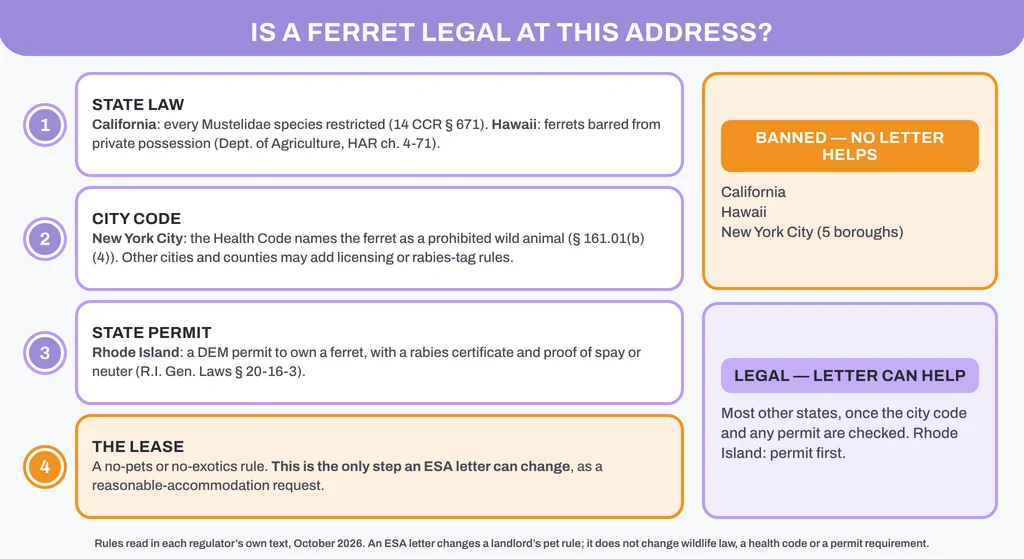
Search results and AI summaries repeat that ferrets are banned in “California, Hawaii and New York City.” That is right, but none of the pages ranking for it names the rule, and the rule is what a renter or a property manager can check. Here are the three bans and one permit state, each read in the regulator’s own text in October 2026.
| Place | The rule | What it says | Does an ESA letter change it? |
|---|---|---|---|
| California | 14 CCR § 671(a) and (c)(2)(K)5 (Fish and Game Commission list; permits from the Department of Fish and Wildlife) | Lists “Family Mustelidae — All species” as detrimental animals and makes it unlawful “to import, transport, or possess” them without a department permit; the domestic ferret is not among the exceptions | No — a clinician’s letter is not a department permit |
| Hawaii | Hawaii Department of Agriculture, Plant Quarantine Branch (HAR ch. 4-71) | Names ferrets among animals “prohibited from entry or possession by private individuals in the State” | No |
| New York City (all five boroughs) | NYC Health Code § 161.01(a)(1) and (b)(4) | No person may “possess, harbor, keep, or yard” a wild animal, and the definition includes “all fur bearing mammals of the family Mustelidae”, naming the ferret; exceptions cover zoos, laboratories, veterinary facilities and permitted exhibits only | No |
| Rhode Island | R.I. Gen. Laws § 20-16-3; 250-RICR-60-00-6 (Department of Environmental Management) | A permit is required to own, possess or import a domestic ferret; the application includes a current rabies certificate for ferrets three months or older and proof of spay or neuter, and is due within two weeks of getting the ferret | No — the permit is still needed; the letter can then address the lease |
| Everywhere else | State law, then the county or city code | Ferrets are generally legal to keep, but local codes can add rules (rabies tags, licensing, limits on numbers) | The letter addresses the landlord’s pet rule only |
California. The ban sits in the Fish and Game Commission’s restricted-species list, not in a law about pets. Section 671(a) says: “It shall be unlawful to import, transport, or possess live animals restricted in subsection (c) below except under permit issued by the department.” Subsection (c)(2)(K)5 then lists “Family Mustelidae — All species,” marked detrimental, with exceptions for a few otter species only. The domestic ferret, Mustela putorius furo, is a mustelid and is not excepted. California’s ESA-letter rules (the 30-day relationship in Health and Safety Code § 122318) are a different law and do not touch this; the California ESA letter page covers them for other species.
Hawaii. The state Department of Agriculture keeps the list of animals that may and may not enter the islands. Its Plant Quarantine Branch names ferrets among the animals that “are prohibited from entry or possession by private individuals in the State,” under chapter 4-71 of the Hawaii Administrative Rules. Hawaii residents with other animals can start with the Hawaii ESA letter page.
New York City. The Health Code’s Article 161 is the city’s animal rulebook. Section 161.01(a)(1) says “No person shall sell or give to another person, possess, harbor, keep, or yard wild or other animals” listed in the section, and § 161.01(b)(4) includes “All fur bearing mammals of the family Mustelidae, including, but not limited to, weasel, marten, mink, badger, ermine, skunk, otter, pole cat, zorille, wolverine, stoat and ferret.” The Board of Health took up a petition to lift the ferret ban in 2014 and heard testimony in January 2015, but the text on nyc.gov in October 2026 still lists the ferret. The ban is a city rule, so it does not apply elsewhere in New York State; the New York ESA letter page covers the state’s ESA rules.
Rhode Island. Ferrets are legal with a Department of Environmental Management permit. The department’s fact sheet says “a permit is required to own, possess or import a domestic (European) ferret into, or within, Rhode Island,” asks for a veterinary certificate of a current rabies vaccination and a certificate of spay or neuter, and gives a new owner two weeks to apply. The Rhode Island ESA letter page has the state’s housing rules.
Two practical points follow. A letter written for a ferret in one of the three ban areas would ask a landlord to permit something the law forbids, and no landlord can waive a state or city law; a careful clinician will say so rather than write it. And a ban is about the address, not the person: someone moving out of California or New York City with a ferret kept elsewhere is in a different position from someone moving in.
A ferret can be a pet or an emotional support animal. It cannot be a service animal under federal law: the Department of Justice limits service animals to dogs (and, under a separate rule, miniature horses) that are individually trained to do work or perform tasks, and says animals “whose sole function is to provide comfort or emotional support do not qualify.” The table sets out what each status does and does not change.
| Emotional support ferret | Pet ferret | Trained service dog | |
|---|---|---|---|
| What it is | A ferret whose presence eases a person’s disability, documented by that person’s clinician | A companion animal with no legal role | A dog individually trained to do work or perform tasks for a person with a disability |
| Training required | None for the role; litter habits and gentle handling | None | Yes — task training is the whole test |
| Federal law that applies | Fair Housing Act (housing only) | None specific | ADA in public places; Fair Housing Act in housing |
| Housing with a no-pets rule | A reasonable accommodation may be requested with an ESA letter | The landlord’s pet policy decides | A reasonable accommodation may be requested |
| Pet rent and deposits | Case-by-case under federal law since the HUD notices were withdrawn; several states set their own rules | The lease decides | Case-by-case under federal law; state law varies |
| California, Hawaii, New York City | Still banned | Still banned | Not a ferret |
| Shops, restaurants, public transit | No access rights | No access rights | Yes, with limited exceptions |
| Commercial flights | Not as an ESA: the DOT rule lets airlines treat an ESA as a pet | Only where an airline accepts ferrets as pets | Yes, with the DOT forms |
| Paperwork that matters | An ESA letter from a clinician licensed in the person’s state, plus vaccine records | Vaccine records and any local permit | None required by the ADA; DOT forms for flights |
The middle column matters more than it looks. Where a lease already allows small pets, a ferret may simply be a pet, with the usual pet terms; an ESA letter is for the case where the lease rule keeps the ferret out. For dogs the same three-way split is laid out in the service dog vs therapy dog vs ESA guide.
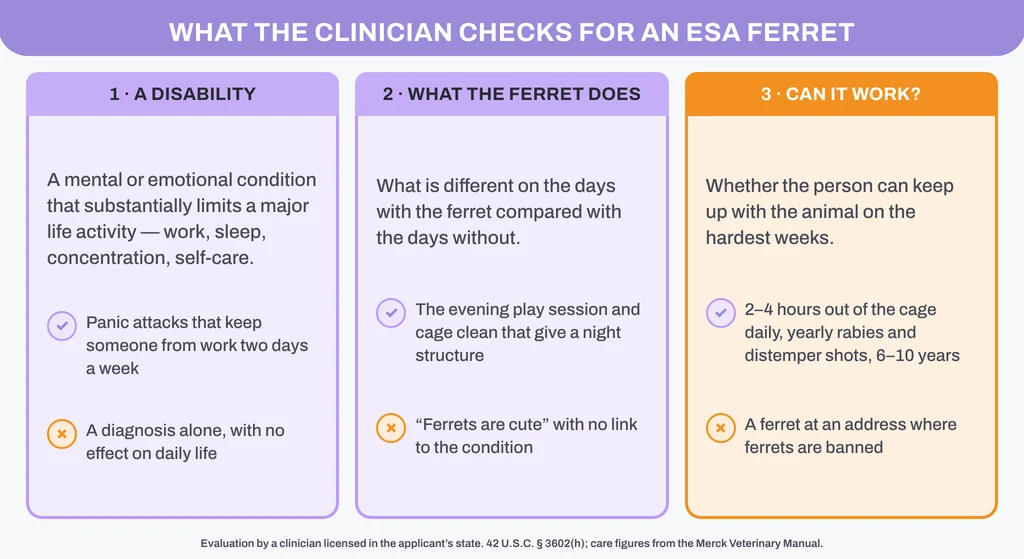
The evaluation is with a therapist licensed in the applicant’s own state, by phone or video in most states (the online ESA evaluation page describes the format). It is about the person first and the ferret second, and it covers three things.
A disability under the Fair Housing Act. That means a mental or emotional condition — anxiety, depression, PTSD and others — that substantially limits a major life activity such as working, sleeping, concentrating or caring for oneself (42 U.S.C. § 3602(h); 24 C.F.R. § 100.201). A diagnosis on its own is not the test; the limitation is. The ESA for anxiety, ESA for depression and ESA for PTSD guides show how the standard plays out for the three conditions people most often raise.
What the ferret actually does. Ferret owners tend to describe it in terms of routine and contact: an animal that sleeps most of the day (Merck puts it at up to 18 hours) and is wide awake for the evening play session that structures a lonely night, a ferret that climbs into a hood or a lap and stays, the daily cage clean that keeps a day from collapsing. The clinician asks what is different on the days with the ferret compared with the days without.
Whether the arrangement can work. A good clinician also asks whether the person can keep up with the animal on the hardest weeks, because an ESA that becomes another source of stress is not a support. For a ferret that means 2 to 4 hours out of the cage every day, supervised or in a ferret-proofed room; yearly rabies and distemper shots from a vet who sees ferrets; a meat-based diet; a room kept between 65°F and 75°F, because ferrets have no sweat glands and handle heat badly (Merck); and a commitment of 6 to 10 years. When the conclusion is that the criteria are not met, the fee comes back under the refund policy.
Sometimes. The housing picture in 2026 has three separate parts, and most answers online blur them — including the AI summary that says landlords “must provide reasonable accommodation, waiving standard pet fees or ‘no-pet’ policies if you have a valid letter.”
The law itself has not moved. The reasonable-accommodation duty in 42 U.S.C. § 3604(f)(3)(B) and 24 C.F.R. § 100.204 is unchanged, contains no training requirement, and can be enforced by a private lawsuit and by state fair-housing agencies. It obliges a housing provider to consider a reasonable accommodation, not to grant every request.
HUD’s how-to notices are gone. With FHEO-2013-01 and FHEO-2020-01 withdrawn, so is the passage saying pet rent and pet deposits could not be charged for an assistance animal. Whether a fee can be charged is now a case-by-case question under federal law, with several states setting their own rules; the ESA pet rent and deposits guide has the state-by-state detail.
HUD’s own enforcement has narrowed. A May 22, 2026 FHEO memorandum says HUD will find reasonable cause and recommend charges only in cases involving animals individually trained for disability-related work or tasks. HUD frames that as prioritizing its resources, not as a change in the statute: open ESA cases go to case-by-case review, and the right to sue privately is untouched. In practice a well-documented letter and a sensible request carry more of the weight than they used to.
Within that framework there are real grounds for a no. The first is the law of the place: a landlord in California, Hawaii or New York City cannot agree to a ferret the state or city prohibits, and an accommodation that requires breaking another law is not a reasonable one. The second is the animal. The statute says nothing requires housing for a tenant “whose tenancy would constitute a direct threat to the health or safety of other individuals or whose tenancy would result in substantial physical damage to the property of others” (42 U.S.C. § 3604(f)(9)). For a ferret the fair questions are bites and damage — and the answer has to be about this ferret, its vaccine record and its history, not ferrets in general. The third is the building. A single-family house rented by an owner who owns no more than three such houses, without a broker or agent, is exempt from the Act (42 U.S.C. § 3603(b)(1)), as is a building with living quarters for no more than four families when the owner lives in one of them (§ 3603(b)(2)). State and local fair-housing laws do not always copy those exemptions, so check the state’s own law before assuming either way.
How to put the request in writing, and what to do if it is refused, is in ESA letter to landlord. The accommodation changes the pet rule; it does not suspend the rest of the lease.
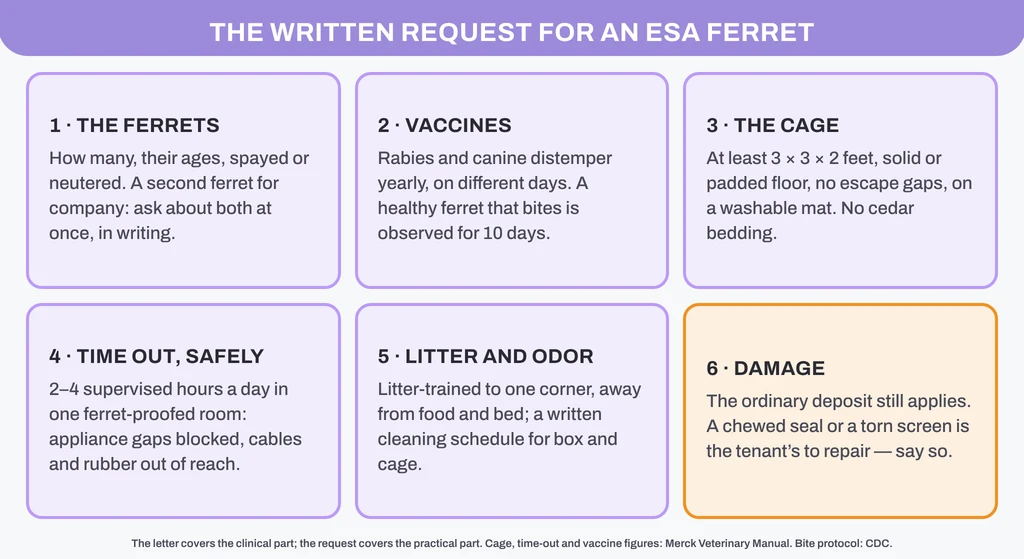
The letter covers the clinical part: that the person has a disability and that the animal is connected to it. The practical part belongs in the tenant’s written request, and for an animal many property managers have never met, it is often what decides the answer. The Merck Veterinary Manual’s owner pages make a good checklist.
The ferrets. How many, their ages, and whether they are spayed or neutered. Some owners keep two or more; if that is the plan, ask about both at once. One ESA letter can cover more than one animal only if the clinician believes that is clinically reasonable for the person, so a second ferret kept for the first one’s company is a separate question for the landlord — put it in writing in the same request.
Vaccines. Merck says ferrets “should be vaccinated annually against rabies and canine distemper,” that only one rabies vaccine is approved for ferrets in the United States, and that the two shots should be given on different days. The CDC tells veterinarians to vaccinate ferrets for rabies according to local law and, if a healthy ferret bites someone, to confine and observe it for 10 days with the public health authorities. Attaching the current certificates answers the first question a manager has before it is asked.
The cage. Merck: “A wire cage at least 3 feet wide by 3 feet deep by 2 feet high is sufficient,” with a padded or solid floor and no gaps a ferret could escape through. A washable mat under it protects the floor. Avoid cedar bedding, which Merck says may be toxic to ferrets.
Ferret-proofing and time out. Ferrets need 2 to 4 hours a day out of the cage, supervised or in a ferret-proofed area (Merck). In a rental that means one room set up for it — gaps behind and under appliances blocked, cables and anything rubbery out of reach, window screens checked — and saying so in the request.
Litter and odor. Merck notes ferrets can be trained to a litter box and prefer one spot, away from where they eat and sleep. A cleaning schedule for the box and the cage is the honest answer to the smell question.
Damage stays with the tenant. An ESA letter changes pet rules and, in some states, pet charges. It does not change liability: the ordinary security deposit still applies, and real damage — a chewed door seal, a dug-up carpet corner, a torn screen — is still the tenant’s to repair. Saying so plainly takes one sentence and removes a landlord’s biggest worry.
No to both. An emotional support animal’s federal protection is housing only. The ADA covers trained service dogs and, under a separate provision, trained miniature horses; the Department of Justice says animals whose sole function is comfort or emotional support do not qualify. An emotional support ferret has no right to enter a store, a restaurant, a workplace or a bus, whatever vest it wears.
Air travel is closed too. Since the Department of Transportation’s revised rule took effect on January 11, 2021, a service animal on a U.S. flight is “a dog, regardless of breed or type, that is individually trained,” and “animal species other than dogs, emotional support animals, comfort animals, companionship animals, and service animals in training are not service animals” (14 C.F.R. § 382.3). A ferret can fly only where an airline accepts it as a pet, which varies by carrier; the which airlines allow emotional support animals guide covers the 2026 airline picture. Hawaii’s rules bar bringing a ferret into the state by any route.
For an adult, the process takes four steps, and the ferret changes almost none of them — except that the first check is whether a ferret is legal where the person lives.
Answer the free five-minute quiz. A handful of questions — is there a condition that affects daily life, is there an animal that helps, which state — so that nobody books an evaluation that cannot go anywhere. The quiz is the only free step.
Get matched with a clinician licensed in the applicant’s state. Not a clinician somewhere in the country: one licensed where the applicant lives, because several states have their own rules about who may sign and what has to come first. The fee is $99 flat, paid at checkout before the evaluation — no membership, no auto-renewal, no add-ons (details on the ESA letter pricing page). If the clinician finds the applicant doesn’t qualify, they get a full refund.
Do the evaluation. It runs through the three checks above. Useful to have to hand: the name of any current therapist or prescriber, how long the ferret has been in the person’s life, what changes on the days with it, and the vaccine record; none of them is required.
Receive the letter if the clinician finds a qualifying need. In most states it usually arrives within 24–48 hours of the evaluation. In California, Louisiana, Arkansas, Montana and Iowa the letter follows a 30-day clinical relationship instead, so it comes after the 30 days, not in two. It states that the person has a disability under the Fair Housing Act and that the animal is connected to it, and carries the clinician’s license number, state and signature. If the housing provider calls to verify, the support team answers. Letters are written for twelve months, and the ESA letter renewal guide covers the year after.
If the clinician decides the applicant doesn’t qualify, the refund is requested within 7 days. If a landlord rejects the letter in writing after our support team has been involved, the refund window is 30 days. Both terms are on the refund policy page. The full walkthrough is in how to get an ESA letter.
State rules. The species does not change the ESA letter rules; the state does. Several states add their own rules about who may write an ESA letter and what has to happen first, and a letter that ignores them is easy to challenge — which is why PetESALetter matches each applicant with a clinician licensed in their own state.
| State | What has to be in place before the letter is signed | Who may sign | Statute |
|---|---|---|---|
| California | A client-provider relationship of at least 30 days and a clinical evaluation; license details stated in the letter | A practitioner licensed in California | Cal. Health & Safety Code § 122318 (AB 468, 2021) |
| Louisiana | A therapeutic relationship of at least 30 days, at least two sessions, a disability assessment and a clinical evaluation | A Louisiana-licensed provider | La. R.S. 46:1974 (Act 558 of 2024) |
| Arkansas | A 30-day client-provider relationship and a clinical evaluation, reviewed at least once a year | A provider licensed in the jurisdiction | Ark. Code Ann. § 20-14-1003 (Act 268 of 2023) |
| Montana | A client-provider relationship of at least 30 days and a clinical evaluation; a registry card is not sufficient on its own | A Montana-licensed mental health professional, license details in the letter | Mont. Code Ann. § 70-24-114 (HB 703, 2023; amended 2025) |
| Iowa | A written finding that states whether the provider-patient relationship has lasted at least 30 days; the state’s own form has the signer certify that it has | A licensed physician, PA, nurse, psychologist, social worker or behavioral-science professional, in Iowa or in good standing in another state | Iowa Code § 216.8C (SF 2268, 2024) |
| Florida | Personal knowledge of the disability; no waiting period. An out-of-state practitioner must have provided in-person care at least once | A practitioner acting within the scope of the license | Fla. Stat. § 760.27 (SB 1084, 2020) |
| Colorado | An in-person meeting and a written finding on disability and need; no waiting period | A mental health licensee with sufficient familiarity with the patient | C.R.S. § 12-245-229; HB26-1045 (eff. Aug 12, 2026) |
Everywhere else the federal framework applies on its own. The California page linked above and our Louisiana ESA letter page go through the two strictest states in detail, and the state pages linked in the navigation cover the rest. Two different sets of rules are in play for a ferret owner: the ESA-letter rules in this table, and the wildlife or health code, which decides whether a ferret can be kept at that address at all. California appears in both: its 30-day rule governs the letter, and its restricted-species list rules out the ferret.
The red flags are the same for every species. A letter in minutes — “instant approval” means nobody evaluated anyone, and the how to verify an ESA letter is real guide lists what a genuine one contains. A registration number, certificate, harness tag or ID card for the ferret — there is no registry. A seller happy to write a ferret letter for an address in California, Hawaii or New York City without a word about the ban. And a promise that the landlord “must” accept the letter — the statute obliges a housing provider to consider a reasonable accommodation, not to grant every request.
The bottom line. A ferret can be an emotional support animal for housing when a licensed clinician finds a disability and finds that the ferret eases it; the law names no species, and HUD’s old household-animal list is withdrawn guidance, not the test. But a letter cannot make a ferret legal where it is banned — California (14 CCR § 671), Hawaii (Department of Agriculture rules) and New York City (Health Code § 161.01) — and in Rhode Island the state permit comes first. Elsewhere, the request should answer the vaccine, cage, ferret-proofing, litter and damage questions before they are asked. There are no flight or public-access rights. PetESALetter evaluates adults, with a clinician licensed in their state, for $99 flat and a full refund if the clinician finds no qualifying need.
Wondering whether your ferret can be your ESA — and whether a ferret is legal where you live? A licensed clinician in your state evaluates whether an emotional support animal fits the situation — and the first step is a free five-minute screen.
Yes. The Fair Housing Act does not limit emotional support animals to any species, so a ferret can be an ESA for housing when a licensed mental health professional evaluates the person, finds a disability that substantially limits daily life, and finds that the ferret helps with it. The exception is legality: where ferrets are banned, no letter changes that.
Yes. California’s restricted-species regulation lists every member of the weasel family, Mustelidae, as detrimental and makes it unlawful to import, transport or possess one without a Department of Fish and Wildlife permit (14 CCR § 671(a), (c)(2)(K)5). The domestic ferret is not excepted, and an ESA letter is not a permit.
Not legally. The city’s Health Code bars anyone from possessing, harboring or keeping a wild animal, and its definition names the ferret among the Mustelidae (§ 161.01(a)(1), (b)(4)). The only exceptions are zoos, laboratories, veterinary facilities and permitted exhibits. The rule is a city rule and does not apply elsewhere in New York State.
Yes, in several situations: where state or city law bans ferrets, where this particular ferret would be a direct threat or cause substantial physical damage (42 U.S.C. § 3604(f)(9)), and in housing exempt from the Act, such as a single-family house rented by its owner without an agent. Otherwise the landlord has to consider the request as a reasonable accommodation.
Not as an ESA, but in practice yes. The Merck Veterinary Manual recommends yearly rabies and canine distemper vaccination for ferrets, the CDC tells veterinarians to vaccinate ferrets for rabies according to local law, and Rhode Island’s ferret permit asks for the certificate. Attaching current records to the accommodation request answers a landlord’s first question.
Not as an emotional support animal. Since the Department of Transportation’s rule took effect on January 11, 2021, only dogs individually trained to do work or perform tasks are service animals on U.S. flights, and emotional support animals and species other than dogs are not. A ferret can fly only where an airline accepts it as a pet, and never into Hawaii.

Licensed Psychotherapist
Darren is a leading expert in mental health advocacy and assistance animal documentation. He specializes in streamlining the process for obtaining ESA Letters, PSD Letters, and State-specific ESA compliance.

ESA Letters Issued

Successful Consultations

Licensed Therapist Network

Client Satisfaction Rate




Petesaletter.com helps you get your emotional support animal letter online with guidance and support.

Got Questions? Call us 24/7
Copyright © 2020-2026 Petesaletter All rights reserved. Terms | Privacy | Refund
Owned and Operated by Verimedix LLC