
Last Updated on: October 15, 2026
Reviewed by Darren Andrew Rafel

Yes — a horse, including a miniature horse, can be an emotional support animal for housing. The Fair Housing Act names no species; what counts is a licensed mental health professional finding a disability the horse eases. A letter helps only where the rental has land for a horse, and it gives no flight or public-access rights. PetESALetter matches adults with a clinician licensed in their state; in most states a qualifying letter follows within 24–48 hours, for $99 flat.
Key takeaways
Yes. Nothing in the Fair Housing Act or HUD’s regulation limits an emotional support animal to a dog or a cat. The statute makes it discrimination to refuse “reasonable accommodations in rules, policies, practices, or services, when such accommodations may be necessary to afford such person equal opportunity to use and enjoy a dwelling” (42 U.S.C. § 3604(f)(3)(B)), and 24 C.F.R. § 100.204 restates that duty. An exception to a lease clause that says “no horses or livestock” is exactly that kind of accommodation. The questions are the ones asked about any animal: does the person have a disability, and does this animal help with it?
What has changed is the guidance around the law. For years, tenants and housing providers worked from HUD Notice FHEO-2020-01, which listed animals “commonly kept in households” — dogs, cats, small birds, rabbits, hamsters, fish, turtles — and asked anyone requesting a different kind of animal to show a disability-related need for that specific type. Horses were never on the list. That notice and the earlier FHEO-2013-01 were withdrawn effective September 17, 2025 (91 FR 17291, April 6, 2026), so neither the list nor its extra step is HUD’s guidance any more. A horse request now rests where every request rests: on a credible letter, and on whether the accommodation is reasonable for that property.
That last part is where horses differ from every other species on this site. A rabbit, a bird or a snake lives inside the home. A horse lives on the land around it. Oklahoma State University’s breed reference describes the American Miniature Horse as no taller than 34 inches at maturity, against “the 1,000 pound-plus horse”, and says minis are cared for the same way as the larger breeds. Either way the animal needs pasture or a paddock, shelter, fencing and company. So the honest first question is not “can a horse be an ESA?” but “is there somewhere on this rental for a horse to live?” The answer decides almost everything else.
Two things a horse never needs: registration and an ID card. U.S. law has no ESA registry, and the ESA registration myths page takes apart the certificate and vest sellers. What a housing provider can rely on is an ESA letter from a licensed clinician who evaluated the person. The same logic runs through the other species guides on this site, from the emotional support rabbit and the emotional support bird to the emotional support snake.
Three different animals share the word “horse” in search results, and Google’s own summary for “emotional support horse” answers with the third one. They have different legal footing, and mixing them up is how people end up with the wrong paperwork.
A miniature service horse is covered by the Americans with Disabilities Act, but not by the dog rule. The Department of Justice keeps a separate provision for miniature horses “that have been individually trained to do work or perform tasks for people with disabilities”, and says businesses and governments “must modify their policies to permit miniature horses where reasonable.” ADA.gov puts them at 24 to 34 inches to the shoulder and 70 to 100 pounds, and lists four questions a business may weigh: is the horse housebroken, is it under the owner’s control, can the facility take its type, size and weight, and would it compromise legitimate safety requirements. Training is the whole test; comfort alone does not count. The service dog vs therapy dog vs ESA guide sets out the same split for dogs, and anyone whose animal is trained for psychiatric tasks should read about the PSD letter instead.
A therapy horse visits hospitals, schools and care homes with a handler, or works in an equine-assisted program run by professionals. It has no legal status of its own: it goes where it is invited. Searches for “therapy horse” far outnumber searches for “emotional support horse”, but they are looking for programs, not housing rights.
An emotional support horse needs no task training at all. Its role is the effect it has on one person with a disability, documented by that person’s clinician, and its protection is housing only.
| Emotional support horse | Miniature service horse | Therapy horse | |
|---|---|---|---|
| What it is | Any horse or pony whose presence eases a person’s disability | A miniature horse individually trained to do work or perform tasks for a person with a disability | A horse that visits hospitals, schools or care homes with its handler, or works in an equine-assisted program |
| Training required | None for the role; ordinary manners and safe handling | Yes — task training, housebroken, under control | Program or handler standards, not a legal test |
| Who decides | A licensed mental health professional evaluates the person | The handler’s disability and the horse’s training; no certificate exists | The facility or program that invites it |
| Federal law that applies | Fair Housing Act (housing only) | ADA, under a separate miniature-horse provision (28 C.F.R. § 36.302(c)(9)) | None specific to the animal |
| Housing with a no-horses rule | A reasonable accommodation may be requested with an ESA letter | A reasonable accommodation may be requested | No housing role of its own |
| Shops, restaurants, public transit | No access rights | Where reasonable, under four ADA assessment factors | Only where invited |
| Commercial flights | Not as an ESA: the DOT rule lets airlines treat an ESA as a pet | Not since January 11, 2021: only dogs are service animals on U.S. flights | No |
| Paperwork that matters | An ESA letter from a clinician licensed in the person’s state | None required; no certificate exists | The program’s own records |
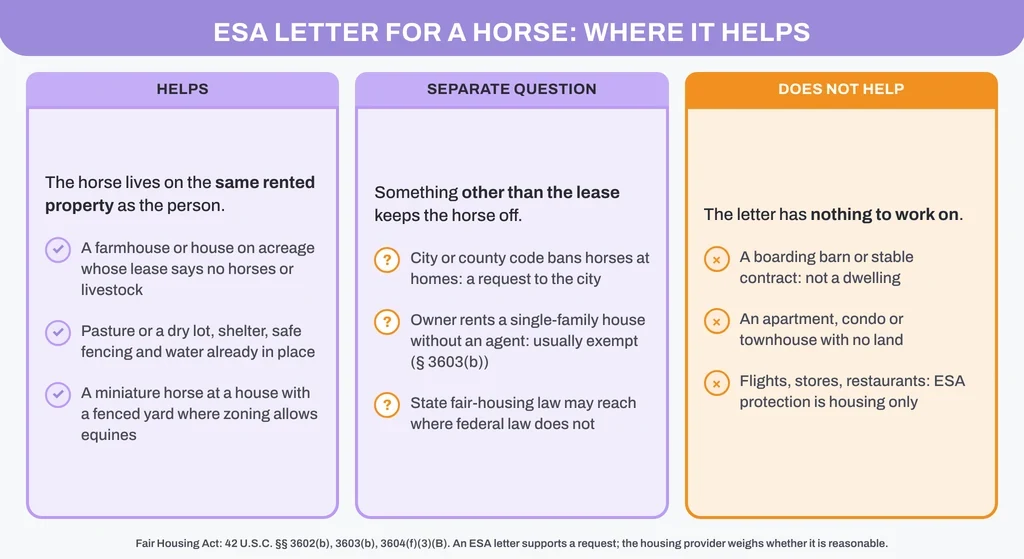
An ESA letter is a housing document. The Fair Housing Act applies to a “dwelling”, which it defines as a building or part of one “occupied as, or designed or intended for occupancy as, a residence” (42 U.S.C. § 3602(b)). That definition draws the map for a horse owner. Where the horse would live on the same rented property as the person, a letter can support a request to change the lease rule that keeps it off. Where the horse lives somewhere else, or where there is no land at all, the letter has nothing to work on.
| Situation | Does an ESA letter help? | Why |
|---|---|---|
| Renting a farmhouse or a house on acreage whose lease bans horses or livestock | Often — this is the main use | The no-horses clause is a rule an accommodation can change, and the land can carry a horse |
| Renting a single-family house with a fenced yard, for a miniature horse, where local zoning allows equines | Possibly | Turns on space, fencing, shelter and neighbors; a mini on a small lot is a hard but not impossible request |
| Apartment, condo or townhouse with no land | Almost never | There is nowhere for a horse to live; a provider can treat the request as unreasonable |
| Boarding the horse at a barn or stable | No | A barn is not a dwelling under the Act, so the board contract is not covered |
| Owner renting out a single-family house without an agent, or living in a building of four units or fewer | Usually not under federal law | Both are exempt from the Act (42 U.S.C. § 3603(b)); state law may still apply |
| City or county code bans horses at homes | Not on its own | That is a separate accommodation request to the city, not to the landlord |
| Flying, or bringing the horse into stores | No | ESA protection is housing only |
The main case is a tenant renting a house with pasture — a farmhouse, a house on a few acres — under a lease that says no horses or no livestock. The horse may already be on a friend’s farm; the person moves, and wants it home. That is a reasonable-accommodation request like any other, and the facts that make it reasonable are physical ones: enough grazing or a dry lot, a shelter, safe fencing, water and a plan for manure.
The plainest no is a boarding barn. A stable that keeps a horse for a monthly fee is not anyone’s residence, so its contract, its rules and its fees are outside the Act whatever a letter says. The same is true for an apartment, condo or townhouse with no land: the request is not for an exception to a pet rule but for space the property does not have, and a housing provider can say so.
A miniature horse sits between the two. Oklahoma State says an acre or less of outdoor space is usually enough for a mini and an indoor stall of 6 by 8 feet is adequate, so a single-family rental with a fenced yard is a real possibility where the local code allows equines. It is still a horse: Horse Illustrated notes that minis do best with daily turnout and often live past the 30 years typical of full-size horses. A mini kept indoors like a dog is not what any of those sources describe.
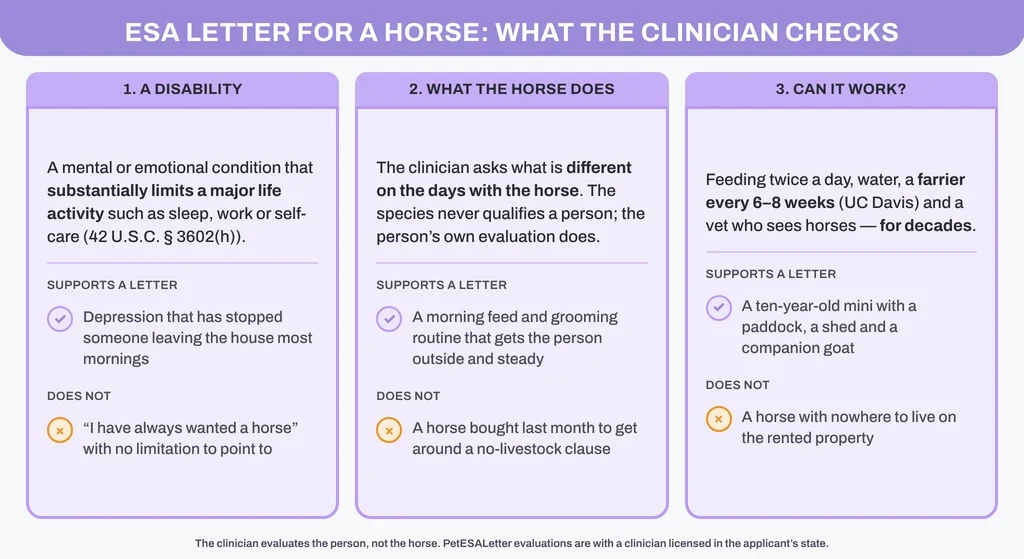
The evaluation is with a therapist licensed in the applicant’s own state, by phone or video in most states (the online ESA evaluation page describes the format). It is about the person first and the horse second, and it covers three things.
A disability under the Fair Housing Act. That means a mental or emotional condition — anxiety, depression, PTSD and others — that substantially limits a major life activity such as working, sleeping, concentrating or caring for oneself (42 U.S.C. § 3602(h); 24 C.F.R. § 100.201). A diagnosis on its own is not the test; the limitation is. The ESA for anxiety, ESA for depression and ESA for PTSD guides show how the standard plays out for the three conditions people most often raise.
What the horse actually does. Horse owners describe it in physical terms: the morning feed that gets them out of bed and outside on the worst days, twenty minutes of grooming that slows a racing mind, a large calm animal that has to be approached calmly. The clinician asks what is different on the days with the horse compared with the days without. Equine-assisted therapy is a structured clinical program and a separate thing; a letter for a personal horse rests on the person’s own evaluation, not on a study of therapy programs.
Whether the arrangement can work. A good clinician also asks whether the person can keep up with the animal on the hardest weeks, because an ESA that becomes another source of stress is not a support. For a horse that means feeding at least twice a day, water every day (UC Davis puts an idle horse at 4 to 8 gallons), hooves trimmed every six to eight weeks, a veterinarian who sees horses, and help lined up for the days the owner cannot get to the paddock — for decades. When the conclusion is that the criteria are not met, the fee comes back under the refund policy.
Sometimes, and with horses the grounds come up more often than with any other animal. The housing picture in 2026 has three separate parts, and most answers online blur them — including the AI summary that says ESAs “are permitted in ‘no-pet’ housing as a reasonable accommodation with a valid support letter.”
The law itself has not moved. The reasonable-accommodation duty in 42 U.S.C. § 3604(f)(3)(B) and 24 C.F.R. § 100.204 is unchanged, contains no training requirement, and can be enforced by a private lawsuit and by state fair-housing agencies. It obliges a housing provider to consider a reasonable accommodation, not to grant every request.
HUD’s how-to notices are gone. With FHEO-2013-01 and FHEO-2020-01 withdrawn, so is the passage saying pet rent and pet deposits could not be charged for an assistance animal. Whether a fee can be charged is now a case-by-case question under federal law, with several states setting their own rules; the ESA pet rent and deposits guide has the state-by-state detail.
HUD’s own enforcement has narrowed. A May 22, 2026 FHEO memorandum says HUD will find reasonable cause and recommend charges only in cases involving animals individually trained for disability-related work or tasks. HUD frames that as prioritizing its resources, not as a change in the statute: open ESA cases go to case-by-case review, and the right to sue privately is untouched. In practice a well-documented letter and a sensible request carry more of the weight than they used to.
Within that framework there are real grounds for a no. The statute says nothing requires housing for a tenant “whose tenancy would constitute a direct threat to the health or safety of other individuals or whose tenancy would result in substantial physical damage to the property of others” (42 U.S.C. § 3604(f)(9)); with a 1,000-pound animal, fencing and damage to the land are fair questions, and the answer has to be about this horse and this property, not horses in general. And some housing is outside the Act altogether. A single-family house rented by an owner who owns no more than three such houses, without a broker or agent and without discriminatory advertising, is exempt (42 U.S.C. § 3603(b)(1)), as is a building with living quarters for no more than four families when the owner lives in one of them (§ 3603(b)(2)). Plenty of country rentals fit the first description. State and local fair-housing laws do not always copy those exemptions, so check the state’s own law before assuming either way.
Zoning is a second, separate door. A landlord can agree and the horse can still be illegal at that address if the city or county bars horses or livestock at homes. That is a request to the local government, not to the landlord, and the leading case is about a horse. In Anderson v. City of Blue Ash, 798 F.3d 338 (6th Cir. 2015), an Ohio suburb passed an ordinance “to prohibit keeping of farm animals at residences within the city” while a family kept a miniature horse for their daughter. The Sixth Circuit said the Fair Housing Act “creates an affirmative duty” on a municipality to make reasonable accommodations, that “[r]equiring public entities to make exceptions to their rules and zoning policies is exactly what the FHAA does”, and that a horse ban “does not mean that any modification permitting a horse necessarily amounts to a fundamental alteration.” Three limits matter: that horse was trained to steady the child as she walked and help her stand after a fall, so it was closer to a service animal than an ESA; the decision binds only the Sixth Circuit (Ohio, Kentucky, Michigan and Tennessee); and the court sent the claim back for trial rather than ruling for the family. Readers in that state can start with the Ohio ESA letter page.
How to put the request in writing, and what to do if it is refused, is in ESA letter to landlord. The accommodation changes the no-horses rule; it does not suspend the rest of the lease.
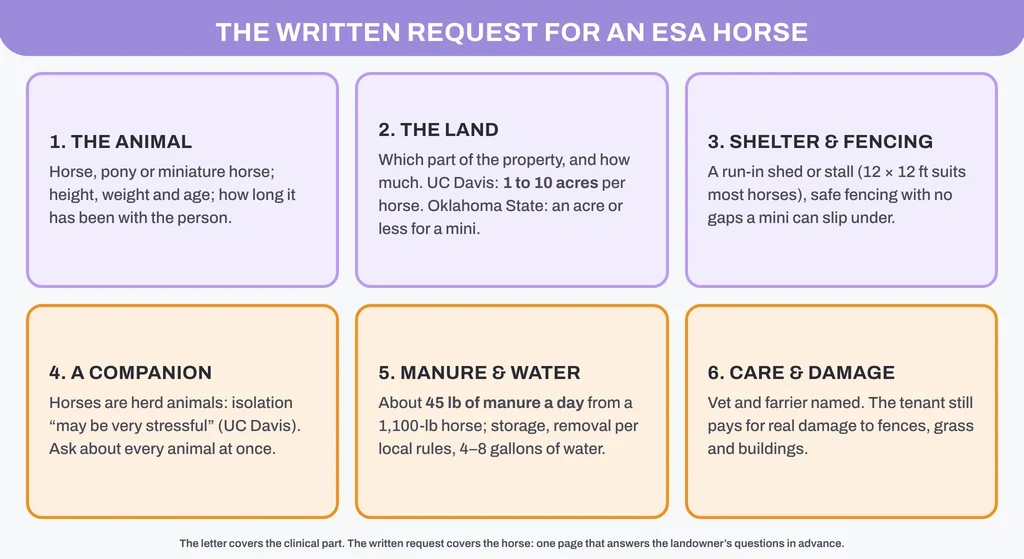
The letter covers the clinical part: that the person has a disability and that the animal is connected to it. The practical part belongs in the tenant’s written request, and for an animal that lives outdoors on the landlord’s land it is usually what decides the answer. UC Davis’s Horses on Small Farms handbook is a useful checklist for it.
The animal. Full-size horse, pony or miniature horse; height, weight and age; and how long it has been with the person. One line that it is current on veterinary care answers the first question any manager has.
The land. Which part of the property the horse would use, and how much of it. UC Davis puts pasture stocking at anywhere from 1 to 10 acres per horse depending on the land; Oklahoma State says an acre or less usually suits a mini. Where grass is thin, a dry lot with hay is the honest plan.
Shelter and fencing. UC Davis says a 12-by-12-foot stall suits most horses and that three-sided run-in sheds are common; a mini needs far less. Say what exists, what the tenant will add, and who removes it at move-out. Safe fencing at the right height — with no gaps a small horse can slip under — protects the landlord’s neighbors as much as the horse.
A companion. Horses are herd animals, and UC Davis notes that isolating a horse from herd mates or other animals “may be very stressful.” If the plan includes a second animal for company, put it in the same request. One ESA letter can cover more than one animal only if the clinician believes that is clinically reasonable for the person; a companion kept for the horse’s welfare is a separate question for the landlord, so ask about every animal at once, in writing.
Manure, water and feed. A mature 1,100-pound horse produces about 45 pounds of manure a day, and UC Davis says it should be disposed of according to local regulations. Say where it will be stored and how it will leave the property, where hay is kept dry and away from the house, and how the water trough is filled and kept from freezing.
Care. The veterinarian’s name, the farrier schedule (UC Davis: every six to eight weeks) and who looks after the horse if the tenant is away. Small details, but they tell a landlord the animal is looked after.
Damage stays with the tenant. An ESA letter changes pet rules and, in some states, pet charges. It does not change liability: the ordinary security deposit still applies, and real damage — chewed fence boards, a churned-up lawn, a kicked-in barn wall — is still the tenant’s to repair. Saying so plainly takes one sentence and removes the biggest worry a landowner has.
No to both. An emotional support animal’s federal protection is housing only. The ADA’s miniature-horse provision covers horses individually trained to do work or perform tasks, and the Department of Justice says plainly that animals whose sole function is to provide comfort or emotional support do not qualify. An emotional support horse has no right to enter a store, a restaurant or a bus, whatever it is called.
Air travel closed the door for every horse in 2021. Before the Department of Transportation’s revised rule took effect on January 11, 2021, a few trained miniature horses flew in the cabin, and news clips of them still sit near the top of search results. The rule now defines a service animal as “a dog, regardless of breed or type, that is individually trained”, and adds that “animal species other than dogs, emotional support animals, comfort animals, companionship animals, and service animals in training are not service animals” (14 C.F.R. § 382.3). That excludes even a task-trained mini. Moving a horse across the country is a job for a professional horse transporter, not an airline. The which airlines allow emotional support animals guide covers the 2026 airline picture for other species.
For an adult, the process takes four steps, and the horse changes almost none of them.
Answer the free five-minute quiz. A handful of questions — is there a condition that affects daily life, is there an animal that helps, which state — so that nobody books an evaluation that cannot go anywhere. The quiz is the only free step.
Get matched with a clinician licensed in the applicant’s state. Not a clinician somewhere in the country: one licensed where the applicant lives, because several states have their own rules about who may sign and what has to come first. The fee is $99 flat, paid at checkout before the evaluation — no membership, no auto-renewal, no add-ons (details on the ESA letter pricing page). If the clinician finds the applicant doesn’t qualify, they get a full refund.
Do the evaluation. It runs through the three checks above. Useful to have to hand: the name of any current therapist or prescriber, how long the horse has been in the person’s life, what changes on the days with it, and the land-and-care plan; none of them is required.
Receive the letter if the clinician finds a qualifying need. In most states it usually arrives within 24–48 hours of the evaluation. In California, Louisiana, Arkansas, Montana and Iowa the letter follows a 30-day clinical relationship instead, so it comes after the 30 days, not in two. It states that the person has a disability under the Fair Housing Act and that the animal is connected to it, and carries the clinician’s license number, state and signature. If the housing provider calls to verify, the support team answers. Letters are written for twelve months, and the ESA letter renewal guide covers the year after.
If the clinician decides the applicant doesn’t qualify, the refund is requested within 7 days. If a landlord rejects the letter in writing after our support team has been involved, the refund window is 30 days. Both terms are on the refund policy page. The full walkthrough is in how to get an ESA letter.
State rules. The species does not change the ESA letter rules; the state does. Several states add their own rules about who may write an ESA letter and what has to happen first, and a letter that ignores them is easy to challenge — which is why PetESALetter matches each applicant with a clinician licensed in their own state.
| State | What has to be in place before the letter is signed | Who may sign | Statute |
|---|---|---|---|
| California | A client-provider relationship of at least 30 days and a clinical evaluation; license details stated in the letter | A practitioner licensed in California | Cal. Health & Safety Code § 122318 (AB 468, 2021) |
| Louisiana | A therapeutic relationship of at least 30 days, at least two sessions, a disability assessment and a clinical evaluation | A Louisiana-licensed provider | La. R.S. 46:1974 (Act 558 of 2024) |
| Arkansas | A 30-day client-provider relationship and a clinical evaluation, reviewed at least once a year | A provider licensed in the jurisdiction | Ark. Code Ann. § 20-14-1003 (Act 268 of 2023) |
| Montana | A client-provider relationship of at least 30 days and a clinical evaluation; a registry card is not sufficient on its own | A Montana-licensed mental health professional, license details in the letter | Mont. Code Ann. § 70-24-114 (HB 703, 2023; amended 2025) |
| Iowa | A written finding that states whether the provider-patient relationship has lasted at least 30 days; the state’s own form has the signer certify that it has | A licensed physician, PA, nurse, psychologist, social worker or behavioral-science professional, in Iowa or in good standing in another state | Iowa Code § 216.8C (SF 2268, 2024) |
| Florida | Personal knowledge of the disability; no waiting period. An out-of-state practitioner must have provided in-person care at least once | A practitioner acting within the scope of the license | Fla. Stat. § 760.27 (SB 1084, 2020) |
| Colorado | An in-person meeting and a written finding on disability and need; no waiting period | A mental health licensee with sufficient familiarity with the patient | C.R.S. § 12-245-229; HB26-1045 (eff. Aug 12, 2026) |
Everywhere else the federal framework applies on its own. Our California ESA letter and Louisiana ESA letter pages go through the two strictest states in detail, and the state pages linked in the navigation cover the rest. Two different sets of rules are in play for a horse owner: the ESA-letter rules in this table, and the local zoning code, which decides whether a horse can be kept at that address at all.
The red flags are the same for every species. A letter in minutes — “instant approval” means nobody evaluated anyone, and the how to verify an ESA letter is real guide lists what a genuine one contains. A registration number, certificate, halter tag or ID card for the horse — there is no registry. And a promise that the landlord “must” accept the letter — the statute obliges a housing provider to consider a reasonable accommodation, not to grant every request.
The bottom line. A horse or a miniature horse can be an emotional support animal for housing when a licensed clinician finds a disability and finds that the horse eases it; the law names no species, and HUD’s old household-animal list is withdrawn guidance, not the test. The letter helps where the rented home has land a horse can live on and a lease rule keeps it off; it does not reach a boarding barn, it is very rarely reasonable in an apartment, it does not change zoning by itself, and owner-rented single-family houses are often exempt. The request should answer the land, shelter, fencing, companion, manure and care questions before they are asked, with an honest line about damage. There are no flight or public-access rights. PetESALetter evaluates adults, with a clinician licensed in their state, for $99 flat and a full refund if the clinician finds no qualifying need.
Wondering whether your horse can be your ESA — and whether a letter fits your rental? A licensed clinician in your state evaluates whether an emotional support animal fits the situation — and the first step is a free five-minute screen.
Yes. The Fair Housing Act does not limit emotional support animals to any species, so a horse or a miniature horse can be an ESA for housing when a licensed mental health professional evaluates the person, finds a disability that substantially limits daily life, and finds that the horse helps with it. In practice the letter only helps where the rented home has land the horse can live on.
Yes, on the same terms as a full-size horse, and a mini is the more realistic request because Oklahoma State University says an acre or less of outdoor space usually suits one. A miniature horse that is individually trained to do work or perform tasks is a different thing: a service animal under the ADA’s miniature-horse provision, with access rights an ESA does not have.
Yes, in several situations. A housing provider may refuse a request that is not reasonable for the property, an animal that would be a direct threat or cause substantial physical damage (42 U.S.C. § 3604(f)(9)), and requests in housing exempt from the Act, such as a single-family house rented by its owner without an agent. Local zoning that bans horses is a separate question for the city.
Almost never. The Fair Housing Act lets a tenant ask for an exception to a rule, not for land the property does not have, and a horse of any size needs outdoor space, shelter and company. An apartment, condo or townhouse with no paddock is the clearest case where an ESA letter will not help a horse owner.
Only a miniature horse, only under the ADA, and only when it is individually trained to do work or perform tasks for a person with a disability. ADA.gov puts those horses at 24 to 34 inches to the shoulder and 70 to 100 pounds. Comfort or emotional support alone does not make any animal a service animal, and on U.S. flights only dogs qualify since 2021.
No. Since the Department of Transportation’s rule took effect on January 11, 2021, only dogs individually trained to do work or perform tasks are service animals on U.S. flights, and the rule says emotional support animals and species other than dogs are not. Moving a horse long-distance is a job for a professional horse transporter.

Licensed Psychotherapist
Darren is a leading expert in mental health advocacy and assistance animal documentation. He specializes in streamlining the process for obtaining ESA Letters, PSD Letters, and State-specific ESA compliance.

ESA Letters Issued

Successful Consultations

Licensed Therapist Network

Client Satisfaction Rate




Petesaletter.com helps you get your emotional support animal letter online with guidance and support.

Got Questions? Call us 24/7
Copyright © 2020-2026 Petesaletter All rights reserved. Terms | Privacy | Refund
Owned and Operated by Verimedix LLC