
Last Updated on: September 21, 2026
Reviewed by Darren Andrew Rafel

Yes — post-traumatic stress disorder qualifies for an emotional support animal when a licensed mental health professional evaluates the person and finds that it substantially limits daily life (sleep, concentration, work, going out) and that the animal alleviates it. A diagnosis alone is not a qualification, and an ESA is not a psychiatric service dog. PetESALetter matches each applicant with a clinician licensed in their state; if the evaluation supports it, the letter arrives in 24–48 hours for $99 flat.
Key takeaways
It does when two things are true and a licensed clinician confirms both. The Fair Housing Act protects a person with a “handicap”, defined as a physical or mental impairment that substantially limits one or more major life activities (42 U.S.C. § 3602(h)). HUD’s regulation lists what those activities are — “caring for one’s self, performing manual tasks, walking, seeing, hearing, speaking, breathing, learning and working” (24 C.F.R. § 100.201). Sleep is not on that list, and PTSD still reaches it easily: the arousal cluster (hypervigilance, startle, concentration problems, disturbed sleep) lands on concentrating and working, and the avoidance cluster lands on caring for oneself and on ordinary tasks like grocery shopping. The second condition is that the animal has to do something about it — provide support that alleviates at least one symptom or effect.
PTSD is not written into the regulation, and it does not need to be. The list is of limitations, not diagnoses, so the same diagnosis qualifies one person and not another. A person who has slept with the lights on for a year, who has missed shifts after every unexpected noise, and whose clinician can say that the dog is the reason the front door gets opened has a clear case. A person who had a hard month after a car accident, is sleeping and working normally, and mostly wants to stop paying pet rent does not — and a clinician who signs a letter anyway is the clinician landlords have learned to distrust.
The scale of the condition is why this question comes up so often. The National Center for PTSD puts it at about 6 out of every 100 U.S. adults at some point in their lives, about 5 in 100 in any given year, and roughly 13 million Americans in 2020; it is more common in women (8%) than men (4%). Among veterans the lifetime figure is 7%, rising to 29% for those who served in Iraq and Afghanistan, and 23% of veterans who use VA health care have had it. PTSD also arrives on its own timetable — the DSM-5-TR has a “with delayed expression” specifier for the person whose full symptom picture appears six months or more after the event — and it is judged the same way whenever it arrives, on limitation rather than label. Our ESA qualification checklist covers the general test; this page is about how it plays out for PTSD, and the ESA for anxiety and ESA for depression guides cover the two conditions most often diagnosed alongside it.
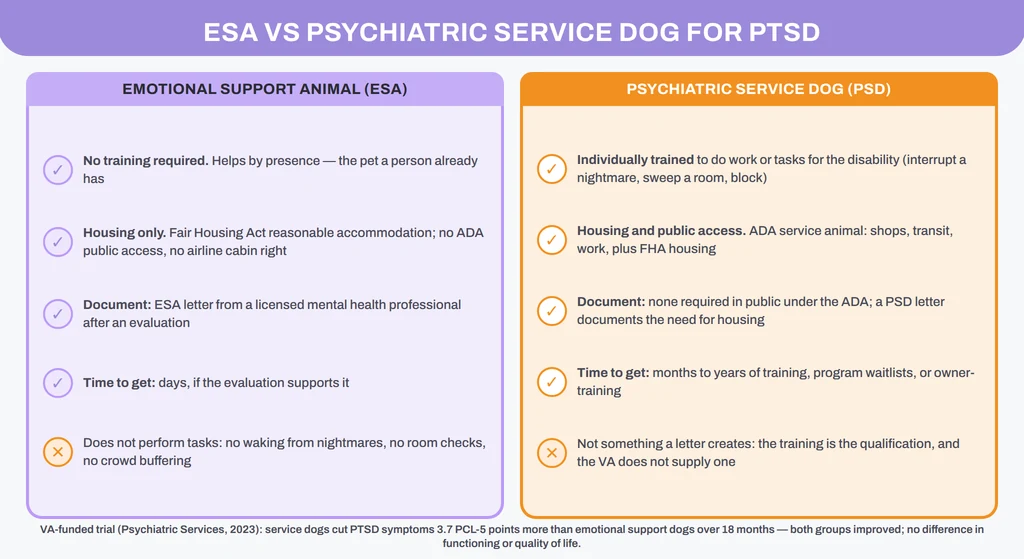
This is the question behind the search, because the results page for it is mostly service-dog programs. The two are different animals in law, and the difference decides what a person can actually get this month. An emotional support animal is any species, needs no training, and helps by presence; its only legal home is housing, through the Fair Housing Act, and a letter from a licensed mental health professional is what documents it. A psychiatric service dog is a dog individually trained to do work or perform tasks for a psychiatric disability — waking its handler from a nightmare, checking a room, standing between them and a crowd — and under the Americans with Disabilities Act it goes where the public goes. No letter creates a service dog; the training is the qualification, and a trained dog takes months to years, whether through a program with a waiting list or by owner-training.
The reason a therapist often recommends an ESA first — the Reddit thread that ranks for this search is exactly that story — is that the animal is already in the house. The evidence behind that advice is better than most ESA sites admit and more modest than most service-dog sites admit. A VA-funded randomized trial published in Psychiatric Services in 2023 (Richerson and colleagues) paired veterans with PTSD with either a trained service dog or an untrained emotional support dog and followed them for 18 months: the service-dog group improved 3.7 points more on the PCL-5 symptom scale and reported less suicidal ideation at 18 months (14% against 30%), but there was no significant difference between the groups in day-to-day functioning or quality of life, and both groups improved. A 2024 trial in JAMA Network Open (Leighton and colleagues, 81 veterans with a service dog against 75 in usual care) found the service-dog group seven points lower on the clinician-rated CAPS-5 after three months, with lower odds of depression, anxiety and social isolation. The honest reading: an animal helps, a trained one helps more with the symptoms themselves, and neither replaces trauma-focused therapy or medication. Our ESA letter vs PSD letter comparison covers the paperwork side, and the PSD letter page covers the document a trained dog’s handler uses for housing.
| For PTSD | Emotional support animal | Psychiatric service dog | Pet with no documentation |
|---|---|---|---|
| Training | None required | Individually trained to do work or tasks for the disability | None |
| What it does | Presence: calm, routine, company, touch | Tasks: interrupts nightmares, room checks, blocking, grounding on cue | Company |
| Housing (FHA) | Reasonable accommodation request with an ESA letter | Reasonable accommodation; the training itself is the strongest case after the 2026 HUD memo | Subject to the lease: pet rent, deposits, breed and weight limits |
| Public places (ADA) | No access rights | Shops, restaurants, transit, workplaces | No access rights |
| Air travel | Standard pet rules since the 2021 DOT rule | Accepted with the DOT service-animal form | Standard pet rules |
| Document | ESA letter from a licensed mental health professional after an evaluation | None required in public; a PSD letter documents the need for housing | None |
| Time to get | Days, if the evaluation supports it | Months to years of training or program waiting lists | — |
For most people with PTSD who rent, the practical sequence is the one the therapist in that thread suggested: the animal already at home becomes an ESA now, and a trained dog is a separate decision for later, if the tasks would change something the presence cannot. The broader legal distinctions — including therapy dogs, which are a third thing — are in service dog vs therapy dog vs ESA.
The evaluation is a clinical conversation by phone or video with a therapist licensed in the applicant’s own state (the online ESA evaluation page describes the format). For PTSD it covers four things, and one of them is a boundary as much as a check:
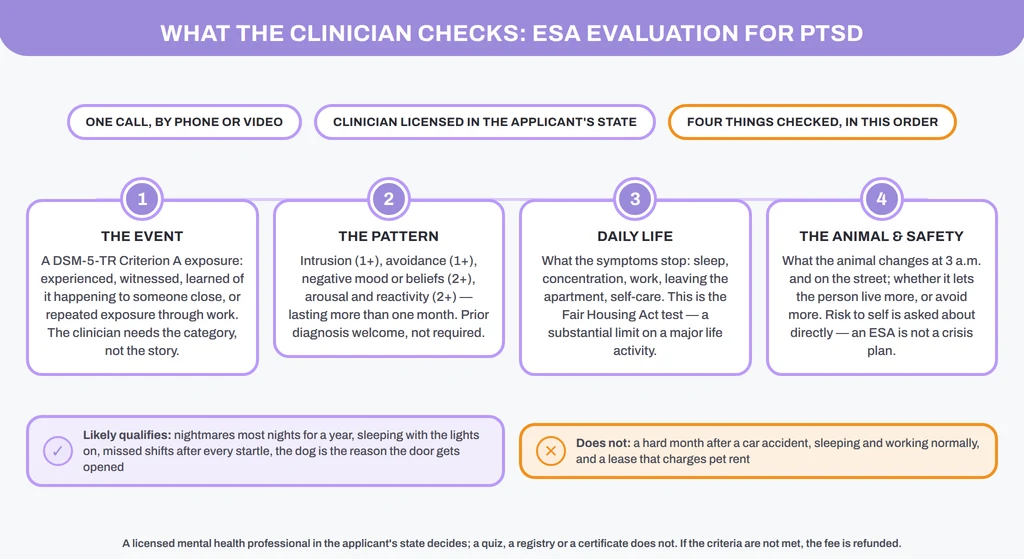
A common worry before the call is having to explain PTSD to a stranger. Specifics about the present do the work, and the past can stay where it is: the lights that stay on, the seat facing the door, the two warnings at work for missed shifts — and what is different on the days the animal is there. There is no script, and there should not be; a clinician can only document what the conversation supports, and an overstated letter is the one a landlord challenges. When the conclusion is that the criteria are not met, the fee comes back under the refund policy.
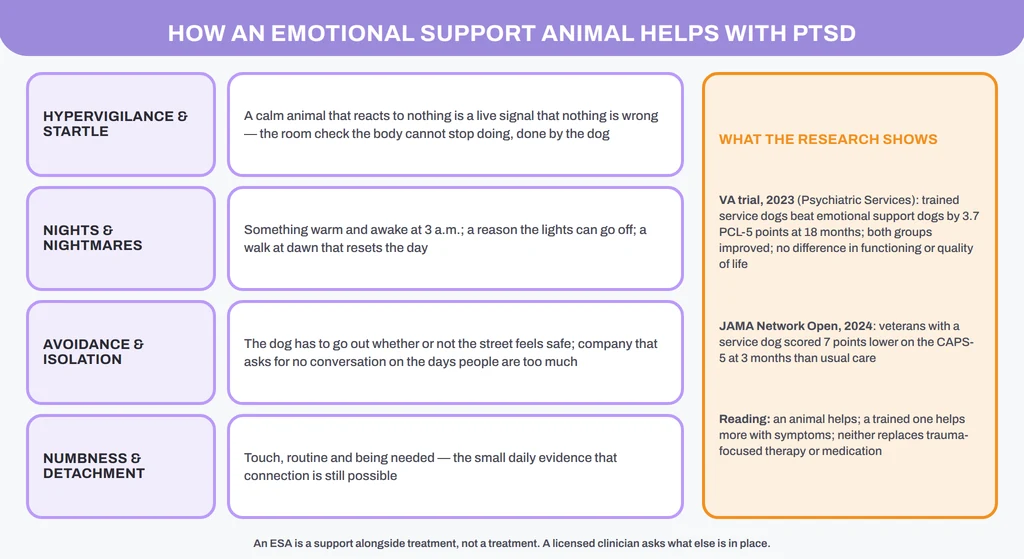
An ESA has no training requirement and performs no tasks; it helps by being there. For PTSD, “being there” lands on the symptoms themselves:
What the research does and does not show matters here, because “get a dog, it cures PTSD” is the slogan of the worst of this industry. The two trials above are the most careful evidence there is, and they say something specific: both trained service dogs and untrained emotional support dogs helped veterans with PTSD, a trained dog helped more with symptom severity, and neither changed overall functioning more than the other. Mental Health America’s summary of animal-assisted work with PTSD describes reduced dissociation and a felt sense of safety, which is what the applicants describe too. The honest reading is that an ESA is a support, not a treatment: a clinician evaluating PTSD will ask what else is in place. The choice of animal is separate from the choice of document — a dog brings the walk and the schedule, a cat brings the company with far less routine load — and our guides to the best emotional support dog breeds for anxiety, depression and PTSD and to an ESA cat cover both.
The whole process takes four steps and, if the evaluation supports it, about two days.
If the clinician decides the applicant doesn’t qualify, the fee is refunded within 7 days. If a landlord rejects the letter in writing after our support team has been involved, the refund window is 30 days. Both terms are on the refund policy page. The full walkthrough, including what a finished letter looks like, is in how to get an ESA letter.
The letter is a housing document, and the housing picture in 2026 has three separate parts. Any site that gives one sentence for all three is wrong about at least two.
The law itself has not moved. 42 U.S.C. § 3604(f)(3)(B) makes it discrimination to refuse a reasonable accommodation in rules, policies, practices or services when a person with a disability needs it to use and enjoy a dwelling, and 24 C.F.R. § 100.204 is HUD’s own regulation restating that duty. Neither contains a training requirement, and both can be enforced by a private lawsuit and by state fair-housing agencies.
HUD’s how-to notices are gone. FHEO Notices 2013-01 and 2020-01 — the checklists landlords and tenants both used to quote — were withdrawn effective September 17, 2025 (91 FR 17291, April 6, 2026), and nothing has replaced them. That includes the passage that said pet deposits and pet rent could not be charged for an assistance animal: whether a fee can be charged is now a case-by-case reasonableness question rather than a rule HUD stands behind.
HUD’s own enforcement has narrowed — and for an untrained animal this is the part to read twice. A May 22, 2026 FHEO memorandum says HUD will find reasonable cause and recommend charges only in cases involving animals individually trained to perform disability-related work or tasks. HUD describes this as prioritising its own resources, not as a change in the statute: open ESA cases go to case-by-case review, Section 504 and the ADA are outside the memo, and the right to sue privately is untouched. In practice it means the quality of an ESA letter carries more of the weight than it did, and a trained psychiatric service dog has the stronger housing case of the two — one more reason the choice in the second section matters.
For PTSD the part people care about most is privacy, and they are right to. The letter confirms a disability and the animal’s connection to it without naming the condition or anything about the event behind it; Florida’s statute (§ 760.27(3)(a)) and Montana’s (§ 70-24-114(4)(a)) go further and bar a housing provider from asking for the diagnosis, its severity or medical records, and Montana requires the landlord to answer in writing. The request itself can be made in writing, so nobody has to explain themselves across a leasing-office counter. What a housing provider may still do is ask for reliable documentation from a licensed professional, verify the letter with the clinician, and set reasonable rules about the animal’s conduct. How to make the request, and what happens if it is refused, is in ESA letter to landlord; the HUD and landlord-rights background is in ESA letter for housing.
Six states regulate who may write the letter and what has to happen first, and a letter that ignores them is easy to challenge — which is why PetESALetter matches each applicant with a clinician licensed in their own state. For PTSD, where the symptom pattern has to have lasted more than a month before it is PTSD at all, the 30-day relationship four of these states require lines up with the diagnosis itself; Louisiana adds a minimum of two sessions, and Colorado wants the meeting in person.
| State | What has to be in place before the letter is signed | Who may sign | Statute |
|---|---|---|---|
| California | A client-provider relationship of at least 30 days and a clinical evaluation; license details stated in the letter | A practitioner licensed in California | Cal. Health & Safety Code § 122318 (AB 468, 2021) |
| Louisiana | A therapeutic relationship of at least 30 days, at least two sessions, a disability assessment and a clinical evaluation | A Louisiana-licensed provider | La. R.S. 46:1974 (Act 558 of 2024) |
| Arkansas | A 30-day client-provider relationship and a clinical evaluation, reviewed at least once a year | A provider licensed in the jurisdiction | Ark. Code Ann. § 20-14-1003 (Act 268 of 2023) |
| Montana | A client-provider relationship of at least 30 days and a clinical evaluation; a registry card is not sufficient on its own | A Montana-licensed mental health professional, license details in the letter | Mont. Code Ann. § 70-24-114 (HB 703, 2023; amended 2025) |
| Florida | Personal knowledge of the disability; no waiting period. An out-of-state practitioner must have provided in-person care at least once | A practitioner acting within the scope of the license | Fla. Stat. § 760.27 (SB 1084, 2020) |
| Colorado | An in-person meeting and a written finding on disability and need; no waiting period. Housing side: an assistance animal is a presumed reasonable accommodation | A mental health licensee with sufficient familiarity with the patient | C.R.S. § 12-245-229; C.R.S. § 24-34-502.2 as amended by HB26-1045 (eff. Aug 12, 2026) |
Everywhere else the federal framework applies on its own. Our California ESA letter and Louisiana ESA letter pages go through the two strictest states in detail, the Montana ESA letter page covers the state that spells out that a registry card proves nothing, and the state pages linked in the navigation cover the rest.
Veterans are a large share of the people asking this question, and the answer from the VA’s own National Center for PTSD is plain: the VA does not provide service dogs for physical or mental health conditions, including PTSD, and it does not provide emotional support animals either. What exists is narrower. Under the PAWS for Veterans Therapy Act (Public Law 117-37, signed August 25, 2021) the VA runs a five-year pilot of canine-training therapy at five or more medical centers for enrolled veterans with PTSD referred by their VA provider — the veteran helps train a future service dog as part of treatment; it is not a dog-issuing program. VA veterinary benefits cover service dogs for permanent physical impairments, not PTSD, unless future research changes that. There is no VA ESA letter program.
What a veteran needs for an ESA letter is the same as anyone else: an evaluation by a licensed mental health professional. A treating VA psychologist, psychiatrist or social worker who already knows the history can write one if they are willing and licensed in the veteran’s state — it is worth asking, and it is worth bringing that provider’s name to any other evaluation. Many decline as a matter of practice policy, which is what an independent evaluation is for; our guide to who can write an ESA letter goes through every license type. A VA disability rating for PTSD is strong evidence of a diagnosis, but it is not the letter, and it does not by itself establish what the animal does.
Then there is the industry built around this search, which is at its most predatory with people who are exhausted and want the problem solved tonight. Four tells:
The bottom line. PTSD can qualify for an emotional support animal when a licensed clinician finds that it substantially limits daily life and that the animal alleviates it. An ESA is the animal already at home and covers housing only; a psychiatric service dog is a trained animal with public-access rights and months of work behind it, and the trials say a trained dog does more for symptoms while both help. The letter never names the condition, six states add their own rules about who writes it, and the 2026 changes narrowed HUD’s enforcement, not the statute. PetESALetter’s evaluation is by a clinician licensed in the applicant’s state, the fee is $99 flat billed only after eligibility is confirmed, and the letter arrives in 24–48 hours if the need is there.
Not sure whether PTSD qualifies — or whether an ESA is the right animal? A licensed clinician in your state evaluates whether an emotional support animal fits the situation — and the first step is a free five-minute screen.
Yes, when a licensed mental health professional evaluates the person and finds that the PTSD substantially limits a major life activity — concentrating, working, caring for oneself, or the sleep that all three depend on — and that the animal alleviates it. A diagnosis or a VA rating by itself does not qualify anyone, and an evaluation can conclude that the criteria are not met.
They do different jobs. An ESA is the animal a person already has, needs no training, and covers housing only. A psychiatric service dog is individually trained to do tasks such as interrupting a nightmare or checking a room, has public-access rights under the ADA, and takes months to years to train. The VA-funded trial in Psychiatric Services (2023) found the trained dog reduced symptoms 3.7 PCL-5 points more over 18 months, with no difference in functioning or quality of life; both groups improved.
A flare-up is the arousal and intrusion clusters getting louder: worse sleep or nightmares, being startled by ordinary noise, scanning rooms, irritability, and pulling away from people, often after a reminder of the event. An ESA helps by presence — a calm animal that reacts to nothing, something to hold at 3 a.m., a reason to go outside — and a licensed clinician will still want treatment in place for the flare-ups themselves.
The VA has no ESA letter program and does not provide or pay for service dogs or emotional support animals for PTSD; its PAWS Act pilot is canine-training therapy, not a dog benefit. A treating VA mental health provider who is willing and licensed in the veteran’s state can write an ESA letter, as can any other licensed mental health professional after an evaluation.
For an ESA, the one already in the house: no breed or size requirement exists, and a cat or another species qualifies the same way. Service-dog programs favour steady, biddable breeds such as Labrador and golden retrievers for task training, but that is a training choice, not a legal one. A licensed clinician evaluates the person and the animal’s role, not the breed.
No. A legitimate letter states that the person has a disability under the Fair Housing Act and that the animal is connected to it, with the clinician’s license details and signature; neither the diagnosis nor anything about the event is named. In Florida and Montana the statute also bars a housing provider from asking for the diagnosis, its severity or medical records.

Licensed Psychotherapist
Darren is a leading expert in mental health advocacy and assistance animal documentation. He specializes in streamlining the process for obtaining ESA Letters, PSD Letters, and State-specific ESA compliance.

ESA Letters Issued

Successful Consultations

Licensed Therapist Network

Client Satisfaction Rate




Petesaletter.com helps you get your emotional support animal letter online with guidance and support.

Got Questions? Call us 24/7
Copyright © 2020-2026 Petesaletter All rights reserved. Terms | Privacy | Refund
Owned and Operated by Verimedix LLC