


ESA Letter Rhode Island: A Real Evaluation and Your Housing Rights
An ESA letter in Rhode Island comes from a licensed clinician after a real evaluation. It costs $99 flat. Clinically reviewed by Darren Rafel, LCSW.






ESA LETTER RHODE ISLAND
What Does an ESA Letter in Rhode Island Do?
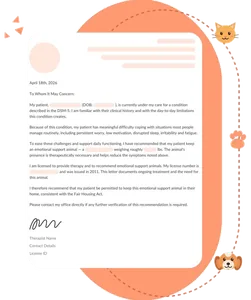
An emotional support animal letter in Rhode Island is written by a licensed clinician after evaluating you. It describes a disability-related need for your animal and backs a reasonable accommodation request.
Rhode Island has no ESA statute. Your request rests on the federal Fair Housing Act and the state Fair Housing Practices Act, R.I. Gen. Laws § 34-37-4(e)(1), whose accommodation duty has no training requirement.
The price is $99 flat, with no subscription. The state keeps no official ESA registry, ID card or certificate, so a site selling ESA registration sells a product, not a legal status.

How Do You Get an ESA in RI?
Getting an ESA letter in Rhode Island takes four online steps: a free quiz, payment at checkout, a one-on-one evaluation, and the clinician's own decision on whether you qualify.

Take the Free Quiz
Answer a few private questions about your mood, daily life and animal. The quiz is free and takes about five minutes.

Pay $99, Meet Your Clinician
After checkout, a clinician licensed in Rhode Island evaluates you by video, phone or secure online visit.

Get an Honest Decision
The clinician decides on clinical grounds, and not everyone qualifies. If you don't, you can request a full refund within 7 days.

Ask Your Landlord in Writing
If you qualify, your letter usually arrives within 24–48 hours. Send it with a written request and keep a copy.
Emotional Support Animal Rhode Island: Who Qualifies?
No online self-test makes you eligible. Rhode Island defines disability as a condition that substantially limits a major life activity (R.I. Gen. Laws § 42-87-1). Your clinician judges whether your animal helps.
Clinicians often evaluate conditions such as:
Rhode Island ESA Laws: The Fair Housing Practices Act
Rhode Island has no ESA statute. H 8215 passed the House 66–6 on June 8, 2026, then died in Senate Judiciary, so it is not law. Your rights come from R.I. Gen. Laws ch. 34-37 and the federal Fair Housing Act.
The Accommodation Duty Has No Training Test
Section 34-37-4(e)(1) bars an owner from refusing reasonable accommodations in rules or policies that a disabled occupant needs. It says nothing about training.
The Commission's Rule Covers ESAs
Regulation 515-RICR-10-00-3 § 3.4(C)(5) says not all animals needed as an accommodation must have specialized training. The rule applies to pet policies.
Andrade v. Westlo (2022)
In Andrade v. Westlo Management, the Rhode Island Supreme Court called the state clause virtually identical to the FHA and decided the case using federal FHA decisions.
Verification Has Limits
A landlord may verify your disability and need only when either is not readily apparent. Owners may not ask about disability when you apply (§ 34-37-4(a)).
No Retaliation for Asserting Rights
Section 34-37-5.1 bars retaliation for filing a charge. Under § 34-18-46, a rent hike or eviction within six months after a complaint is presumed retaliatory.
Can a Rhode Island Landlord Deny an ESA?
Only on narrow grounds. Denials can go to the Rhode Island Commission for Human Rights, a HUD FHAP agency, within one year: (401) 222-2661.
No-Pet Rules Can Bend
The Commission's rule applies the accommodation duty to pet policies, so a no-pet lease is where your request starts, not where it ends.
No Breed Rule in State Law
No Rhode Island statute or rule addresses breed. In Andrade, a pit bull case, the court sent the direct-threat question to trial.
Fees: Ask for a Waiver
No Rhode Island law bans pet fees for an untrained ESA. Ask for a fee waiver as part of your accommodation request.
Deposit Cap: One Month
A pet deposit counts inside the one-month cap on deposits "however denominated" (§ 34-18-19). It is due back within 20 days after you leave.
Direct Threat or Damage
A landlord may refuse an animal that poses a direct threat or risks substantial damage, based on objective evidence about that animal (§ 34-37-4(j)).
Undue Burden
A request can also fail if it imposes an undue financial and administrative burden or fundamentally alters the provider's operations.
No Small-Landlord Exemption
The state Act has no owner-occupied or small-landlord exemption for disability, even where the federal four-family exemption would apply.
FLYING WITH AN ESA
RI Service Dog Laws and ESAs
Airlines may treat an ESA as a pet under the Department of Transportation's Air Carrier Access Act rule, effective January 11, 2021. Your letter covers housing, not the cabin.
Rhode Island service dog laws give public access to a service animal specially trained for its handler, and only dogs count (R.I. Gen. Laws § 40-9.1-1.1(6)). ESAs cannot enter stores or restaurants.
If your dog is trained to perform tasks for a psychiatric condition, a PSD letter may fit better than an ESA letter. Ask our team about it.
Is There ESA Registration in Rhode Island?
No. Rhode Island has no ESA registry, ID card or certificate, and buying one adds no legal weight. Misuse is a separate question: no state statute penalizes a false ESA request in housing, but honesty still matters.
What the law actually says:
WHY CHOOSE US
Why Rhode Island Renters Choose PetESALetter
Clinicians Licensed in Your State
A mental health professional licensed in Rhode Island evaluates you one-on-one, by video, phone or secure online visit.
Letters Usually in 24–48 Hours
Once your clinician finds you qualify, the signed letter usually arrives by email within 24–48 hours of the evaluation.
A Real One-on-One Evaluation
Your clinician talks with you about your symptoms and daily life rather than skimming a form. That conversation is what makes the letter credible to a landlord.
Letterhead With License Details
Each letter is on professional letterhead and shows the clinician's name, license type, license number, state and the date it was signed.
Landlord Verification Support
If your landlord wants to confirm the letter is genuine, our support team answers their verification questions directly.
Private and HIPAA-Conscious
We handle your health information with HIPAA-conscious care and never sell your data.
Help by Email or Phone
Questions about your letter, or a landlord who wants more information? Email support@petesaletter.com or call (470) 887-9106, and a real person answers.
Clear Refund Terms
No Subscription, No Upsells
Full refund if the clinician finds you don't qualify (request within 7 days) or your landlord rejects the letter (send the written denial within 30 days).
Trustpilot Reviews From Our Clients
The team was super quick and got me the letter I needed verified by an in-state licensed therapist. Cheapest option I found and worked great!
They got back to me right away, they asked me if the information was correct and if not they can change it on the letter and send it back. They were very helpful, and kind. I loved their service. They can send you an email or a text which I think was very helpful. And the pricing is very good with very thing it comes with
I had a great experience with PetesaLetter.com. The process was simple, fast, and easy to understand. The staff was helpful, and I appreciated how smooth everything went from start to finish. I would recommend them to anyone needing an ESA letter and looking for a convenient service.
RHODE ISLAND FAQ
Rhode Island ESA Letter FAQ
Yes. Rhode Island has no ESA statute, but its accommodation duty, R.I. Gen. Laws § 34-37-4(e)(1), has no training element, and the state Commission's rule agrees.
No Rhode Island law requires an in-state license for ESA letters. General licensing rules still cover telehealth, so PetESALetter uses clinicians licensed in your state.
HUD withdrew its older assistance-animal notices effective September 17, 2025. A May 22, 2026 memo limits HUD cause findings to trained animals. The FHA is unchanged.
Rhode Island law names no profession. The Commission's fact sheet, quoting older HUD guidance, lists physicians, psychiatrists, social workers and other mental health professionals, not veterinarians.
Only on individual grounds: direct threat, substantial damage, undue burden or fundamental alteration (515-RICR-10-00-3 § 3.4(C)). A landlord may also verify a disability or need that isn't apparent.
ESAs have no right to enter stores, restaurants or other public places. Rhode Island's access law covers trained service dogs only.