
Last Updated on: October 10, 2026
Reviewed by Darren Andrew Rafel

Yes, a veteran can get an ESA letter, but not through a VA program: the VA has none and pays for no emotional support animal. A VA mental health provider who treats the veteran may write one, and so can any clinician licensed in the veteran’s state after an evaluation. The letter covers housing, not VA medical centers. PetESALetter evaluates adults with a state-licensed clinician; in most states a qualifying letter usually follows within 24–48 hours, for $99 flat.
Key takeaways
No. The VA’s only animal benefit for individual veterans is built around trained service dogs, and even there the VA does not hand out dogs. Its Prosthetic and Sensory Aids Service says so directly: veterans approved for a service dog are referred to an organization accredited by Assistance Dogs International or the International Guide Dog Federation. What the VA pays for, under 38 CFR 17.148, is a veterinary insurance policy, the dog’s hardware (a harness, for example) and travel to the training. It does that only when the veteran has a visual, hearing or substantial mobility impairment and the VA clinical team decides a trained dog is the best way to manage it. Food, grooming, boarding and over-the-counter medicine are excluded by name.
The PAWS for Veterans Therapy Act (Public Law 117-37, signed August 25, 2021) widened the picture for PTSD without touching emotional support animals. Section 2 set up a five-year pilot at no fewer than five VA medical centers in which veterans with PTSD help train a dog as part of their treatment. Section 3 amended 38 U.S.C. § 1714 so the VA may provide a service dog to a veteran with a mental illness “regardless of whether the veteran has a mobility impairment,” with a veterinary insurance policy for veterans with PTSD who receive one. Every word of it concerns service dogs. How a given VA facility applies those provisions is a question for the veteran’s care team; the regulation that pays the benefits, 17.148, still names visual, hearing and mobility impairments.
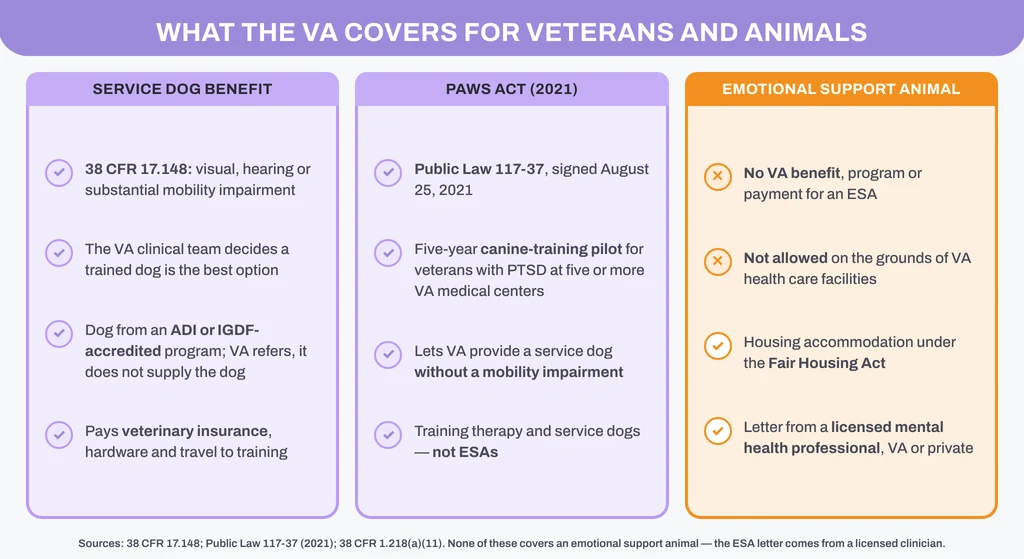
So the VA answer to an emotional support animal is a short one: no benefit, no payment, no program, and no VA-issued ESA card. There is no ESA registry anywhere in U.S. law, VA or otherwise, and the ESA registration myths page takes the ID-card sellers apart. The animal is the veteran’s own pet, and the only document that changes how a housing provider treats it is an ESA letter from a licensed clinician. If what the veteran needs is a dog trained to do tasks in public, that is a psychiatric service dog, a different path compared further down this page.
Sometimes, and it is worth asking first. The VA publishes no national ESA-letter program and no VA-wide rule on whether its clinicians write housing letters. Its animal directives, VHA Directive 1188 and VHA Directive 1178, deal with animals on VA property and with animal-assisted therapy, not with a veteran’s apartment. That leaves the decision with the individual provider, and veterans report both answers. A VA psychologist, psychiatrist, social worker or counselor who already treats the veteran and agrees an animal helps is in a strong position to write one, because the history is already in the chart.
Three things decide whether that letter does its job. First, the license: the letter should give the clinician’s license type, number, state and date. Second, the state: in California, Arkansas, Montana and Louisiana the statute also expects a clinician licensed in that state (Louisiana accepts a compact license) and a relationship of at least 30 days. A VA provider licensed somewhere else may not be able to sign for a rental there, while a treatment relationship that already runs past 30 days meets that part of the rule. Third, the content: the letter has to say what a housing provider needs to hear, that the person has a disability under the Fair Housing Act and that the animal helps with it, and it does not need to name the diagnosis. Our guide to who can write an ESA letter covers every license type.
When the VA provider declines, or the next appointment falls after the lease deadline, a private evaluation is the other route. The table sets the two side by side.
| Letter from a VA provider | Letter from a private licensed clinician | |
|---|---|---|
| Who writes it | A VA psychologist, psychiatrist, social worker or counselor who treats the veteran | A clinician licensed in the state where the veteran rents, after an evaluation |
| Whether it is offered | Up to the provider; the VA publishes no national ESA-letter process | Yes, if the evaluation finds a qualifying disability and need |
| Relationship | Usually long, and often already past the 30-day rule some states set | New unless the clinician already treats the veteran; 30-day states add a wait |
| License | Can be from a different state than the rental | Matched to the veteran’s state |
| Timing | Depends on the next appointment | In most states usually 24–48 hours after the evaluation |
| Fee | No separate VA ESA fee is published | $99 flat at PetESALetter, paid at checkout; full refund if the clinician finds no qualifying need |
| What the landlord sees | License details, a statement of disability, the animal’s role | The same |
The same ones as anyone else. There is no veteran category in the law, and no veteran qualifies automatically. The test is a disability under the Fair Housing Act, meaning a mental or emotional condition that substantially limits a major life activity such as sleeping, working or concentrating (42 U.S.C. § 3602(h); 24 C.F.R. § 100.201), and an animal that eases it. A licensed clinician makes that call in an evaluation.
Military service shapes the evaluation, not the standard. Post-traumatic stress is the condition veterans ask about most, and our ESA for PTSD guide covers how a clinician weighs it; depression and anxiety follow the same logic in the ESA for depression and ESA for anxiety guides. A VA disability rating can help show the first half of the test, that a disability exists, but it says nothing about the animal, which is the second half. A DD-214 says neither. The clinician asks what changes on the days with the animal: the dog that gets a veteran out the door at 6 a.m., the cat that makes a new apartment feel less empty.
The VA’s National Center for PTSD says there is not enough research to know whether dogs help treat PTSD, and that a dog is not a substitute for effective treatment. An ESA works alongside care, not instead of it. Anyone in crisis can reach the Veterans Crisis Line by dialing 988 and pressing 1, or by texting 838255; VA enrollment is not required.
Home, yes. The VA medical center, no. 38 CFR 1.218(a)(11) admits service animals, defined as dogs individually trained to do work or perform tasks for a person with a disability, and states that “the provision of emotional support, well-being, comfort, or companionship do not constitute work or tasks.” Other animals generally may not be on VA property; the exceptions are law-enforcement animals, research animals and animal-assisted therapy run by VA clinicians. VA Palo Alto’s guidance tells veterans plainly that emotional support animals cannot come with them to appointments. The rule covers property under the Veterans Health Administration, the Veterans Benefits Administration and the National Cemetery Administration alike.
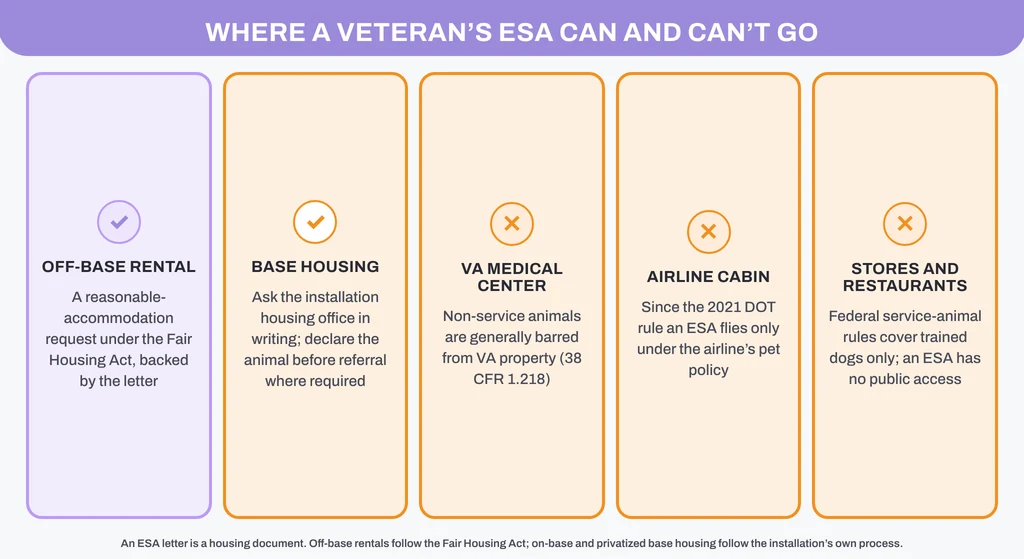
Planes and stores follow the same split. Since the Department of Transportation’s 2021 rule, airlines may treat an ESA as a pet, so it flies only under the carrier’s pet policy (our guide to which airlines allow emotional support animals tracks them), and under the federal service-animal definitions only trained dogs have public access. The table draws the line between the three kinds of animal veterans ask about.
| ESA with a letter | Psychiatric service dog (obtained privately) | Service dog through the VA | |
|---|---|---|---|
| What it is | A pet whose presence eases a disability | A dog individually trained to do tasks for a psychiatric disability | A trained dog the VA supports under its own rules |
| Training | None required | Task training required | From an ADI or IGDF-accredited program |
| At home | Reasonable accommodation under the Fair Housing Act | Yes | Yes |
| VA medical center | No | Yes, as a service animal | Yes |
| Stores and restaurants | No | Yes | Yes |
| Flights | Only under the airline’s pet policy | As a service animal, with the DOT forms | As a service animal, with the DOT forms |
| Paperwork | ESA letter from a licensed clinician | No certification exists under the ADA | VA clinical determination and a training certificate |
| What the VA pays | Nothing | Nothing, unless approved through the VA | Veterinary insurance, hardware, travel to training |
A psychiatric service dog is a bigger commitment: months of task training and a dog that works in public. Our PSD letter page explains that route for housing and travel, the psychiatric service dog tasks guide lists what such a dog is trained to do, and service dog vs therapy dog vs ESA compares all three.
Off base, the same ones every renter has, and they have shifted in the last year. The statute is unchanged: refusing “reasonable accommodations in rules, policies, practices, or services, when such accommodations may be necessary to afford such person equal opportunity to use and enjoy a dwelling” is discrimination (42 U.S.C. § 3604(f)(3)(B)), and HUD’s regulation at 24 C.F.R. § 100.204 restates it. A no-pets rule is a policy, and an exception for a veteran’s ESA is the classic accommodation.
What changed is HUD’s guidance and enforcement. Notices FHEO-2013-01 and FHEO-2020-01, the checklists most landlords and letter sites still quote, were withdrawn effective September 17, 2025 (91 FR 17291, April 6, 2026). On May 22, 2026, HUD’s fair housing office said it will find reasonable cause and recommend charges only where the animal is individually trained, and sent open ESA cases for case-by-case review. HUD frames that as an enforcement priority, not a change in the law: the memo does not address Section 504 or the ADA, and it leaves a tenant’s right to sue within two years untouched. Fees and deposits for an ESA are now argued case by case rather than settled by guidance; the ESA pet rent and deposits guide goes through it. Some states settle it by statute: Florida’s § 760.27 says a tenant approved for an ESA may not be required to pay extra for the animal.
Two points matter more to veterans than to most renters. Veterans housed through HUD-VASH vouchers deal with a public housing agency, and the agency, as a recipient of federal funds, is also covered by Section 504 of the Rehabilitation Act, which is the part of the law HUD’s 2026 memo expressly leaves aside. And some housing sits outside the Fair Housing Act altogether: an owner-occupied building with four or fewer units, and a single-family house rented by its owner without an agent (42 U.S.C. § 3603(b)). A housing provider may also refuse an animal that would be a direct threat or cause substantial physical damage (42 U.S.C. § 3604(f)(9)). Our guide on how to talk to your landlord about an ESA covers the conversation itself.
It can be part of the file, but base housing does not run on a landlord’s say-so. On an installation the process for any animal runs through the Military Housing Office and, where there is one, the housing partner’s leasing office. Kirtland Air Force Base is a typical example. Its Military OneSource housing page requires every applicant who intends to keep a service animal or an emotional support or therapy animal in housing to declare it and provide the required documentation before referral, warns that failing to do so may void the application, and bans pit bulls, American and English Staffordshire bull terriers, Rottweilers and wolf hybrids from base housing.
Rules differ by installation, so the practical advice is procedural. Before signing, ask the housing office in writing what documentation it accepts for an emotional support animal, whether breed or size limits apply to it, and whom to contact if the request is refused. Keep the answer. Off base, in the apartment a veteran rents in town after separating or that a service member’s family rents near the installation, the Fair Housing Act section above applies. Student veterans living on campus face a third set of rules, covered in the ESA letter for college dorms guide.
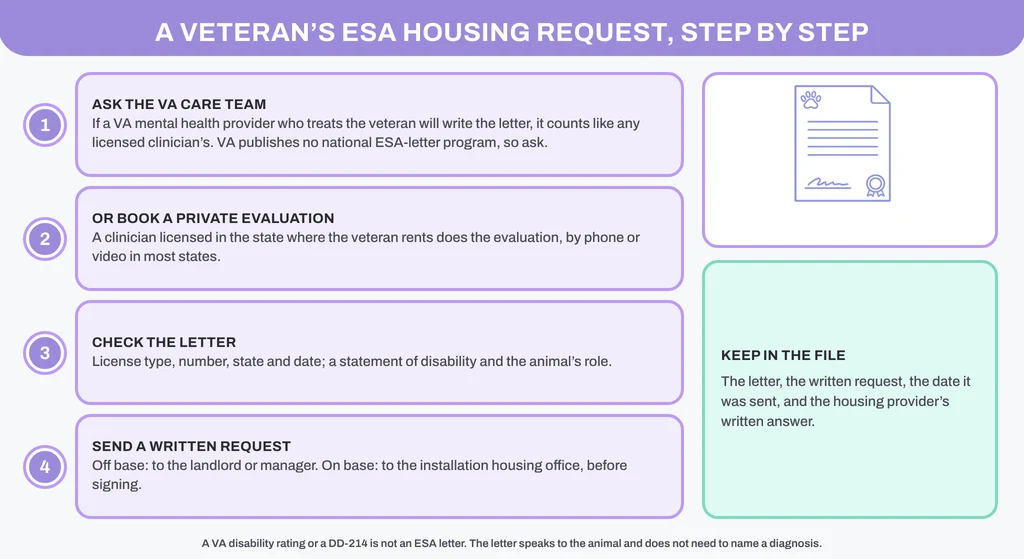
For an adult veteran, the process takes four steps.
If the clinician decides the applicant doesn’t qualify, the refund is requested within 7 days. If a landlord rejects the letter in writing after our support team has been involved, the refund window is 30 days. Both terms are on the refund policy page. The full walkthrough is in how to get an ESA letter.
State rules. Several states add their own rules about who may write an ESA letter and what has to happen first. That matters for a veteran who relocates, because a letter written for one state may not meet the next state’s rules. PetESALetter matches each applicant with a clinician licensed in their own state.
| State | What has to be in place before the letter is signed | Who may sign | Statute |
|---|---|---|---|
| California | A client-provider relationship of at least 30 days and a clinical evaluation; license details stated in the letter | A practitioner licensed in California | Cal. Health & Safety Code § 122318 (AB 468, 2021) |
| Louisiana | A therapeutic relationship of at least 30 days, at least two sessions, a disability assessment and a clinical evaluation | A Louisiana-licensed provider | La. R.S. 46:1974 (Act 558 of 2024) |
| Arkansas | A 30-day client-provider relationship and a clinical evaluation, reviewed at least once a year | A provider licensed in the jurisdiction | Ark. Code Ann. § 20-14-1003 (Act 268 of 2023) |
| Montana | A client-provider relationship of at least 30 days and a clinical evaluation; a registry card is not sufficient on its own | A Montana-licensed mental health professional, license details in the letter | Mont. Code Ann. § 70-24-114 (HB 703, 2023; amended 2025) |
| Iowa | A written finding that states whether the provider-patient relationship has lasted at least 30 days; the state’s own form has the signer certify that it has | A licensed physician, PA, nurse, psychologist, social worker or behavioral-science professional, in Iowa or in good standing in another state | Iowa Code § 216.8C (SF 2268, 2024) |
| Florida | Personal knowledge of the disability; no waiting period. An out-of-state practitioner must have provided in-person care at least once | A practitioner acting within the scope of the license | Fla. Stat. § 760.27 (SB 1084, 2020) |
| Colorado | An in-person meeting and a written finding on disability and need; no waiting period | A mental health licensee with sufficient familiarity with the patient | C.R.S. § 12-245-229; HB26-1045 (eff. Aug 12, 2026) |
Everywhere else the federal framework applies on its own. Our California ESA letter and Louisiana ESA letter pages go through the two strictest states in detail. Florida’s statute (§ 760.27(3)(a)) and Montana’s (§ 70-24-114(4)(a)) bar a housing provider from asking for the diagnosis, its severity or medical records, which helps a veteran who would rather not hand a landlord a VA chart.
The red flags are the same for every applicant, with one veteran twist. A letter in minutes: “instant approval” means nobody evaluated anyone, and the how to verify an ESA letter is real guide lists what a genuine one contains. A “veteran ESA registration,” ID card or vest sold as proof: there is no registry, VA or otherwise. A site implying VA affiliation or a VA-backed ESA program: PetESALetter is not affiliated with the VA. And a promise that the landlord “must” accept the letter: the statute obliges a housing provider to consider a reasonable accommodation, not to grant every request.
The bottom line. The VA does not provide, pay for or register emotional support animals; its benefits are for trained service dogs. A VA provider who treats the veteran may write an ESA letter, and any clinician licensed in the veteran’s state can after an evaluation. Off base, the letter supports a Fair Housing Act request that is judged case by case since HUD’s 2025 withdrawal; base housing follows the installation’s process; and an ESA has no place in VA medical centers or stores, and flies only as a pet. PetESALetter evaluates adults with a clinician licensed in their state, for $99 flat, with a full refund if the clinician finds no qualifying need.
Served, renting, and wondering whether the VA or an independent clinician should write your ESA letter? A licensed clinician in your state evaluates whether an emotional support animal fits the situation — and the first step is a free five-minute screen.
Through a licensed mental health professional: either a VA provider who treats the veteran and agrees to write one, or a private clinician licensed in the veteran’s state after an evaluation. The VA has no ESA-letter program. The letter should show the clinician’s license details and state that the person has a disability and that the animal helps with it.
No. The VA pays veterinary insurance, hardware and travel to training only for trained service dogs that qualify under 38 CFR 17.148, and the 2021 PAWS Act concerns service dogs and a canine-training pilot. No VA benefit covers an emotional support animal or an ESA letter.
Yes, if the provider is willing; the VA publishes no national rule either way, so the veteran has to ask. The letter carries the same weight as any licensed clinician’s, but in California, Arkansas, Montana and Louisiana state law expects a clinician licensed in that state and a relationship of at least 30 days.
No. 38 CFR 1.218 admits only service dogs individually trained to do work or tasks, and says emotional support and companionship are not work or tasks. Other animals are generally not allowed on VA property, apart from law-enforcement, research and VA animal-assisted therapy animals.
It can, but no diagnosis qualifies on its own. A licensed clinician decides whether the condition substantially limits a major life activity and whether the animal eases it. A VA disability rating can help show the disability, but not the need for the animal.
Not automatically. Off base, the Fair Housing Act requires a landlord to consider a reasonable accommodation, and allows a refusal for exempt housing, a direct threat or substantial damage; since HUD withdrew its animal guidance in 2025, requests are judged case by case. Base housing follows the installation’s own process.

Licensed Psychotherapist
Darren is a leading expert in mental health advocacy and assistance animal documentation. He specializes in streamlining the process for obtaining ESA Letters, PSD Letters, and State-specific ESA compliance.

ESA Letters Issued

Successful Consultations

Licensed Therapist Network

Client Satisfaction Rate




Petesaletter.com helps you get your emotional support animal letter online with guidance and support.

Got Questions? Call us 24/7
Copyright © 2020-2026 Petesaletter All rights reserved. Terms | Privacy | Refund
Owned and Operated by Verimedix LLC