
Last Updated on: October 30, 2026
Reviewed by Darren Rafel, LCSW
Yes — a turtle can be an emotional support animal for housing. The Fair Housing Act names no species; the test is a licensed mental health professional finding a disability the animal eases. Lawfulness comes first: federal law bans selling turtles under 4 inches, Florida allows no new pet red-eared sliders, and Hawaii bars snapping turtles. PetESALetter matches adults with a clinician licensed in their state; in most states a qualifying letter follows within 24–48 hours, for $99 flat.
Key takeaways
Yes. Nothing in the Fair Housing Act or in HUD’s regulation limits an emotional support animal to a dog or a cat, or to a mammal. The statute obliges a housing provider to consider a reasonable accommodation in “rules, policies, practices, or services” when it may be necessary for a person with a disability to use and enjoy the home (42 U.S.C. § 3604(f)(3)(B)), and the regulation says the same without naming a species (24 C.F.R. § 100.204). A turtle in a tank is an animal; whether it is an emotional support animal is a question about the person, answered by a licensed mental health professional after an evaluation. That is what an ESA letter records.
The AI summary at the top of this search says much the same and then stops, which is where the trouble starts. Three things decide whether a turtle request works in practice, and the ranking pages mention none of them. The first is whether the animal is lawful: federal law bans the sale of turtles under 4 inches as pets, Florida bars new pet red-eared sliders, and Hawaii bars snapping turtles — rules read on the regulators’ own pages below. The second is the setup: a grown slider needs a tank most property managers have never pictured, and the request has to answer the weight, lamp and water questions before they are asked. The third is the 2026 housing picture, in which HUD’s how-to notices are gone and a documented letter carries more of the weight than it used to.
One honest note before the rules. A turtle does not come when called, does not sit on a lap, and the CDC’s advice is not to kiss or snuggle it at all. What a turtle gives is a routine — feeding, the water change, the basking light on a timer — and a quiet animal to watch. For some people that is exactly the right thing and a clinician will say so; for others a turtle is the wrong animal for the job, and a clinician will say that too. The species does not disqualify anyone; it just has to fit the person.
Any of them can qualify; the question is which one a housing provider can reasonably accommodate in that unit. The figures below come from veterinary sources, not from pet-store labels, and the last row is the one most turtle owners have never been told about.
| Turtle or tortoise | Adult size and life span (source) | What the rental needs | Our read for a request |
|---|---|---|---|
| Red-eared slider (Trachemys scripta elegans) | Males 7–9 inches, females 10–12 inches of shell (VCA Animal Hospitals); lives for decades | 10 gallons of water per inch of shell (VCA) — about 100 gallons for a grown female — plus a basking dock, a basking lamp, a UVB tube, a filter and a heater | The usual pet-store turtle and the heaviest request on this list; Conditional in Florida, where no new pet sliders are allowed |
| Box turtle (Terrapene) | Roughly 5–7 inches; “captive box turtles usually live up to 20 years, but some have been reported to live 30 to 40 years” (VCA); Merck gives 25–50 years for the eastern box turtle | A land enclosure with a shallow water dish, a warm end and UVB; a hibernation question every autumn | Small, dry and quiet; a native species with its own wildlife rules — Florida caps possession at two and bans selling any turtle taken from the wild |
| Russian, Hermann’s or Greek tortoise (Testudo) | “Generally reach a maximum of 10 inches when they are full-grown” (VCA); decades — Merck lists the leopard tortoise at 50+ years | A tortoise table or pen with a heat lamp and UVB; no water tank, no filter, no weight problem | The easiest turtle request on the list, and the animal in the 2025 college-dorm case below |
| Sulcata / African spurred tortoise (Centrochelys sulcata) | “Can reach almost 3 feet in length”, “may reach 150 pounds”, “may live 100 years” (VCA) | Outdoor space, heated shelter, a yard it cannot dig out of | Not a rental animal; a clinician can still find a need, but the accommodation is unlikely to be reasonable in an apartment |
| Any turtle with a shell under 4 inches | A hatchling of any species | Illegal to sell, hold for sale or distribute as a pet anywhere in the United States (21 C.F.R. § 1240.62) | If it came that small from a store, a flea market or a reptile expo, the sale was unlawful; the CDC’s 2026 outbreak traced most of its turtle contacts to animals this size |
The word “tortoise” deserves its own line because the request is so different. A Russian or Hermann’s tortoise lives on dry ground in a tortoise table with a heat lamp and a UVB tube over it; there is no tank, no filter, no 800 pounds of water, and nothing to leak into the unit below. Most of the practical objections a manager has to an aquatic turtle do not apply, which is why a tortoise is the easiest reptile request this site has written about — easier, in setup terms, than the emotional support lizard or the emotional support snake. What a tortoise brings instead is time: VCA puts a sulcata at a possible 100 years, and even the small species outlive most leases by decades, so the request should say who cares for the animal if the tenant moves or cannot.
Aquatic turtles are the opposite case. A red-eared slider is sold at two inches and grows to ten; VCA’s rule of 10 gallons of water per inch of shell means the cute tank from the pet store becomes a 100-gallon aquarium within a few years, and a gallon of water weighs about 8.3 pounds. Nobody should lie about that in a request. The honest version — the adult tank size, the stand, where it sits — is what gets the yes.
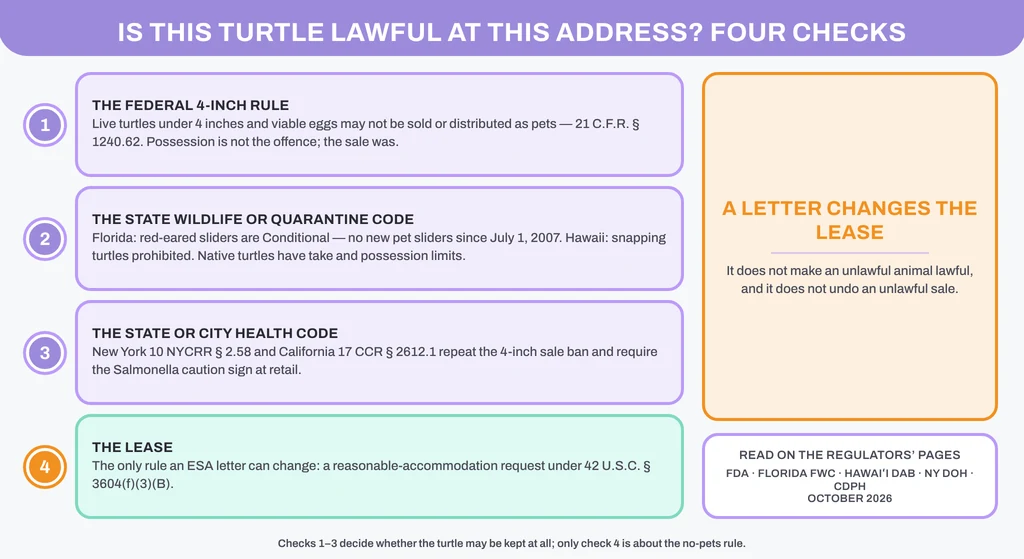
An ESA letter is a housing document. It asks a housing provider to bend a pet rule; it does not license anyone to keep an animal the law says they may not keep, and it does not launder a sale that was illegal when it happened. Turtles run into that line more often than people expect, because the most common pet turtle in America is sold at exactly the size the federal government bans. Here are the rules, read on each regulator’s own page in October 2026.
| Place | The rule | What it says | Does an ESA letter change it? |
|---|---|---|---|
| Everywhere in the United States | 21 C.F.R. § 1240.62 (Food and Drug Administration) | “Viable turtle eggs and live turtles with a carapace length of less than 4 inches shall not be sold, held for sale, or offered for any other type of commercial or public distribution”; “turtles” covers turtles, tortoises and terrapins; exceptions for bona fide scientific, educational or exhibitional use other than as pets, for sales not connected with a business, and for export. The rule governs sale and distribution, not possession. | No |
| Florida | Florida Fish and Wildlife Conservation Commission — Conditional species rule (Chapter 68-5, F.A.C.) and the freshwater turtle rule (68A-25.002(9), F.A.C.) | “Red-eared sliders are a Conditional species in Florida”: a pet owned before July 1, 2007 may be kept without a permit, but Florida residents may not acquire one as a personal pet after that date; sliders “can only be rehomed to permitted individuals”; releasing any nonnative animal is prohibited. Native turtles: one per person per day from the wild for noncommercial use, box turtles capped at two, “No one may sell turtles taken from the wild in Florida”, softshells and yellow-bellied sliders barred from take all year. | No — a clinician’s letter is not a wildlife permit |
| Hawaii | Department of Agriculture and Biosecurity, Plant Quarantine Branch — Animal Guidelines | Lists “snapping turtles” among the examples of animals “prohibited from entry or possession by private individuals in the State”; the page points to the Plant Quarantine non-domestic animal lists for everything else, so check them before shipping any turtle to the islands. | No |
| New York State | 10 NYCRR § 2.58 (Department of Health) | No person may bring into the state, sell, offer for sale or distribute — “wholesale, retail, or as gifts to the public” — live turtles with a shell under four inches; retail displays carry the sign “CAUTION: Turtles may transmit bacteria causing disease in humans”. Possession is not addressed. | No |
| California | 17 CCR § 2612.1 (Department of Public Health) | “Unlawful to import, sell or offer for sale or distribution to the public any live turtle(s) with a carapace length of less than 4 inches”; the same caution sign at every retail display and on the sales slip; the seller keeps the buyer’s name and address for a year. Possession is not addressed. | No |
Two things follow from the table. First, a turtle sold at two inches at a flea market, a reptile expo or online was sold unlawfully — the FDA rule bans the sale outright, and the CDC’s 2026 investigation found that six of the seven sick people who knew the size of their turtle had one under 4 inches. Owning the animal is not the offence; selling it was. Second, a Florida tenant cannot fix a new red-eared slider with a letter, because the problem is not the lease: the state closed the door on new pet sliders in 2007 and a clinician’s finding has nothing to say about it. The Florida ESA letter page covers the state’s own letter statute; this is a different rulebook. Other states protect their native turtles with rules of their own, and a box turtle found in a yard is not a free pet — the state wildlife agency’s page settles it, and it was not read for every state here, so the page says only what was verified.
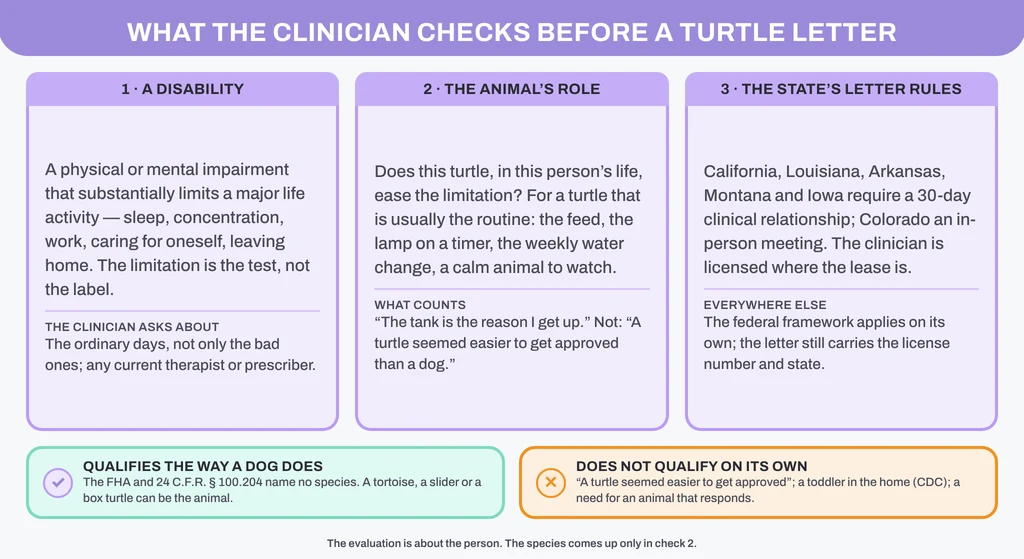
The same three things as for any animal, and the turtle changes none of them. The evaluation is about the person; the species comes up only in the second check.
A disability under the Fair Housing Act. A physical or mental impairment that substantially limits one or more major life activities — sleeping, concentrating, working, caring for oneself, leaving the home. A diagnosis on its own is not the test; the limitation is. The clinician asks about the ordinary days, not only the bad ones.
A connection between the animal and the disability. This is the part people worry about with a turtle, and it is more straightforward than it sounds. The question is whether the animal, in this person’s life, eases the limitation. For a turtle that usually means the routine: the morning feed, the basking lamp on at the same time, the weekly water change, an hour of watching a slow animal do slow things. A clinician who hears that the tank is the reason the person gets up, or the one calm fixed point in a bad week, has something to document. A clinician who hears “I thought a turtle would be easier to get approved than a dog” does not, and says so. The animal has to be the one that helps, not the one that seemed convenient.
The state’s rules for the letter itself. Five states require a clinical relationship of at least 30 days before a letter can be signed and one requires an in-person meeting; the table at the end lists them. PetESALetter matches each applicant with a clinician licensed in the applicant’s own state so that the letter meets the rules where the lease is.
When a turtle is the wrong move. The CDC says turtles are not recommended for households with children under 5, adults 65 and older or people with weakened immune systems, and a clinician hearing about a toddler in the home will raise it. A person who needs an animal that responds — that notices a panic attack, that wants to be held — is describing a dog or a cat, not a turtle, and the honest evaluation says that. And a tortoise is a decades-long commitment; someone whose housing is uncertain year to year should hear that from the clinician before the letter, not from a landlord after it. The ESA qualification checklist walks through the evaluation in more detail.
Sometimes, and it helps to know exactly when. The housing picture in 2026 has three separate parts, and most answers online blur them — the AI summary at the top of this search still says the FHA “protects you in no-pet housing” and leaves it there.
The law itself has not moved. The reasonable-accommodation duty in 42 U.S.C. § 3604(f)(3)(B) and 24 C.F.R. § 100.204 is unchanged, contains no training requirement, and can be enforced by a private lawsuit and by state fair-housing agencies. It obliges a housing provider to consider a reasonable accommodation, not to grant every request.
HUD’s how-to notices are gone. With FHEO-2013-01 and FHEO-2020-01 withdrawn, so is the passage saying pet rent and pet deposits could not be charged for an assistance animal. Whether a fee can be charged is now a case-by-case question under federal law, but nine states cap or bar ESA fees in their own statutes (Kentucky, Virginia, Illinois, Maine, Minnesota, Hawaii, Wisconsin, Utah and Florida), while Alaska and North Carolina expressly allow pet charges and Iowa repealed its waiver in 2024. The ESA pet rent and deposits guide has the state-by-state detail.
HUD’s own enforcement has narrowed. A May 22, 2026 FHEO memorandum says HUD will find reasonable cause and recommend charges only in cases involving animals individually trained for disability-related work or tasks. HUD frames that as prioritizing its resources, not as a change in the statute: open ESA cases go to case-by-case review, and the right to sue privately is untouched. In practice a well-documented letter and a sensible request carry more of the weight than they used to.
Within that framework, there are real grounds for a no. The statute says nothing requires housing for a tenant “whose tenancy would constitute a direct threat to the health or safety of other individuals or whose tenancy would result in substantial physical damage to the property of others” (42 U.S.C. § 3604(f)(9)). With a turtle the threat argument is the thinnest of any reptile — a slider in a tank bites nobody in the next unit and climbs no walls — but it is not empty: Salmonella is a real question in a building with young children in the shared laundry room, and the damage question is real in a different way. A 100-gallon aquarium holds about 830 pounds of water before the tank, the stand and the gravel are counted; on a wooden floor in an old walk-up that is a structural question a manager is entitled to ask, and a leak from that tank reaches the ceiling below. The assessment has to be about the specific animal and the specific setup, not about reptiles in general. Some housing is outside the Act altogether, including an owner-occupied building with four or fewer units (42 U.S.C. § 3603(b)(2)). And a housing provider may still verify the letter with the clinician and set reasonable conduct rules for the animal.
For a turtle, then, the realistic friction is weight, water and the lamp. A tenant who can say where the tank sits, what it weighs full, how the water is changed and where it goes, and how the basking lamp is mounted and switched has answered the three questions that produce most refusals. The accommodation changes the no-pets rule; it does not suspend the rest of the lease, and a written plan that answers those worries is worth more than the letter alone. How to make the request, and what to do if it is refused, is in ESA letter to landlord.
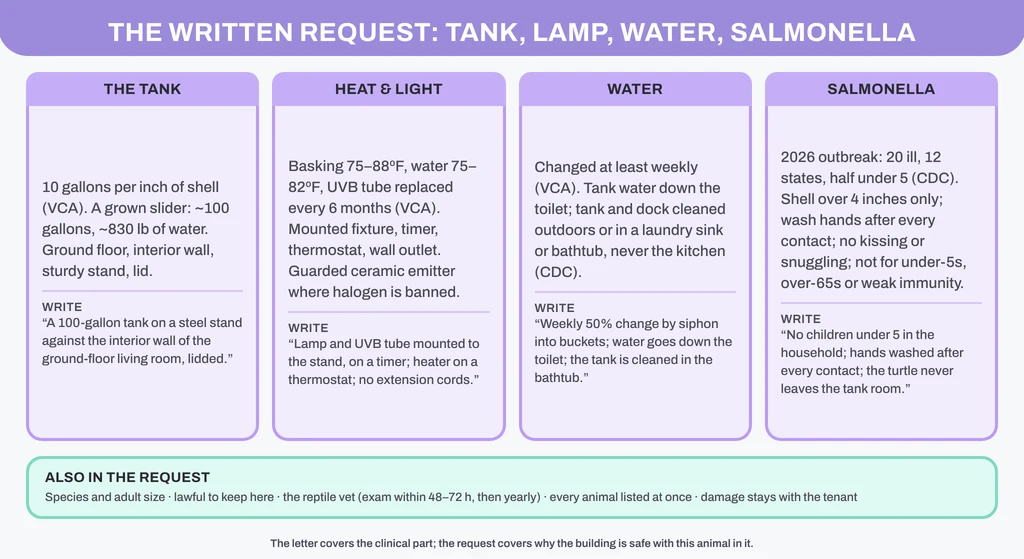
The letter covers the clinical part: that the person has a disability and that the animal is connected to it. The practical part — why the building is safe with this animal in it — belongs in the tenant’s written request, and for a turtle it is often what turns a hesitant reply into a yes. In a July 2025 Tortoise Forum thread a student who had already been approved for a single room with a Russian tortoise as an emotional support animal was told, weeks before move-in, that the room could not contain halogen bulbs or exposed heating elements. The approval was never the problem; the lamp was. Answer the lamp first.
The species. Common and scientific name, the adult size, and one plain line that it is lawful to keep in the state and the city. For a red-eared slider that is Trachemys scripta elegans, 10 to 12 inches of shell as an adult female, kept as an ordinary pet everywhere except Florida, where a slider owned since before July 1, 2007 is grandfathered. For a Russian tortoise it is Testudo horsfieldii, up to about 10 inches, kept on dry ground.
The tank and its weight. VCA Animal Hospitals’ minimum is 10 gallons of water per inch of shell, water at least one and a half to two times the shell length deep, a swimming length four to six times the shell, and a dry basking area of 15 to 25 per cent of the surface. Give the real number for the adult animal, the full weight at about 8.3 pounds per gallon, the stand it sits on and the wall it sits against — an interior wall on the ground floor is the easy answer, and a manager who hears it stops worrying about the floor joists. A lid or a tall rim keeps a slider in; the manager’s picture of a turtle loose in the building is answered in one sentence.
Heat and light. This is the question that undid the dorm approval above. A slider needs a basking spot of 75 to 88ºF, water at 75 to 82ºF from a submersible heater, and a UVB tube in the 290–320 nm range within 12 to 18 inches of the animal, replaced every six months (VCA). Say how it is done safely: the basking lamp in a ceramic-socket fixture clamped or mounted to the stand so it cannot fall into the water, the lamp and the UVB tube on a timer, the heater on a thermostat, everything plugged directly into a wall outlet rather than a chain of extension cords, and — where a building or a dorm bans halogen bulbs or exposed elements — a ceramic heat emitter in a guarded fixture instead. A tortoise table needs the same lamp and tube without the water.
Water, and where it goes. VCA says the tank water is changed at least once a week, or more often if it is dirty, with a filter keeping it clean in between. The CDC says tank water goes down the toilet, not a sink or a drain used for anything else, and that tanks, docks and bowls are cleaned outdoors if possible and otherwise in a laundry sink or a bathtub, never where food is prepared, with the area disinfected afterwards. Writing that routine into the request answers the leak question and the kitchen question at once.
Salmonella. This is the one health question a manager is entitled to ask, and small turtles have a long outbreak record: the CDC’s August 2024 investigation counted 51 illnesses in 21 states, 23 of 48 hospitalized, 17 of them children under 5 and 10 under a year old. The CDC’s current investigation, opened on August 5, 2026 and updated on September 18, counts 20 people ill across 12 states, 5 of them hospitalized, half of them children under 5, with illnesses starting between June 6 and August 22; 11 of the 14 people interviewed had handled a pet turtle, and 6 of the 7 who knew its size had one under 4 inches, bought at pet stores, flea markets and a reptile expo or received as a gift. The agency’s advice is plain: buy only turtles with shells longer than 4 inches and only from a reputable store; none at all in a household with children under 5, adults 65 and older or weakened immune systems; wash hands with soap and water right after touching the turtle, its food or its tank; “don’t kiss or snuggle your turtle, and don’t eat or drink around it”; keep the turtle and its equipment out of the kitchen; never let it roam where young children crawl. Put that routine, and who in the household it covers, in the request.
Feeding. Commercial turtle pellets and leafy greens for a slider, greens and weeds for a tortoise; nothing lives in the freezer, nothing lives loose in the unit, and nothing about the diet needs explaining to a manager the way a snake’s does.
A veterinarian. VCA recommends an exam with a reptile-familiar veterinarian within 48 to 72 hours of a turtle coming home and within a week for a tortoise, with a fecal sample checked for parasites, and an exam every year after that. Naming the vet in the request is a small detail that tells a manager the animal is looked after — and that it is a long-term animal in a stable home, not an impulse hatchling.
One turtle or several. One ESA letter can cover more than one animal if the clinician believes that more than one ESA is clinically reasonable for the person; a turtle collection kept as a hobby is a different thing. Request every animal at once, in writing; a second turtle added after the accommodation is granted is a new request, not an extension of the first. The ESA letter for two dogs guide covers the two-animal question.
Damage stays with the tenant. An ESA letter changes pet rules and, in some states, pet charges. It does not change liability: the ordinary security deposit still applies, and real damage — a water-stained floor from a failed seam, a scorched shelf under a lamp — is still the tenant’s to pay for. Saying so plainly in the request takes one sentence and removes the manager’s biggest worry.
Stores and planes, no; college, yes but through a different door. The reason for the first two is the same: an emotional support animal’s federal protection is housing only. Under the Americans with Disabilities Act a service animal is a dog individually trained to do work or tasks for a person with a disability, and the definition says that emotional support and companionship do not count as tasks (28 C.F.R. § 36.104). A turtle cannot meet it, so it has no right to enter shops, restaurants or public transit, whatever it is called.
Air travel changed in 2021, when the Department of Transportation’s revised rule took effect on January 11. Its service-animal definition is also limited to dogs (14 C.F.R. § 382.3), and airlines may treat emotional support animals as pets. The Tortoise Forum thread that ranks for this search is from December 2016, when a member planned to fly home for Christmas with a tortoise as an ESA; that world is gone. Whether any reptile can travel at all is set by each airline’s own pet policy, so check the carrier’s pet page before planning a trip. The which airlines allow emotional support animals guide covers the 2026 airline picture.
College housing is the case turtle owners actually win. Student rooms run through the school’s disability-accommodation process rather than a lease, the Fair Housing Act applies to most campus housing, and a tortoise in a tortoise table is a request a housing office can say yes to — the 2025 case above was approved. What the approval does not do is suspend the room’s equipment rules: a residence hall that bans halogen bulbs and exposed heating elements still bans them, so the request names a guarded ceramic emitter and a timer up front. The ESA letter for college dorms guide covers what universities ask for.
| For a turtle or tortoise | Turtle with an ESA letter | Turtle kept as an ordinary pet | Trained service dog (for comparison) |
|---|---|---|---|
| Can a turtle be one? | Yes, if a clinician finds a disability-related need and the turtle is lawful to keep | Yes, if lawful to keep | No: the ADA and DOT definitions cover dogs only |
| No-pets lease | Reasonable accommodation request with the letter | Lease rules apply in full | Reasonable accommodation; training is the strongest case after the 2026 HUD memo |
| Pet rent and deposits | Case by case since 2025; barred or capped by statute in nine states | Whatever the lease says | Case by case; state statutes vary |
| Federal, state and local animal laws | Still apply in full (the 4-inch rule, Florida, Hawaii, New York, California above) | Apply | Apply |
| Tank, heat lamp, UVB, water | Tenant’s responsibility; a written safety plan helps the request | Tenant’s responsibility | Not applicable |
| Damage to the unit | Tenant still responsible | Tenant responsible | Tenant responsible |
| College dorm | Through the school’s disability-accommodation process; the room’s equipment rules still apply | Only if the housing contract allows pets | Allowed under the ADA |
| Stores, restaurants, transit | No access rights | No access rights | Access under the ADA |
| Flights | Airline’s pet policy since the 2021 DOT rule | Airline’s pet policy | Accepted with the DOT service-animal form |
| Document | ESA letter from a licensed mental health professional after an evaluation | None | None in public; housing still runs through an accommodation request |
For an adult, the process takes four steps, and the turtle changes almost none of them — except that the first check is whether the animal is lawful where the person lives, and the request that follows the letter has to carry the tank plan.
If the clinician decides the applicant doesn’t qualify, the refund is requested within 7 days. If a landlord rejects the letter in writing after our support team has been involved, the refund window is 30 days. Both terms are on the refund policy page. The full walkthrough, and the letter itself, is on the ESA letter page; the ESA letter for housing guide covers what the document does once it reaches a landlord.
State rules. The species does not change the ESA letter rules; the state does. Several states add their own rules about who may write an ESA letter and what has to happen first, and a letter that ignores them is easy to challenge — which is why PetESALetter matches each applicant with a clinician licensed in their own state.
| State | What has to be in place before the letter is signed | Who may sign | Statute |
|---|---|---|---|
| California | A client-provider relationship of at least 30 days and a clinical evaluation; license details stated in the letter | A practitioner licensed in California | Cal. Health & Safety Code § 122318 (AB 468, 2021) |
| Louisiana | A therapeutic relationship of at least 30 days, at least two sessions, a disability assessment and a clinical evaluation | A Louisiana-licensed provider | La. R.S. 46:1974 (Act 558 of 2024) |
| Arkansas | A 30-day client-provider relationship and a clinical evaluation, reviewed at least once a year | A provider licensed in the jurisdiction | Ark. Code Ann. § 20-14-1003 (Act 268 of 2023) |
| Montana | A client-provider relationship of at least 30 days and a clinical evaluation; a registry card is not sufficient on its own | A Montana-licensed mental health professional, license details in the letter | Mont. Code Ann. § 70-24-114 (HB 703, 2023; amended 2025) |
| Iowa | A written finding that states whether the provider-patient relationship has lasted at least 30 days; the state’s own form has the signer certify that it has | A licensed physician, PA, nurse, psychologist, social worker or behavioral-science professional, in Iowa or in good standing in another state | Iowa Code § 216.8C (SF 2268, 2024) |
| Florida | Personal knowledge of the disability; no waiting period. An out-of-state practitioner must have provided in-person care at least once | A practitioner acting within the scope of the license | Fla. Stat. § 760.27 (SB 1084, 2020) |
| Colorado | An in-person meeting and a written finding on disability and need; no waiting period | A mental health licensee with sufficient familiarity with the patient | C.R.S. § 12-245-229; HB26-1045 (eff. Aug 12, 2026) |
Everywhere else the federal framework applies on its own. The California ESA letter and Louisiana ESA letter pages go through the two strictest states in detail, and the state pages linked in the navigation cover the rest. Two different sets of rules are in play for a turtle owner: the ESA-letter rules in this table, and the wildlife, health or quarantine code, which decides whether that turtle can be kept at that address at all. Florida appears in both: its ESA statute governs the letter, and its Conditional list rules out a new pet slider. New York appears in both too, in a quieter way: the New York ESA letter page covers the state’s housing rules, and § 2.58 is why no pet store in the state sells a hatchling.
The red flags are the same for every species. A letter in minutes — “instant approval” means nobody evaluated anyone, and the how to verify an ESA letter is real guide lists what a genuine one contains. A registration number, certificate or ID card for the turtle — there is no registry, and the ESA registration myths page explains who sells them anyway. A seller happy to write a slider letter for a Florida address without a word about the Conditional list. And a promise that the landlord “must” accept the letter — the statute obliges a housing provider to consider a reasonable accommodation, not to grant every request.
The bottom line. A turtle or a tortoise can be an emotional support animal for housing when a licensed clinician finds a disability and finds that the animal eases it; the law names no species, and HUD’s old household-animal list is withdrawn guidance, not the test. But a letter cannot make a turtle lawful where it is not — a hatchling sold under 4 inches anywhere in the country, a new pet slider in Florida, a snapping turtle in Hawaii — and a request that ignores the weight of the tank, the lamp and the CDC’s Salmonella routine is the one that gets refused. There are no flight or public-access rights; college housing has its own process. PetESALetter evaluates adults, with a clinician licensed in their state, for $99 flat and a full refund if the clinician finds no qualifying need.
Wondering whether your turtle or tortoise can be your ESA — and whether it is lawful where you live? A licensed clinician in your state evaluates whether an emotional support animal fits the situation — and the first step is a free five-minute screen.
No, because there is nothing to register with. No federal or state agency keeps an ESA registry, and a registration number, certificate or ID card bought online has no legal weight with a landlord. What the Fair Housing Act recognises is a letter from a licensed mental health professional who has evaluated the person; that letter, plus a written accommodation request, is the whole process for a turtle as for a dog.
Yes, on the same terms as a turtle: a licensed clinician finds a disability and finds that the animal eases it. In practice a Russian, Hermann’s or Greek tortoise — a maximum of about 10 inches as an adult (VCA Animal Hospitals), kept on dry ground in a tortoise table — is the easiest reptile request a housing provider can be asked for, with no tank, no filter and no weight problem. A sulcata is a different animal: almost 3 feet, up to 150 pounds and a possible 100-year life span, so an apartment accommodation is unlikely to be reasonable even where the clinical finding is solid.
The Fair Housing Act names no species in either direction, so there is no banned list for ESAs as such. The limits come from elsewhere: an animal that is unlawful to keep at that address (a new pet red-eared slider in Florida, a snapping turtle in Hawaii, an iguana in New York City) cannot be made lawful by a letter; an animal that is a direct threat to others or would cause substantial damage can be refused under 42 U.S.C. § 3604(f)(9); and an accommodation that is not reasonable for that building — a 150-pound sulcata in a studio, a 300-gallon tank on a third-floor wooden floor — can be refused on that ground. A hatchling turtle under 4 inches was sold unlawfully, which is a problem for the seller rather than a bar to the request.
For some people, yes, and a clinician is the right judge of which. A turtle is quiet, sheds no dander, needs no walks and gives a fixed daily routine — feeding, the basking lamp on a timer, the weekly water change — that some people find steadying. It does not respond the way a dog or a cat does, the CDC advises against kissing or snuggling it at all, it can carry Salmonella, and it outlives most leases by decades. Someone who needs an animal that notices a bad night is describing a different animal, and an honest evaluation says so.
Not as a pet. Federal rule 21 C.F.R. § 1240.62 bans selling, holding for sale or distributing live turtles with a shell under 4 inches, or viable turtle eggs, except for bona fide scientific, educational or exhibitional use, sales not connected with a business, and export. New York (10 NYCRR § 2.58) and California (17 CCR § 2612.1) repeat the ban in their own health codes. The rule exists because of Salmonella in small children: the CDC’s 2026 outbreak investigation found that six of the seven sick people who knew their turtle’s size had one under 4 inches. Owning a small turtle is not the offence; selling it was.
Usually, through the school’s disability-accommodation office rather than a lease; the Fair Housing Act applies to most campus housing and a tortoise in a tortoise table is a request housing offices do approve. The approval does not change the room’s equipment rules, which is where a 2025 case went wrong: the student was approved with a Russian tortoise, then told the room could not contain halogen bulbs or exposed heating elements. Ask about the lighting rules in the same email as the accommodation request and name a guarded ceramic heat emitter on a timer.

Licensed Clinical Social Worker
Darren is a leading expert in mental health advocacy and assistance animal documentation. He specializes in streamlining the process for obtaining ESA Letters, PSD Letters, and State-specific ESA compliance.

ESA Letters Issued

Successful Consultations

Licensed Therapist Network

Client Satisfaction Rate




Petesaletter.com helps you get your emotional support animal letter online with guidance and support.

Got Questions? Call us 24/7
Copyright © 2020-2026 Petesaletter All rights reserved. Terms | Privacy | Refund
Owned and Operated by Verimedix LLC