
Last Updated on: October 28, 2026
Reviewed by Darren Rafel, LCSW

The DOT Service Animal Air Transportation Form is the federal form a U.S. airline may require before a trained service dog flies in the cabin. You fill it in yourself: who you are, which dog, its rabies vaccine and vet, who trained it, and your signature. It goes to the airline, never to DOT, up to 48 hours before departure; one form covers one trip. Emotional support animals cannot use it; since January 11, 2021 they fly as pets.
Key takeaways
This guide walks through the form section by section, then the timing rules, then what nine U.S. airlines actually do with it, read on their own pages on October 28, 2026. If you are still deciding whether your dog is a service dog or an emotional support animal, start with the difference between service dogs and ESAs; the form only applies to the first.
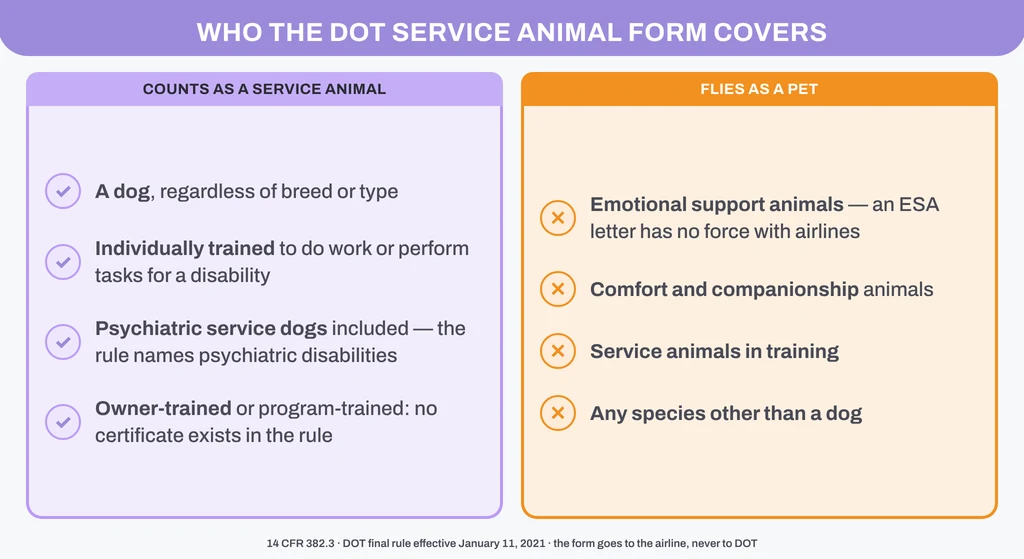
The rule draws one line, and it is about training, not paperwork. Under 14 CFR 382.3 a service animal is “a dog, regardless of breed or type, that is individually trained to do work or perform tasks for the benefit of a qualified individual with a disability, including a physical, sensory, psychiatric, intellectual, or other mental disability.” The same definition says what is left out: “Animal species other than dogs, emotional support animals, comfort animals, companionship animals, and service animals in training are not service animals for the purposes of this part.”
Three consequences follow for the people who search for this form.
A psychiatric service dog is a service dog. A dog trained to interrupt a panic attack, wake its handler from a nightmare, apply deep pressure during dissociation or guide a disoriented person out of a crowd is doing tasks, and the airline is required to allow it on the same terms as a guide dog (14 CFR 382.72 also bars refusal by breed or type). The tasks that count are described in the psychological service dog guide.
Owner-trained dogs qualify. The form asks who trained the dog and has a line for a person as well as an organization. Federal law has never required a program certificate, so a handler who trained the dog can enter their own name — the rules for doing that properly are in self-training a service dog. What you cannot do is attest to training that has not happened: Section D warns that a dog that is not trained to behave in public may be treated as a pet, and Section E reminds you that a knowingly false statement is a federal offense.
Emotional support animals are pets on a plane. This is the part most people land here to check. An ESA letter from a licensed clinician is a housing document under the Fair Housing Act; it has had no force with U.S. airlines since the 2020 rule took effect on January 11, 2021. The 2026 airline-by-airline picture for ESAs is in which airlines allow emotional support animals. If your dog is not task-trained, do not fill in this form — a false attestation is worse than a pet fee.
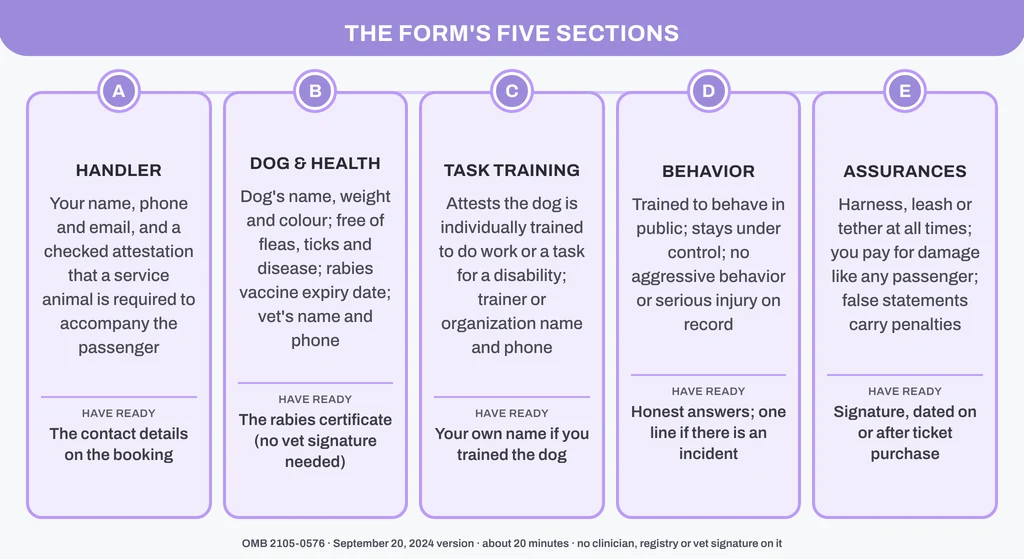
The September 2024 version runs five lettered sections, with an instruction sheet. DOT estimates 20 minutes. Nothing on it needs a signature from anyone but you — the veterinarian’s name goes in, but the form says in so many words that the vet’s signature is not required.
| Section | What it asks | What to have ready | Watch for |
|---|---|---|---|
| A — Service animal handler | Your full name, phone and email, and a checked attestation that a service animal is required to accompany you (or the passenger with a disability you are travelling with) | The contact details on the booking | A parent or companion can be the handler for someone else; the attestation is about the passenger with the disability |
| B — Identification and health | The dog’s name and description including weight and colour; an attestation that it is free of fleas, ticks and diseases that would endanger people or other animals and is vaccinated for rabies; the rabies vaccination expiry date; the veterinarian’s name and phone | The rabies certificate from your vet | “Vaccination expiration date”, not the date of the shot. American ties its SVAN ID to this date |
| C — Task training | An attestation that the dog has been individually trained to do work or perform a task to assist with a disability, plus the name and phone of the trainer or training organization | Your own name and number if you trained the dog | No description of the disability is asked for, and none should be volunteered |
| D — Behavior training | An attestation that the dog has been trained to behave in a public setting, the trainer’s name and phone, an acknowledgement that the dog must stay under your control and may be treated as a pet if it is not trained, and an attestation that it has not behaved aggressively or caused serious injury (with a space to explain if you cannot say so) | Honest answers; a one-line explanation if there is an incident in the dog’s history | “Treated as a pet” means pet fee, carrier requirements or refusal of transport |
| E — Other assurances | Acknowledgement that the dog will be harnessed, leashed or tethered at all times in the airport and on the aircraft, that you can be charged for damage the dog causes on the same terms as any passenger, and that false statements carry fines and penalties; your signature and the date | A pen, or the fillable PDF in Acrobat Reader | Date it on or after the day you bought the ticket — an older date makes the form not “current” |
Two practical notes. The DOT’s own PDF is labelled a sample: the regulation lets each airline publish the form in its own format, so American, Frontier, JetBlue and Allegiant host their own copies, and Delta and United collect the same answers through a web form. The questions are identical, and an airline that requires the form in advance has to offer both an electronic and a paper route (14 CFR 382.75(f)). The second note is about what is missing. There is no field for a diagnosis, a doctor, a therapist, a registry number or a certificate, because none of those exists in the regulation. Sites that sell “service dog registration” sometimes bundle a pre-filled DOT form with it; the form is free from DOT and from every airline, and the registration myth page explains why a registry number has no legal weight.
The timing rules sit in 14 CFR 382.75(g) and (h), and they turn on when you booked, not on when you fly.
| Your situation | What the airline may require | Where that comes from |
|---|---|---|
| Booked more than 48 hours before the first scheduled departure | The completed form up to 48 hours before departure, and the relief form too if any segment is 8 hours or more | 382.75(g)(1)–(2) |
| Booked less than 48 hours before departure | No advance notice. The airline may still require both forms and a copy at the departure gate on the day of travel | 382.75(g)(3) |
| You missed the airline’s deadline | The airline still has to carry the dog if it can do so with reasonable efforts without delaying the flight | 382.75(h) |
| Any flight | Nothing beyond the two DOT forms, except documents a federal agency, a U.S. territory or a foreign country requires for animals | 382.75(c) |
Four more rules come from the form’s instruction sheet and the regulation together. Send it to the airline, not to DOT — the instructions say so in bold, and DOT has no office that processes them. One form per trip. An airline may require the form once per itinerary, not once per flight, so a round trip with a connection is one form. “Current” has a definition. The form must be completed on or after the date you bought the ticket (382.75(a)), which is why Southwest and Spirit both tell you to date it after purchase. Partner airlines are separate. American, JetBlue and Delta each say that a segment on another carrier needs a separate submission under that carrier’s process.
What “48 hours” means in practice also varies. For American it is a recommendation for electronic submission, with day-of-travel submission at the airport allowed. For JetBlue, Spirit, Frontier and Allegiant it is the stated deadline, with the airport route reserved for bookings made inside 48 hours. Southwest does not run an advance process for the form at all — you present it at the counter or gate. Read the row for your airline below before you assume.
Every row below was read on the airline’s own page on October 28, 2026, and the link in the first column is that page. Airlines change these pages without notice; if a link no longer matches what you see, the airline’s page wins.
| Airline | How you submit | Advance notice on its page | 8-hour relief form named | ESA policy on its page |
|---|---|---|---|---|
| American Airlines | Online form to the Special Assistance Desk; an approved form earns a Service Animal ID (SVAN ID) by email, reusable until the rabies vaccine expires. Or bring the form to the airport on the day and arrive early | “Ideally at least 48 hours” | Yes, with the CDC Dog Import Form noted for flights into the U.S. | Fly as pets, pet fees apply |
| Delta Air Lines | “Submit Completed Forms” accessibility request, Step 4 “Trained Service Animal”; bring printed copies to the airport if you need help with the forms | At least 48 hours | Yes (PDF on the page) | Not recognized as service animals |
| United Airlines | Tick “I’m bringing a task-trained service dog” when booking, then complete the paperwork under Trip details; a MileagePlus profile can store the form for later trips. International, Hawaii and Guam flights go through the accessibility desk (1-800-228-2744) | Not stated on the policy page | Yes | Fly as pets, in a carrier |
| Southwest Airlines | Present the completed digital or printed form at the ticket counter or departure gate on the day of travel; no portal | None for the form (24 hours for seating needs) | Not mentioned | Fly as pets |
| JetBlue | Open Doors Service Animal Forms Portal, or mail a hard copy to Customer Accessibility in Salt Lake City; booked inside 48 hours → complete the form at the airport with a Complaints Resolution Official | At least 48 hours | Not mentioned | Not accepted |
| Spirit Airlines | Submit online 48 hours before; otherwise ticket counter or gate on the day, with approval needed before departure. One form per reservation, per dog; up to two dogs | 48 hours | Not mentioned | Fly as pets |
| Frontier Airlines | Upload portal (the “Request Service Animal” form), or mail to Customer Care in Denver; booked inside 48 hours → in person to an agent at the airport | 48 hours | Not mentioned | Not accepted since February 1, 2021 |
| Allegiant Air | Open Doors portal (preferred), email to the disabilities team, or mail to Las Vegas; the page advises against relying on airport submission. Up to two dogs | 48 hours | Not mentioned | Not addressed on the page |
| Alaska / Hawaiian | One combined service-animal page; its body would not load for us on the day, so check it directly | Not read | Not read | “No longer accepted as service animals and may fly as a pet instead” |
Three patterns are worth knowing before you book. First, the two airlines that keep an approved form on file — American’s SVAN ID and United’s MileagePlus profile — save real time for frequent flyers, but both IDs are tied to the rabies expiry date, so a booster resets them. Second, JetBlue and Allegiant route the form through the Open Doors Organization’s portal, a non-profit contractor, rather than their own sites; the form is still the airline’s, and a confirmation from the portal is what you carry. Third, Southwest is the outlier: no advance submission, so the counter agent’s review on the day is the whole process, and arriving early matters more there than anywhere else.
The second DOT form applies only to a flight segment scheduled to take 8 hours or more — a nonstop from the East Coast to Honolulu or most transatlantic flights, not a connection that adds up to eight hours across two legs. Under 14 CFR 382.75(b) the airline may require you to confirm either that the dog will not need to relieve itself on the flight, or that it can do so in a way that does not create a health or sanitation issue on board. Same timing as the main form: 48 hours in advance when booked 48 hours out, at the gate otherwise, and current means dated after ticket purchase.
American and Delta host the relief form beside the main one and name it on their pages; United lists it as the form “for flights 8 hours or more.” Spirit, Frontier and Allegiant do not mention it on the pages we read, which tracks their route maps — few of their segments reach eight hours. For the dog, the practical preparation is the same whatever the airline: a long walk and a relief-area visit before security, water managed rather than withheld, and a plan for the terminal’s animal relief areas (Southwest says it has one at every airport it serves; the United app maps them). Leaving the sterile area to use one means going through screening again.
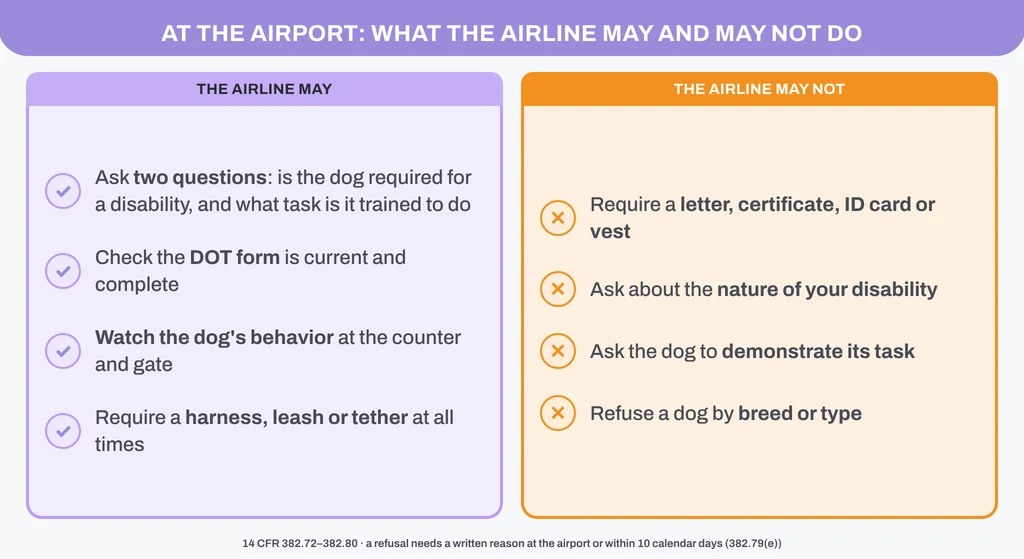
The form does not end the airline’s judgment; it frames it. Part 382 gives the airline four tools at the counter and gate, and takes several away.
| At the airport the airline may… | …and may not |
|---|---|
| Ask whether the dog is required because of a disability, and what work or task it has been trained to perform (382.73) | Ask about the nature or extent of your disability, or require the dog to demonstrate its task |
| Look at the DOT form(s) and check they are current and complete (382.75) | Require any other document — a letter, a certificate, an ID card, a registry printout, a vest |
| Observe the dog’s behavior, and treat a dog that is out of control, aggressive or relieving itself in the gate area as not trained for public settings (382.73, 382.79) | Refuse a dog because of its breed or type, or because its presence might offend or annoy staff or passengers (382.72) |
| Require the dog to be harnessed, leashed or tethered at all times in the airport and on the aircraft (382.73) | Impose restrictions Part 382 does not allow, unless a federal, territorial or foreign rule requires them (382.80) |
| Limit you to two service dogs (382.74) and restrict where the dog sits — your foot space or lap, never an aisle or exit row (382.77) | Charge for the dog, except for damage it causes, on the same terms as any passenger (382.78) |
| Refuse transport for a direct threat, a significant disruption, a federal or foreign health rule, or because the required forms were not provided (382.79) | Refuse without first considering whether reasonable steps would fix the problem, or without a written statement of the specific reason at the airport or within 10 calendar days (382.79(e)) |
Two points from that table are regularly misunderstood. The written statement is a right: if an airline turns the dog away, ask for the reason in writing, and if it is not given at the airport it is owed within 10 days. And the “direct threat” ground is defined in 14 CFR 382.3 as “a significant risk to the health or safety of others that cannot be eliminated by a modification of policies, practices, or procedures” — an individualized assessment of this dog, not a judgment about dogs in general or about the handler’s condition.
Security is a separate step with a separate agency. TSA screens the dog; it does not collect the form. TSA’s own guidance is that you and your dog go through the walk-through metal detector together, or the dog is led through separately on a leash; an alarm by either of you means additional screening, including a pat-down; harnesses, vests and leashes are screened, so low-metal gear is quicker; and “TSA will not separate you from your service animal.” Nothing on TSA’s page asks for paperwork, which matches the regulation — the airline is the only party entitled to the form.
Neither replaces the other, because they do different jobs. The DOT form is a self-attestation about the dog that an airline may require. A PSD letter is a licensed clinician’s determination that you have a qualifying disability and that a psychiatric service dog is part of managing it — the document a landlord can ask for under the Fair Housing Act when the disability is not obvious, and the record that supports the attestation you make in Section C. An airline may not require it (14 CFR 382.75(c)), so it stays in your bag, not on the counter.
Where the letter matters for air travel is before the trip. The DOT form asks you to state, under a federal warning, that your dog is trained to perform a task for a disability. The honest version of that sentence starts with a disability a clinician has evaluated and a task that addresses it; the helper dogs for anxiety guide shows what those tasks look like for panic and anxiety disorders. At PetESALetter the evaluation is live, by phone or video, with a therapist licensed in your state; you can read who they are on our therapists page. If the clinician finds the criteria are not met, the fee is refunded under the refund policy. The evaluation is charged at checkout; the eligibility quiz is the only free step. Full terms, including the ESA and PSD letter together, are on the ESA letter pricing page.
How to get through the airport the first time, in order.
Bottom line. The DOT Service Animal Air Transportation Form is free, one page, and the only paperwork a U.S. airline may require for a trained service dog, with the relief form added on flights of 8 hours or more. Fill it in after you book, send it where your airline says, and carry a copy. A psychiatric service dog qualifies on the same terms as any other service dog; an emotional support animal does not qualify at all. For the housing side — where the clinician’s letter does carry legal weight — see the ESA letter for housing guide.
Flying with a psychiatric service dog and want the paperwork right the first time? A licensed clinician in your state evaluates whether a psychiatric service dog fits your situation and signs the letter for your records — and PetESALetter walks you through the DOT form, which you complete yourself. The first step is a free five-minute screen.
No. Since the Department of Transportation’s rule took effect on January 11, 2021, U.S. airlines treat emotional support animals as pets, and an ESA letter does not change that. The only documents an airline may require for a service dog are the DOT Service Animal Air Transportation Form and, on flights of 8 hours or more, the DOT Service Animal Relief Attestation Form (14 CFR 382.75). An ESA letter is a housing document under the Fair Housing Act.
To the airline you are flying, never to the DOT. Each airline chooses its own path: American uses an online Special Assistance form, Delta an accessibility service request, United the Trip details page after booking, JetBlue and Allegiant the Open Doors Service Animal Forms Portal, Frontier an upload portal, Spirit an online submission, and Southwest takes the form at the ticket counter or gate. A flight on a partner airline needs a separate submission to that airline.
American asks you to send the form electronically to its Special Assistance Desk through the online form on aa.com, ideally at least 48 hours before the flight, and it emails a Service Animal ID (SVAN ID) once the form is approved. That ID can be reused on later bookings until the dog’s rabies vaccination expires. You can also bring the completed form to the airport on the day of travel and arrive early.
TSA screens the dog; it does not collect the DOT form. TSA’s own guidance says you and your dog go through the walk-through metal detector together or with the dog led through separately on a leash, that an alarm means additional screening including a pat-down, and that TSA will not separate you from your service animal. The form is the airline’s document, and the airline checks it at the counter or gate.
One form covers one trip, not each flight on it. The regulation lets an airline require a current form, and current means completed on or after the date you bought the ticket, so a form filled in for an earlier trip is not current for a new booking. Some airlines, such as American with its SVAN ID and United with the MileagePlus profile, store an approved form so you can attach it to the next reservation.
No. An airline may not require any document beyond the two DOT forms (14 CFR 382.75(c)), so a psychiatric service dog letter is never a boarding requirement. The letter is the clinician’s record that you have a qualifying disability and that the dog is part of its treatment, which matters for housing and for your own files. On the DOT form you attest to the training yourself; no clinician signature appears on it.

Licensed Psychotherapist
Darren is a leading expert in mental health advocacy and assistance animal documentation. He specializes in streamlining the process for obtaining ESA Letters, PSD Letters, and State-specific ESA compliance.

ESA Letters Issued

Successful Consultations

Licensed Therapist Network

Client Satisfaction Rate




Petesaletter.com helps you get your emotional support animal letter online with guidance and support.

Got Questions? Call us 24/7
Copyright © 2020-2026 Petesaletter All rights reserved. Terms | Privacy | Refund
Owned and Operated by Verimedix LLC