If you are searching for a helper dog for anxiety, you probably want two things answered fast: does a dog like this actually help, and what do you legally need to bring one into your home or onto a plane? The short answer is yes — dogs can meaningfully reduce anxiety symptoms — but the legal rules around them changed in a big way in 2025 and 2026. Housing protection got narrower. Air travel rules already excluded emotional support animals back in 2021. This guide will walk you through both sides: the legal side of getting a helper dog recognized, and the practical side of qualifying, documenting, and traveling with one.
What Is a Helper Dog for Anxiety?
A helper dog for anxiety is a dog that provides comfort or performs tasks for a person with an anxiety-related condition. This can mean an emotional support animal, which offers comfort just by being present, or a psychiatric service dog, which is trained to do specific jobs like interrupting a panic attack.
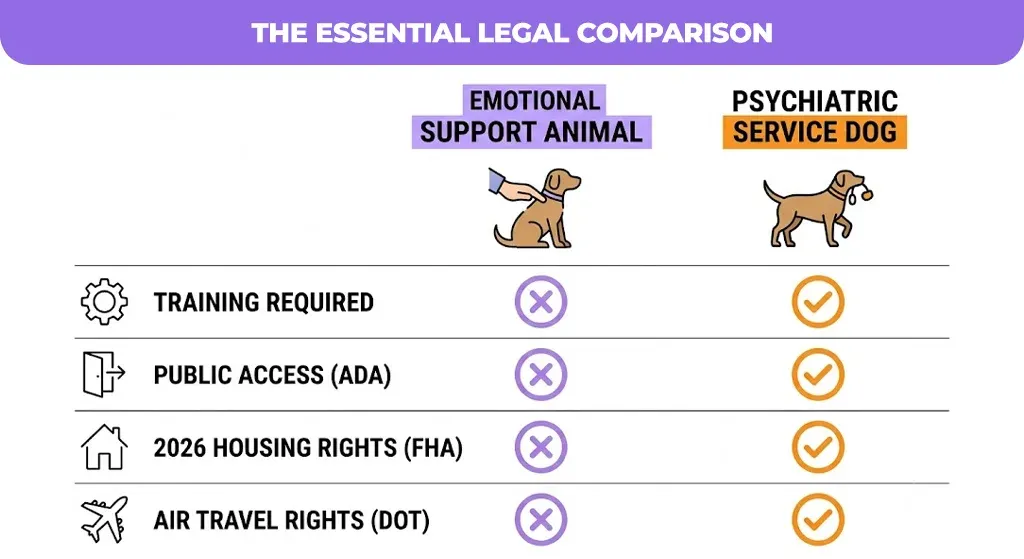
These two categories are mixed up constantly, and mixing them up causes real legal problems. An ESA does not need any training. A psychiatric service dog does. That single difference decides whether your dog has public access rights under the Americans with Disabilities Act (ADA), or only limited housing rights under the Fair Housing Act (FHA).
ESA vs. Psychiatric Service Dog vs. Therapy Dog
Type
Training Required
Public Access
Housing Rights
Air Travel Rights
Emotional Support Animal (ESA)
None
No
Limited, varies by housing provider in 2026
None, treated as a pet
Psychiatric Service Dog (PSD)
Task-trained for a specific disability
Yes, under ADA
Yes
Yes, with DOT form
Therapy Dog
Trained to comfort groups of people
No, invited locations only
No
No
Do I Qualify for a Helper Dog for Anxiety?
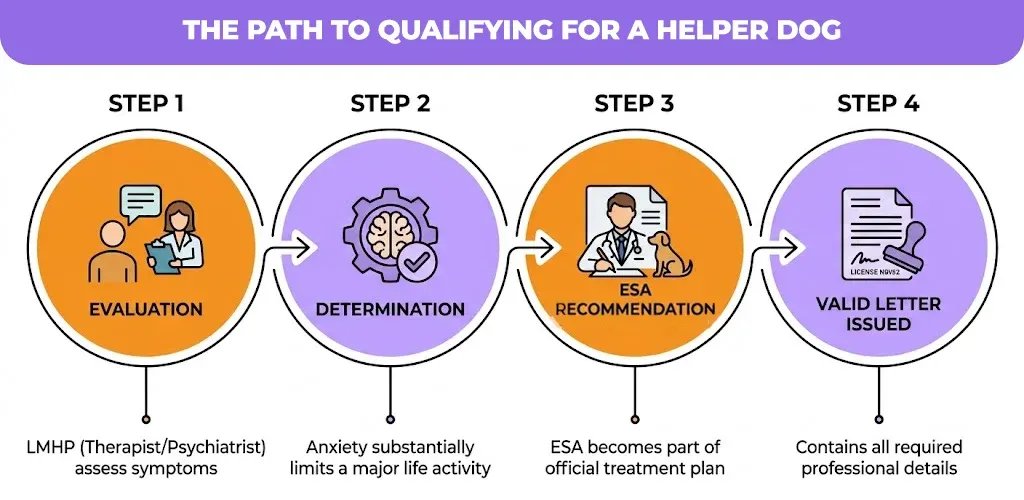
You can qualify if a licensed mental health professional determines that your anxiety substantially limits a major life activity and that an animal would help manage your symptoms. This applies to diagnosed conditions like generalized anxiety disorder, panic disorder, PTSD, and social anxiety disorder. You do not need a specific diagnosis label to start the conversation, but you do need a real evaluation. A licensed therapist, counselor, or psychiatrist must actually assess you, either in person or through a legitimate online appointment.
A letter from a website that never talked to you is not a valid ESA letter, and using one can create legal exposure, which we cover further down.
How to Get an ESA Letter the Right Way
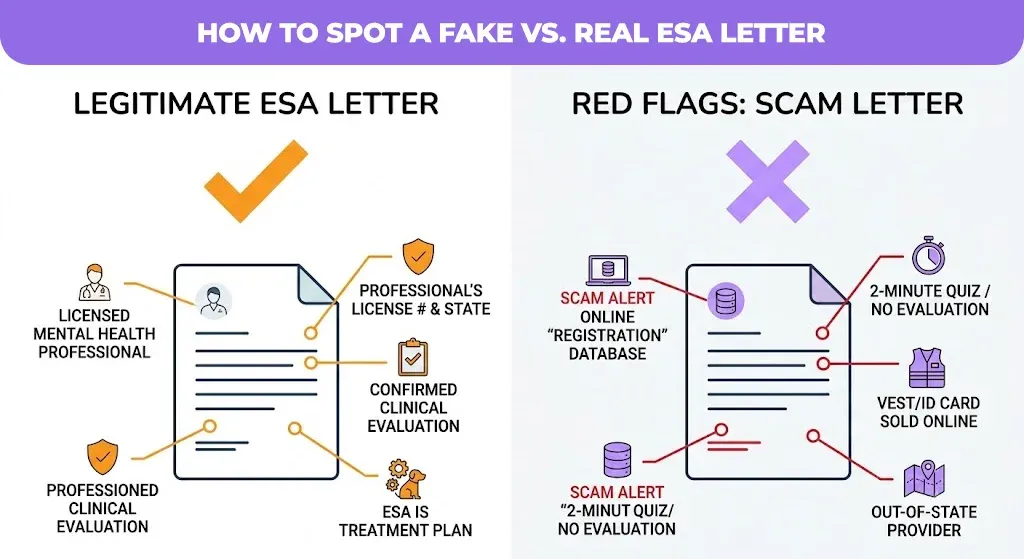
A valid ESA letter comes from a licensed mental health professional who is authorized to practice in your state, is written on letterhead, includes their license number, and confirms your need for the animal based on a real clinical relationship.
Provider Requirements
Here is what a legitimate letter needs, at minimum:
The provider’s license type, license number, and state of licensure
A statement that you were clinically evaluated
Confirmation that an emotional support animal is part of your treatment plan
The date the letter was issued
No mention of your specific diagnosis is required, and a good provider usually leaves it out for your privacy
Some states add extra steps. California requires a 30-day relationship with the provider before they can write the letter, and the provider must be licensed in California. Florida requires the letter to come from a Florida-licensed provider and specifically bans relying only on an online registration. Always check your state’s exact rule before assuming a letter is valid everywhere you live or travel.
Housing Rights in 2026: What Actually Changed
This is the section most other articles get wrong, because most of them were written before the rules shifted. Here is what is true right now.
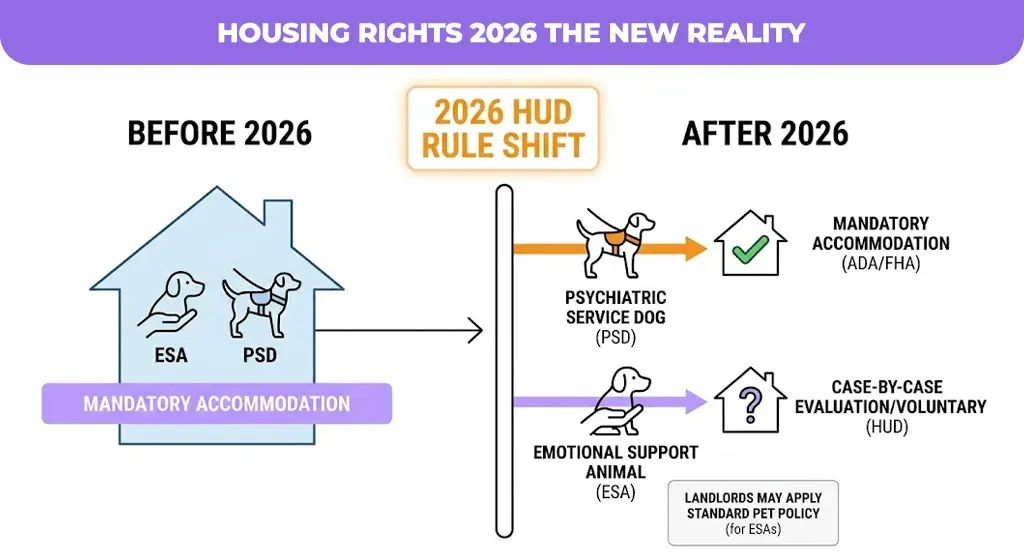
In May 2026, HUD narrowed its enforcement guidance so that only trained service animals are effectively guaranteed exemption from pet policies and pet fees at the federal enforcement level. Emotional support animals are no longer presumed to require accommodation — but the Fair Housing Act itself still requires housing providers to consider reasonable accommodation requests case by case.
What Landlords Can Legally Ask
A landlord is allowed to ask two things when your disability is not obvious:
Do you have a disability that limits a major life activity?
Do you have a disability-related need for the animal?
They cannot ask for your medical records, your specific diagnosis, or details about your treatment. They also cannot charge a pet deposit for a legitimate service animal under the ADA. For ESAs in 2026, this gets murkier, since HUD’s narrower stance gives landlords more room to apply their standard pet policy unless you can show the accommodation is genuinely necessary.
When Landlords Can Deny a Helper Dog
A landlord can lawfully deny a request when:
The animal poses a direct threat to health or safety that cannot be reduced by other accommodations
The animal would cause substantial physical damage to the property
Your documentation is clearly fraudulent or from an unlicensed source
The specific animal is not the type or size reasonably needed for your condition
For ESAs specifically: under the 2026 enforcement posture, a denial is less likely to draw federal enforcement than it was under the 2020 rule — though the FHA statute still requires case-by-case consideration, and many state fair housing laws impose stricter obligations of their own
Flying With a Helper Dog for Anxiety
Under the DOT’s 2021 rule, which remains in force through 2026, airlines are not required to accept emotional support animals in the cabin for free. Only trained psychiatric service dogs qualify for guaranteed cabin access, and they require a DOT Service Animal Air Transportation Form submitted at least 48 hours before departure.
If your dog is an ESA rather than a trained psychiatric service dog, it will fly under the airline’s regular pet policy. That usually means a carrier fee between $95 and $150 each way, a size limit, and the requirement that the animal stay in an approved carrier for the whole flight. A few international carriers on some routes to Latin America still accept ESAs on selected flights, so it is worth checking directly with the airline before booking.
Psychiatric Service Dog Travel Checklist
File the DOT Service Animal Air Transportation Form 48 hours before departure
Confirm your dog is trained to perform a specific task tied to your disability, not just to provide comfort
Book a bulkhead seat if available for extra floor space
Bring current vaccination records in case of a connecting international flight
Expect a limit of two to four service dogs per flight, so book early
State Laws and Fake Letter Warning Signs
More than 30 states now have penalties for misrepresenting a pet as a trained service animal, and a growing number also penalize falsely claiming a disability-related need for an ESA in housing. Penalties usually start as a misdemeanor with a fine between $100 and $1,000.
Common Scams to Avoid
Websites that issue a letter after a two-minute quiz with no real evaluation
“Registration” databases that charge a fee and claim your dog is now federally certified, which does not exist as a legal category
Vests or ID cards sold online with no connection to an actual clinical letter
Providers who are not licensed in your specific state, which can make your letter invalid there even if it looks official
A real letter comes from a real conversation with a licensed provider. If the entire process took less than ten minutes and never involved a live evaluation, treat that as a red flag.
Your companion already helps. Make it count where it matters. A licensed clinician can document that support so your housing rights are protected too.
🐾 100% Risk-Free Guarantee (full refund if you don’t qualify, or if your landlord rejects the letter)
🐾 Assessed on your real clinical need, not a questionnaire
🐾 Live consultation with a clinician licensed in your state
A dementia service dog is trained to redirect wandering, locate the person, alert caregivers to danger, and offer calming companionship.
THE AUTHOR
Darren Andrew Rafel
LMFT, LCSW, LMHP
Licensed Psychotherapist
Darren is a leading expert in mental health advocacy and assistance animal documentation. He specializes in streamlining the process for obtaining ESA Letters, PSD Letters, and State-specific ESA compliance.