
Last Updated on: August 14, 2026
Reviewed by Darren Andrew Rafel
If anxiety, depression, or chronic stress has made everyday life harder, you already know how much calmer a good dog can make a room feel. But comfort alone isn’t the same as reliability, and that’s exactly where emotional support dog training comes in. A dog who sits with you through a panic attack, ignores distractions in public, and settles calmly at home isn’t born that way. That dog is trained, one small habit at a time.
This guide walks through everything pet owners need to know about training an emotional support dog: the difference between an ESA and a service dog, the core obedience skills every ESA should know, calming and comfort techniques, how to handle common behavioral hurdles, and the legal protections that come with a properly documented emotional support animal. Whether you’re starting with a new puppy or want to know how to train an emotional support dog you’ve already had for years, you’ll find a clear, actionable path forward here.
An Emotional Support Animal (ESA) is a companion animal prescribed by a Licensed Mental Health Professional (LMHP) to provide comfort to a person with a diagnosed mental or emotional condition, such as anxiety, depression, or PTSD. Unlike a psychiatric service dog, an ESA doesn’t need to perform a specific trained task; its presence alone is considered therapeutic.
Quick Answer: An emotional support dog offers comfort through companionship and does not require task-specific training like a service dog. Basic obedience and calm behavior are still essential for the dog to function well in daily life and housing situations.
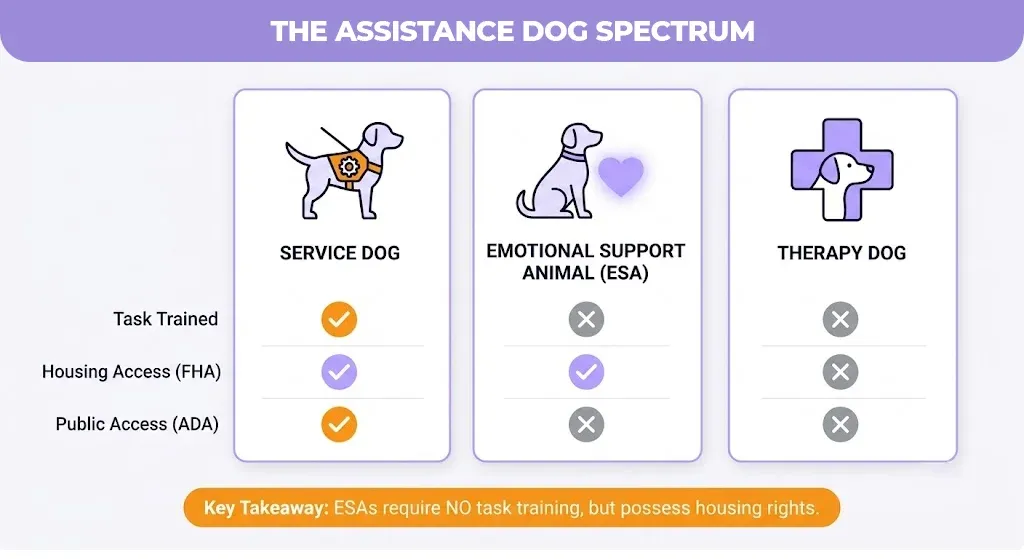
These three categories get confused constantly, and the legal distinctions matter — especially for housing and travel. Here’s how they break down under federal law:
| Category | Legal Definition | Public Access Rights |
|---|---|---|
| Service Dog | Trained under the ADA to perform specific tasks for a person with a disability | Broad public access, including restaurants and stores |
| Emotional Support Animal | Prescribed by an LMHP; provides comfort through presence, no task training required | Housing protection under the Fair Housing Act; no guaranteed public access |
| Therapy Dog | Trained and certified to visit hospitals, schools, or care facilities | Access only where the facility invites the dog in |
The U.S. Department of Housing and Urban Development (HUD) treats ESAs as assistance animals under the Fair Housing Act, meaning landlords generally must make reasonable accommodations for them even in “no pet” housing. Separately, research summarized by the American Psychological Association has repeatedly linked human-animal interaction to measurable reductions in stress and improved emotional regulation, which is the underlying rationale for ESA accommodations.
Because federal law doesn’t require task-specific training for an ESA, some owners assume training isn’t necessary at all. That’s a mistake. A well-mannered, obedient dog is what actually makes the emotional support relationship work day to day — in your home, in your building’s hallways, and anywhere your dog goes with you.
Whether you’re starting emotional support dog training from scratch or building on an existing bond, obedience is the foundation everything else is built on. This is true whether you work with a local trainer, enroll in emotional support dog training classes, or handle training a dog to be an emotional support dog entirely on your own.
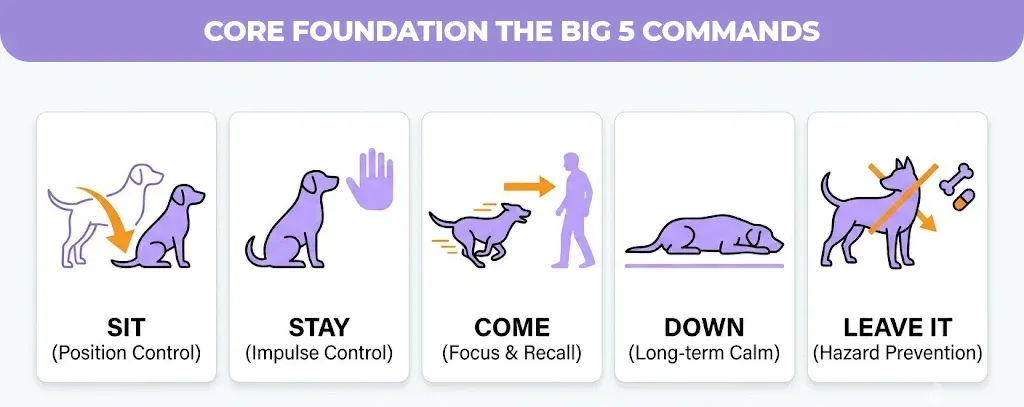
Every emotional support dog should reliably know these five commands before moving on to calming or comfort work:
Sit — teaches your dog to stop and settle in place on command.
Stay — builds impulse control, especially useful in waiting rooms or hallways.
Come — essential for redirecting your dog’s attention back to you during stressful moments.
Down — supports longer periods of calm, especially in public or during a stressful episode.
Leave It (or Heel) — prevents your dog from grabbing dropped medication, food, or hazards, and keeps walks controlled.
A dog that startles at every new sound or person can’t offer reliable comfort. Gradual exposure to elevators, traffic noise, crowds, and unfamiliar dogs — always paired with calm praise — builds the confidence an ESA needs to stay steady wherever you are.
Crate training, consistent housebreaking, and correcting jumping or excessive barking round out the basics. These may seem unrelated to emotional support work, but a dog with poor house manners adds stress rather than relieving it.
Positive Reinforcement: Use clicker training, high-value treats, and verbal praise. Avoid dominance-based or punishment-heavy methods, which increase anxiety in both dog and owner.
Consistency: Daily 10-minute training sessions outperform a single long weekly session for building lasting habits.
Repetition Across Environments: Everyone in the household should use the same commands and rewards to avoid confusing the dog.
This is where emotional support animal dog training goes beyond general obedience and starts addressing the actual purpose of the role: helping you regulate during difficult moments.
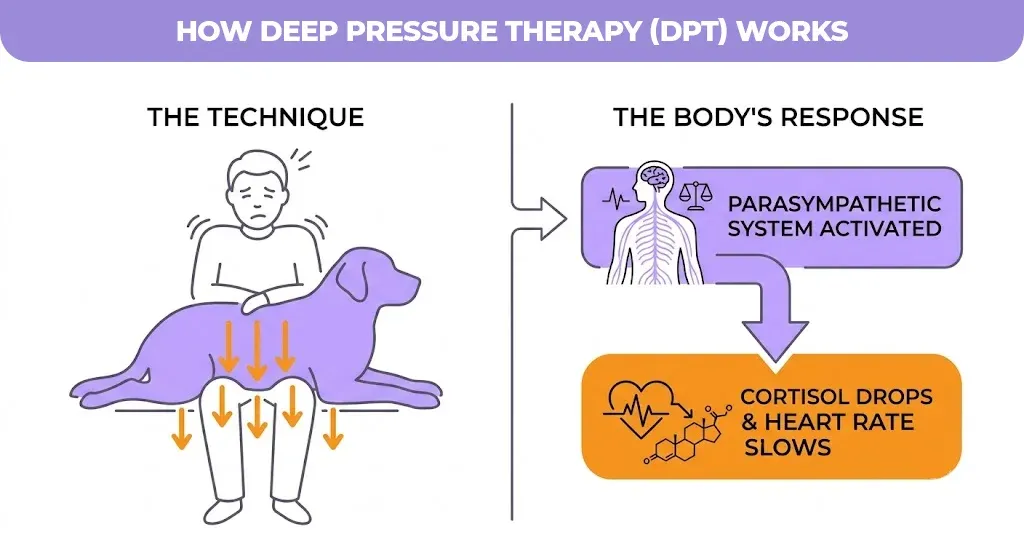
Deep Pressure Therapy involves teaching your dog to lie across your lap, chest, or legs during moments of panic or sensory overload. The physical weight and warmth can have a grounding, calming effect. Training this behavior typically starts with rewarding your dog for resting a paw or head on you, then gradually shaping toward full body contact on a cue like “Snuggle” or “Press.”
Physiologically, sustained gentle pressure is understood to help activate the parasympathetic nervous system — the body’s “rest and digest” response — which can help lower cortisol and slow a racing heart rate during acute stress.
Some owners work with their dog to recognize physical signs of distress — shaking, crying, leg bouncing, rapid breathing — and respond by leaning in or making gentle contact. This isn’t instinctive for most dogs; it’s built gradually by rewarding the dog every time it naturally checks in on you during a stressful moment, then reinforcing that pattern.
A “Place” or “Settle” cue teaches your dog to go to a designated spot and relax, which is invaluable when you need a moment of quiet. This command also helps your dog regulate its own energy, which in turn makes it a steadier presence for you.
Even with consistent training, most owners hit a few predictable roadblocks. Knowing what’s normal — and what warrants professional help — makes the process far less frustrating.
An ESA can become so bonded to its owner that being left alone triggers real distress. Preventing hyper-attachment means practicing short, low-stakes departures early on and gradually increasing the time apart, rather than only leaving for long stretches all at once.
Start with departures under two minutes and return before your dog reacts.
Gradually extend the time away in small increments over several weeks.
Avoid dramatic hellos and goodbyes, which reinforce anxiety around your comings and goings.
Leash reactivity, fear-based aggression, or nervousness around strangers can undermine an ESA’s ability to accompany you confidently. These behaviors typically respond well to gradual desensitization: exposing the dog to the trigger at a distance it can tolerate, then slowly closing that distance over repeated, reward-based sessions.
Some challenges are best handled with expert support. A Certified Professional Dog Trainer (CPDT) or animal behaviorist can help when progress stalls or when a behavior poses any safety risk.
Gradual Desensitization: Build a step-by-step desensitization routine for departures, starting with grabbing your keys and not leaving.
Red Flags to Watch For: Severe aggression or uncontrollable fear are signs a dog may not be suited for ESA work, regardless of how much training is applied.
Training builds the behavior; documentation protects the rights. Both matter, but they solve different problems.
Under the Fair Housing Act, a properly documented ESA generally grants access to housing that otherwise has a no-pet policy, without pet rent or a pet deposit. This protection applies even in buildings with strict pet restrictions, as long as the ESA letter meets the expected documentation standards.
It’s worth being direct about a common misconception: ESAs are no longer guaranteed free cabin access on commercial flights. The U.S. Department of Transportation’s final rule on traveling with service animals reclassified ESAs separately from psychiatric service animals, meaning airlines can now treat ESAs as regular pets subject to standard pet fees and carrier requirements.
Housing protection isn’t a blank check. Landlords retain the right to address property damage or genuinely disruptive behavior, which is another reason obedience and calming training aren’t optional extras; they’re what keeps your housing accommodation stable long-term.
Training makes your dog reliable. A legitimate letter makes your rights enforceable. The two are separate, and skipping the second one is where most owners run into trouble.
Online vests, badges, and “registry” certificates are sold widely, but none of them carry any legal weight under federal law. No registry database is recognized by HUD, the DOT, or any court. A landlord is under no legal obligation to accept one as proof of ESA status.
The single legal requirement for an ESA is a genuine ESA letter written by a Licensed Mental Health Professional (LMHP) — a psychologist, therapist, psychiatrist, or licensed clinical social worker — who is licensed in your state and has evaluated your qualifying condition.
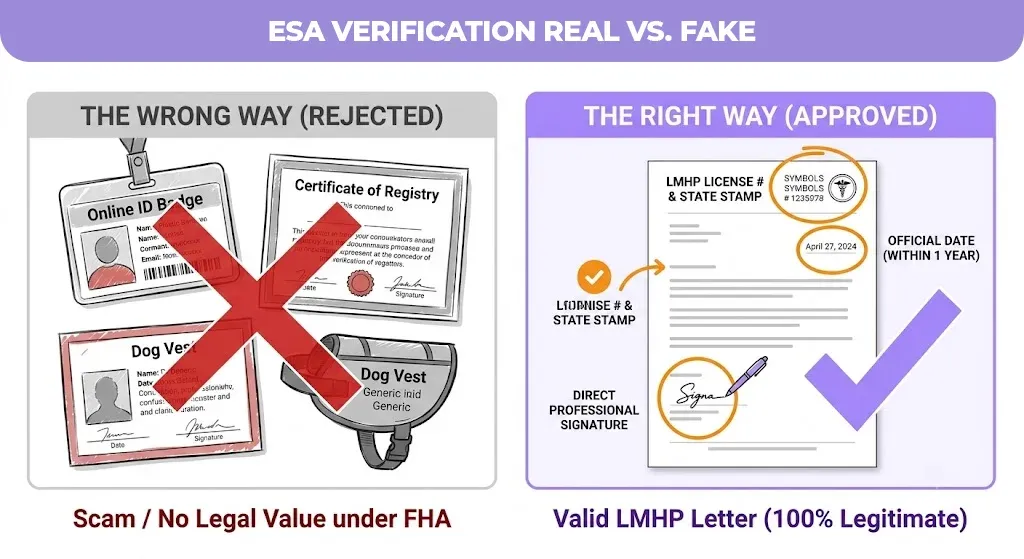
The LMHP’s license number, type, and issuing state.
The date the letter was issued (most housing providers expect a letter dated within the past year).
A statement confirming you have a qualifying emotional or mental health condition and that the animal provides related support.
The LMHP’s signature and contact information for verification.
Training an emotional support dog is a genuine investment — in obedience, in calming skills, in patience through the inevitable setbacks. What you get in return is a companion who’s actually equipped to help you through hard moments, not just present for them. Whether you work with a local trainer or take on virtual emotional support dog training on your own schedule, the process is the same: consistent, positive, and built one small skill at a time.
But training only tells half the story. The behavior protects your bond with your dog; the documentation protects your rights as an owner. Without a valid ESA letter from a licensed mental health professional, even the best-trained dog in the world has no legal standing under the Fair Housing Act.
Training your emotional support dog creates a life-changing bond — but protecting your housing rights requires official documentation. Don’t fall for fake registries or scam certificates. Get a legitimate ESA letter written by a licensed mental health practitioner in your state.
Visit PetESALetter today to complete a quick online screening and connect with a licensed professional near you.
Your companion already helps. Make it count where it matters. A licensed clinician can document that support so your housing rights are protected too.
Start with the core obedience commands (sit, stay, come, down, leave it), then layer in socialization and calming techniques like Deep Pressure Therapy and a “Settle” cue. Use short, consistent, reward-based sessions — daily 10-minute sessions build reliability faster than infrequent long ones. Once behavior is solid, pair the training with a legitimate ESA letter from a licensed mental health professional to secure your legal protections.
Yes. Many owners successfully complete emotional support dog training at home using positive reinforcement methods, while others prefer emotional support dog training classes or a professional emotional support dog trainer for structured guidance. Either path works, as long as the training is consistent and the dog reliably demonstrates calm, obedient behavior in everyday and public settings.
While federal law doesn’t require task-specific training for ESAs the way it does for service dogs, basic obedience and calming skills are strongly recommended. A trained emotional support dog is easier to house, travel with, and rely on during moments of genuine distress, and it reduces the risk of behavior issues that could jeopardize housing protections.
Emotional support dog training cost varies widely depending on format. At-home, self-guided training is essentially free beyond basic supplies. Group emotional support dog training classes typically run in the range of a standard obedience course, while one-on-one sessions with a private emotional support dog trainer or specialized behaviorist cost more, reflecting the personalized attention involved. Getting exact price quotes from a few local or virtual trainers is the most reliable way to budget.

Licensed Psychotherapist
Darren is a leading expert in mental health advocacy and assistance animal documentation. He specializes in streamlining the process for obtaining ESA Letters, PSD Letters, and State-specific ESA compliance.

ESA Letters Issued

Successful Consultations

Licensed Therapist Network

Client Satisfaction Rate




Petesaletter.com helps you get your emotional support animal letter online with guidance and support.

Got Questions? Call us 24/7
Copyright © 2020-2026 Petesaletter All rights reserved. Terms | Privacy | Refund
Owned and Operated by Verimedix LLC