
Last Updated on: August 14, 2026
Reviewed by Darren Andrew Rafel
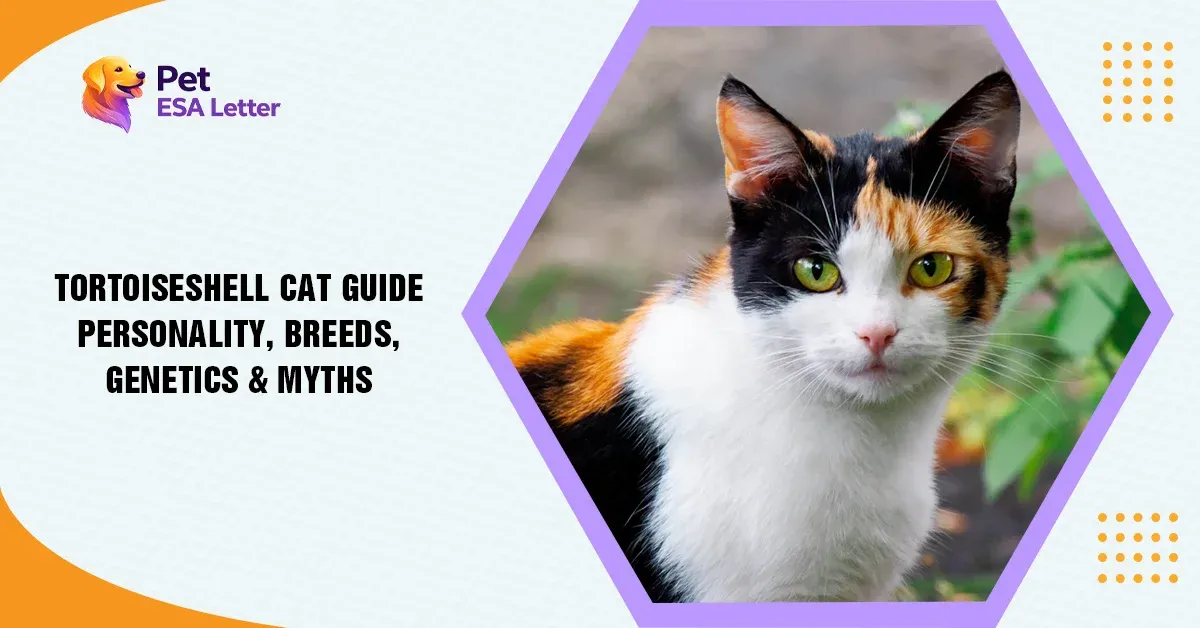
Every cat person has paused mid-scroll at a stunning mosaic of flame and shadow — a tortoiseshell cat, boldly wearing nature’s most chaotic paint job like it was tailor-made. These beautiful, patchwork-coated felines inspire devoted fan bases, wild legends, and a surprising amount of genuine scientific intrigue. But what exactly are they?
A tortoiseshell cat — nicknamed the “tortie” — is a domestic cat defined by its bi-colored coat of black (or brown) and orange (or red) patches, with little to no white. Crucially, tortoiseshell refers to a coat pattern, not a breed. Any number of breeds can wear the tortie coat, from the majestic Persian to the compact British Shorthair.
The famous “tortitude” — a spirited, feisty, almost diva-like personality — has become the tortie’s unofficial trademark. Whether that reputation is science or folklore, we dig into all of it below. This is your definitive, no-fluff expert guide to everything tortoiseshell.
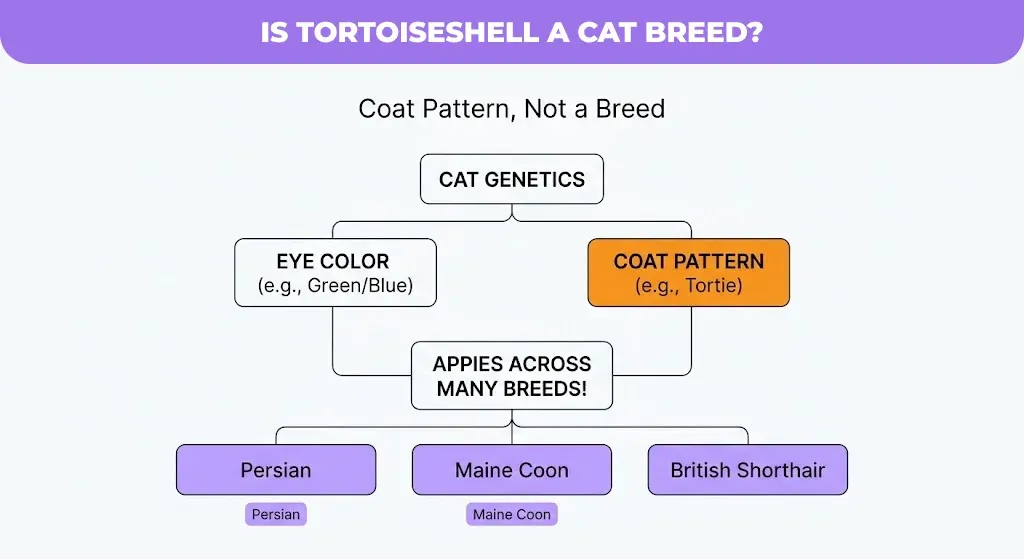
This is the single most common misconception about torties: there is no tortoiseshell cat breed. The tortoiseshell pattern is a genetic coat expression that can appear across dozens of recognized breeds. Think of it like eye color in humans; it appears in many different people regardless of their background.
Common breeds where you’ll spot the tortoiseshell pattern include:
Tortoiseshell Persian: Long, luxurious coat with the classic tortie mosaic; one of the most sought-after combinations.
Maine Coon: America’s gentle giant wears the tortie pattern with regal authority.
British Shorthair: The plush, round-faced breed frequently carries tortoiseshell markings.
American Shorthair: Rugged and adaptable, the domestic tortoiseshell cat is often this breed or a mix.
Cornish Rex & Devon Rex: Curly-coated breeds that produce striking tortoiseshell variations.
Not all torties look the same. Here are the most widely searched coat variations:
Black Tortoiseshell Cat
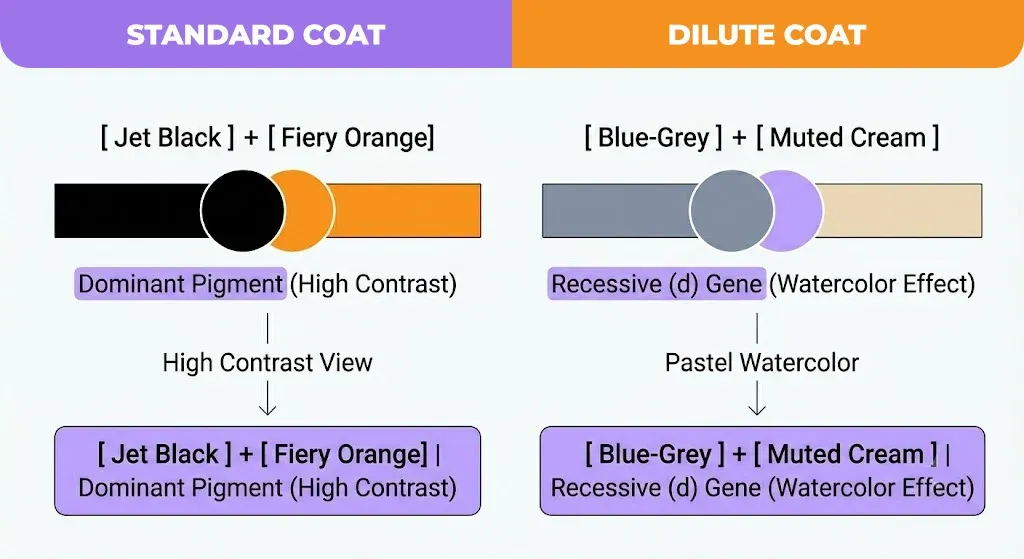
The classic, high-contrast tortie — jet black and vivid orange patches interwoven across the coat. This is what most people picture when they hear the term. The deeper the black, the more dramatic the contrast against the fiery orange.
Grey / Gray Tortoiseshell Cat
Also known as the dilute tortoiseshell cat, the grey tortoiseshell replaces the standard black with a soft blue-grey, and the orange becomes a muted cream. The result is a pastel, painterly coat that feels more watercolor than oil painting. (More on the genetics behind this in the dilute section below.)
Tortoiseshell Tabby Cat — The “Torbie”
When a tortoiseshell tabby cat (affectionately called a “torbie”) appears, you get the tabby’s distinctive striped or mackerel pattern layered on top of the tortie’s bi-color mosaic. The result is a visually complex, fascinatingly patterned cat. The torbie is less common than the standard tortie and attracts serious attention from cat enthusiasts.
Long-Haired Tortoiseshell Cat
A long-haired tortoiseshell cat — think the Persian, the Maine Coon, or the Norwegian Forest Cat — carries the same color genetics but requires significantly more grooming. Their coats are prone to tangling and matting; a weekly slicker brush session is non-negotiable.
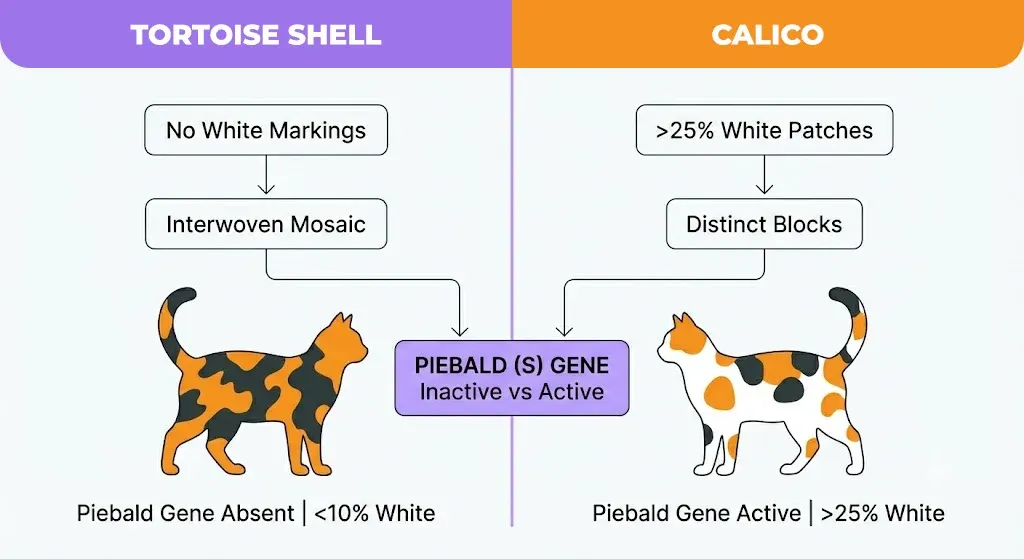
The tortoiseshell-vs-calico debate trips up even experienced cat owners. Both patterns share the same underlying genetics — but one critical gene separates them. Remember this simple rule: torties have almost no white; calicos are defined by white.
Here is a full comparison to clarify the confusion:
| Feature | Tortoiseshell Cat | Calico Cat |
|---|---|---|
| Base Colors | Black/orange (or blue/cream) | Black, orange AND white |
| White Spotting | Absent or minimal (<10%) | Dominant — >25% white coat |
| Pattern Distribution | Blended, mosaic, interwoven | Distinct, separated patches |
| White Gene | No piebald gene active | Piebald (S) gene present |
| Genetic Overlap | XX females; XXY rare males | XX females; XXY rare males |
| Dilute Version | Blue tortoiseshell (grey/cream) | Dilute calico (grey/cream/white) |
The scientific name for the white-spreading gene is the piebald (S) gene. When it’s absent, you get a tortie. When the S gene is active and adds white, you cross into calico territory. Some cats sit in the middle with just a small white locket or belly patch; these are sometimes called tortoiseshell-calico cats, depending on how much white is present.
Reference: TICA breed color standards — tica.org
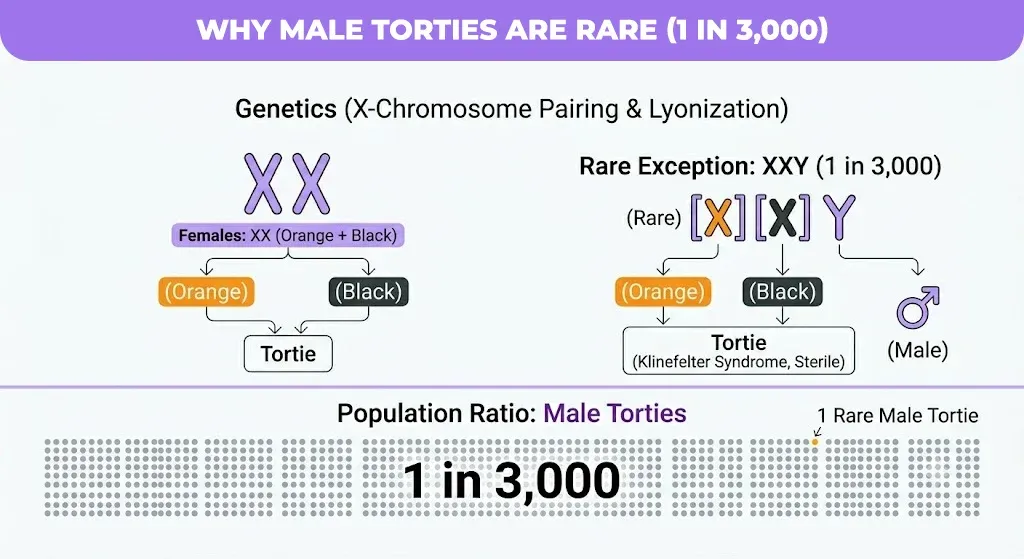
Female tortoiseshell cats? Common enough. Male tortoiseshell cats? That’s where things get biologically remarkable. To understand why, you need to understand X-chromosome inactivation, a phenomenon geneticists call Lyonization.
Here’s how it works in plain terms:
The genes that produce orange coat color and non-orange (black/brown) coat color are both carried on the X chromosome.
Females have two X chromosomes (XX), meaning they can carry one gene for orange on one X, and one gene for black on the other.
Early in embryonic development, each cell randomly silences (“inactivates”) one of the two X chromosomes. The result is a patchwork of cells, some expressing orange, some expressing black — which is literally what creates the mosaic tortoiseshell pattern.
Males have only one X chromosome (XY), so they can only express one color — making them either orange or black/brown, never both.
Science fact: This random X-inactivation process — named after geneticist Mary Lyon — means no two tortoiseshell cats have the same pattern. Every tortie coat is a one-of-a-kind genetic fingerprint.
Occasionally, a genetic anomaly produces a male with an XXY chromosome configuration, a condition called Klinefelter syndrome. With two X chromosomes, the male can carry both the orange and black coat genes, producing a tortoiseshell pattern. The statistical probability is staggeringly rare: approximately 1 in 3,000 tortoiseshell cats is male. Most of these males are sterile due to the chromosomal abnormality.
The dilute tortoiseshell cat carries a recessive dilution gene (d) that dilutes pigment intensity across the coat. Black becomes blue-grey, and orange becomes cream. The result is the soft, ethereal blue tortoiseshell cat — also called a gray tortoiseshell cat — with a completely different visual impact than its standard counterpart but identical underlying genetics otherwise.
A dilute tortoiseshell requires both parents to carry the recessive dilution gene. It’s rarer than standard tortoiseshell coloring, which adds to the wow factor when you encounter one.
Reference: Veterinary Genetics Laboratory, UC Davis — vgl.ucdavis.edu (coat color inheritance resources)
Ask any tortie owner and they’ll tell you: their cat has “tortitude” — that distinctive cocktail of independence, feistiness, fierce loyalty, and an unshakeable opinion about everything from meal timing to lap access. The term has become so embedded in cat culture that it now has its own Wikipedia mention.
But is tortitude real? In 2015, a University of California, Davis study by Dr. Elizabeth Stelow surveyed over 1,200 cat owners and found that cats with tortoiseshell, calico, and tortoiseshell-tabby patterns were more frequently described as aggressive toward humans — hissing, biting, chasing — compared to cats of other colorings. The study controlled for breed and age, suggesting the correlation may have a genetic basis worth exploring further.
However, coat color genetics and personality genetics are not the same thing. The UC Davis study found correlations, not causation — and sample bias (owners of “feisty” cats being more likely to participate) may have influenced results. Veterinary consensus remains that environment, socialization, and early handling are the primary shapers of actual tortoiseshell cat personality. A tortie raised with gentle handling from kittenhood can be as placid and affectionate as any other cat.
Pro tip: Socialize your tortoiseshell kitten early and consistently. Expose them to different people, sounds, and handling during the first 2–7 weeks of life for the best behavioral outcomes.
Compared to the tortoiseshell-tabby overlap (torbie), a standard tortie tends to be slightly more assertive in temperament perception. But individual personality variance between cats far exceeds any coat-color-based patterns. Your tortie is an individual first, a color pattern second.
The tortoiseshell cat lifespan mirrors that of domestic cats broadly. A healthy indoor domestic tortoiseshell cat typically lives 12 to 16 years, with many reaching their late teens given good nutrition, regular veterinary care, and an indoor lifestyle. Outdoor cats face significantly reduced life expectancy due to accidents, predators, and disease exposure.
Since tortoiseshell is a pattern rather than a breed, there are no specific health conditions uniquely tied to tortie coloring. The exception is the rare male tortoiseshell cat: due to Klinefelter syndrome (XXY), these males may face hormonal imbalances, increased obesity risk, and bone density issues associated with their chromosomal anomaly.
Reference: ASPCA cat health resources — aspca.org/pet-care/cat-care
A tortoiseshell kitten is an investment of time, attention, and patience — especially in those first critical months. Here’s what to prepare for:
Vet check within 48 hours: Get a full wellness exam, parasite screening, and vaccination schedule established immediately.
Kitten-proof your space: Remove toxic plants, secure loose cords, and store chemical hazards out of reach.
High-quality kitten food: Protein-first, grain-optional nutrition supports rapid early development.
Socialization window: The 2–7 week critical period shapes lifetime temperament. Gentle daily handling is essential.
Grooming early: If you have a long-haired tortoiseshell kitten, introduce brushing from week one so it becomes a positive routine.
The tortoiseshell cat price varies enormously depending on whether you’re adopting from a shelter or purchasing from a breeder. Here’s a realistic breakdown:
| Source | Typical Price Range | Notes |
|---|---|---|
| Shelter / Rescue Adoption | $50–$150 | Includes spay/neuter, vaccines |
| Breed Rescue (specific breed) | $100–$300 | May include microchip & vet check |
| Domestic Shorthair (breeder) | $200–$600 | Common non-pedigreed tortie |
| Tortoiseshell Persian | $800–$2,500+ | CFA/TICA registered cattery |
| Maine Coon Tortoiseshell | $1,000–$2,000 | Show quality may exceed this |
| British Shorthair Tortoiseshell | $1,200–$2,500 | Varies by bloodline & region |
Keep in mind that purchase price is only the beginning. Factor in spay/neuter (if not included), microchipping, initial vaccines, cat carriers, litter setups, and the first year’s veterinary wellness costs — typically $400–$900 in year one.
Adopting a tortoiseshell cat from a shelter or rescue is not only the most affordable route — it’s genuinely the most rewarding. Torties are among the most common coat patterns in shelters, meaning you are very likely to find a beautiful, healthy tortie waiting for a home near you right now.
Search resources include:
Petfinder.com: Filter by coat color to find local tortoiseshell cats and kittens.
Adopt-a-Pet.com: Broad shelter database with photo browsing.
Local breed-specific rescues: If you want a tortoiseshell Persian or Maine Coon tortie, contact breed rescue organizations directly.
Municipal animal shelters: Often have adult torties overlooked in favor of kittens; adult cats adapt quickly and come already personality-tested.
Naming a tortie is a genuine art form. Here are some curated thematic options to match your cat’s personality and coat:
Fiery & Bold (for the cat with maximum tortitude): Ember, Blaze, Cinder, Vega, Nova, Sable, Inferno, Scarlett, Rogue, Vixen
Earthy & Autumnal (for the classic black tortoiseshell): Maple, Hazel, Clove, Sienna, Autumn, Sedona, Acorn, Russet, Amber, Terra
Soft & Vintage (for the dilute or grey tortoiseshell): Misty, Pearl, Sage, Marigold, Opal, Fern, Willa, Violet, Clementine, Esme
Mythological & Regal (for the long-haired tortoiseshell): Calypso, Athena, Isolde, Freya, Morgaine, Persephone, Thessaly, Selene, Circe, Vela
The tortoiseshell cat is one of the most visually striking, genetically fascinating, and personality-rich companions you can welcome into your home. Whether you’re drawn to the high-contrast drama of a black tortoiseshell, the pastel softness of a dilute tortoiseshell, or the flowing coat of a long-haired tortoiseshell, you’re choosing a companion with a coat that is literally unique in the world — and a personality that will keep you on your toes in the best possible way.
They’re adaptable, loyal, endlessly interesting, and available at virtually every shelter and rescue in the country. If you’re ready to share your space with a cat that has strong opinions, an irreplaceable coat, and centuries of good luck behind it, your tortie is waiting.
Curious whether your pet could be recognized as an emotional support animal? It comes down to your own clinical need, not the breed — and a licensed professional is the only one who can make that call.
Tortoiseshell cats are genetically unique in several ways. Their mosaic coat is produced by random X-chromosome inactivation during embryonic development, meaning no two torties share the same pattern; every one is a genetic one-of-a-kind. They are almost exclusively female due to the sex-linked nature of coat color genetics, with males occurring at a staggeringly rare rate of 1 in 3,000. Add in the cultural mythology of “tortitude” and centuries of global superstition crediting them with good luck, and you have a cat that is genuinely unlike any other.
No, a tortoiseshell cat is not the same as a calico cat, though the terms are frequently confused. Both patterns share the same bi-color (orange + black) genetic foundation, but a tortoiseshell-calico blending occurs when the piebald gene introduces significant white into the coat. Torties have little to no white; calicos are dominated by white. A calico-vs-tortoiseshell comparison always comes down to one thing: how much white is present.
Tortoiseshell cat personality varies by individual, but torties have a reputation for being intensely loyal and bonded to their primary person — often described as “one-person cats.” They can be demanding, vocal, and opinionated, but that same intensity translates into deep affection. Whether they’re warm toward strangers depends largely on socialization. A well-socialized, properly raised tortie is as friendly and affectionate as any cat — just with stronger opinions about it.
Across cultures, the tortoiseshell cat has long been considered a powerful good-luck symbol. In Japan, the “mi-ke” (three-colored) cat — which includes torties — is believed to protect sailors at sea and bring good fortune to a household. In Celtic folklore, a tortoiseshell cat entering your home was considered an omen of prosperity. In the American South, tortoiseshell cats were sometimes called “money cats” for the same reason. The spiritual meaning of a tortoiseshell cat consistently centers on protection, luck, and feminine power across cultures worldwide.
Why leave your cat's housing security to chance? Whether you own a rare male tortie, a pastel dilute tortoiseshell, or a beautiful long-haired mix, your mental wellbeing and their companionship matter. Pet ESA Letter makes protection simple and straightforward.

Licensed Psychotherapist
Darren is a leading expert in mental health advocacy and assistance animal documentation. He specializes in streamlining the process for obtaining ESA Letters, PSD Letters, and State-specific ESA compliance.

ESA Letters Issued

Successful Consultations

Licensed Therapist Network

Client Satisfaction Rate




Petesaletter.com helps you get your emotional support animal letter online with guidance and support.

Got Questions? Call us 24/7
Copyright © 2020-2026 Petesaletter All rights reserved. Terms | Privacy | Refund
Owned and Operated by Verimedix LLC