
Last Updated on: August 14, 2026
Reviewed by Darren Andrew Rafel

Quick answer: The Fair Housing Act (FHA) requires most landlords to allow emotional support animals as a reasonable accommodation, even in no-pet buildings. You’ll need a valid ESA letter from a licensed mental health professional. Landlords can’t charge pet fees or enforce breed restrictions for ESAs — but there are narrow exemptions.
Your landlord has a strict no-pets policy. You have an emotional support animal. Sounds like a problem — but under the Fair Housing Act’s emotional support animal protections, it usually isn’t. Federal law gives you the right to keep your ESA in most rental housing, regardless of what the lease says.
A lot of renters don’t realize how strong these protections actually are. They assume their landlord has the final word. They pay pet deposits they don’t owe, surrender animals they need, or move out unnecessarily. This article breaks down the federal law for emotional support animals under the FHA — what it covers, what it doesn’t, and exactly what you need to do if a landlord pushes back.
We’ll go through the rules in plain language, cover the exemptions that actually matter, and walk you through the steps to take if you’re denied. By the end, you’ll know your rights cold.
The Fair Housing Act (FHA) is a federal civil rights law administered by the U.S. Department of Housing and Urban Development (HUD). It prohibits housing discrimination based on disability. Under the FHA, a landlord must provide a “reasonable accommodation” for a tenant with a disability — and allowing an emotional support animal is one of the most common examples of that accommodation.
An emotional support animal is not a pet in the legal sense. It’s an assistance animal that provides therapeutic benefit to a person with a mental or emotional disability, such as depression, anxiety, PTSD, or bipolar disorder. Because ESAs are classified as assistance animals under Fair Housing Act emotional support animal law, the normal rules about pets simply don’t apply to them.
What does that mean in practice? It means a landlord with a “no pets” policy must still allow your ESA if you qualify. It means no-pet clauses in your lease can’t be used to evict you or deny your application. It means the FHA’s protections apply to apartment complexes, condos, co-ops, and most single-family rentals — covering the vast majority of US rental housing.
HUD’s guidance on assistance animals clarified the rules around ESA documentation and what landlords can and cannot ask. If you’ve heard conflicting information about ESA rules under the FHA, that guidance is the document that settles most disputes.
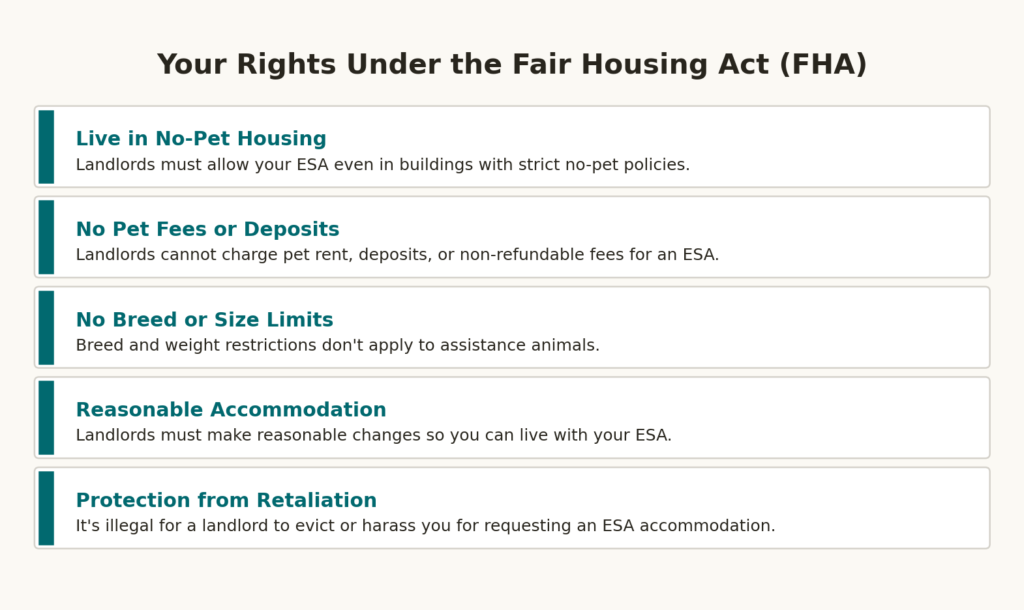
Federal ESA law gives you a clear set of protections. Here’s what it actually covers — because knowing the specifics matters when you’re sitting across from a landlord who claims they don’t have to comply.
No pet fees or pet deposits for ESAs. This is one that surprises a lot of people. Under federal law for emotional support animals, your landlord cannot charge you a pet deposit, a monthly pet rent, or any pet-related surcharge for your ESA. You can still be held liable for actual damage the animal causes — that’s standard lease language — but a preemptive fee just for having the animal is illegal under the FHA.
No breed or size restrictions. Your landlord’s policy banning pit bulls, Rottweilers, or dogs over 50 pounds doesn’t apply to your ESA. The FHA requires them to evaluate your accommodation request individually. A blanket breed or weight policy cannot be used to deny an ESA.
No requirement to register your animal. There’s no federal ESA registry. Anyone selling “registration certificates” or ID cards is selling something that has no legal weight. What you do need is a valid ESA letter — a signed document from a licensed mental health professional (LMHP) stating that you have a disability and that the animal provides necessary support.
Here’s the part no one tells you about: your landlord has 10 days to respond to an accommodation request. That’s not written into the FHA explicitly, but it’s the standard HUD expects in practice. If they sit on your request for weeks, that can itself be treated as a denial — and you can file a complaint.
No pet fees, pet deposits, or monthly pet rent
No breed, size, or species restrictions (within reason)
No requirement to register your ESA or use an “official” vest
No blanket denial based on the building’s no-pet policy
Right to a timely response (typically within 10 days)
Here’s a real scenario: you submit your ESA letter to your property manager. A week later, they email you asking for your full medical records and the name of every therapist you’ve seen. Can they do that?
No. They cannot. Under the FHA and HUD’s guidance, a landlord can verify two things: (1) that you have a disability, and (2) that the animal provides disability-related support. They are not entitled to a diagnosis, a medical history, or any specific condition details. A well-written Fair Housing Act ESA letter from a licensed therapist covers both requirements.
What a landlord can ask for: a letter from a licensed mental health professional confirming your disability and the therapeutic need for the animal. That’s it. They can verify the provider appears to be a real, licensed professional — but they can’t demand credentials be mailed, call your therapist directly without your consent, or require you to use a specific provider or format.
What a landlord cannot ask for: your diagnosis by name, any medical records, a “registration” certificate, proof the animal has specific training, or documentation beyond a standard ESA housing letter. Asking for these things may itself be a Fair Housing Act violation.
If your disability is obvious or your prior communications already make it clear, the landlord may not even be able to request any documentation at all — though in practice, submitting a letter proactively is the smoothest path. Getting your ESA housing requirements right from the start saves weeks of back-and-forth.
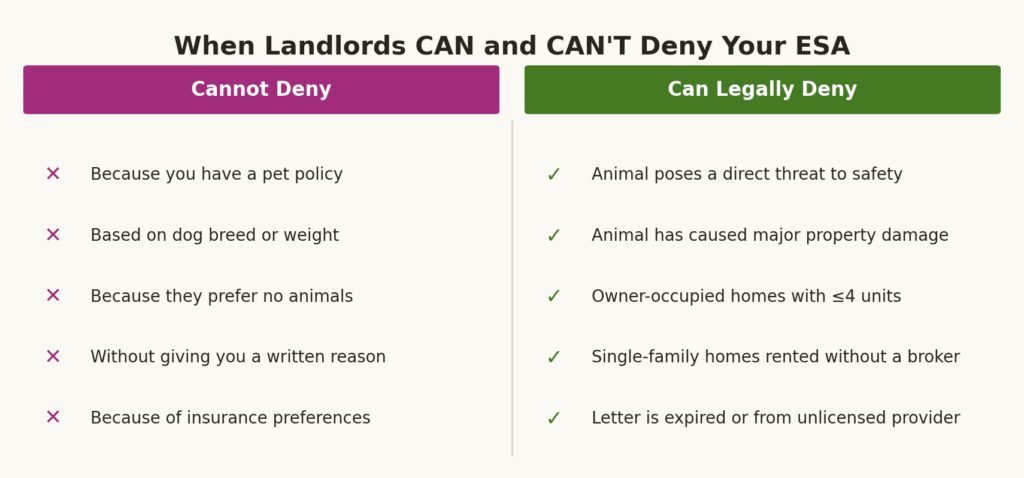
Can an apartment complex deny an ESA? Yes — in limited, specific circumstances. The FHA is strong, but it isn’t absolute. Landlords have a few narrow legal grounds to deny an ESA accommodation request.
The animal poses a direct threat. If your specific animal has a documented history of violent behavior — not the breed, not hypothetically, but your actual animal — a landlord can deny based on that. The key phrase is “direct threat”: a real, individualized risk, not a generalized fear.
The accommodation is an undue burden. For very small landlords with limited resources, an accommodation might create an undue financial or administrative hardship. This is rare and hard to prove, but it exists as an exception in the law.
The animal causes substantial physical damage. If an ESA has already caused significant damage to the property that goes beyond what a security deposit would cover, a landlord may have grounds to deny a future accommodation. This is different from preemptive breed or size discrimination.
The FHA exemptions. This is the big one. Not all housing is covered by the FHA (more on this in the next section).
Importantly, a landlord’s preference, discomfort, or other tenants’ objections are not legal grounds to deny an ESA accommodation. Neither is the landlord’s personal belief that ESAs aren’t “real.” Those denials are Fair Housing Act violations.
Direct, documented threat posed by the specific animal
Undue financial or administrative burden (rare; applies mainly to very small landlords)
Substantial property damage already caused by the animal
The housing falls under an FHA exemption (see below)
Federal ESA law doesn’t cover every rental situation. There are two main exemptions that matter for ESA renters.
The owner-occupied exemption. If a landlord owns a building with four or fewer units and lives in one of them, they’re generally exempt from the FHA. So a landlord renting out rooms in their own home, or renting two units in a four-plex they live in, may not be required to accept your ESA. This is sometimes called the “Mrs. Murphy exemption” in housing law.
The single-family rental exemption. A private owner renting a single-family home — without using a real estate agent and without owning more than three such properties — may also be exempt from the FHA. If you’re renting a house directly from an individual landlord who meets those criteria, your FHA protections may not apply.
A few important notes: these exemptions do not apply if the landlord advertises in discriminatory ways (e.g., “no emotional support animals” in a listing). And some states have their own fair housing laws that eliminate these exemptions or add protections. California, for instance, has broader tenant protections than federal law requires. If you’re renting in one of those states, check your state-level rights too.
Most rental housing — large apartment complexes, professionally managed buildings, condominiums, co-ops, student housing — is fully covered by the FHA. If you’re in a standard apartment building, the exemptions almost certainly don’t apply to you.
You submitted your emotional support animal letter to your landlord. Your landlord said no — or just stopped responding. Here’s your path forward.
First, make sure your letter is solid. A valid Fair Housing Act ESA letter comes from a licensed mental health professional who has actually assessed you — not a website that auto-generates letters after a five-question quiz. If your letter doesn’t meet HUD standards, that’s the first thing to fix. Get a proper letter from a licensed therapist.
Second, respond in writing. If your landlord verbally denied your request, follow up with a written message summarizing the denial and asking for the specific reason. You want a paper trail. Keep every email, text, and letter.
Third, file a complaint with HUD’s Office of Fair Housing and Equal Opportunity (FHEO). You can file online, by mail, or by phone. The complaint is free. HUD will investigate and can impose penalties, order remediation, and even pursue legal action against landlords who violate the FHA. The statute of limitations for filing is one year from the date of the discriminatory act.
You can also file a complaint with your state’s civil rights agency, or consult a fair housing attorney. Many attorneys take these cases on contingency because landlords who lose FHA cases can be ordered to pay attorney fees.
Retaliation is also illegal. If your landlord raises your rent, issues a bogus eviction notice, or makes your living situation difficult after you request an ESA accommodation, that’s retaliation — a separate FHA violation on top of the original denial. Document everything.
Ensure your ESA letter is from a licensed mental health professional
Get the denial in writing and document all communications
File a complaint with HUD’s FHEO office (free, online, one-year window)
Consider your state’s civil rights agency as an additional or alternative route
Consult a fair housing attorney; many work on contingency for FHA cases
Need documentation your landlord will actually accept? Establish a compliant clinical connection before you submit your accommodation request, not after it gets denied.
The Fair Housing Act is a federal civil rights law that prohibits housing discrimination based on disability. It requires most landlords to allow emotional support animals as a reasonable accommodation, even if the building has a no-pet policy. ESAs are classified as assistance animals under the FHA — not pets — so standard pet rules don’t apply to them.
Yes, but only in narrow circumstances: if your specific animal poses a documented direct threat, causes substantial property damage, or if the housing falls under an FHA exemption (like owner-occupied buildings with four or fewer units). A landlord’s personal preference, other tenants’ complaints, or breed-based fears are not valid legal grounds for denial.
No. Under federal law for emotional support animals, pet deposits, pet fees, and monthly pet rent are prohibited for ESAs. You can still be held responsible for any actual damage your animal causes — that’s normal lease liability — but preemptive pet-related charges are illegal under Fair Housing Act emotional support animal law.
They can request a letter from a licensed mental health professional confirming your disability and the therapeutic need for the ESA. What they cannot request is your specific diagnosis, medical records, or any documentation beyond a standard ESA housing letter. Demanding medical records is itself a potential Fair Housing Act violation.
The two main exemptions are: (1) owner-occupied buildings with four or fewer units (the “Mrs. Murphy” exemption), and (2) single-family rentals by private owners who don’t use agents and own fewer than three such properties. Most apartment complexes and professionally managed rentals are fully covered. Some states eliminate these exemptions entirely.
Retaliation — such as a rent increase, bogus eviction notice, or hostile treatment after an accommodation request — is a separate FHA violation. If your landlord ignores your request, that can be treated as a denial. Document every communication, respond in writing, and file a complaint with HUD’s Office of Fair Housing and Equal Opportunity (FHEO).
You can file an FHEO complaint online at HUD’s website, by mail, or by phone — it’s free. You have one year from the date of the discriminatory act to file. HUD will investigate, and if they find a violation, they can order remediation, impose civil penalties, and pursue legal action on your behalf. You can also file with your state’s civil rights agency.
Don’t risk a fake letter Get your FHA-compliant ESA letter today from a licensed mental health professional. 100% money-back guarantee. |

Licensed Psychotherapist
Darren is a leading expert in mental health advocacy and assistance animal documentation. He specializes in streamlining the process for obtaining ESA Letters, PSD Letters, and State-specific ESA compliance.

ESA Letters Issued

Successful Consultations

Licensed Therapist Network

Client Satisfaction Rate




Petesaletter.com helps you get your emotional support animal letter online with guidance and support.

Got Questions? Call us 24/7
Copyright © 2020-2026 Petesaletter All rights reserved. Terms | Privacy | Refund
Owned and Operated by Verimedix LLC